Security Public Storage: A SOC Architecture Guide for 2026

Security public storage keeps creating the same ugly incident pattern: a file share, bucket, container, or object path becomes reachable from the internet, nobody owns it cleanly, and the SOC gets the alert after the data has already been indexed, copied, or abused.
Teams think the problem is public access. The real problem is uncontrolled storage state across engineering, cloud platforms, SaaS exports, CI pipelines, backups, logs, and third-party workflows.
That changes the conversation. Security public storage is not a checkbox that says private bucket equals safe bucket. It is an architecture and workflow problem: inventory, classification, ownership, detection, response, validation, and evidence.
In 2026, the practical question is not whether your organization uses public storage. It does. The practical question is whether your SOC can tell which exposure is intentional, which exposure is dangerous, who can fix it, and whether it stayed fixed.
Table of contents
- Security public storage is a workflow problem
- Threat model security public storage before you monitor it
- Separate the data plane from the control plane
- Build the control plane before writing detections
- Detection engineering for security public storage
- Response workflows that actually close exposure
- Common failure modes in security public storage programs
- What works and what fails
- Metrics that make security public storage manageable
- Where ThreatCrush fits in the workflow
Security public storage is a workflow problem
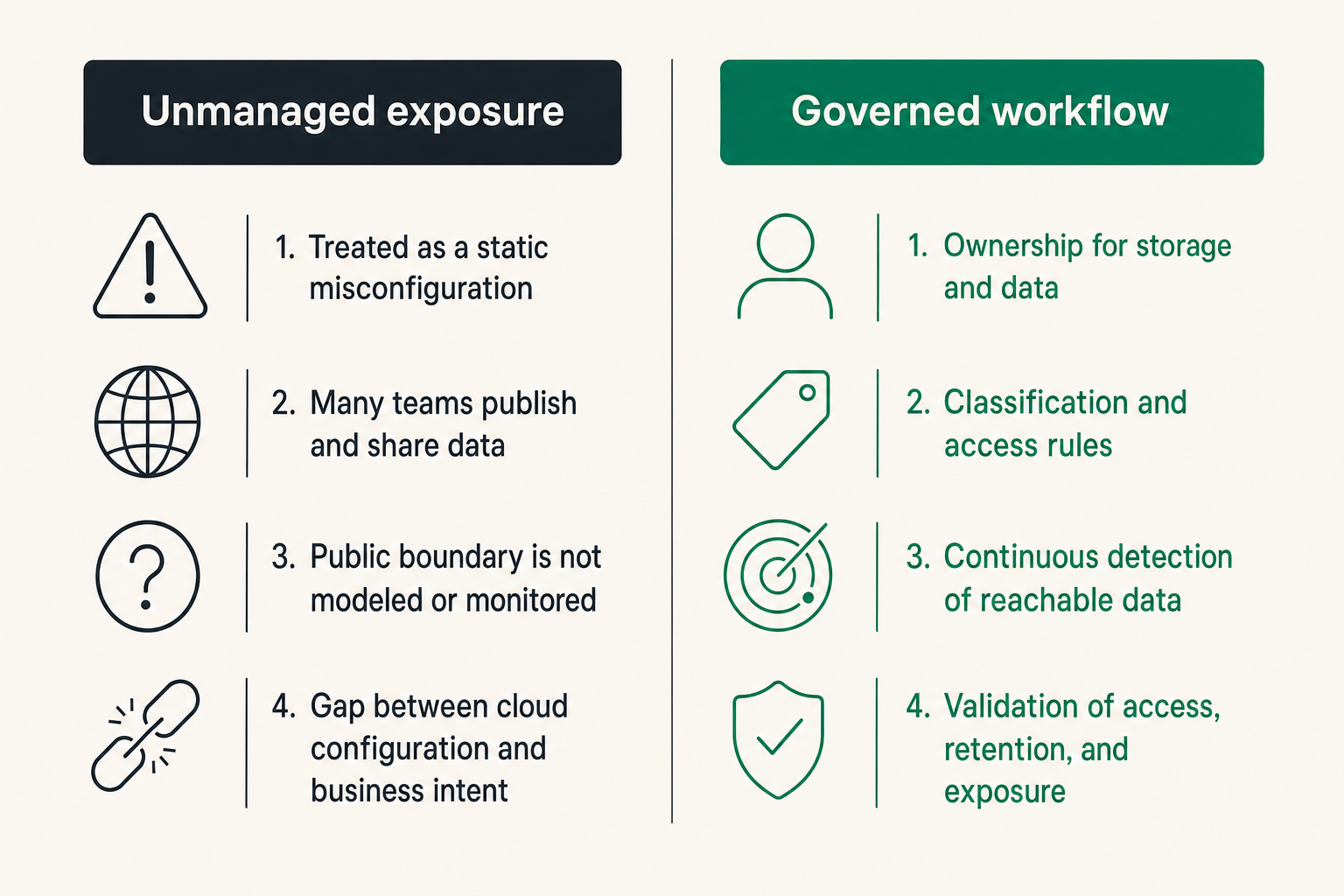
Security public storage is usually discussed as if the only meaningful question is whether a bucket, container, folder, or object is public. That is too narrow for a real SOC.
The mistake teams make is treating storage exposure as a static misconfiguration. In practice, storage is a moving operational layer. Developers publish assets. Data teams export reports. Marketing hosts downloads. Support teams share logs. CI systems upload artifacts. Backup jobs copy snapshots. Vendors request temporary access. A policy can be correct on Monday and wrong by Friday.
A useful way to think about it is this: public storage is not one resource type. It is a set of reachable data locations with different owners, access models, retention rules, and blast radius.
Why public storage keeps showing up in incidents
Public storage keeps showing up because it is convenient. It is cheap, globally reachable, scriptable, and easy to integrate with applications. Those are the same traits that make it risky.
Most teams do not expose storage because they ignore security. They expose it because business workflows need movement: files must be delivered, artifacts must be downloaded, partner data must be exchanged, and static content must be served. The risk appears when the public boundary is not modeled, monitored, or owned.
What breaks in practice is the gap between cloud configuration and business intent. A security tool may see a public object store. It cannot always tell whether it is a documented CDN origin, a temporary analytics export, an accidental PII dump, or a legacy integration nobody remembers.
What counts as security public storage
For SOC purposes, security public storage includes any storage location where data can be reached by unauthenticated users, broad authenticated groups, exposed links, permissive service identities, or internet-facing intermediaries.
Common examples include:
- Public object storage buckets and containers
- Static website hosting backed by object storage
- CDN origins with weak origin controls
- Shared SaaS folders with anyone-with-link access
- Public build artifacts and release assets
- Log exports and support bundles
- Data lake prefixes exposed through permissive policies
- Backup archives copied into less restricted accounts
The point is not to put every case into the same severity bucket. The point is to make them visible under one operating model.
The ownership trap
Security public storage fails when the SOC owns the alert but not the fix. Cloud platform teams own guardrails. Application teams own workflows. Data teams own datasets. Legal and privacy teams own impact assessment. The SOC owns detection and coordination.
If ownership is not explicit, response turns into Slack archaeology. That is when minutes become hours.
Practical rule: Every public storage finding needs four fields before it can be operational: technical owner, business purpose, data class, and approved exposure window.
A storage exposure without those fields is not just an alert. It is an unresolved asset management problem.
Threat model security public storage before you monitor it
Security public storage monitoring without a threat model produces noise. You end up with a list of public resources and no way to decide what matters.
The practical question is: what can an attacker do with this exposure, and what business process created it?
Exposure is not the same as breach
A public logo image is not a breach. A public payroll export is. A public release artifact may be expected. A public debug bundle with tokens is not. A public bucket used behind a CDN may be acceptable if origin controls, object paths, and cache rules are correct. A public bucket with list permissions is usually a different conversation.
This distinction matters because SOC teams lose credibility when everything becomes critical. Severity should be based on reachable data, permissions, exploitability, and evidence of access.
A simple severity model:
- Low: public content with documented business purpose and no sensitive data
- Medium: public storage with unknown owner, weak policy, or broad access path
- High: public storage containing regulated, confidential, credential, or customer data
- Critical: confirmed sensitive exposure plus evidence of external access, indexing, or abuse
Attack paths that start with storage
Attackers do not need storage exposure to be dramatic. They need it to be useful.
Typical attack paths include:
- Pulling credentials from logs, build artifacts, or environment dumps
- Finding internal hostnames, API paths, and system names in exported files
- Downloading customer data for extortion or fraud
- Identifying software versions from public artifacts
- Poisoning content where write access is misconfigured
- Enumerating object names when list permissions are enabled
- Using exposed backups to reconstruct application data
Storage exposure often becomes the first step in a broader intrusion. A SOC should treat it as both a data protection issue and an attack surface signal.
Related reading from our network: teams dealing with private communication systems face similar metadata, retention, and exposure tradeoffs in secure messaging app architecture, even though the product surface is different.
Context decides severity
Context is what turns a scanner finding into a response decision. Useful context includes:
- Account, subscription, project, and environment
- Application or service mapping
- Data classification tags
- Recent policy changes
- Access logs and geographic distribution
- External references, search indexing, or threat intelligence hits
- Whether the storage path is reachable directly or only through approved intermediaries
Without context, detection engineers write brittle rules. With context, they write rules that reflect actual risk.
Separate the data plane from the control plane
The cleanest way to reason about security public storage is to separate the data plane from the control plane.
The data plane is where objects live and where reads and writes happen. The control plane is where permissions, identities, policies, logging, encryption, network paths, and lifecycle rules are configured.
Teams often monitor the data plane and forget the control plane. Or they enforce control plane policy and never inspect what data moved. Both approaches leave gaps.
Data plane controls
Data plane controls answer: what data is present, who accessed it, and what changed?
Examples include:
- Object access logs
- Object creation, deletion, and modification events
- Sensitive data discovery
- File type and extension analysis
- Hashing and duplicate detection
- Malware scanning for uploads
- Retention and deletion enforcement
Data plane visibility matters because policy state does not tell you whether sensitive data was actually exposed. A bucket can be public and empty. A bucket can be private but contain copied secrets that later move elsewhere.
Control plane controls
Control plane controls answer: who can change access, what access exists, and whether policy drift occurred?
Examples include:
- Public access block settings
- Bucket or container policies
- IAM roles, service principals, and access keys
- Organization-level guardrails
- Network access rules
- Encryption settings
- Replication and cross-account sharing
- Audit logs for policy changes
Control plane monitoring is where many preventable incidents are caught early. If a role suddenly gains permission to make storage public, that is often more important than waiting for the first public read.
Why logs alone are not enough
Logs are evidence. They are not governance.
If your only control is alerting on public access logs, you are already late. You may still need that signal for incident response, but it should not be your first line of defense.
Practical rule: Monitor configuration changes before data access, and monitor data access before declaring impact.
That ordering matters. Configuration tells you what became possible. Access logs tell you what may have happened. Data classification tells you why anyone should care.
Build the control plane before writing detections
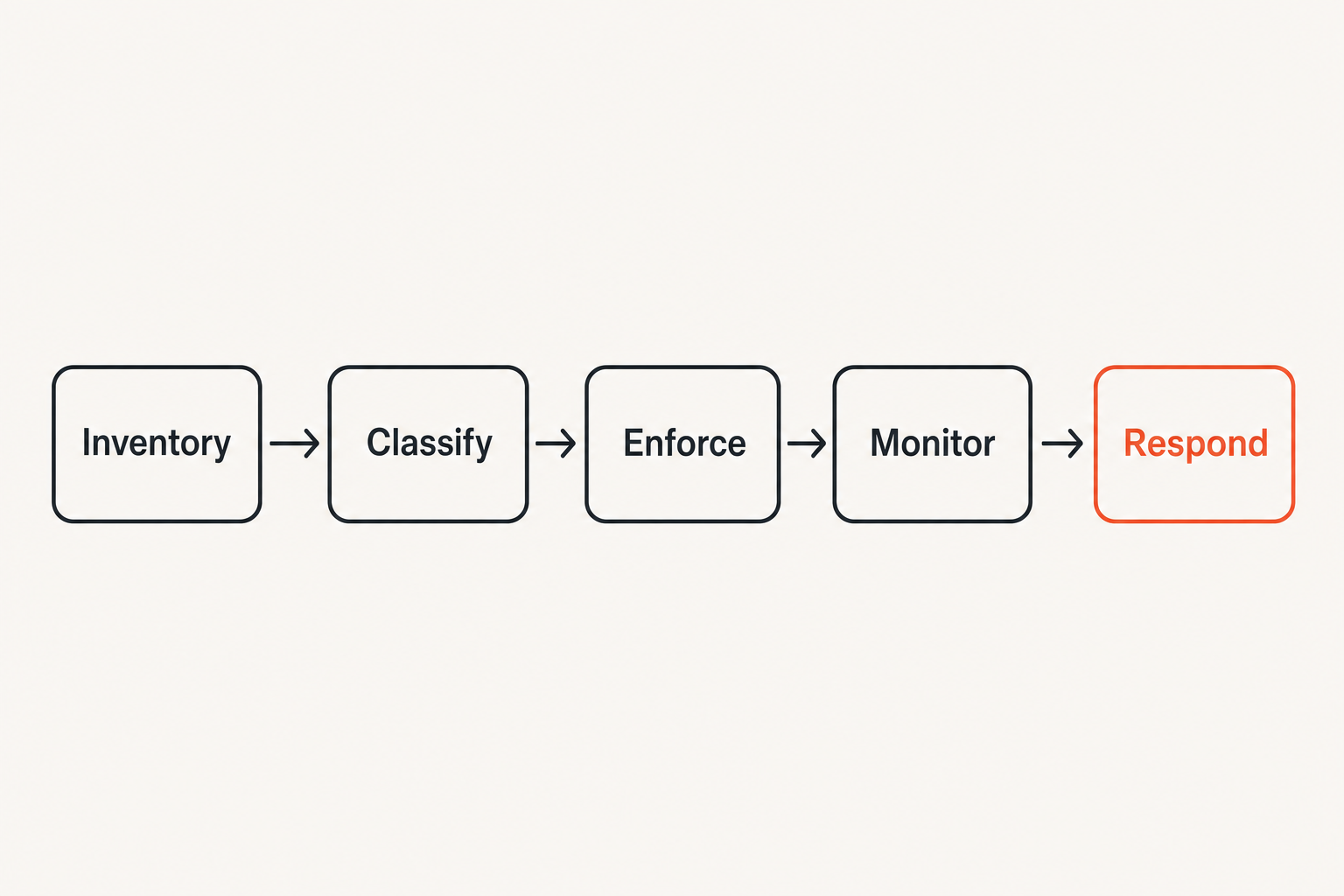
Detection engineering works better when the control plane is already structured. Otherwise, every rule has to rediscover ownership, environment, asset criticality, and expected behavior from scratch.
The practical sequence is boring, but it works:
- Inventory all storage services and SaaS sharing surfaces.
- Normalize names, tags, owners, environments, and applications.
- Classify data or at least assign provisional sensitivity.
- Define approved public exposure patterns.
- Detect drift from those patterns.
- Route findings to owners with remediation context.
- Validate closure through both policy state and access tests.
This is the same operating pattern mature SOCs use elsewhere: asset context first, signal second, response third. If you are building the broader operating model, the ThreatCrush guide to security operations in 2026 is a useful adjacent framework.
Inventory every storage surface
Inventory needs to include more than cloud buckets. Include SaaS drives, artifact repositories, package registries, static site storage, data lake zones, customer upload locations, analytics exports, and backup targets.
Minimum inventory fields:
- Provider and account
- Resource name and unique ID
- Region or location
- Environment
- Technical owner
- Business owner if different
- Application or workflow
- Data class
- Public exposure status
- Logging status
- Last policy change
- Last observed access
The mistake teams make is starting with scanner output and treating it as inventory. Scanner output is a signal. Inventory is a maintained source of operational truth.
Classify data before assigning response
Not every storage location needs perfect data classification on day one. But every public storage location needs enough classification to route and prioritize.
Use a tiered approach:
- Tier 0: unknown data class
- Tier 1: public-approved content
- Tier 2: internal operational data
- Tier 3: confidential business data
- Tier 4: regulated, customer, credential, or highly sensitive data
Unknown should not mean safe. Unknown should mean the finding cannot be closed until someone establishes the class or removes exposure.
Normalize ownership and business purpose
Ownership is not a tag you add for compliance screenshots. It is how response moves.
For each public storage surface, define:
- Who can approve public access
- Who can remove public access
- Who can confirm data sensitivity
- Who must be notified for customer or regulated data
- What change record or exception approves the exposure
Related reading from our network: the same routing-and-follow-up problem appears in local infrastructure programs, where community connections require trust and workflow architecture rather than vague engagement.
Detection engineering for security public storage
Security public storage detection should combine configuration drift, access behavior, and data movement. One rule class is not enough.
A useful detection stack has three layers:
- Preventive guardrails that block obvious risky states
- Near-real-time detections for policy drift and abnormal access
- Periodic validation that checks exposure from the outside
Detect policy drift
Policy drift is the easiest place to start because it is deterministic. You can detect when a resource becomes public, when list permissions are enabled, when cross-account access is added, or when public access blocks are disabled.
Example detection logic:
rule: public_storage_policy_drift
when:
  event_type: storage_policy_change
  conditions:
    - public_read_enabled: true
    - approved_exception: false
severity:
  if data_class in [regulated, credentials, customer]: critical
  elif owner_unknown: high
  else: medium
actions:
  - enrich_with_owner
  - check_recent_access
  - create_case
  - notify_platform_and_app_owner
The rule is simple. The enrichment is where the quality comes from.
Detect access anomalies
Access anomalies tell you whether exposure might have been used. Look for:
- First external read from a new country or ASN
- Sudden spike in object downloads
- Access to uncommon prefixes or sensitive file types
- Anonymous access where authenticated access is expected
- Reads shortly after a public policy change
- User agents associated with scraping, indexing, or automation
Be careful with user agent logic. It is useful as a weak signal, not a decision engine. Combine it with object sensitivity, access volume, and timing.
Detect sensitive data movement
Sensitive data movement is where cloud storage detection overlaps with DLP, application security, and insider risk. If a CI job exports environment variables into public artifacts, the SOC should see it. If a data pipeline writes customer records into a public prefix, the SOC should see it.
App and platform teams often create these paths unintentionally. For SOC teams working across pipelines and runtime systems, the guide to DevSecOps and application security for SOC teams covers the ownership and signal problems that show up here.
Response workflows that actually close exposure
A public storage alert is not closed because someone clicked private. It is closed when exposure is removed or approved, impact is assessed, and recurrence is controlled.
Triage with evidence, not panic
Triage should answer five questions quickly:
- What became public?
- What data was reachable?
- Who owns the workflow?
- Was there external access?
- Is the exposure approved, accidental, or malicious?
Evidence to capture:
- Current policy and previous policy
- Object listing if allowed
- Sample file names and types
- Data classification results
- Access logs for the exposure window
- Recent identity and policy changes
- Screenshots or command output proving reachability
Do not rely on a single console screenshot. Console state changes. Cases need reproducible evidence.
Contain without breaking the business
Containment must consider production dependencies. A public bucket might be serving product downloads, static assets, device updates, documentation, or partner integrations.
Safe containment options include:
- Disable listing before disabling all public reads
- Restrict access to CDN origin identity or signed URLs
- Move sensitive objects to a private location
- Rotate credentials found in exposed files
- Apply temporary deny policies to risky prefixes
- Freeze writes while preserving reads for approved public content
- Notify business owners before destructive changes if no active exfiltration is observed
If there is confirmed sensitive exposure, speed matters. But random lockdowns can create outages and destroy evidence.
Practical rule: Containment should reduce attacker utility first, preserve evidence second, and minimize business disruption third. Do not invert that order during a real incident.
Validate that the fix stayed fixed
Validation needs two checks: inside-out and outside-in.
Inside-out validation confirms the configuration is correct in the provider control plane. Outside-in validation attempts to reach the storage path the way an unauthenticated user would.
A closure checklist:
- Public access removed or approved exception documented
- Sensitive objects moved, deleted, or protected
- Access logs reviewed for the exposure window
- Credentials and tokens rotated where needed
- Owner confirmed business impact
- Detection rule or guardrail updated if needed
- External reachability test passed
- Case includes evidence and timeline
The mistake teams make is closing on configuration alone. Attackers do not read your console. They test reachability.
Common failure modes in security public storage programs
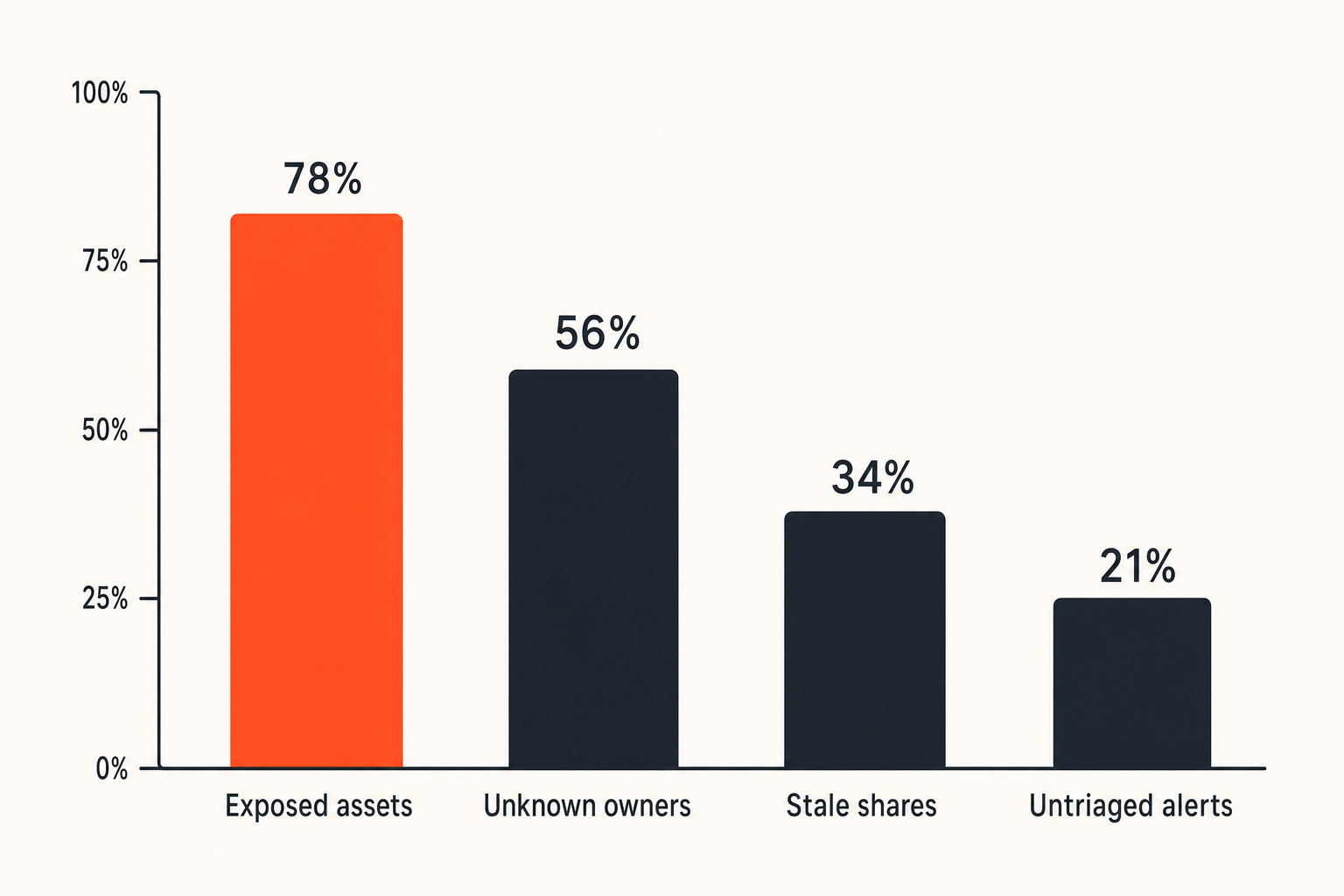
Most public storage programs fail in predictable ways. The tooling may differ, but the operational failure is usually the same: too many findings, too little context, unclear ownership, and incomplete validation.
Everything becomes a critical alert
If every public bucket is critical, no public bucket is critical. Analysts start ignoring the queue. Engineering teams learn that security alerts are noisy. Leadership gets a distorted view of risk.
Severity inflation usually happens when detections lack data classification and business purpose. A public brochure and an exposed customer export should not trigger the same workflow.
Fix it by separating exposure type from impact:
- Exposure type: public read, public list, public write, broad authenticated access, signed link, CDN origin
- Impact: public content, internal data, confidential data, regulated data, credentials, unknown
Unknown should generate urgency, but it should not automatically equal confirmed breach.
No one knows the real owner
Cloud tags often point to a team that no longer exists. Repositories get archived. Vendors change. Data pipelines outlive the people who built them.
When ownership is stale, the SOC becomes the coordinator of last resort. That is expensive and slow.
What works:
- Require owner metadata at provisioning time
- Sync ownership from source control, service catalogs, and cloud accounts
- Age ownership records and require reconfirmation
- Route findings to both technical and business owners
- Escalate unknown-owner public storage as an asset governance issue
Remediation creates outages
The fastest fix is often the riskiest fix. Blocking all public access may break customer downloads, product updates, embedded assets, partner feeds, or compliance reporting.
This does not mean security should hesitate forever. It means response playbooks need containment patterns that match the storage use case.
For example, a public static asset bucket should usually move behind a CDN with origin restrictions. A partner exchange path may need signed URLs, expiration, and object-level logging. A public analytics export should probably stop being public at all.
Related reading from our network: storage-heavy consumer workflows have similar failure modes around organization, access, and operational drift, even in a very different context like home media architecture and storage workflows.
What works and what fails
The best security public storage programs are not the ones with the most alerts. They are the ones that reduce unknown exposure, shorten response time, and keep approved public workflows from becoming accidental data leaks.
What works in production
What works is usually operationally simple:
- Default-private storage creation
- Explicit exception workflow for public exposure
- Strong owner and data class metadata
- Detection on policy change events
- Periodic external reachability tests
- Sensitive data scanning for public locations
- Playbooks that distinguish content hosting from accidental exposure
- Case closure based on validation, not intent
None of this requires magic. It requires discipline across cloud, SOC, engineering, and data teams.
What fails in production
What fails is also predictable:
- One-time cleanup projects with no drift monitoring
- DLP alerts with no owner or asset context
- Public access reports emailed weekly and ignored
- Blocking controls rolled out without exception paths
- Closing incidents before reviewing access logs
- Treating CDN-backed storage as automatically safe
- Assuming private storage means sensitive data is handled correctly
The practical question is not whether a tool can find public resources. Most can. The question is whether the finding becomes a resolved operational state.
A comparison table for operating models
| Operating model | What it optimizes for | What breaks in practice | Better approach |
|---|---|---|---|
| Scanner-only | Fast discovery | No owner, no impact, no closure proof | Add inventory, classification, and response routing |
| Guardrail-only | Prevention | Business exceptions bypass controls | Add exception governance and monitoring |
| DLP-only | Sensitive content detection | Misses risky policy drift and access paths | Combine data class with control plane events |
| Manual review | Human judgment | Too slow for drift and scale | Automate enrichment, keep humans for impact decisions |
| SOC-only ownership | Alert handling | SOC cannot safely fix everything | Shared ownership with cloud, app, and data teams |
Practical rule: A public storage program is mature when it can explain why an exposure exists, not merely prove that it exists.
Metrics that make security public storage manageable
Metrics should help operators improve the workflow. Vanity counts do not help. A dashboard showing thousands of public objects is not useful unless it separates approved exposure from unknown risk.
Coverage metrics
Coverage metrics answer whether you can see the problem.
Track:
- Percent of storage resources inventoried
- Percent with owner metadata
- Percent with data class metadata
- Percent with access logging enabled
- Percent covered by drift detection
- Percent tested by outside-in reachability checks
The important metric is not total public resources. It is unknown public resources.
Response metrics
Response metrics answer whether the SOC can move.
Track:
- Mean time to owner identification
- Mean time to containment
- Mean time to validation
- Reopen rate for supposedly fixed exposure
- Percent of cases with access log review
- Percent of critical cases with credential rotation decision
These metrics expose workflow friction. If owner identification takes longer than containment, you have an asset governance problem. If validation takes days, your response process is incomplete.
Quality metrics
Quality metrics answer whether detections are trustworthy.
Track:
- False positive rate by rule
- Approved exception match rate
- Unknown data class rate
- Alert-to-case conversion rate
- Cases closed without evidence
- Repeat offenders by team, application, or account
A useful quality review asks: which alerts changed a decision? If an alert never changes behavior, tune it, enrich it, or remove it.
Where ThreatCrush fits in the workflow
Security public storage is a good example of why modern SOC work cannot stay trapped in disconnected tooling. The signal may start in cloud logs, but the decision requires asset context, threat intelligence, vulnerability context, identity changes, and response history.
That changes the conversation from tool coverage to workflow design.
Connecting proactive and reactive work
Public storage exposure sits between proactive security and incident response. CTEM programs want to reduce exposed attack surface. Detection teams want reliable signals. Incident responders need evidence and timelines. Security architects want guardrails that do not break delivery.
A useful SOC architecture connects those concerns:
- Attack surface monitoring identifies exposed storage paths
- Threat intelligence adds external context and abuse indicators
- Cloud telemetry captures policy drift and access
- Case management tracks owner, evidence, impact, and validation
- Automation handles enrichment and routing
- Humans decide business risk, containment tradeoffs, and disclosure paths
The goal is not to automate every decision. The goal is to remove the manual searching that delays the important decisions.
Product fit without replacing your cloud stack
ThreatCrush is relevant when security public storage becomes part of a broader exposure management and SOC workflow. You still need cloud-native controls, provider logs, IAM policy management, and data classification. Those are not optional.
Where a SOC platform helps is correlation and operational context: connecting exposed assets to threat activity, vulnerabilities, ownership, detection rules, and response workflows. That is especially useful when public storage findings are one signal among many, not a standalone queue.
For teams building and scaling SOC capabilities, the architectural win is reducing handoffs. The SOC should not have to pivot through nine tools to answer whether a storage exposure is known, risky, exploited, and fixed.
Try threatcrush.com
ThreatCrush is for security operations professionals building and scaling SOC capabilities, with practical workflows for threat intelligence, exposure monitoring, detection, and response. Try threatcrush.com.
Security public storage will not disappear in 2026. The teams that handle it well will treat it as a governed workflow: known assets, clear owners, useful detections, fast response, and validation that proves the exposure stayed closed.
Try ThreatCrush
Real-time threat intelligence, CTEM, and exposure management — built for security teams that move fast.
Get started →