Personal Emergency Response Systems for Seniors: SOC Architecture Lessons for Reliable Signal-to-Response
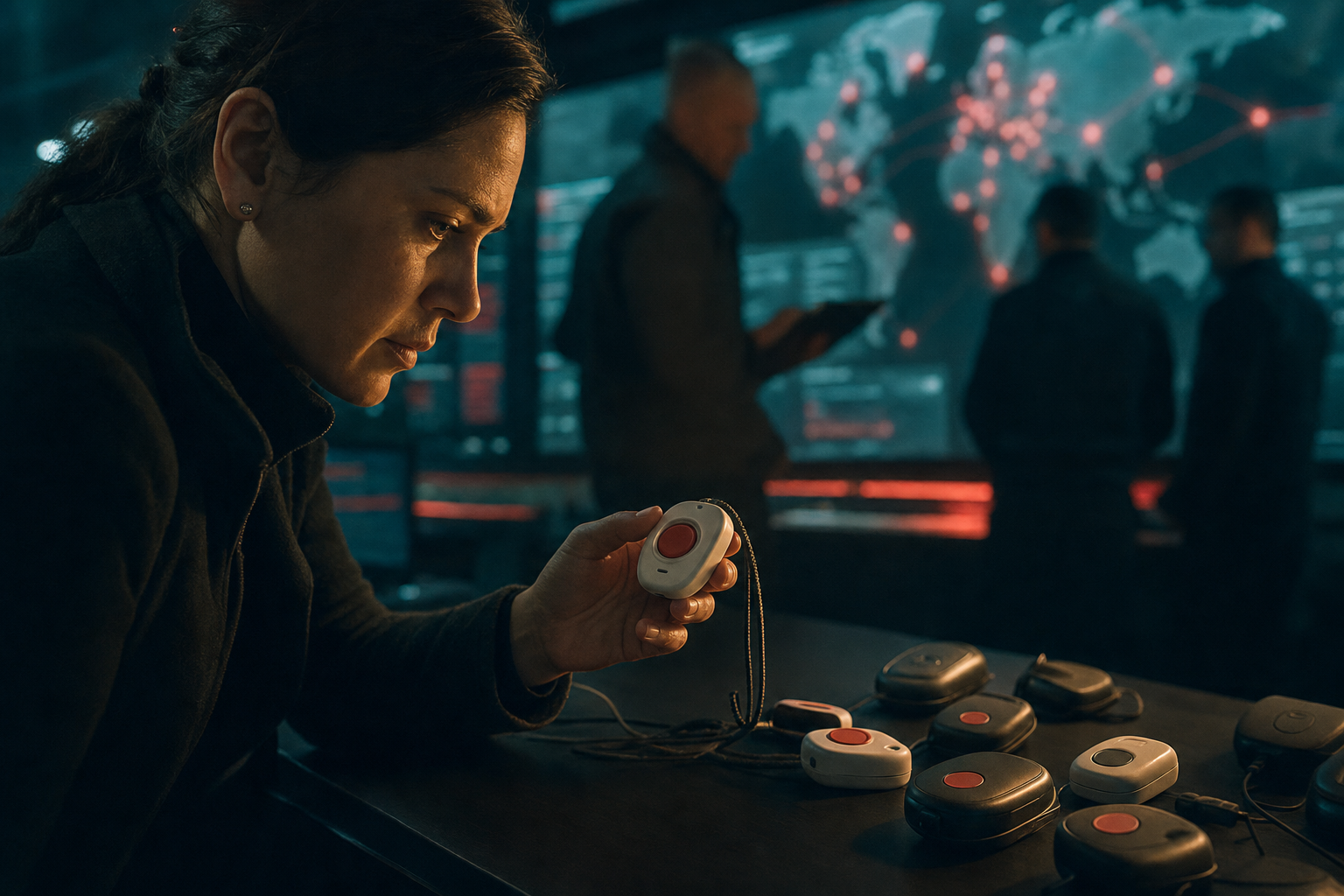
Personal emergency response systems for seniors look simple from the outside: a button, a wearable, maybe fall detection, and a call center. In production, they are not simple at all. They are distributed alerting systems where missed signals have real consequences, false positives exhaust responders, and unclear ownership turns minutes into risk.
SOC teams should pay attention to that architecture. Not because medical alert devices are the same as EDR alerts, but because the operating problem is familiar.
Teams think the problem is detecting that something happened. The real problem is proving that the right signal reached the right human, with enough context, fast enough to change the outcome.
That changes the conversation. The keyword personal emergency response systems for seniors is usually treated as a buying category. For security operations, it is a useful model for signal design, escalation, reliability, and response ownership.
Table of contents
- Why personal emergency response systems for seniors matter to SOC design
- The reference architecture: button, sensor, network, dispatcher, responder
- Signal quality: when an emergency alert becomes noise
- Escalation design: who owns the next action
- Reliability engineering for life-safety and SOC alerts
- Data context: location, identity, history, and consent
- What works: implementation rules borrowed from PERS
- What fails: common breakdowns in bad implementations
- Metrics that matter for personal emergency response systems for seniors and SOCs
- Product fit: applying the model inside ThreatCrush-era security operations
Why personal emergency response systems for seniors matter to SOC design
The signal is simple; the workflow is not
A personal emergency response system starts with an event. A senior presses a pendant, a fall sensor triggers, or a base station detects distress. That event becomes an alert. The alert is routed to a monitoring center, a caregiver, emergency services, or some combination of all three.
The mistake teams make is assuming the button is the system. The button is only the signal source. The actual system includes identity, connectivity, dispatch logic, responder availability, call scripts, escalation timing, and post-event review.
SOC teams make the same mistake with detections. They treat a rule, indicator, EDR analytic, or SIEM correlation as the system. It is not. The detection is the button. The system is everything that happens after it fires.
A useful way to think about it is this: a detection without a response path is a pendant with no monitoring center. It may produce a signal, but it does not produce safety.
Why this is a 2026 architecture problem
In 2026, both life-safety and security operations are dealing with distributed environments. Seniors may live alone, move between home and community settings, rely on cellular coverage, and interact with multiple caregivers. Enterprises have hybrid infrastructure, cloud workloads, SaaS identities, unmanaged devices, third-party risk, and a growing set of telemetry sources.
The practical question is not whether you can collect signals. Most teams can. The question is whether your architecture can preserve meaning across handoffs.
For SOCs, this matters because proactive and reactive work are converging. Threat intelligence, exposure management, vulnerability context, endpoint telemetry, identity events, and network signals all need to land in a workflow that someone can act on. If they remain disconnected, the SOC becomes a noisy dispatch center with no reliable responder map.
The reference architecture: button, sensor, network, dispatcher, responder
Five components that have to work together
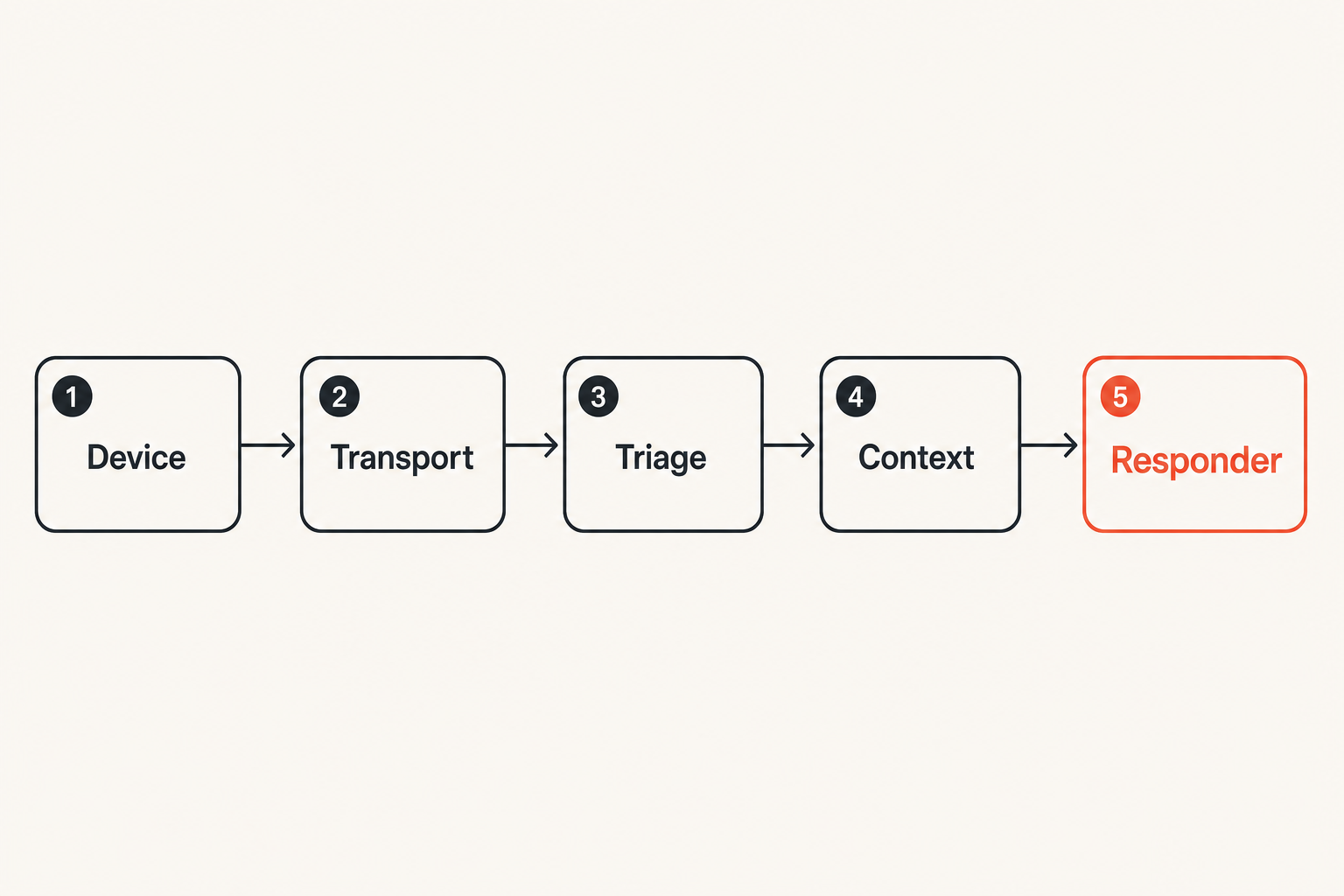
Most personal emergency response systems for seniors can be reduced to five moving parts:
- Input device: wearable button, wall button, mobile app, fall detector, bed sensor, or voice-activated unit.
- Transport layer: landline, cellular, Wi-Fi, Bluetooth, or local hub connectivity.
- Monitoring function: live agent, automated screening, caregiver notification service, or emergency dispatch integration.
- Context store: identity, medical notes, location, access instructions, caregiver contacts, device status, and incident history.
- Responder path: family member, neighbor, facility staff, EMS, or a contracted response service.
Every component can work independently and still fail as a system. The pendant can transmit, but the monitoring center may have stale caregiver contacts. The call center can answer, but the device may report the wrong location. The fall sensor can trigger, but the user may be unable to speak. What breaks in practice is the seam between components.
Practical rule: Do not evaluate an alerting system by its sensor alone. Evaluate the full path from signal creation to confirmed response.
SOC architecture follows the same rule. A detection is not complete until it has routing logic, enrichment, ownership, escalation, containment options, and validation.
Where SOC systems map to the same pattern
The mapping is direct enough to be useful:
- Pendant or fall sensor becomes detection logic.
- Cellular or base station transport becomes event pipeline and log delivery.
- Monitoring center becomes SOC triage.
- Caregiver profile becomes asset, identity, and business context.
- EMS or caregiver response becomes containment, remediation, or incident command.
This is why mature teams document threat analysis workflows instead of only documenting rules. If you want a deeper SOC-specific architecture pattern, the same operating logic shows up in threat analysis workflows that actually work: the value is in connecting evidence, decision points, and ownership.
Related reading from our network: teams designing distributed controls in software delivery face a similar problem, and the SimpliSafe security system model for CI/CD and supply chain defense is a useful adjacent analogy for layered controls and response paths.
Signal quality: when an emergency alert becomes noise
False positives are operational debt
Fall detection is hard. People sit down quickly, drop devices, bump into furniture, or forget to wear the pendant. A system that fires too often creates fatigue. Caregivers stop taking alerts seriously. Monitoring agents spend time clearing non-events. The user may stop wearing the device because it feels intrusive or embarrassing.
The SOC version is obvious. A rule that fires on every admin tool, every suspicious PowerShell command, or every new cloud API call teaches analysts to distrust the queue. Eventually the alert becomes background radiation.
The mistake teams make is treating false positives as a tuning annoyance instead of operational debt. Every bad alert consumes attention, weakens trust, and raises the chance that a real event gets dismissed.
False positives are not only a detection engineering problem. They are a workflow problem. If analysts have to manually reconstruct the same context every time, even a decent signal becomes expensive.
Missing the alert is worse than alert fatigue
The other failure mode is worse: silence when the system should have fired. A fall detector that avoids false positives by becoming insensitive is not reliable. A pendant that depends on a user being conscious enough to press it has a known gap. A cellular device with poor indoor coverage may appear functional until the one moment that matters.
In SOC terms, under-alerting often hides behind clean dashboards. The queue looks manageable because the detection fabric is incomplete. Critical assets are not sending logs. Identity telemetry is delayed. Cloud audit events are sampled incorrectly. Endpoint coverage is assumed rather than verified.
Practical rule: A quiet alert queue is not evidence of control. It may be evidence that signal paths are broken.
The practical question is how to balance sensitivity with response capacity. A useful pattern is to separate alert generation from alert urgency. Not every event needs a page, but important anomalies should still be stored, enriched, and available for correlation.
Escalation design: who owns the next action
The monitoring center is a triage function
In personal emergency response systems for seniors, the monitoring center does more than answer calls. It decides whether the event is accidental, whether the user can respond, whether a caregiver should be called, whether EMS is required, and what information responders need.
That is triage. The quality of triage depends on scripts, context, training, routing policy, and the ability to escalate when the situation is ambiguous.
A SOC has the same job. Analysts take a signal and decide whether it is benign, suspicious, confirmed malicious, or unresolved. They need enough context to avoid both overreaction and delay. If the triage layer is weak, automation does not fix it. It just moves bad decisions faster.
Related reading from our network: escalation also depends on shared language, and the community operations framing in Community Other Words: Build the Vocabulary That Makes Local Networks Work maps surprisingly well to SOC ownership labels, routing, and follow-up.
Caregiver trees look like incident routing
Caregiver escalation trees are practical. Call the user first. If no response, call the primary caregiver. If unreachable, call the secondary caregiver. If the symptoms or silence meet a threshold, contact emergency services. Some systems also include neighbor access instructions, lockbox codes, facility front-desk numbers, or known medical risks.
Incident routing should be equally explicit. Who owns a suspected credential theft event at 02:00? Who can disable an executive account? Who can isolate a production database host? Who approves blocking a partner IP range? Who communicates to legal or customer support?
What breaks in practice is unclear authority. The analyst sees the alert but cannot take the next step. The engineer who can act is not on call. The business owner is unknown. The runbook says escalate, but does not define to whom, by what channel, with what evidence, and after what timeout.
Practical rule: Escalation is not a Slack mention. Escalation is a defined transfer of responsibility with a timeout and a fallback path.
Reliability engineering for life-safety and SOC alerts
Battery, connectivity, and dead zones
Personal emergency response devices fail in boring ways. Batteries drain. Pendants are left on nightstands. Cellular signal drops in basements. A base station is unplugged during cleaning. The user moves to a new address and nobody updates the profile. A device that worked during installation becomes unreliable over time.
SOC systems fail in equally boring ways. Agents stop reporting. Log collectors fill disks. API tokens expire. Cloud integrations lose permissions. Network taps miss traffic after a routing change. Detection content assumes fields that changed during a vendor update.
The lesson is not to buy more tools. The lesson is to monitor the monitoring system.
For PERS, that means battery status, device check-ins, connectivity tests, and periodic user drills. For SOCs, it means telemetry health checks, event volume baselines, parser validation, endpoint coverage reporting, and alert path tests.
Heartbeats, tests, and silent failure detection
The highest-risk failure is not a loud error. It is silent failure. The dashboard says the system is fine because no alert has arrived. Meanwhile, the device stopped checking in two days ago or the log source stopped sending events after a certificate rotation.
Every critical signal path needs a heartbeat. A heartbeat is not just a ping. It is proof that the source can generate, transport, process, route, and display a known test signal.
For SOCs, useful heartbeat patterns include:
- Synthetic identity events that confirm cloud audit ingestion.
- Test malware or benign EDR simulations that confirm endpoint alerting.
- Canary tokens that validate outbound detection and alert routing.
- Scheduled parser checks against known-good event samples.
- Daily coverage reports for high-priority assets and identities.
The practical question is not whether the SIEM is up. The practical question is whether a real signal from a critical source can reach the responder queue with usable context.
Data context: location, identity, history, and consent
Context changes priority
An emergency alert from a senior living alone with a recent fall history is different from an accidental pendant press during a scheduled test. Location matters. User history matters. Device type matters. Time of day matters. Whether the user can speak matters.
Security alerts have the same dependency on context. A suspicious login to a test account is not the same as a suspicious login to a payroll administrator. A port scan from an internal vulnerability scanner is not the same as reconnaissance from an unmanaged endpoint. A malware alert on an isolated lab host is not the same as execution on a domain controller.
Context changes priority because it changes expected impact and required response.
Good SOC enrichment should answer basic questions quickly:
- What asset, identity, or workload is involved?
- Is it internet-facing, privileged, regulated, or business-critical?
- Is the behavior expected for this entity?
- Is there related threat intelligence or exposure context?
- What is the minimum safe action if the event is real?
Privacy boundaries are part of the design
Personal emergency response systems for seniors handle sensitive information: health conditions, home access details, emergency contacts, location, and behavioral patterns. More context can improve response, but unmanaged context creates privacy and trust problems.
SOCs have the same tradeoff. Identity data, endpoint telemetry, email content, browser activity, HR data, and geolocation can help investigations. They can also become excessive, poorly governed, or accessible to people who do not need it.
The mistake teams make is treating privacy as a legal review after the architecture is already built. Privacy boundaries should shape the workflow from the beginning.
Practical controls include role-based access, field-level redaction, audit trails, retention limits, approval gates for sensitive searches, and clear separation between operational context and unrelated personal data.
What works: implementation rules borrowed from PERS
A practical rollout sequence
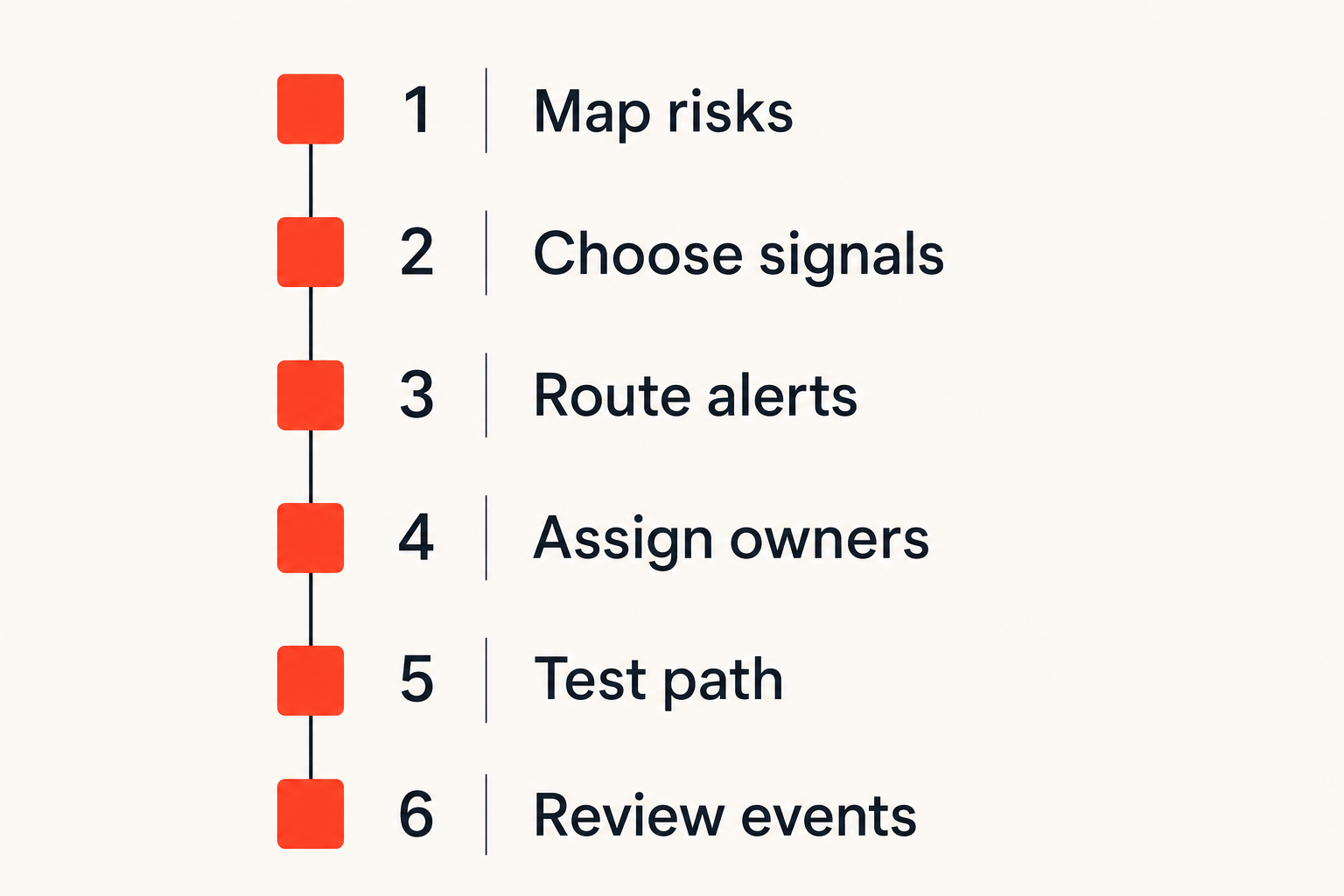
A PERS rollout works best when it starts with the response model, not the device catalog. SOC improvements should follow the same order.
- Define the protected person or asset. For PERS, that is the senior, their living situation, and their known risks. For SOC, it is the critical identity, workload, system, or business process.
- Map the credible emergency scenarios. Fall with no voice response, medication issue, wandering, panic button activation. In SOC terms: credential theft, ransomware staging, data exfiltration, cloud privilege abuse.
- Choose the signal sources. Pendant, fall sensor, base station, mobile GPS. In SOC: EDR, identity provider logs, cloud audit, network telemetry, threat intel, exposure findings.
- Design the triage path. Who receives the first alert, what context is shown, what questions are asked, and when escalation happens.
- Define response authority. Who can enter the home, call EMS, isolate a host, disable an account, or block an IP.
- Test the full path. Press the button. Simulate the detection. Confirm routing, timing, context, and fallback.
- Review and tune. Adjust thresholds, contacts, scripts, runbooks, and alert severity based on real events.
That sequence avoids the common trap of buying hardware or detection tools before the organization knows how it will respond.
Controls that improve response quality
What works in PERS translates well to SOC operations:
- Known-good contact data. Stale responders break both emergency care and incident response.
- Priority tiers. Not every signal requires the same urgency, but every signal needs a defined path.
- Context cards. A concise profile beats forcing the operator to search five systems.
- Fallback paths. If the first responder is unavailable, the system must know what happens next.
- Regular drills. Untested workflows are assumptions, not controls.
- Post-event review. Every meaningful event should improve the routing, context, or detection logic.
Practical rule: If a workflow cannot be tested safely before an emergency, it is not operationally ready.
A SOC can implement this with runbook validation, purple-team simulations, tabletop exercises, and synthetic events. The point is not theater. The point is to find broken ownership before an attacker does.
What fails: common breakdowns in bad implementations
Tool-first buying creates brittle workflows
The most common failure pattern is tool-first thinking. In the PERS world, this sounds like choosing the device with the longest feature list without validating coverage, comfort, caregiver routing, or monitoring quality. In security, it sounds like buying another platform because it detects more things, without asking who will triage, enrich, and act.
Feature depth is not worthless. It is just not sufficient.
A fall sensor with excellent detection but poor connectivity is not a reliable emergency system. A threat feed with impressive indicators but no integration into triage is not a reliable SOC control. A SIEM rule that fires without asset context becomes analyst homework.
The practical question is whether the new tool reduces time to correct action. If it adds another queue, another login, or another ambiguous severity model, it may increase operational drag.
Automation without ownership makes incidents slower
Automation is useful when it compresses known steps. It is dangerous when it hides unclear decisions.
A PERS system might automatically call caregivers, but somebody still owns the decision to dispatch emergency services when the user cannot respond. A SOC automation can enrich an IP, query endpoint state, or open a ticket, but somebody still owns containment when the evidence is incomplete.
What breaks in practice is automation that creates motion without resolution. The alert gets enriched, tagged, ticketed, messaged, and synchronized, but nobody is accountable for the next decision.
Related reading from our network: the same ownership issue appears in AI-enabled workflows, where interoperability only helps if identity, events, credentials, and audit trails are designed as a workflow; see Standards Def for AI Agent Systems for an adjacent view.
Metrics that matter for personal emergency response systems for seniors and SOCs
Measure the handoff, not just the alert
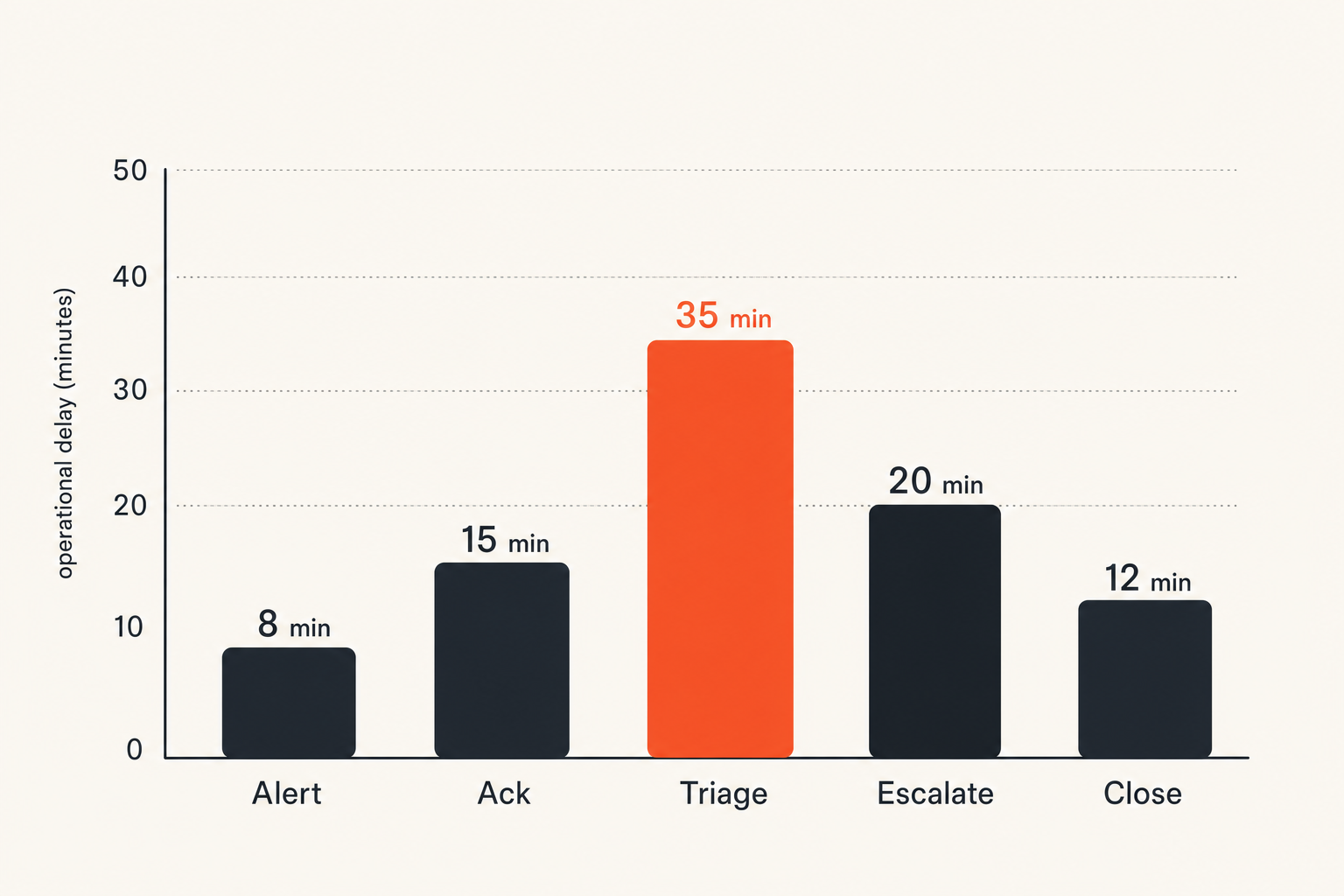
Personal emergency response systems for seniors should not be measured only by whether an alert was generated. The important metrics are operational: did the alert reach the monitoring center, did the operator understand the context, did the right responder accept ownership, and did the event close with a verified outcome?
SOCs often over-measure detection volume and under-measure handoff quality. Alert counts are easy. Response reliability is harder. But handoff reliability is where real operational maturity lives.
Useful SOC metrics include:
- Time from event occurrence to alert creation.
- Time from alert creation to analyst acknowledgement.
- Time from acknowledgement to first qualified decision.
- Percentage of high-severity alerts with complete context.
- Percentage of escalations accepted within SLA.
- Percentage of incidents with validated containment.
- Number of alerts closed as unknown because evidence was insufficient.
The metric that matters most depends on the workflow stage you are trying to improve. Early maturity teams often need coverage and routing metrics. Mature teams need decision quality, containment validation, and feedback loop metrics.
A comparison table for operational metrics
| Operational concern | PERS example | SOC equivalent | What good looks like | What fails |
|---|---|---|---|---|
| Signal generation | Fall sensor or button press | Detection rule or analytic | Event is captured with timestamp and source | Sensor never fires or rule is disabled |
| Transport | Cellular link to monitoring center | Log pipeline to SIEM or data lake | Signal arrives quickly and reliably | API token, agent, or collector silently fails |
| Triage | Agent confirms emergency | Analyst validates suspicious activity | Operator has context and script | Operator must search multiple tools manually |
| Escalation | Caregiver or EMS contacted | Incident owner or responder paged | Ownership accepted within timeout | Alert is forwarded but not owned |
| Context | Location and medical notes | Asset, identity, exposure, threat intel | Priority reflects real risk | Generic severity causes overreaction or delay |
| Closure | Responder confirms outcome | Containment and remediation validated | Event has verified resolution | Ticket closes without proof |
The table is intentionally plain. Complex dashboards often hide simple gaps. If you cannot answer where the handoff failed, you cannot improve the workflow.
Product fit: applying the model inside ThreatCrush-era security operations
Where threat intelligence fits in the response chain
Threat intelligence is often sold as more signal. That is only partly useful. The better use is operational context: what does this indicator mean, which assets are exposed, which actor behavior is relevant, and what should the responder do next?
For teams building modern security operations programs, the PERS model is a reminder that intelligence must connect to response. A watchlist, feed, or exposure finding has to land in a workflow with ownership. If it does not, it becomes another pendant nobody answers.
ThreatCrush is built around that operating reality: real-time threat feeds, vulnerability tracking, attack surface monitoring, and threat actor intelligence need to support the SOC workflow rather than sit beside it. If you are mapping that broader operating model, our security operations guide for 2026 covers the SOC architecture, workflow, and maturity layers in more detail.
The practical fit is straightforward:
- Use intelligence to enrich alerts before analyst review.
- Connect exposure context to detection priority.
- Route findings by asset owner and response authority.
- Validate whether signals are reaching the right queue.
- Feed incident outcomes back into detections and watchlists.
Personal emergency response systems for seniors make the lesson concrete. A signal has value only when it improves response. The same is true for SOC telemetry, threat intelligence, and detection engineering.
Try threatcrush.com
ThreatCrush is for security operations professionals building and scaling SOC capabilities. If you want threat intelligence and exposure context wired into practical response workflows, Try threatcrush.com.
Try ThreatCrush
Real-time threat intelligence, CTEM, and exposure management — built for security teams that move fast.
Get started →