Mass Casualty Incident Near Me: A SOC Architecture Guide for Location-Aware Crisis Response
A spike in searches for mass casualty incident near me usually means one of two things: something bad is happening locally, or people believe something bad may be happening locally. Either way, your SOC does not get to treat it as background noise.
The first alerts rarely arrive cleanly. Someone in HR posts in Slack. A local news push notification hits an executive phone. Employees start searching. A regional office asks whether they should close. A helpdesk ticket says badge access is failing because police blocked a street.
Teams think the problem is “how do we monitor breaking news?” The real problem is how do we turn messy location-based crisis signals into an operational decision without flooding the SOC, overreacting, or missing a real risk to people and facilities?
That changes the conversation. “Mass casualty incident near me” is not just a search phrase. For security operations, it is a workflow trigger that touches threat intelligence, physical security, executive protection, corporate communications, travel risk, HR, facilities, and incident command.
Table of contents
- Why mass casualty incident near me belongs in SOC architecture
- Define the operating model before collecting signals
- Build a location-aware signal pipeline
- What good detection looks like for physical crisis events
- The response workflow from signal to decision
- Common failure modes when teams implement this badly
- Integrate cyber, physical, and business context
- Metrics that tell you whether the workflow works
- Implementation blueprint for SOC teams
- Where ThreatCrush fits
Why mass casualty incident near me belongs in SOC architecture

The keyword is a signal, not the incident
When people search “mass casualty incident near me,” they are trying to answer a local safety question quickly. A SOC should not treat that phrase as proof of an event. It is better understood as a weak signal that may correlate with stronger signals: local emergency alerts, police scanner references, news desk updates, social media posts, employee check-ins, access control anomalies, building closure notices, or executive travel routes.
The mistake teams make is building a feed collector and calling it preparedness. Feed collection only tells you that information exists. It does not tell you whether a facility is exposed, whether employees are nearby, whether travel should change, or who can make a decision.
A useful way to think about it is this: the SOC is not trying to “detect tragedy.” The SOC is trying to detect organizational exposure to a local crisis.
Practical rule: Treat public crisis language as a trigger for context enrichment, not as a standalone alert.
Why this matters more in 2026
In 2026, employees are distributed, executives travel constantly, facilities are hybrid, and emergency information spreads faster than official confirmation. Security operations teams are often the only function with 24/7 monitoring, case management discipline, and escalation muscle.
That does not mean the SOC should become a public safety agency. It means the SOC needs a clear interface with physical security, HR, travel, legal, facilities, and communications. The operational gap appears when everyone assumes someone else is checking the local risk picture.
This is similar to modern cyber operations. The value is not the tool. The value is the workflow that turns signals into validated decisions. Teams that want a broader grounding in SOC structure can use our guide to security operations in 2026 as the baseline for ownership, tooling, and maturity.
The SOC ownership question
The practical question is simple: what should the SOC do when a mass casualty incident may be near a company location, employee population, event, or travel route?
The answer should not be improvised during the incident. Define ownership before the first alert:
- SOC monitors and triages signals.
- Physical security validates facility exposure.
- HR or people operations handles employee accountability.
- Travel or executive protection handles itinerary changes.
- Communications owns employee messaging.
- Incident command owns business decisions.
If the SOC owns everything, the workflow fails. If the SOC owns nothing, the organization loses its best 24/7 signal-processing function.
Define the operating model before collecting signals
Decide what the SOC is responsible for
Before buying feeds or building dashboards, write a one-page operating model. It should define what the SOC is expected to detect, enrich, escalate, and document.
For example, the SOC may be responsible for:
- Monitoring crisis indicators near defined company locations.
- Correlating public signals with internal asset and personnel context.
- Opening a case when threshold criteria are met.
- Notifying physical security and incident command.
- Maintaining an evidence timeline.
- Closing the loop after the event.
The SOC should usually not be responsible for:
- Issuing public safety instructions beyond approved templates.
- Confirming casualty counts.
- Contacting law enforcement unless authorized.
- Making office closure decisions alone.
- Publishing employee-wide crisis communications without approval.
That boundary matters. During a local crisis, ambiguity creates delay and duplicate work.
Separate awareness from action
Many teams collapse awareness and action into one alert. A news mention appears, and someone immediately escalates to leadership. After enough false alarms, leadership stops trusting the SOC.
Build two layers instead:
| Layer | Purpose | Example trigger | Output |
|---|---|---|---|
| Awareness | Track weak or early signals | Local mention of shooting, explosion, active threat, large police response | Watch item with location enrichment |
| Action | Escalate potential organizational exposure | Credible event within defined radius of office, employee event, executive route, or critical vendor | Incident case and notification |
Awareness is cheap if it is quiet. Action is expensive because it interrupts people. The workflow should protect the action layer from weak signals.
Practical rule: Do not page humans for every crisis mention. Page when credible signals intersect with organizational exposure.
Write escalation thresholds in plain language
Thresholds should be readable by an analyst under stress. Avoid vague policy language like “escalate significant events.” Define what significant means.
Example thresholds:
- Open a watch item when two independent public sources mention a violent event within 10 miles of a company location.
- Open an incident case when a credible source reports an active threat within 2 miles of an occupied facility.
- Notify executive protection when a verified event intersects an executive itinerary within the next 12 hours.
- Notify facilities when emergency services block access routes to a site.
- Notify HR when an event occurs near a company-sponsored gathering.
Plain thresholds reduce argument. They also make after-action review possible.
Related reading from our network: local coordination has the same routing and trust problem outside security operations, and this piece on running a local community network is a useful adjacent model for asks, offers, follow-up, and accountability.
Build a location-aware signal pipeline
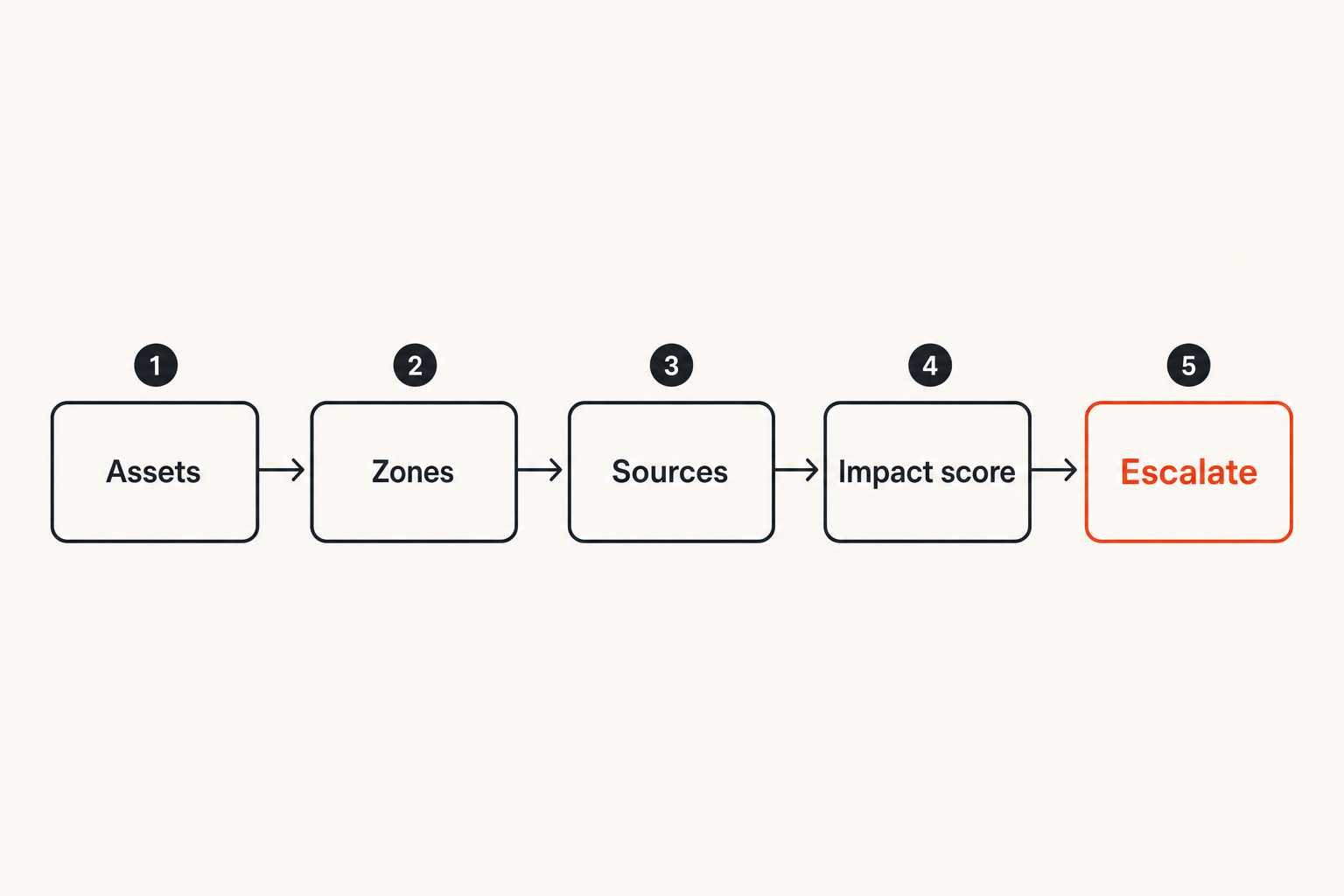
Start with assets and people, not feeds
The mistake teams make is starting with news, social media, and OSINT sources. Start with what you are protecting.
You need a location inventory that includes:
- Offices and branches.
- Warehouses, labs, and manufacturing sites.
- Data centers and network points of presence.
- Executive residences if covered by policy.
- Company events and temporary venues.
- Travel itineraries where approved and privacy-reviewed.
- Critical vendors with operational dependency.
Without that inventory, “near me” has no meaning. Near which facility? Near which employee group? Near which business process?
Location data should have owners, freshness, and sensitivity labels. A stale facilities spreadsheet is not an operational data source. Treat the asset-location layer like any other critical SOC input.
Normalize location data into zones
Do not hard-code every alert around raw addresses. Normalize locations into operational zones.
A simple model:
- Zone 0: inside company property or event venue.
- Zone 1: within immediate walking radius.
- Zone 2: within likely commute or access disruption radius.
- Zone 3: same city or metro area.
- Zone 4: regional awareness only.
The radius will vary by environment. A dense city campus is different from a rural distribution center. The point is not perfect geometry. The point is repeatable triage.
For each zone, define the default action. Zone 1 near an occupied office may require escalation. Zone 4 may only create a watch item unless there is a specific business dependency.
Score proximity, credibility, and impact
A practical scoring model should be simple enough to explain and strict enough to automate.
| Factor | Low | Medium | High |
|---|---|---|---|
| Proximity | Same region | Same city | Within defined exposure zone |
| Credibility | Single unverified post | Multiple public reports | Official or trusted source confirmation |
| Impact | No known company exposure | Possible commute or vendor disruption | Employees, executives, facility, or event exposed |
| Time sensitivity | Historical or resolved | Developing | Active or escalating |
You do not need a magic score. You need consistent logic. A “medium credibility, high proximity, high impact” case deserves more attention than a “high credibility, low proximity, low impact” item.
What breaks in practice is that analysts over-weight dramatic language and under-weight company exposure. The phrase “mass casualty incident” sounds severe, but severity to the organization depends on intersection with people, assets, and operations.
What good detection looks like for physical crisis events
Use correlation instead of single-source alerts
A single source can be wrong, late, or misleading. Good detection correlates multiple signal classes:
- Public emergency alerts.
- Local news and official agency updates.
- Social media with geospatial hints.
- Employee safety reports.
- Building access activity.
- Network or VPN changes from a local office.
- Travel itinerary proximity.
- Vendor or facility notifications.
The SOC should not need every source to agree. But it should distinguish between one noisy mention and a pattern.
A simple detection rule might look like this in pseudocode:
rule: possible_local_mass_casualty_exposure
when:
  public_signal.category in [active_threat, shooting, explosion, mass_casualty]
  and public_signal.location within exposure_zone(company_location)
  and count_distinct(source.id, 30m) >= 2
  and company_location.occupancy_status in [open, unknown]
then:
  create_case: crisis_watch
  enrich:
    - nearest_company_locations
    - current_occupancy_status
    - executive_travel_overlap
    - employee_event_overlap
    - access_route_disruption
This is not about replacing analyst judgment. It is about giving analysts a better starting point than a Slack message and a search tab.
Make uncertainty visible
Crisis detection is uncertainty management. Early information may be wrong. Official confirmation may lag. Social posts may contain duplicates, exaggeration, or old footage.
Your case view should show:
- Confidence level.
- Source count and source type.
- Last updated time.
- Location precision.
- Known unknowns.
- Decision pending owner.
Do not hide uncertainty behind a red severity badge. Red without explanation creates panic. Green without evidence creates complacency.
Practical rule: Every crisis case should separate confirmed facts, plausible assumptions, and unverified reports.
Tune for business impact
The SOC’s detection goal is not to track every public emergency. It is to identify events that may affect the organization.
Detection should prioritize:
- Occupied sites over unoccupied sites.
- Company events over generic city-level news.
- Executive travel over broad regional awareness.
- Access disruption over distant incident reports.
- Employee safety reports over public chatter.
- Critical vendor disruption over low-dependency vendors.
This is where security architecture becomes business architecture. A technically perfect feed that cannot answer “who is affected?” will fail when leadership asks for a decision.
The response workflow from signal to decision
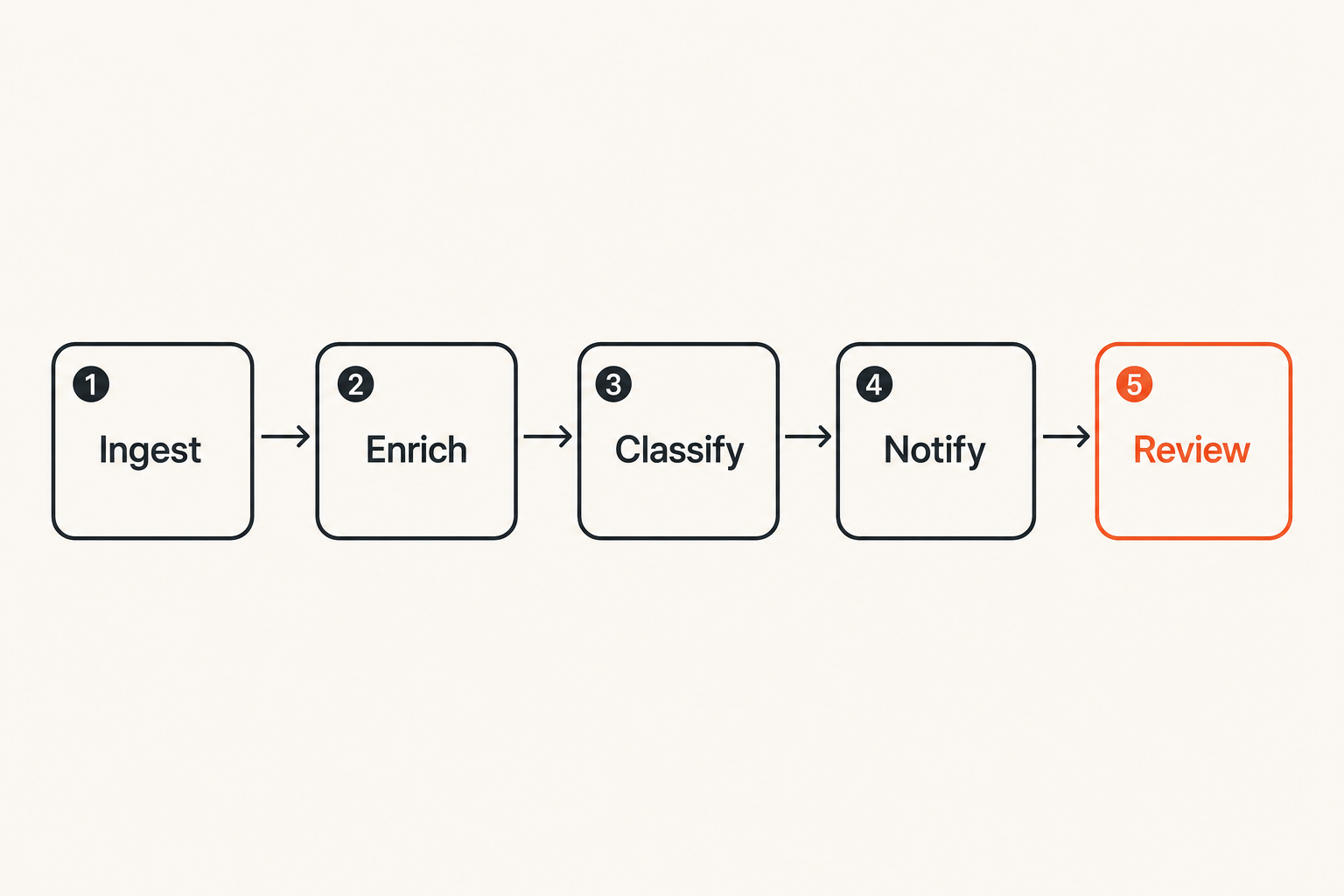
A practical eight-step workflow
When a possible mass casualty incident near me signal intersects your organization, the SOC needs a predictable path from first signal to action.
- Ingest the signal. Capture source, timestamp, location, category, and raw content.
- Geocode and normalize. Map the event to operational zones around company assets and people.
- Correlate sources. Look for independent confirmation or conflicting reports.
- Enrich with business context. Add facility status, occupancy, travel, events, vendors, and access routes.
- Classify the case. Watch item, advisory, active incident, or false/irrelevant.
- Notify the right owner. Route to physical security, HR, travel, communications, or incident command.
- Maintain the timeline. Log decisions, updates, evidence, and handoffs.
- Close and review. Record outcome, missed signals, false positives, and threshold changes.
This workflow is intentionally boring. Boring is good. During a crisis, the SOC should not be inventing process.
Where automation helps and where it hurts
Automation helps with enrichment, deduplication, routing, and reminders. It hurts when it sends high-confidence messages from low-confidence data.
What works:
- Auto-create watch items for weak signals.
- Auto-enrich with nearby assets and open offices.
- Auto-deduplicate repeated news or social posts.
- Auto-suggest escalation paths based on zone and impact.
- Auto-remind owners when a decision is pending.
What fails:
- Auto-sending employee safety messages from unverified reports.
- Auto-closing cases because one source deleted a post.
- Auto-escalating every mention of “shooting” in a large metro area.
- Auto-labeling events as mass casualty without confirmation.
The practical question is not “can we automate this?” It is “which parts of the workflow require speed, and which require accountable judgment?”
What must be logged
Crisis cases need clean records because decisions may be reviewed later by leadership, legal, HR, or regulators. The log does not need to be theatrical. It needs to be complete.
Capture:
- First detection time.
- Sources observed.
- Location precision and confidence.
- Company assets or people potentially exposed.
- Who was notified and when.
- Decisions made and by whom.
- Employee or facility impact.
- Final disposition.
- Lessons learned.
This is also where your threat analysis discipline matters. The same habits that improve cyber investigations improve crisis workflows: evidence preservation, timeline construction, source confidence, and clear handoff. We have written more on this architecture in threat analysis workflows that actually work.
Common failure modes when teams implement this badly
Failure mode one news monitoring becomes alert spam
Many implementations fail because they start with broad keyword monitoring: shooting, explosion, casualty, active threat, police activity, evacuation. In a large region, those terms can produce constant noise.
The SOC starts ignoring alerts. Physical security complains. Leadership gets notified too often. Eventually the system is disabled or reduced to a dashboard nobody watches.
The fix is not fewer keywords. The fix is correlation with location, credibility, and business context. A generic incident across town may not matter. A less dramatic event blocking the only access road to a site may matter a lot.
Failure mode two nobody owns the decision
The SOC can identify exposure, but someone must decide what to do. If decision ownership is unclear, the case stalls.
Common symptoms:
- Analysts keep gathering more information instead of escalating.
- Physical security assumes HR is messaging employees.
- HR assumes communications is drafting the note.
- Executives ask the SOC for recommendations outside policy.
- Facilities closes a site without notifying IT or business operations.
Define decision rights. If the SOC recommends an escalation, the case should show the accountable owner and expected response time.
Related reading from our network: product teams face a similar “shipping is operations, not slogans” problem, and this article on tops products in 2026 is a useful adjacent reminder that workflow ownership determines outcomes.
Failure mode three the SOC becomes a rumor desk
During breaking events, people forward screenshots, social posts, scanner clips, and hearsay. If the SOC accepts every item as equivalent evidence, the case becomes a rumor aggregator.
Set evidence standards:
- Mark unofficial social posts as unverified.
- Prefer primary sources when available.
- Distinguish live information from recycled media.
- Record contradictions instead of smoothing them over.
- Avoid casualty counts unless confirmed by trusted sources.
The SOC’s value is disciplined uncertainty. Anyone can paste links into a channel. Operators create a decision-grade timeline.
Integrate cyber, physical, and business context
Cyber impact is usually indirect
A local mass casualty event may not be a cyber incident, but cyber effects can appear indirectly.
Examples:
- A local office loses network connectivity because emergency response blocks building access.
- Employees shift to remote work, changing VPN patterns and helpdesk volume.
- Attackers exploit the crisis with phishing themes.
- Fraud attempts target employee donation drives.
- Misinformation impersonates company communications.
- Critical vendors pause operations.
Detection engineers should prebuild queries for abnormal remote access, phishing lures using local crisis language, and spikes in helpdesk tickets from affected regions. The cyber signal is not the tragedy itself. The cyber signal is adversary behavior or operational disruption around it.
Physical security needs SOC-grade evidence handling
Physical security teams often have strong field knowledge but weaker case instrumentation. SOC teams often have strong case discipline but weak local context. The best operating model combines both.
Give physical security a case interface that includes:
- Map view of affected assets.
- Current source confidence.
- Facility contacts.
- Building status.
- Employee event overlap.
- Decision log.
- Attachments and evidence.
Do not force physical security to work from a SIEM event payload. Also do not let crisis decisions live only in text messages. The shared case is the system of record.
Business context changes severity
Severity should reflect organizational exposure, not public drama alone.
Consider two examples:
| Scenario | Public severity | Organizational exposure | SOC severity |
|---|---|---|---|
| Confirmed incident 20 miles from any asset | High | Low | Awareness |
| Unconfirmed active threat report beside occupied office | Unknown | High | Escalate |
| Police activity near executive route | Medium | Medium to high | Escalate to protection |
| Road closures near data center shift change | Low to medium | Operational | Notify facilities and site owner |
This is why asset and business context cannot be bolted on after the alert. It must be part of the detection and triage model from the beginning.
Related reading from our network: even home media infrastructure has similar state, routing, and privacy tradeoffs; this guide to doc streaming architecture in 2026 is an adjacent example of why the visible interface is never the whole system.
Metrics that tell you whether the workflow works
Measure decision latency
Mean time to detect is useful, but decision latency is more important. How long does it take from first credible signal to the right owner making a decision?
Track:
- First signal observed.
- First case opened.
- First enrichment completed.
- First owner notified.
- First decision recorded.
- First employee or facility action taken.
If detection is fast but decision latency is slow, the problem is not monitoring. The problem is ownership, routing, or missing context.
Measure escalation quality
Escalation quality tells you whether the SOC is interrupting the right people at the right time.
Useful review questions:
- Was the escalation threshold met?
- Was the right owner notified?
- Was the evidence sufficient for action?
- Was the severity appropriate?
- Did the case include business context?
- Did the notification create confusion or clarity?
You will not eliminate false positives. The goal is to make false positives cheap and true positives fast.
Measure after-action closure
After-action work is where the workflow improves. Many teams skip it because the crisis ends and everyone moves on. That is how the same problems repeat.
For every significant case, record:
- What worked.
- What failed.
- Which thresholds were too sensitive or too weak.
- Which contacts were wrong.
- Which assets lacked location metadata.
- Which automations helped.
- Which messages caused confusion.
Then assign remediation owners. A lesson without an owner is just documentation.
Implementation blueprint for SOC teams
Minimum viable architecture
You do not need a giant platform project to start. A minimum viable architecture includes:
- A maintained asset and location inventory.
- A small set of trusted external crisis sources.
- A way to ingest employee or internal reports.
- A geospatial enrichment step.
- A case queue with severity and owner fields.
- Notification routes for physical security, HR, travel, facilities, and communications.
- A timeline and evidence model.
- A post-incident review process.
Keep it small enough to run. The first version should support a real decision, not impress a steering committee.
Data model and case fields
A practical case schema might include:
case_type: physical_crisis_exposure
status: watch | active | resolved | irrelevant
confidence: low | medium | high
source_summary:
  source_count: 3
  trusted_source_seen: true
location:
  event_location: "approximate address or area"
  precision: exact | approximate | city_level
  nearest_company_asset: "office-nyc-02"
  exposure_zone: zone_1
business_context:
  occupancy_status: open
  employee_event_overlap: false
  executive_travel_overlap: true
  critical_vendor_overlap: false
routing:
  primary_owner: physical_security
  secondary_owner: executive_protection
  decision_due: "2026-08-11T16:30:00Z"
disposition:
  final_impact: none | employee | facility | travel | vendor | unknown
  lessons_required: true
The field names matter less than the discipline. The case must answer: what happened, how confident are we, who may be affected, who owns the decision, and what changed?
Rollout sequence
A clean rollout avoids boiling the ocean.
- Pick three to five priority locations or executive travel workflows.
- Define exposure zones and escalation thresholds.
- Identify trusted external and internal signal sources.
- Build the case schema and notification routes.
- Run tabletop exercises with SOC, physical security, HR, and communications.
- Tune thresholds based on exercise results.
- Expand to more locations and vendors.
- Add automation only after the manual workflow is understood.
The mistake teams make is automating before they know the decision path. Automation amplifies the workflow you already have. If the workflow is confused, automation makes confusion faster.
Where ThreatCrush fits
Use threat intelligence without turning it into noise
Threat intelligence is useful when it is connected to assets, exposure, and response. It is not useful as another stream of disconnected alerts.
For mass casualty incident near me workflows, the same principle applies. Your SOC needs timely signals, but it also needs context: which assets matter, what threats are credible, what vulnerabilities or dependencies are exposed, and who should act.
ThreatCrush is built for security operations teams that want to connect threat feeds, vulnerability tracking, attack surface monitoring, and operational intelligence into workflows that analysts can actually use. You can explore the platform at ThreatCrush if your team is consolidating threat intelligence and response context.
Connect proactive monitoring to response
The strongest SOCs do not separate proactive and reactive work into disconnected systems. They use proactive monitoring to shorten reactive investigation time.
For local crisis workflows, that means:
- Location-aware monitoring before an incident.
- Asset and exposure context ready before escalation.
- Clear routing before the first urgent message.
- Evidence timelines that survive leadership review.
- Post-incident updates that improve future detection.
The same architecture helps with cyber threats, vulnerability exposure, third-party risk, and executive protection support. Different signals, same operating principle: context turns alerts into decisions.
Closing the loop on mass casualty incident near me workflows
A mass casualty incident near me search spike is not something the SOC can control. The workflow around it is.
If the team only monitors headlines, it will drown in noise. If it only waits for official confirmation, it may move too slowly. If it escalates without business context, it will create confusion. The practical path is a location-aware operating model that correlates signals, enriches exposure, routes decisions, and records outcomes.
That is the architecture lesson: the UI is not the system, the feed is not the workflow, and the alert is not the decision.
Try threatcrush.com
ThreatCrush publishes for security operations professionals building and scaling SOC capabilities. Try threatcrush.com.
Try ThreatCrush
Real-time threat intelligence, CTEM, and exposure management — built for security teams that move fast.
Get started →