Incident Commander: The SOC Operating Role That Keeps Response From Collapsing
An incident commander sounds like a role you only need during a headline breach. In practice, many SOCs need one every week: ransomware triage, identity compromise, suspicious cloud activity, exploited edge devices, data exposure, vendor alerts, and executive pressure arriving before evidence is clean.
Teams think the problem is incident response speed. The real problem is command structure under uncertainty.
Without a clear incident commander, every responder optimizes locally. Detection engineers chase alert fidelity. IR analysts pull artifacts. IT owners ask whether to isolate hosts. Legal wants wording. Executives want impact. Nobody is wrong, but the response drifts because nobody owns the operating rhythm.
That changes the conversation. The incident commander is not a ceremonial role and not a synonym for senior analyst. It is the control plane for a live security workflow: scope, decisions, communication, tasking, evidence, escalation, and recovery.
Table of contents
- Why the incident commander role matters in 2026
- What an incident commander actually owns
- The incident commander operating model
- How incident commander workflows connect to SOC architecture
- Incident commander versus analyst, manager, and executive
- A practical incident commander workflow
- What breaks when incident command is implemented badly
- Metrics that make incident command measurable
- Building the role into runbooks, training, and tooling
- Where ThreatCrush fits in the incident commander workflow
- Closing: make incident commander a system role
Why the incident commander role matters in 2026

The alert volume problem became a coordination problem
Most SOCs already know they have too much signal. SIEM rules, EDR detections, cloud logs, identity risk events, vulnerability scanners, deception alerts, vendor reports, and threat intel feeds all compete for attention. The mistake teams make is assuming better filtering alone will fix incident response.
Filtering helps, but serious incidents still create ambiguity. A valid identity compromise may start as a low-confidence impossible travel alert. A cloud intrusion may first appear as unusual API calls. A ransomware precursor may look like normal admin tooling until lateral movement is visible.
The practical question is not just whether the alert is true. It is who decides what the organization does next while the evidence is incomplete.
That is where the incident commander matters. The commander turns a scattered investigation into a controlled operating rhythm. They decide when to declare, who owns which workstream, what evidence is required, what gets contained, who gets informed, and when assumptions need to be challenged.
The role is about authority, not heroics
Many teams accidentally turn incident command into a personality contest. The loudest responder leads. The most senior engineer leads. The person who found the alert leads. That works until the incident crosses domains.
A useful way to think about it is this: the incident commander owns the response system, not every technical answer inside it. They do not need to be the best malware analyst, cloud engineer, forensics specialist, or detection engineer in the room. They need enough technical judgment to ask the right questions and enough authority to keep the response moving.
Practical rule: If nobody can say who owns the next decision, you do not have incident command. You have a group chat.
Authority also means the commander can say no. No to speculative rabbit holes. No to premature executive certainty. No to containment steps that destroy evidence without a business decision. No to twenty people joining a bridge and asking the same question in different words.
What the incident commander must protect
The incident commander protects four things during response:
- Time: investigations lose value when responders wait for permission, duplicate work, or debate severity endlessly.
- Evidence: containment and remediation can erase artifacts if sequencing is sloppy.
- Trust: executives, legal, customers, and internal teams need consistent communication, even when facts are still forming.
- Focus: analysts need a narrow set of hypotheses and tasks, not a flood of disconnected asks.
This is why the role belongs in SOC architecture, not just HR role descriptions. If your tools, runbooks, and escalation paths do not make command ownership explicit, the role will fail during stress.
Related reading from our network: teams managing local networks face a similar trust-and-routing problem in this operating model for community coordination, even though the domain is different.
What an incident commander actually owns
Decision ownership
The incident commander owns decisions that affect the response as a whole. That does not mean they make every decision alone. It means they are accountable for getting a decision made, recording the reasoning, and making sure the decision is executed.
Typical command-level decisions include:
- Do we declare this as an incident or keep it as an investigation?
- What severity level applies right now?
- What is the current working hypothesis?
- Which systems, accounts, tenants, or business processes are in scope?
- Do we isolate endpoints, disable accounts, revoke sessions, rotate secrets, block infrastructure, or wait for more evidence?
- Who needs to be notified internally?
- When do legal, privacy, communications, or executive stakeholders join?
- What is the next checkpoint and what evidence must be available by then?
The important part is not that the commander is always right. It is that decisions stop floating.
Response tempo
Good incident command has a tempo. Bad incident response has mood swings.
Tempo means the commander sets check-in intervals based on severity and uncertainty. A high-severity active intrusion may need 15-minute operational checkpoints. A contained phishing campaign may need hourly updates. A third-party notification may need a scheduled evidence review twice a day.
The commander should make this explicit:
Current severity: SEV-2
Current hypothesis: compromised contractor account used to access cloud storage
Command checkpoint: every 30 minutes
Next decision: disable all contractor sessions or only affected identity group
Evidence needed: IdP logs, cloud audit trail, endpoint status for contractor device
This simple structure reduces chaos. People know what matters before the next checkpoint. The commander knows whether the response is converging or drifting.
Scope control
Scope creep is one of the most expensive failure modes in incident response. It can happen in both directions. Teams may under-scope because they want the incident to be smaller, or over-scope because every weak signal suddenly looks related.
The incident commander owns the scope boundary and forces evidence-based expansion.
Practical rule: Scope should expand because evidence demands it, not because anxiety demands it.
A good scope statement is concrete:
In scope: Okta user j.smith, AWS account prod-analytics, S3 buckets accessed between 08:20 and 09:10 UTC, contractor laptop CR-4472.
Out of scope for now: unrelated VPN failures, blocked phishing emails from prior week, non-prod AWS accounts without matching API activity.
This does not prevent discovery. It prevents uncontrolled investigation sprawl.
The incident commander operating model
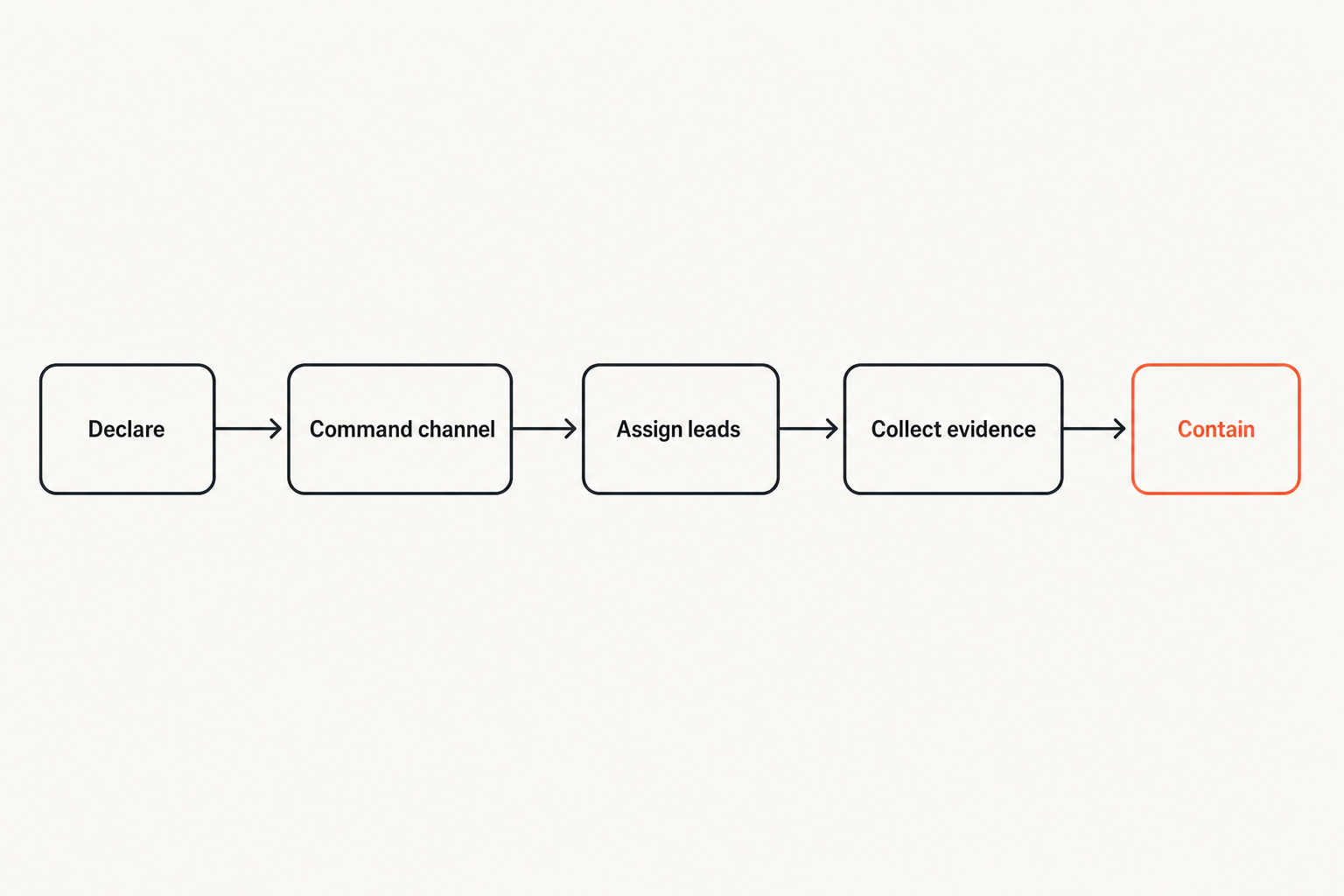
Declare the incident
The first command act is declaration. This sounds obvious, but many teams avoid it because declaring an incident feels politically expensive. They keep investigating in a gray zone until the situation is already visible to leadership.
The mistake teams make is treating declaration as proof of breach. It is not. Declaration is a workflow state. It means the organization is switching from analyst-led triage to command-led response.
A declaration should include:
- Incident ID
- Current severity
- Commander name
- Scribe or documentation owner
- Initial hypothesis
- Known affected assets or identities
- Command channel and meeting bridge
- Next checkpoint time
Example:
incident_id: IR-2026-0812-01
severity: SEV-2
commander: maya.chen
scribe: alex.rojas
hypothesis: cloud access token abuse from compromised engineer workstation
known_scope:
  - github-org-prod
  - aws-prod-shared-services
  - workstation-mac-2031
checkpoint_minutes: 30
status: declared
This gives the response a backbone.
Create the command channel
The command channel is not just a chat room. It is the operational record. It should contain decisions, timestamps, task assignments, evidence summaries, and unresolved questions.
Separate command communication from noisy analysis where possible:
- Command channel: decisions, status, owners, deadlines, stakeholder updates.
- Investigation channels: artifact review, log queries, endpoint triage, reverse engineering, detection tuning.
- Executive channel: concise impact, risk, decisions needed, next update time.
What breaks in practice is mixing all of this into one thread. The commander asks for the current scope and gets buried under screenshots, half-parsed logs, and speculation. The scribe cannot reconstruct decisions. Executives see raw uncertainty and interpret it as lack of control.
Assign functional leads
The commander should not personally run every workstream. Assign leads by function:
- Investigation lead
- Containment lead
- Identity lead
- Cloud or infrastructure lead
- Endpoint lead
- Communications lead
- Legal or privacy contact
- Business owner contact
- Detection engineering lead
Each lead owns tasks and returns summaries to command. The commander owns conflict resolution between leads.
This is where many SOCs mature from talented responders into a repeatable response organization. For a broader SOC workflow foundation, the ThreatCrush guide to modern security operations in 2026 is useful context because it frames incident response as part of a larger operating system, not a standalone drill.
How incident commander workflows connect to SOC architecture
Signals must become decisions
Detection systems produce signals. Incident response requires decisions. The incident commander is the conversion layer.
A SIEM alert might say an admin account authenticated from a new ASN. EDR might say PowerShell spawned a suspicious child process. A vulnerability scanner might say an internet-facing appliance is exposed to a known exploit. Threat intelligence might say infrastructure contacted by an endpoint overlaps with active adversary campaigns.
None of those signals automatically answer the operational question: what should we do now?
The incident commander forces the SOC to translate signal into action:
| Signal type | Raw output | Command question | Possible decision |
|---|---|---|---|
| SIEM alert | Suspicious login | Is this account still active and privileged? | Revoke sessions and force reset |
| EDR alert | Suspicious process tree | Is the host isolated or needed for evidence? | Isolate after memory capture |
| Cloud log | Unusual API calls | Was data accessed or changed? | Freeze keys and review object access |
| Threat intel | Known malicious infrastructure | Is there internal contact? | Block IOC and hunt related activity |
| Vulnerability finding | Exploitable edge device | Is exploitation observed? | Patch, isolate, or activate crisis response |
The table matters because it keeps tooling in its lane. Tools surface facts and context. Command turns them into coordinated action.
Runbooks need ownership points
Runbooks often fail because they describe tasks but not command decisions. A phishing runbook says to analyze headers, detonate attachments, block senders, search mailboxes, and reset credentials. Fine. But who decides whether the campaign is user-contained or enterprise-wide? Who decides whether to notify employees? Who decides whether mailbox access indicates reportable exposure?
Add ownership points to runbooks:
Decision point: credential exposure confirmed
Owner: incident commander
Inputs: IdP logs, mailbox rules, EDR status, user interview
Decision options:
  A. reset password only
  B. revoke sessions and reset MFA
  C. disable account pending endpoint review
  D. escalate to privacy review
Required log: decision, timestamp, rationale, approver if outside commander authority
This turns a checklist into an operating workflow.
Threat intelligence needs operational context
Threat intelligence is useful only when it changes prioritization, investigation, containment, or communication. Dumping indicators into a SIEM is not enough.
The incident commander needs intelligence that answers practical questions:
- Is this infrastructure associated with commodity malware, initial access brokers, ransomware operators, or benign scanning?
- Are the observed TTPs consistent with a known campaign?
- Are there exploited vulnerabilities in our exposed stack related to this activity?
- Do we have historical contact with the same domains, hashes, IPs, certificates, or autonomous systems?
- Does the intelligence change containment urgency?
This is why threat analysis workflows need to be connected to response. The prior ThreatCrush architecture guide on threat analysis workflows that actually work goes deeper on turning intel and telemetry into repeatable SOC decisions.
Related reading from our network: software delivery teams face adjacent ownership and validation problems, especially around pipeline evidence, in this CI/CD security system installation guide.
Incident commander versus analyst, manager, and executive
Why seniority is not enough
A senior analyst may be the best person to lead a technical investigation and still be the wrong incident commander. A manager may have people authority and still lack the technical judgment for live response. An executive may own business risk and still be too far from evidence to control incident flow.
The incident commander role sits between technical execution and business decision-making. It requires translation in both directions.
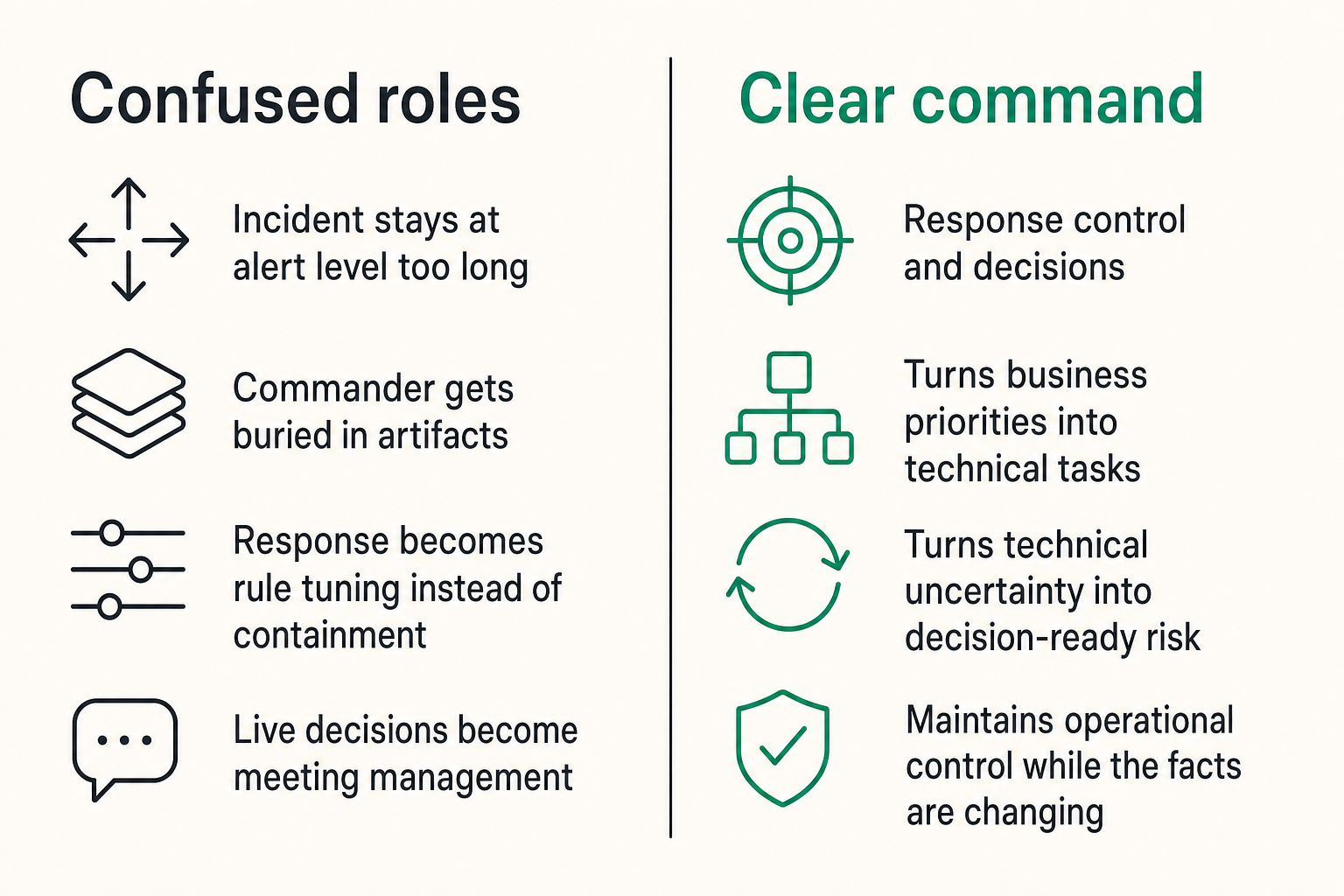
Downward, the commander turns business priorities into technical tasks. Upward, the commander turns technical uncertainty into decision-ready risk.
The practical question is not who has the highest title. It is who can maintain operational control while the facts are changing.
The comparison that prevents confusion
| Role | Primary job | Should they command? | Failure if confused |
|---|---|---|---|
| Tier 1 analyst | Initial triage and escalation | Usually no | Incident stays at alert level too long |
| Senior analyst | Deep investigation | Sometimes | Commander gets buried in artifacts |
| Detection engineer | Detection logic and hunts | Sometimes | Response becomes rule tuning instead of containment |
| SOC manager | Staffing and process | Sometimes | Live decisions become meeting management |
| Incident commander | Response control and decisions | Yes | Not applicable |
| Executive sponsor | Business risk and authority | No, but informs major decisions | Technical workflow becomes political theater |
The commander may come from any background, but the role must be explicit. If a detection engineer is commander, someone else should own detection changes. If a SOC manager is commander, someone else should run analyst tasking. If a senior responder is commander, they must resist becoming the primary keyboard operator.
Practical rule: The incident commander can delegate execution, but cannot delegate clarity.
When the role should rotate
For smaller SOCs, the role may rotate among trained responders. For larger organizations, it may belong to an incident management function. Both models can work.
Rotation works when:
- Commanders are trained on the same severity model.
- Runbooks define decision points.
- Handoffs are documented.
- Executives recognize the role.
- Tooling supports a single incident record.
Rotation fails when it is just an on-call label. If the commander has no authority to pull in infrastructure owners, request containment, or control communications, the rotation is cosmetic.
A practical incident commander workflow
Step 1: establish severity and hypothesis
The commander starts by forcing the team to state what is known, what is assumed, and what decision is next. Do not wait for perfect certainty.
A practical opening sequence:
- Confirm the triggering signal and source reliability.
- Identify affected identities, hosts, workloads, applications, or data stores.
- State the initial hypothesis in one sentence.
- Assign severity based on current evidence, not worst-case imagination.
- Define what would raise or lower severity.
- Set the first checkpoint.
Example severity logic:
SEV-3 if suspicious activity is limited to one endpoint with no privileged access.
SEV-2 if privileged credentials, production cloud access, or lateral movement indicators appear.
SEV-1 if active data destruction, confirmed exfiltration, widespread encryption, or business-critical outage is present.
This gives the team a shared frame. It also prevents the common failure where everyone privately imagines a different incident.
Step 2: stabilize evidence collection
Before containment, the commander should ask what evidence may be lost. Sometimes immediate containment is correct. Sometimes sequencing matters.
Evidence priorities often include:
- Authentication logs and session state
- Endpoint process trees and memory artifacts
- Cloud audit logs and object access records
- Email forwarding rules and mailbox access
- Network connections and DNS history
- Admin actions and configuration changes
- Vulnerability exposure and exploit telemetry
The commander does not collect all of this personally. They make sure someone owns each evidence stream and that containment does not destroy the most important artifacts without a conscious tradeoff.
Step 3: drive containment and communication
Containment is where command quality becomes visible. Weak command produces either paralysis or overreaction.
A good commander asks:
- What are we trying to stop?
- What business function might containment affect?
- What evidence will containment destroy?
- What is the rollback plan?
- Who approves if the action affects production?
- How will we confirm the action worked?
A useful containment decision record looks like this:
Time: 14:35 UTC
Decision: revoke all active sessions for contractor group ENG-CONTRACTORS
Reason: confirmed token abuse from contractor account and unclear account reuse risk
Expected impact: contractors must reauthenticate, possible build delay
Owner: identity lead
Validation: IdP session logs show termination; no new cloud API calls from affected tokens after 14:40 UTC
Communication should follow the same discipline. The commander should communicate what is known, what is being done, what is not yet known, and when the next update will arrive.
Related reading from our network: merchants handling regulated checkout flows face a different but familiar state-management problem around ownership, reconciliation, and support, covered in this piece on solution peptides payment architecture.
What breaks when incident command is implemented badly
Too many commanders
The fastest way to lose control is to let every stakeholder issue instructions. IT says isolate the host. Legal says preserve evidence. The application owner says do not touch production. The executive says take whatever action is needed. The analyst says they need ten more minutes.
All of those perspectives matter. They cannot all be command.
When there are too many commanders:
- Analysts receive conflicting tasks.
- Containment actions happen without sequencing.
- Stakeholder updates contradict each other.
- Decisions are made in private side channels.
- Nobody can reconstruct why something happened.
The fix is a single incident commander with named deputies and functional leads. Deputies can cover handoffs, time zones, or specific domains. They should not create parallel command structures.
No decision log
A decision log is not bureaucracy. It is memory under pressure.
Without it, post-incident review becomes folklore. People remember different timelines. Executives ask why a system was isolated and nobody can produce the rationale. Legal asks when exposure was known and the answer is buried in chat scrollback. Detection engineers try to improve rules but cannot determine which signal actually changed the response.
Minimum viable decision log fields:
- Timestamp
- Decision
- Owner
- Inputs considered
- Expected impact
- Validation method
- Follow-up required
This can live in a case management system, SOAR platform, ticket, markdown document, or incident tool. The format matters less than completeness and consistency.
Automation without command authority
Automation is valuable, but uncontrolled automation creates incident debt. A SOAR playbook can disable accounts, isolate endpoints, block indicators, enrich artifacts, and open tickets. But if nobody owns the command decision, automation just makes ungoverned action faster.
What fails:
- Auto-isolating endpoints that host critical services.
- Blocking infrastructure based on low-confidence indicators.
- Resetting passwords before collecting session data.
- Opening duplicate tickets across teams.
- Updating executives from raw alert severity instead of command status.
What works:
- Automation gathers context before the first checkpoint.
- High-risk actions require commander approval.
- Every automated action writes to the incident record.
- Playbooks expose decision points instead of hiding them.
- Validation tasks are created automatically after containment.
Practical rule: Automate evidence collection aggressively; automate destructive containment carefully.
Metrics that make incident command measurable
Measure flow, not theater
Many response metrics are easy to game. Number of incidents closed says little. Number of alerts processed says less. Meeting attendance says nothing.
Incident command should be measured by flow: how quickly the organization moves from signal to decision to validated action.
Useful metrics include:
| Metric | What it reveals | Bad pattern |
|---|---|---|
| Time to declare | Delay between credible signal and command state | Endless triage without ownership |
| Time to first scope statement | How fast responders align | Everyone investigates different assets |
| Decision latency | Time from evidence availability to action | Waiting for informal approval |
| Containment validation time | How fast actions are confirmed | Actions taken but not verified |
| Stakeholder update consistency | Whether communications match command state | Executives get conflicting narratives |
| Post-incident action closure | Whether lessons become changes | Review creates tasks nobody owns |
The point is not to punish responders. It is to see where the response system stalls.
Track decision latency
Decision latency is especially useful because it exposes hidden organizational friction. You may find that analysts detect quickly but wait hours for asset owner approval. Or identity containment is fast but cloud key rotation is unclear. Or legal review is necessary but gets pulled in too late.
Track decisions by type:
- Declaration
- Severity change
- Account disablement
- Endpoint isolation
- Network block
- Cloud key rotation
- Customer or regulator notification review
- Recovery approval
Once you see the delays, you can decide whether the fix is authority, automation, runbook clarity, executive policy, or better evidence.
Use post-incident review as calibration
Post-incident review should calibrate the incident commander model, not just list technical gaps.
Ask command-specific questions:
- Was the incident declared early enough?
- Did the first severity match available evidence?
- Were functional leads assigned clearly?
- Which decision took too long?
- Which decision was made with poor evidence?
- Did communication stay consistent?
- Did containment actions have validation steps?
- Did the commander have enough authority?
If the answer to the last question is no, do not pretend a better checklist will solve it. Authority is an architecture issue.
Building the role into runbooks, training, and tooling
Write runbooks for command handoffs
Every runbook should say who becomes incident commander, how command transfers, and what must be present at handoff.
A handoff template should include:
Incident ID:
Current commander:
Incoming commander:
Severity:
Current hypothesis:
Confirmed scope:
Open decisions:
Active containment:
Stakeholders notified:
Next checkpoint:
Risks if no action in next hour:
This is critical for global teams and long incidents. Fatigue causes mistakes. A clean handoff lets the next commander inherit the response instead of rediscovering it.
Train on ambiguity
Tabletop exercises often over-script the scenario. Real incidents are messier. Train commanders on partial evidence, contradictory signals, unavailable owners, unclear business impact, and executive interruptions.
Good commander training includes:
- Declaring with incomplete facts.
- Saying what is unknown without sounding lost.
- Pushing back on unsupported assumptions.
- Choosing between evidence preservation and containment.
- Managing multiple technical leads.
- Writing concise status updates.
- Escalating when business authority is required.
The goal is not performance theater. The goal is building decision muscle.
Design tooling around the incident object
Tooling should make the incident object the center of gravity. Alerts, assets, identities, indicators, vulnerabilities, tasks, decisions, evidence, and communications should attach to the incident record.
If your SOC tooling forces responders to pivot across five systems and manually reconstruct context, the commander will spend too much time asking for status. That is not command. That is clerical recovery.
A practical architecture looks like this:
- Detection creates or attaches to an incident candidate.
- Enrichment adds identity, asset, vulnerability, and threat intelligence context.
- Commander declares incident state and severity.
- Functional leads receive tasks from the incident record.
- Containment actions and approvals write back to the record.
- Stakeholder updates pull from command-approved summaries.
- Post-incident review uses the same timeline.
This is also where API discipline matters. If enrichment, case management, SIEM, EDR, identity, and ticketing systems do not preserve state consistently, the commander sees stale or conflicting views.
Where ThreatCrush fits in the incident commander workflow
Use intelligence to reduce uncertainty
Incident commanders do not need more random feeds during a live response. They need operational context that reduces uncertainty.
ThreatCrush is built for security operations teams that need real-time threat intelligence, vulnerability tracking, attack surface monitoring, and threat actor context in the same workflow. In incident command terms, that means the commander can ask better questions faster:
- Is this indicator known, new, or seen in active campaigns?
- Does this vulnerability matter to our exposed environment right now?
- Are related assets already visible in our attack surface?
- Does this activity align with known actor behavior?
- Should this change severity or containment urgency?
That kind of context does not replace analyst judgment. It gives the commander a cleaner decision surface.
Connect proactive and reactive work
The best incident response programs connect CTEM, detection engineering, threat hunting, vulnerability management, and incident command. Otherwise, proactive teams find exposure that never changes response, and reactive teams fight incidents without knowing which exposures were already known.
When threat intelligence and attack surface context are connected to incident records, the commander can see whether the current event is isolated or part of a known risk pattern. That changes prioritization.
For example, if an exploited edge device alert maps to an asset already flagged as exposed and associated with active exploitation, the commander can justify faster escalation. If an IOC appears in a commodity feed but has no internal sightings and low relevance, the commander can keep the team focused.
Keep the commander focused on decisions
ThreatCrush should fit as context and workflow support, not as another place responders must babysit. The commander needs fewer tabs, clearer ownership, and faster validation.
Useful product fit looks like:
- Enrichment that attaches to incidents automatically.
- Threat actor and infrastructure context presented in plain operational terms.
- Vulnerability and exposure context tied to affected assets.
- API and documentation support for SOC integrations.
- Outputs that help detection engineers tune rules after the incident.
If your team is connecting threat intelligence into incident response workflows, the ThreatCrush platform is the natural place to evaluate how those signals can support command decisions instead of adding noise.
Closing: make incident commander a system role
The practical takeaway
The incident commander is not just the person running the bridge. The incident commander is the operating role that keeps detection, investigation, containment, communication, and recovery aligned when the facts are incomplete.
Teams think the problem is finding a better responder. The real problem is designing a response system where command is explicit, decisions are logged, scope is controlled, and tooling supports the incident record.
If you make incident command a real system role, investigations get cleaner. Containment gets safer. Executives get better updates. Detection engineers get better feedback. Post-incident reviews produce changes instead of theater.
The practical question is simple: during your next serious alert, can everyone name the incident commander, the current hypothesis, the active scope, the next decision, and the next checkpoint?
If not, that is the architecture problem to fix.
Try threatcrush.com
ThreatCrush publishes for security operations professionals building and scaling SOC capabilities. Try threatcrush.com
Try threatcrush.com
You are writing for security operations professionals building and scaling SOC capabilities. Try threatcrush.com
Try ThreatCrush
Real-time threat intelligence, CTEM, and exposure management — built for security teams that move fast.
Get started →