The Incident Command System ICS Is a SOC Operating Model, Not an Incident Response Template
During a real breach, the problem is rarely that nobody cares. The problem is that everyone cares at the same time, in different tools, with different assumptions about who owns the next decision. That is why the incident command system ICS is worth discussing inside the SOC.
Teams think the problem is incident response documentation. The real problem is command, context, and controlled execution under pressure.
Most security teams already have a runbook, a Slack channel, a SIEM queue, an EDR console, and a ticketing system. What breaks in practice is the space between them. Who declares the incident? Who can pull engineers away from roadmap work? Who talks to legal? Who decides whether containment risk is acceptable?
The practical question is not whether the incident command system is a public safety framework. The practical question is whether your SOC can adapt ICS into a repeatable operating model for cyber incidents without turning it into theater.
Table of contents
- Why the incident command system ICS is an operating model
- What changes when a SOC runs incidents through ICS
- Map ICS roles to security operations
- Build the workflow before the breach
- Integrate ICS with detection and threat intelligence
- Tooling architecture for ICS in the SOC
- Metrics that tell you ICS is working
- Common failure modes when teams implement ICS badly
- What works and what fails in practice
- Where ThreatCrush fits in an ICS-driven SOC
- Closing: the incident command system ICS is how SOCs create control
Why the incident command system ICS is an operating model
The incident command system ICS is often introduced to security teams as a definition: standardized structure, clear roles, common terminology. That is technically true and operationally incomplete.
A useful way to think about it is this: ICS is a way to stop an incident from becoming a meeting problem. It gives the team a command surface. The commander sets objectives. Operations executes. Planning maintains the picture. Logistics removes blockers. Communications controls the message.
ICS solves command ambiguity
In a SOC, command ambiguity shows up as duplicate work, slow containment, and endless status requests. The detection engineer is still tuning the rule. The responder is pulling triage artifacts. The infrastructure owner is asking whether to isolate the host. The CISO wants a business impact statement. Nobody is wrong. The system is missing a decision model.
Practical rule: If nobody can name the incident commander within five minutes of declaration, you do not have an incident command process. You have a group chat.
ICS creates a named owner for the current response objective. That does not mean the commander is the smartest technical person in the room. It means one person is accountable for prioritization, tempo, and escalation.
Cyber incidents need a smaller version
Security teams do not need to copy every public safety role. A phishing cluster, cloud credential leak, ransomware precursor, or exploited internet-facing service needs a lightweight command model that can expand when the blast radius grows.
The mistake teams make is building a heavy enterprise incident process that only works during tabletop exercises. In production, responders bypass it because it slows them down. A cyber-adapted ICS model should start small and scale up:
- Single commander for declared incidents.
- Clear operations owner for containment and eradication.
- Planning owner for timeline, scope, and open questions.
- Communications owner for internal updates and stakeholder routing.
- Escalation path to legal, privacy, engineering, and executives.
The goal is control, not ceremony
The point is not to make every suspicious login an enterprise incident. The point is to avoid improvising command structure when the event becomes material.
That changes the conversation. Instead of asking whether the team followed the template, ask whether the team kept control of objectives, evidence, decisions, and communications.
What changes when a SOC runs incidents through ICS
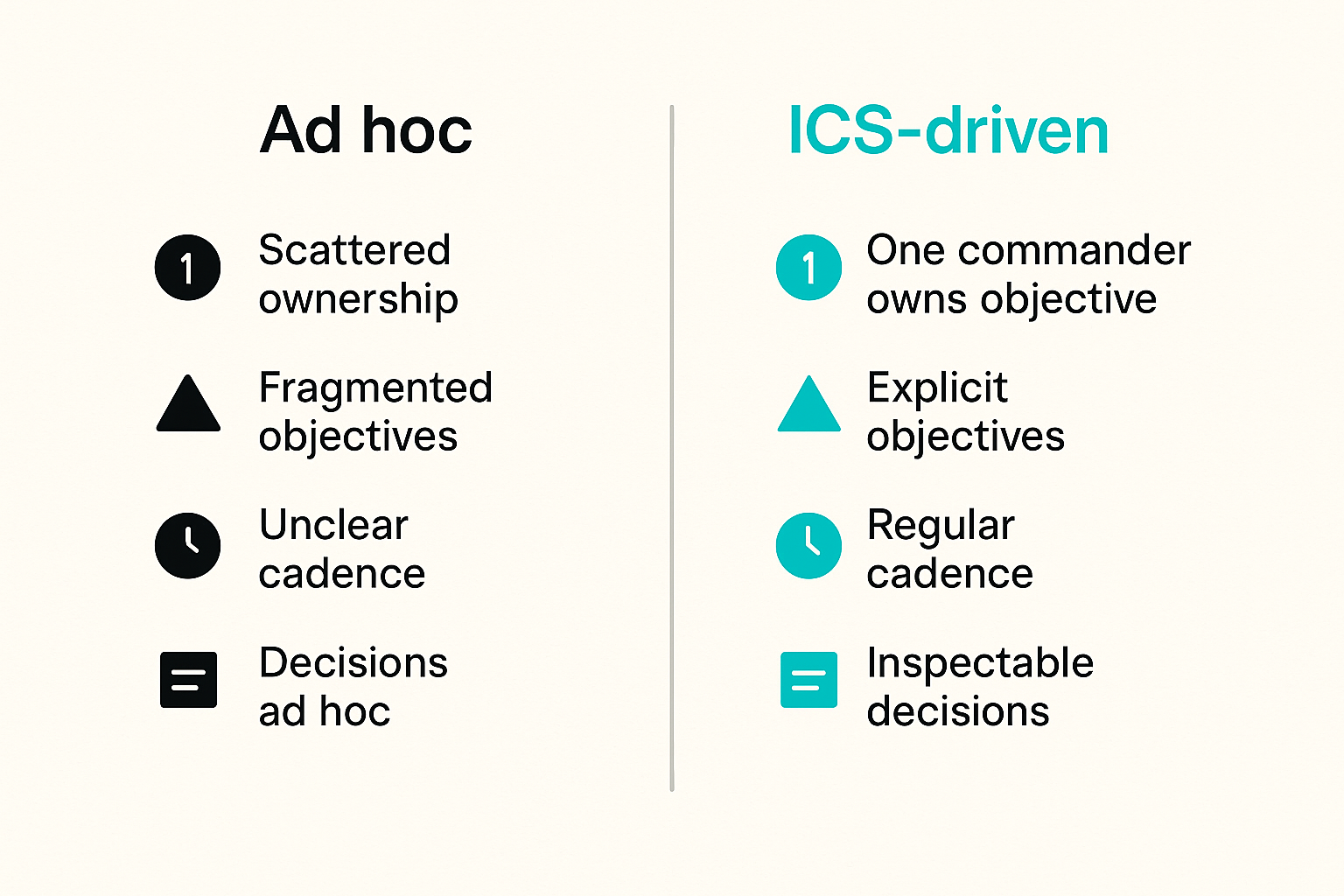
When a SOC adopts ICS well, the day-to-day alert workflow does not become bureaucratic. The incident layer becomes cleaner. Analysts still investigate. Engineers still contain. Managers still communicate. The difference is that response activity is coordinated around explicit incident objectives.
One commander owns the current objective
The incident commander owns the next operational goal, not every keyboard action. Examples:
- Determine whether the attacker has active hands-on-keyboard access.
- Contain all confirmed compromised identities without breaking critical operations.
- Preserve forensic evidence before endpoint reimage.
- Confirm whether customer data was accessed.
Each objective should be short enough to guide the next operating period. If the objective is vague, the work fragments.
Response cadence becomes explicit
Good incident command creates rhythm. For a high-severity incident, that may mean a 15-minute operations sync, a 30-minute stakeholder update, and a written decision log. For a lower-severity incident, it may mean one update per shift.
The cadence matters because status requests are expensive. Every unscheduled update pulls responders out of the work. ICS gives stakeholders a predictable place to get answers.
Decisions become inspectable
Security incidents involve tradeoffs. Isolate a server and you may disrupt revenue. Leave it online and you may give the attacker more time. Force password resets and you may create support load. Wait too long and identity abuse spreads.
ICS does not eliminate judgment. It makes judgment visible. A decision log should capture:
- Decision made.
- Time and owner.
- Evidence available at the time.
- Risk accepted.
- Follow-up action.
That record helps during post-incident review and prevents the same debate from repeating every hour.
Map ICS roles to security operations
The practical question is how to map traditional ICS functions to a SOC without overfitting. The mapping below works for many security teams because it keeps command separate from execution.
| ICS function | SOC equivalent | Primary output | Common mistake |
|---|---|---|---|
| Incident command | Incident commander | Objectives, priorities, escalation | Commander also tries to be lead analyst |
| Operations | IR lead, SOC lead, engineering lead | Containment, eradication, recovery actions | Multiple teams execute without one operations owner |
| Planning | Threat intel, detection, case analyst | Timeline, scope, hypotheses, next questions | Nobody maintains the incident picture |
| Logistics | IT, platform, access, tooling | Accounts, access, systems, vendor coordination | Responders wait on permissions mid-incident |
| Communications | Comms, legal, customer support, leadership liaison | Approved updates and stakeholder routing | Every stakeholder asks analysts directly |
Incident commander
The incident commander should be trained to manage uncertainty. They need enough technical literacy to ask good questions, but they should not disappear into packet captures while the incident loses structure.
A strong commander says things like:
- Current objective is to establish scope across identity and endpoint telemetry.
- Operations owns containment recommendations by 14:30.
- Planning owns a timeline update every 30 minutes.
- Communications will provide executive status at the top of the hour.
Operations lead
Operations turns objectives into action. In a cyber incident, this role may coordinate EDR isolation, firewall blocks, identity revocation, cloud key rotation, mailbox search, or application owner engagement.
Operations should avoid silent hero work. If they take a risky action, the commander needs to know. If containment depends on another team, logistics or liaison needs to unblock it.
Planning and intelligence
Planning is often the missing function in SOC incidents. Analysts investigate, but nobody maintains the consolidated picture. Planning owns the timeline, known affected assets, open hypotheses, evidence gaps, and likely attacker path.
This is where detection engineering and threat intelligence become operational. For a deeper architecture view of connected SOC analysis, ThreatCrush has a guide on threat analysis workflows that actually work that pairs well with an ICS operating model.
Logistics, communications, and liaison
Logistics sounds boring until the incident depends on access to a cloud tenant, a backup console, a SaaS admin panel, or a vendor escalation path. Communications sounds soft until executives start asking different responders for conflicting updates.
Related reading from our network: teams evaluating secure access paths face similar ownership and support tradeoffs in this guide to remote access software architecture.
Build the workflow before the breach
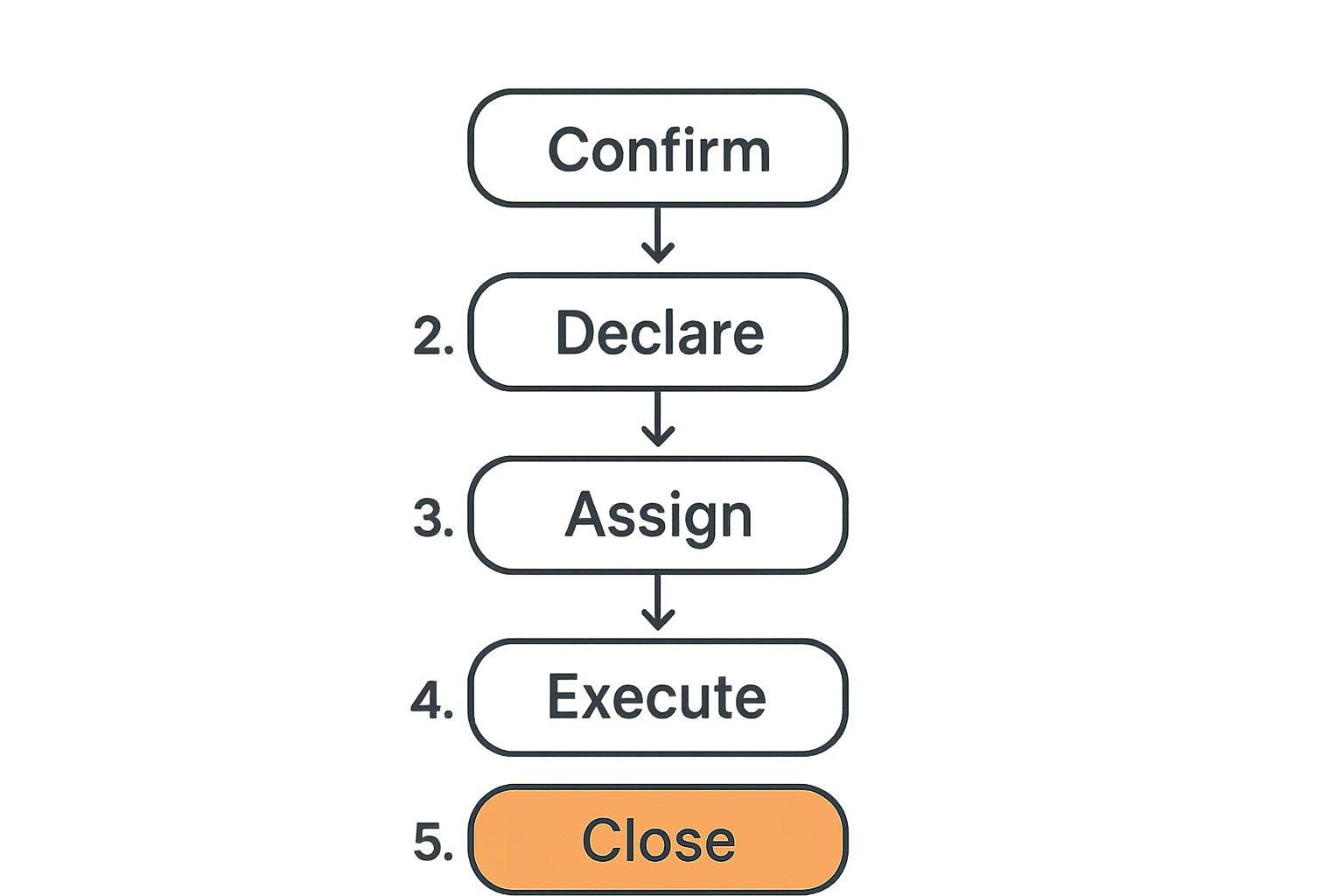
ICS fails when it exists only as a PDF. It works when it is embedded into the normal security operations workflow: alerts, cases, severity, escalation, collaboration, evidence, and review.
Define declaration triggers
A declaration trigger is not just a severity label. It is the condition that moves work from analyst-owned investigation into incident command.
Useful triggers include:
- Confirmed compromise of privileged identity.
- Evidence of lateral movement.
- Active exploitation of an internet-facing asset.
- Malware execution on a critical server.
- Data access by unauthorized actor.
- Multiple related alerts across identity, endpoint, and cloud.
- Threat intelligence match against exposed assets with exploit activity.
Practical rule: Declare early when coordination risk is higher than process overhead. You can always downgrade. You cannot recover lost time easily.
Create delegation rules
Delegation rules prevent the commander from becoming a bottleneck. They define which actions operations can take without additional approval and which require explicit command decision.
Example delegation model:
- Analyst confirms evidence and opens a candidate incident.
- SOC lead validates declaration criteria and assigns an incident commander.
- Commander sets the first objective and names operations, planning, and communications owners.
- Operations executes pre-approved containment actions within the delegated boundary.
- Planning updates scope, timeline, and hypotheses in the case record.
- Commander reviews progress at the next cadence checkpoint and adjusts objectives.
- Communications sends stakeholder updates from the approved source of truth.
This sequence should be practiced before the breach. If nobody has used it during a medium-severity event, it will not work cleanly during a critical one.
Write handoff contracts
A handoff contract defines what one function must provide to another. It keeps incident work from becoming a pile of incomplete asks.
Examples:
- Detection to incident command: alert summary, confidence, affected entities, supporting evidence, suggested severity.
- Command to operations: objective, allowed actions, approval boundary, deadline.
- Operations to planning: actions taken, timestamps, systems touched, residual risk.
- Planning to communications: current facts, unknowns, business impact, confidence level.
Related reading from our network: CI/CD security teams deal with similar gating and ownership issues when they design security license architecture for CI/CD.
Integrate ICS with detection and threat intelligence
The incident command system is not separate from detection. It is the escalation layer that turns detection output into coordinated action.
Alerts need operational context
An alert saying suspicious PowerShell is useful. An alert saying suspicious PowerShell ran on a domain admin workstation that recently authenticated to three critical servers is operationally different.
ICS needs context like:
- Asset criticality.
- Identity privilege.
- Exposure status.
- Known vulnerabilities.
- Threat actor association.
- Prior related alerts.
- Business owner.
- Containment constraints.
Without context, the commander cannot set the right objective. The team either overreacts to noise or underreacts to weak signals that matter.
Threat intelligence should shape objectives
Threat intelligence is often treated as enrichment. In incident command, it should shape the response plan.
If intelligence suggests the activity matches a ransomware affiliate, objectives may prioritize rapid containment and backup validation. If the activity matches credential harvesting, objectives may prioritize identity scope, mailbox rules, OAuth grants, and session revocation. If the exploit is tied to a specific CVE, objectives may prioritize asset exposure and patch status.
This is where proactive and reactive work should connect. Attack surface monitoring, vulnerability tracking, and actor intelligence are not side dashboards. They are inputs into command decisions.
Validation closes the loop
Detection without validation creates confidence problems. Commanders need to know whether actions worked.
Validation questions include:
- Did the containment rule fire on all affected endpoints?
- Did the identity reset revoke active sessions?
- Did the firewall block cover all observed infrastructure?
- Did the detection rule catch the known technique in test data?
- Did vulnerability remediation remove the exploitable path?
Validation should update both the incident record and the detection backlog. If the incident exposed a blind spot, it should not remain tribal knowledge.
Tooling architecture for ICS in the SOC
Tooling does not create command. It either supports command or fragments it. The mistake teams make is assuming a SOAR playbook is the same thing as an incident command system.
Pick a system of record
Every incident needs one authoritative record. It can be a case management platform, SIEM case, ITSM ticket, SOAR case, or dedicated incident management system. The specific tool matters less than the rule: one place owns status, evidence links, decisions, objectives, and handoffs.
If the real incident lives in chat and the ticket is updated afterward, the ticket is not the system of record. It is documentation residue.
A practical case record should include:
- Incident ID and severity.
- Commander and functional owners.
- Current objective.
- Timeline.
- Affected entities.
- Evidence links.
- Decisions and approvals.
- Open questions.
- Communications log.
- Closure criteria.
Automate evidence, not judgment
Automation is useful when it gathers context, normalizes artifacts, opens cases, routes notifications, and executes pre-approved actions. It is dangerous when it hides uncertainty or makes irreversible decisions without command visibility.
Practical rule: Automate repeatable collection and reversible containment first. Keep business-risk decisions inside the command loop.
Good automation examples:
- Pull endpoint process tree and network connections.
- Enrich IPs, domains, hashes, users, and assets.
- Create an incident channel from a declared case.
- Add current vulnerability and exposure context.
- Notify on-call owners based on asset metadata.
- Execute isolation only when severity and approval conditions match.
Design integrations around state
SOC tools should exchange state, not just alerts. State includes declared severity, ownership, objective, affected assets, containment status, and closure criteria.
For example, if EDR isolation completes, the case record should update automatically. If vulnerability status changes, planning should see it. If threat intelligence confidence drops, the objective may need to change.
Related reading from our network: coordination problems are not unique to SOCs; local networks face similar routing and follow-up challenges, described in this piece on community coordination as an operating system.
Metrics that tell you ICS is working
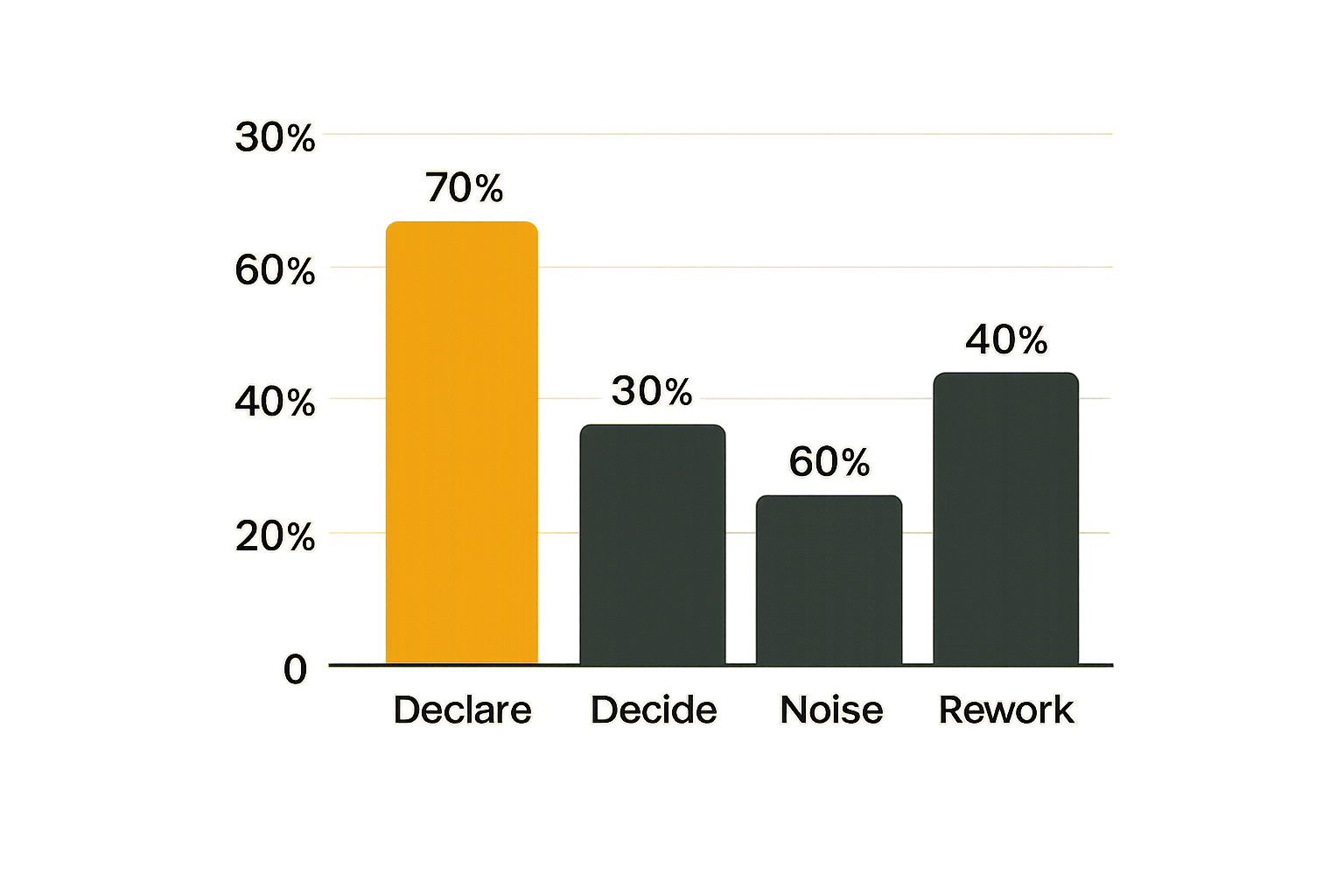
ICS should make incidents more controlled and less chaotic. If you cannot measure that, the process will drift into ceremony.
Time to declare
Time to declare measures how long it takes to move from qualifying evidence to formal incident command. This is not the same as time to detect. Detection may happen quickly while declaration stalls because severity is unclear or ownership is political.
Track:
- First signal time.
- Confirmation time.
- Declaration time.
- Commander assignment time.
Long delays often mean declaration criteria are unclear or analysts fear over-escalation.
Decision latency
Decision latency measures how long risky or cross-functional decisions sit unresolved. Examples include isolating production assets, disabling accounts, blocking external infrastructure, notifying customers, or engaging legal.
If decision latency is high, the issue may not be technical. It may be missing authority, unclear escalation, or lack of pre-approved containment boundaries.
Noise and rework
ICS should reduce noise by giving stakeholders one update path and responders one command structure. Watch for:
- Duplicate investigations.
- Repeated status requests.
- Conflicting containment actions.
- Decisions reopened without new evidence.
- Chat threads that never make it into the case record.
A mature SOC should treat these as operational defects, not personality problems. The broader security operations architecture matters here; ThreatCrush has a practical overview of modern security operations for 2026 that covers SOC workflows, metrics, and tooling maturity.
Common failure modes when teams implement ICS badly
The incident command system can fail in ways that look professional from the outside. The calendar invite exists. The bridge is active. The template is filled out. The incident is still unmanaged.
Role confusion under stress
The most common failure is assigning roles without changing behavior. The commander keeps investigating. Operations waits for permission on every minor step. Planning becomes note-taking instead of analysis. Communications forwards raw technical speculation to stakeholders.
Fix it by writing role outputs, not just role titles. Each role should know what it produces and when.
Too many channels
Multiple channels create multiple truths. One Slack channel has the latest IOCs. Another has executive questions. The SIEM case has old evidence. The ticket has the wrong severity. Email has legal guidance that responders have not seen.
Fix it by defining:
- One command channel.
- One evidence record.
- One stakeholder update path.
- One decision log.
Chat can be fast, but it should not be the only memory of the incident.
Automation without command
SOAR can create a false sense of control. A playbook may isolate a host, block an IP, open a ticket, and notify a channel. That is useful. It is not the same as knowing the objective, blast radius, attacker path, or business risk.
What breaks in practice is that automation handles the first move, then humans argue about the second. ICS provides the structure for the second, third, and fourth move.
What works and what fails in practice
A cyber ICS model should be boring in the best way. It should make incident work predictable enough that responders can spend their attention on the attacker, not the organization.
What works
What works is a small command model used frequently:
- Declare incidents at clear thresholds.
- Assign one commander and visible functional owners.
- Keep objectives short and current.
- Maintain a live timeline and decision log.
- Use automation for enrichment and routing.
- Practice with medium-severity incidents, not only annual tabletops.
- Feed lessons into detection engineering, exposure management, and response playbooks.
What fails
What fails is copying a complex framework without adapting it to SOC reality:
- Too many roles for the size of the incident.
- No commander authority.
- Technical leads overloaded with coordination.
- Case records updated after the fact.
- Stakeholders bypassing communications.
- Automation that cannot represent incident state.
- Post-incident reviews that produce no engineering backlog.
The minimum viable ICS pattern
For most SOCs, the minimum viable pattern is enough:
- Clear declaration criteria.
- Named incident commander.
- Operations owner.
- Planning owner for scope and timeline.
- Communications owner for stakeholders.
- Single system of record.
- Decision log.
- Closure criteria.
That pattern scales down to a small team and scales up when legal, engineering, privacy, executives, and vendors enter the incident.
Where ThreatCrush fits in an ICS-driven SOC
Threat intelligence and exposure context are most useful when they reach the incident command workflow at the moment decisions are being made. A dashboard nobody checks during the incident does not help the commander.
Turn intelligence into response context
ThreatCrush is designed for security operations professionals building and scaling SOC capabilities. In an ICS-driven workflow, that means intelligence should answer operational questions:
- Is this infrastructure associated with known malicious activity?
- Are exposed assets affected by the exploited vulnerability?
- Does actor behavior suggest ransomware, espionage, credential theft, or commodity scanning?
- Which entities need priority investigation?
- Which detections or mitigations should be validated?
The product fit is not replacing your incident commander. It is giving command, planning, and operations better context so they can set better objectives and reduce investigation time.
Connect proactive and reactive work
Many SOCs split proactive and reactive work too cleanly. CTEM, vulnerability management, attack surface monitoring, detection engineering, and incident response live in different queues. During an incident, that separation becomes expensive.
An ICS model benefits from a shared intelligence layer because planning can connect active alerts to known exposures, exploited vulnerabilities, actor patterns, and affected business assets.
Keep the command layer tool-agnostic
The command layer should not depend on one vendor console. Your SIEM, EDR, SOAR, cloud logs, ticketing system, and threat intelligence sources should feed the case record and decision process.
ThreatCrush fits best when it is wired into that architecture as a context and intelligence source, not as another disconnected tab responders must remember to check.
Closing: the incident command system ICS is how SOCs create control
The incident command system ICS is not magic, and it is not a substitute for skilled responders. It is a control model for messy conditions: incomplete evidence, business pressure, tool fragmentation, and attacker movement.
Teams think the problem is writing a better incident response plan. The real problem is building a command workflow that survives contact with production.
Next steps for operators
Start small. Pick one incident class, such as compromised identity or exploited internet-facing asset. Define declaration triggers. Assign roles. Choose the system of record. Write the first objective format. Run it during a real medium-severity event. Then review where command broke.
The practical question is not whether you are compliant with every possible ICS concept. The practical question is whether your SOC can declare, coordinate, decide, communicate, and learn faster than the incident expands.
Try threatcrush.com
ThreatCrush publishes in-depth technical guides for security operations professionals building and scaling SOC capabilities. Try threatcrush.com to connect threat intelligence, vulnerability context, and attack surface monitoring into your SOC workflow.
Try ThreatCrush
Real-time threat intelligence, CTEM, and exposure management — built for security teams that move fast.
Get started →