Incident Command Structure for SOC Teams: A Practical Architecture Guide
Incidents do not usually fall apart because nobody cares. They fall apart because too many people care at the same time, in different tools, with different assumptions about who is making the next decision.
A SOC engineer is in EDR. A detection engineer is checking the SIEM query. IT is asking whether to isolate hosts. Legal wants wording. An executive wants a timeline. Someone creates a bridge. Someone else creates a chat room. Nobody is malicious. The workflow is just undefined.
Teams think the problem is incident command structure. The real problem is decision architecture.
An incident command structure is not a template copied from emergency management and dropped into Slack. For security operations, it is the operating model that decides who declares, who coordinates, who validates evidence, who approves containment, who communicates impact, and who closes the loop into detection engineering. That changes the conversation from roles on paper to work moving through systems.
Table of contents
- Why Incident Command Structure Fails in the SOC
- Start With Decision Rights, Not Titles
- Build the Incident Lifecycle Around Command
- Map Roles to Systems and Evidence
- A Practical Workflow for Activating Incident Command
- What Works and What Fails
- Metrics That Show Whether Command Is Helping
- Integrating Incident Command With Detection Engineering
- Adapting the Structure for Small, Distributed, and Hybrid Teams
- Bringing Incident Command Structure into ThreatCrush Workflows
Why Incident Command Structure Fails in the SOC
The chart is not the workflow
The mistake teams make is treating incident command structure as an org chart. They name an incident commander, a technical lead, a communications lead, and maybe a scribe. Then they assume the hard part is solved.
It is not solved. It is only labeled.
What breaks in practice is the transition between alert triage and coordinated response. The SOC receives a high-confidence alert. The analyst enriches it. The responder starts containment. The infrastructure owner asks for proof. The business owner asks whether customers are affected. The commander, if there is one, is pulled into evidence review instead of command.
A useful way to think about it is this: command is the control plane for incident response. It does not replace the data plane of logs, alerts, endpoint telemetry, packet data, cases, and tickets. It governs how decisions are made from that data.
Practical rule: If your incident commander has to discover the current state by reading five tools and scrolling chat, you do not have command. You have a meeting with better branding.
Why now: faster alerts, slower decisions
Security teams have improved detection speed. EDR alerts faster. SIEM correlation is better. Cloud logs are broader. Threat intelligence arrives continuously. Automation can open cases, enrich indicators, and page responders in seconds.
But decision speed has not improved at the same rate. In many SOCs, the time from alert to declaration is short, while the time from declaration to confident containment is still messy. That gap is where command structure matters.
The practical question is not whether you have an incident commander. The practical question is whether a critical incident can move from signal to decision without losing context, ownership, or evidence integrity.
The practical definition that matters
For SOC teams, an incident command structure is a repeatable operating model for assigning authority, coordinating technical work, preserving evidence, managing communications, and validating recovery during security incidents.
That definition matters because it keeps the structure tied to work. It also prevents command theater, where everyone joins a bridge but nobody owns the next decision.
The structure should answer:
- Who can declare severity?
- Who can approve containment actions that affect production?
- Who owns the canonical timeline?
- Who communicates business impact?
- Who validates that the threat is contained?
- Who converts incident findings into detection and control improvements?
If those questions are not answered before the incident, they will be negotiated during the incident. That is expensive time.
Start With Decision Rights, Not Titles
The three decisions every incident needs
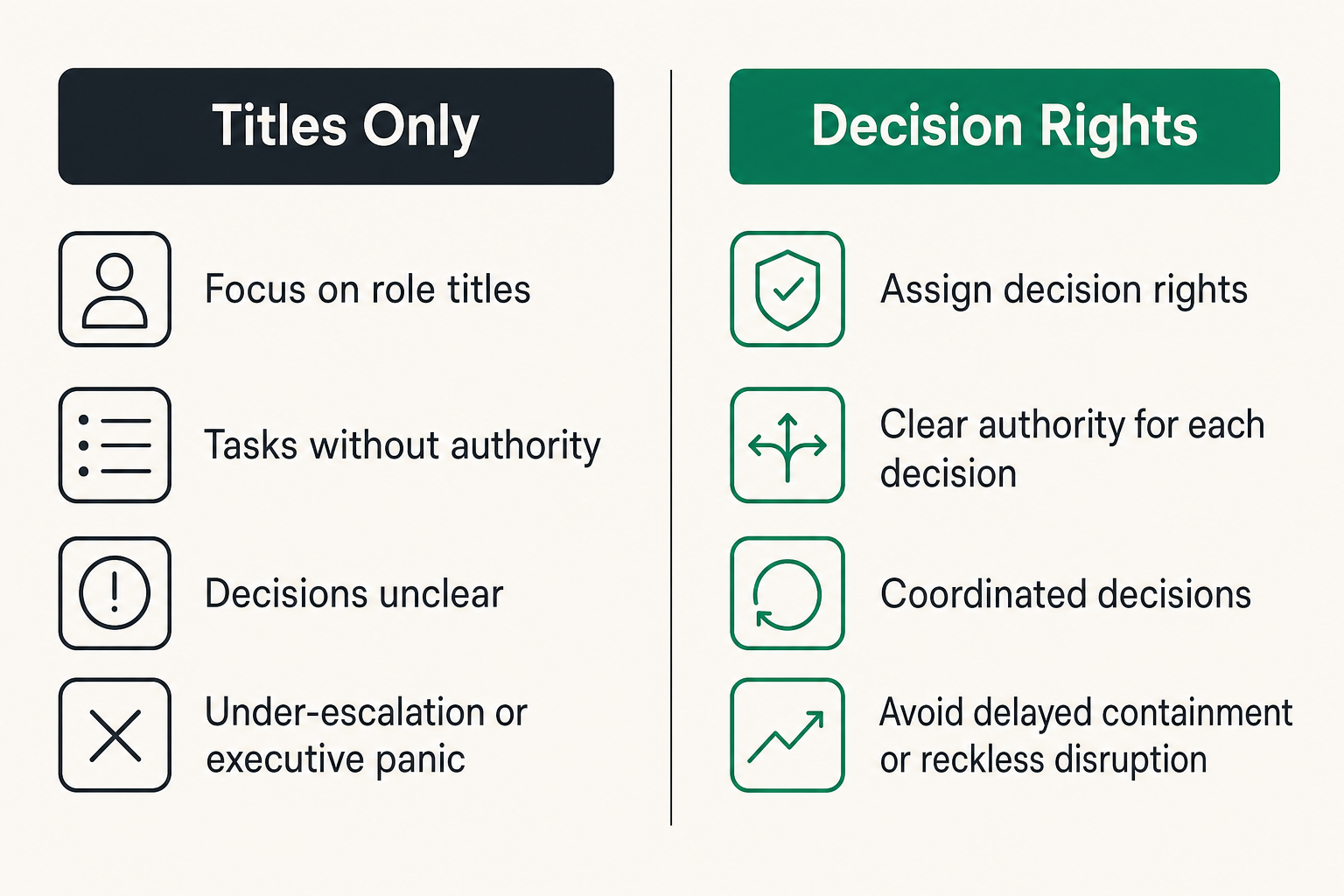
Incident response has many tasks, but command needs clear ownership for three decision categories.
| Decision category | Common question | Owner pattern | What fails if unclear |
|---|---|---|---|
| Severity and scope | Is this a Sev 1 or Sev 2? | Incident commander with technical input | Under-escalation or executive panic |
| Technical action | Do we isolate, block, rotate, revoke, or monitor? | Technical lead with system owner approval rules | Delayed containment or reckless disruption |
| External and internal messaging | What do we say, to whom, and when? | Communications lead with legal or leadership input | Conflicting updates and loss of trust |
The names matter less than the decision rights. Some teams call the top role incident commander. Others call it incident lead, response coordinator, or major incident manager. Fine. The label is secondary. Authority is primary.
Practical rule: Do not assign roles unless you also assign the decisions each role is allowed to make.
Commander, technical lead, and communications lead
A minimal structure for most SOCs has three core roles.
The incident commander owns coordination, severity, cadence, escalation, and final decision routing. The commander should not be the deepest packet analyst on the bridge. If the commander is doing forensic analysis, nobody is commanding.
The technical lead owns investigation direction. This person decides which evidence matters, which hypotheses are active, which response actions are technically sound, and what validation is required before declaring containment.
The communications lead owns updates. That includes internal leadership updates, customer-facing language if needed, regulator or legal routing where appropriate, and status summaries for teams not living in the incident channel.
In smaller teams, one person may hold two roles briefly. But the responsibilities should still be separate in the workflow.
When one person holds multiple roles
Small SOCs often do not have enough people for a textbook structure. That is normal. The mistake is pretending the structure does not apply because the team is small.
If one responder is both commander and technical lead, write it down in the case. If the on-call manager is both commander and communications lead, define when to split those roles as severity increases. If a managed service provider is handling triage, define whether they can declare an incident or only recommend declaration.
The structure should degrade gracefully. It should not depend on a perfect staffing model.
Build the Incident Lifecycle Around Command
Intake and severity declaration
The incident command structure starts before a war room. It starts at intake.
A SOC alert becomes a candidate incident when it crosses defined thresholds: credible evidence of compromise, material business risk, active attacker behavior, sensitive data exposure, privileged account misuse, destructive activity, or broad operational impact.
Severity declaration should use a small number of clear inputs:
- Asset criticality
- Confirmed attacker activity
- Identity privilege involved
- Data sensitivity
- Blast radius
- Business disruption
- Regulatory or contractual exposure
The mistake teams make is writing severity criteria but not assigning who can apply them. A severity matrix without authority is documentation, not operations.
Stabilization and containment
Once declared, the first command objective is stabilization. The team needs to prevent the incident from expanding while preserving enough evidence to understand what happened.
Containment decisions should be pre-modeled. For example:
- Endpoint isolation can be approved by the technical lead for user workstations.
- Server isolation requires service owner approval unless destructive activity is active.
- Credential revocation for suspected compromised accounts can be executed immediately for non-service accounts.
- Service account rotation requires a named owner and fallback plan.
- Network blocks can be applied at edge controls if the indicator confidence is high and business impact is low.
These rules reduce debate during pressure. They also prevent over-automation. Not every high-severity alert should trigger isolation, but every high-severity incident should have a known path to decide isolation.
Recovery, evidence, and post-incident work
Recovery is not just restoring systems. It is proving that attacker access has been removed, persistence has been addressed, affected identities have been handled, and monitoring has been increased where risk remains.
The commander should keep recovery separate from closure. A system can be back online before the incident is closed. Users can be functional before root cause is understood. Executives can receive a stable update before detection gaps are fixed.
Post-incident work should include control changes, detection updates, evidence retention, and ownership of longer-term remediation. If those items are left as vague action items, the same class of incident will return.
For a broader operating model around SOC maturity, tooling, and workflow design, our guide to security operations in 2026 covers the surrounding architecture that incident command depends on.
Map Roles to Systems and Evidence
SIEM, EDR, SOAR, ticketing, and chat ownership
Command fails when the official truth is spread across too many places. Most SOCs have at least five active surfaces during a serious incident: SIEM, EDR, SOAR or automation, ticketing or case management, and chat.
Each system needs an owner during the incident.
| System | Primary purpose during incident | Command ownership question |
|---|---|---|
| SIEM | Correlate logs and build timeline | Who validates queries and exports evidence? |
| EDR | Endpoint state and response actions | Who approves isolation, collection, and remediation? |
| SOAR | Enrichment and workflow automation | Who can trigger playbooks and override failures? |
| Ticket or case | Canonical record | Who maintains status, severity, and assignments? |
| Chat or bridge | Coordination | Who summarizes decisions and prevents side-channel drift? |
The case should be the canonical record. Chat is useful for coordination, but it is a bad long-term evidence system. Threads get lost. Reactions are ambiguous. People join late and miss context.
Evidence custody and timeline discipline
The incident commander does not need to personally collect every artifact, but command needs evidence discipline. That means a known process for preserving logs, endpoint collections, memory captures where appropriate, cloud audit trails, identity events, firewall decisions, and communications.
A simple timeline format works better than a perfect but unused forensic notebook:
2026-08-14T09:12Z  Alert fired: suspicious OAuth consent grant for user@example.com
2026-08-14T09:18Z  Analyst confirmed consent from unknown ASN
2026-08-14T09:25Z  Incident declared Sev 2 by incident commander
2026-08-14T09:31Z  Token revoked; user session invalidated
2026-08-14T09:44Z  Search started for same app ID across tenant
The timeline should capture decisions, not just observations. If the team chooses not to isolate a server, write down why. If a risky action is approved because customer impact is already occurring, write down who approved it.
Related reading from our network: teams designing payment systems face a similar state and reconciliation problem, and this guide to solution peptides payment architecture is a useful adjacent example of why UI events are not the system of record.
Threat intelligence as command context
Threat intelligence should support command decisions, not decorate the incident report. During response, intelligence is useful when it changes prioritization, containment, or hunting scope.
Examples:
- An IP indicator is tied to commodity scanning. Lower confidence for host isolation.
- A domain is associated with an active phishing kit targeting your industry. Expand mailbox and identity hunting.
- A malware family commonly uses scheduled tasks for persistence. Add specific endpoint checks before recovery.
- A vulnerability is being exploited in the wild. Raise severity for exposed systems even before confirmed lateral movement.
Good command turns intelligence into operational context. Bad command pastes threat actor names into updates before evidence supports it.
A Practical Workflow for Activating Incident Command
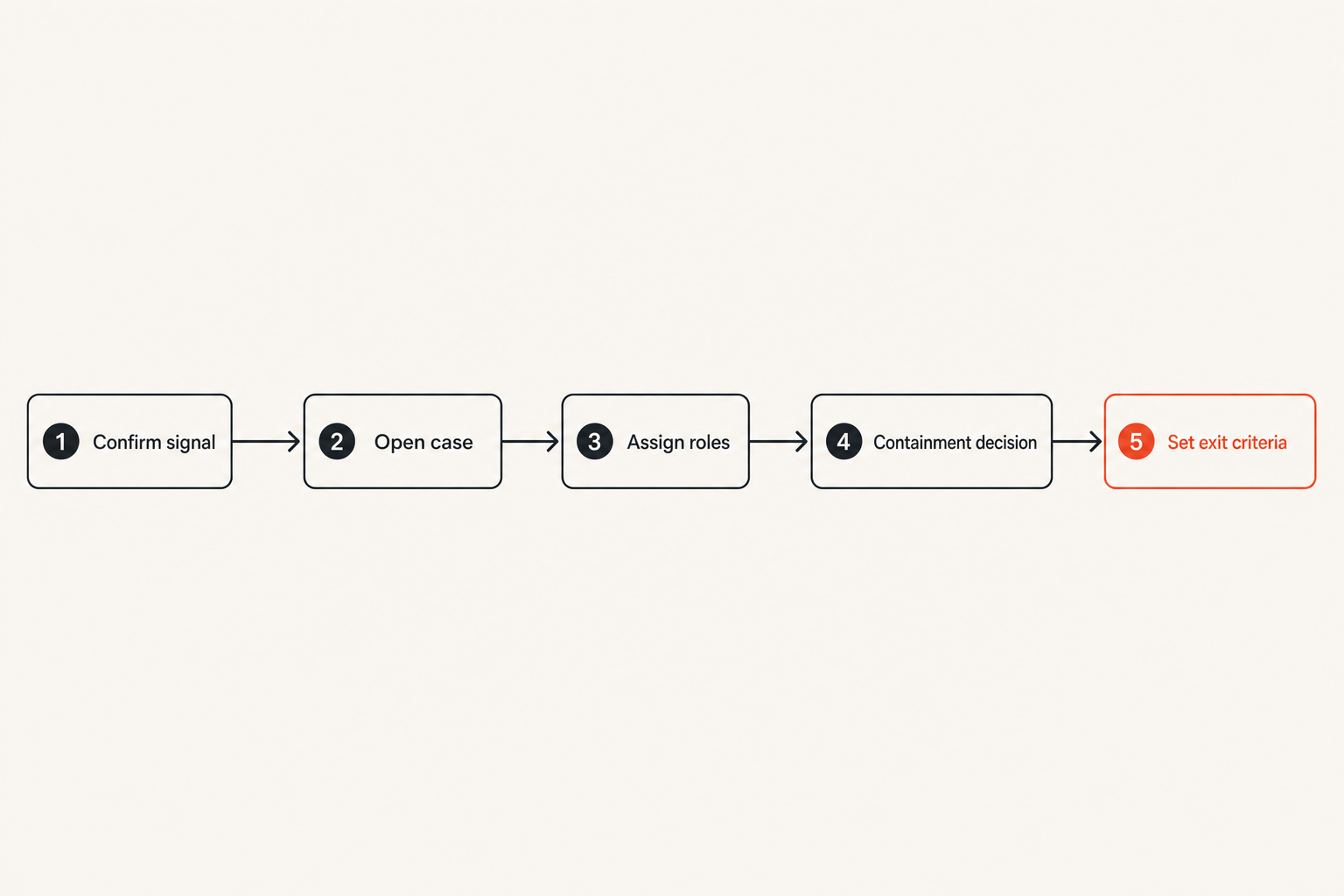
Step-by-step activation sequence
The practical question is how to activate command without creating ceremony. Here is a workflow that works for many SOCs.
- Confirm the signal threshold. The triage analyst validates that the alert is not obviously false positive and meets candidate incident criteria.
- Open or promote the case. The case becomes the canonical record and receives severity, owner, affected assets, and initial hypothesis.
- Assign command roles. Name the incident commander, technical lead, communications lead, and scribe if separate.
- Establish the coordination channel. Create the bridge or incident room, link it from the case, and pin current state.
- Declare decision cadence. Set update intervals, decision checkpoints, and escalation triggers.
- Execute first containment decision. Approve, reject, or defer the first response action with rationale.
- Start the timeline. Record key observations, actions, owners, and decisions in the case.
- Define exit criteria. State what must be true to move from active containment to recovery.
This sequence is intentionally boring. Boring is good during incidents.
Practical rule: The first ten minutes of command should create ownership, state, and cadence. If it creates a long meeting instead, redesign it.
What should be automated
Automation should prepare command, not replace it.
Good automation includes:
- Creating the incident case from a qualifying alert
- Pulling asset criticality and owner data
- Enriching indicators with confidence and first-seen data
- Creating an incident channel with a pinned summary
- Assigning default roles based on schedule and severity
- Starting evidence preservation playbooks
- Posting runbook links and containment options
Automation should also fail visibly. If enrichment times out, the case should show that enrichment failed. Silent automation failure creates false confidence.
What must stay human
Human judgment is still required for severity, containment risk, business impact, communication timing, and closure confidence.
The technical lead can use automation to collect process trees. The commander still needs a human decision about whether isolation will create unacceptable production impact. The communications lead can use templates. A human still needs to decide whether the template reflects what is known.
The goal is not full autonomy. The goal is faster, cleaner decisions with better context.
What Works and What Fails
What works in production
What works is a small structure that is easy to activate and hard to misunderstand.
Effective teams usually have:
- A severity model tied to authority
- A commander who is not buried in technical analysis
- A technical lead who owns hypotheses and validation
- A communications lead who prevents update chaos
- A single case record for decisions and evidence
- Pre-approved containment rules for common scenarios
- Clear handoff rules for shift changes
- Post-incident conversion into detections and controls
The structure should fit the team. A 12-person SOC and a two-person security team do not need the same staffing model. They do need the same clarity about decisions.
What fails under pressure
What fails is anything that requires people to remember a complex process while stressed.
Common failures include:
- Role names with no authority behind them
- Multiple incident channels with different facts
- Leaders asking for updates directly from analysts instead of through command
- Containment playbooks that ignore business impact
- Evidence scattered across screenshots and chat messages
- No shift handoff summary
- Closing the incident when systems recover, not when access is removed
- Postmortems that list lessons but assign no engineering work
The worst version is the incident bridge where everyone is present but nobody is accountable. It feels busy. It does not move work.
The failure modes operators should test
Do not test incident command only during annual tabletop exercises. Test the parts that break.
Run focused drills:
- Commander unavailable during escalation
- EDR isolation fails for a critical host
- Cloud logs delayed by ingestion lag
- Executive asks for customer impact before scope is known
- Legal asks for evidence preservation after remediation has started
- Third-party provider owns the affected system
- Two simultaneous incidents compete for the same responders
A useful way to think about it is chaos engineering for coordination. You are not trying to embarrass the team. You are finding the places where the workflow depends on luck.
Metrics That Show Whether Command Is Helping
Decision latency
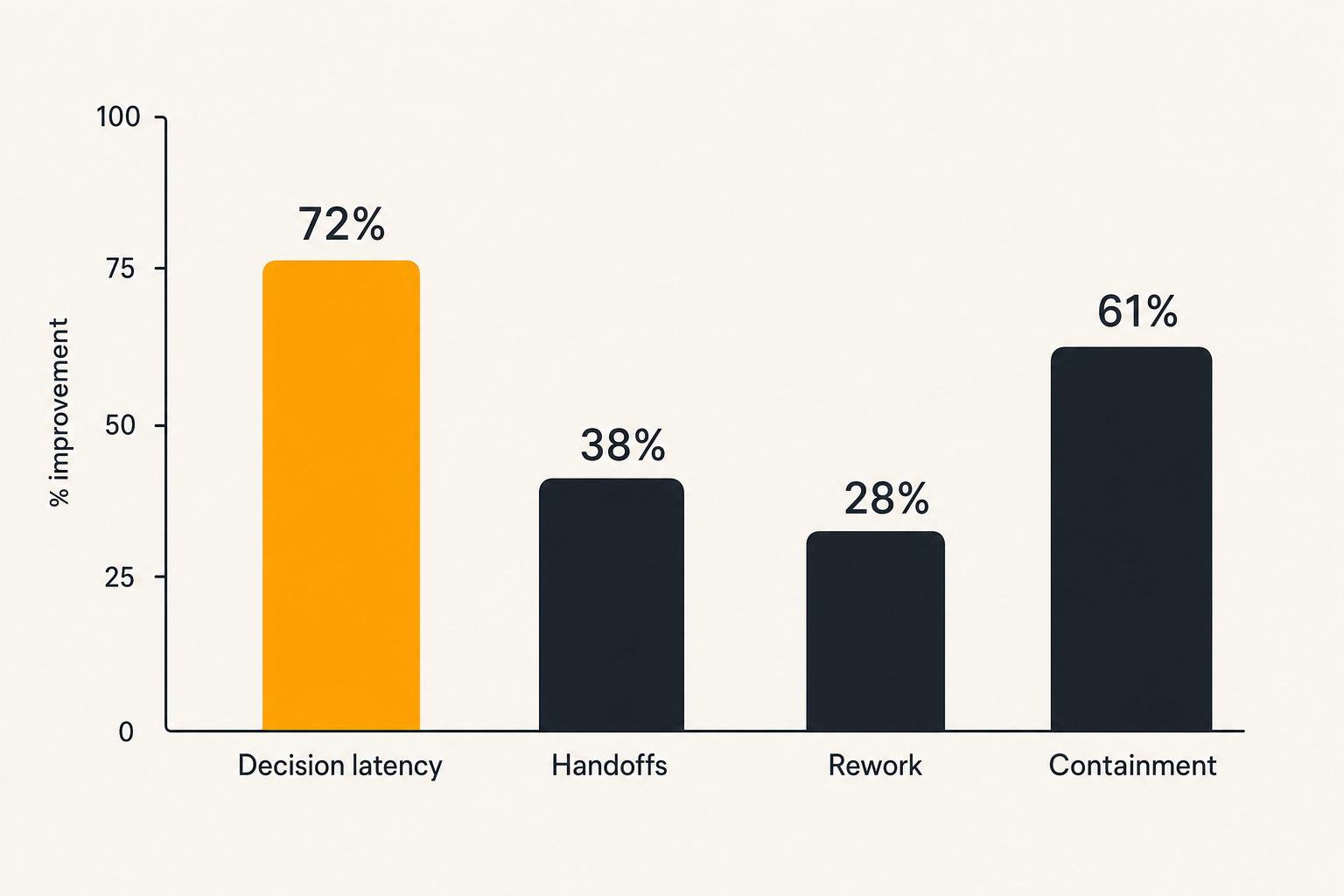
If incident command structure is working, decision latency should improve. Measure the time between key events:
- Alert fired to incident declared
- Incident declared to commander assigned
- Commander assigned to first containment decision
- Containment decision to action executed
- Action executed to validation completed
Do not obsess over a single average. Look for stuck states. If cases sit for 40 minutes between declaration and first containment decision, the problem is probably authority or missing context.
Handoff count and rework
Handoffs are not bad. Uncontrolled handoffs are bad.
Track how many times ownership changes and how often work is repeated because context was not preserved. Re-running the same SIEM search after every shift change is a command failure. Asking three teams whether the same asset is production is a command failure. Recreating an executive summary from chat because nobody updated the case is a command failure.
Good command reduces rework because it keeps state visible.
Containment confidence
Containment confidence is the degree to which the team can explain why attacker access is removed or reduced. It is not a vanity metric. It is a closure requirement.
Useful containment confidence questions:
- Which accounts, hosts, workloads, or tokens were affected?
- Which persistence mechanisms were checked?
- Which indicators were blocked or monitored?
- Which detections were added or tuned?
- Which assets remain at elevated risk?
- What evidence supports closure?
If the team cannot answer those questions, the incident may be stable, but command should not treat it as closed.
Integrating Incident Command With Detection Engineering
Feedback loops from incidents to detections
Incident command should produce better detections. If it does not, the SOC is losing value after every incident.
The technical lead should identify detection gaps while the incident is still fresh. Did the alert fire too late? Did enrichment miss asset context? Did a noisy rule hide the signal? Did the team lack coverage for identity abuse, cloud control plane changes, lateral movement, or data exfiltration?
Those findings should become detection engineering tasks with owners and due dates. For a deeper architecture view of connected analysis, see our guide to threat analysis workflows that actually work.
Runbooks as detection contracts
A runbook is not just a checklist for responders. It is a contract between detection engineering and incident response.
A good detection should tell responders:
- Why this alert matters
- What evidence supports it
- What false positives are common
- What asset or identity context is required
- What first actions are safe
- When to declare an incident
- Which command roles should be paged
If a detection cannot support a response decision, it is not operationally complete. It may still be a useful signal, but it should not pretend to be incident-ready.
Related reading from our network: supply chain defense has the same problem of connecting signals to response, and this piece on the SimpliSafe security system model for CI/CD and supply chain defense is a useful adjacent comparison.
Validation after response
Validation is where many teams underinvest. They block an indicator, isolate a host, reset a password, and move on. Command should require proof that the action worked.
Examples:
- After token revocation, confirm no new sessions from the same app or ASN.
- After endpoint isolation, confirm no lateral authentication from that host.
- After firewall block, confirm traffic is denied at the expected control point.
- After detection tuning, replay known event samples or run controlled tests.
- After credential rotation, confirm dependent services are healthy.
This is where proactive and reactive work connect. Incident command gives detection engineers the operational feedback they need, and detection engineering gives commanders better evidence during the next incident.
Adapting the Structure for Small, Distributed, and Hybrid Teams
Small SOCs and on-call teams
Small teams should not copy the staffing chart of a Fortune 100 SOC. They should copy the decision clarity.
A small on-call model might define:
- Primary responder acts as technical lead until escalation.
- Security manager acts as incident commander for Sev 1 and Sev 2.
- Engineering manager approves production containment actions.
- Communications owner is paged only for business impact.
- MSP or MDR provider can recommend declaration but cannot approve disruptive actions.
This is enough structure to prevent improvisation without adding heavy process.
Distributed engineering and business stakeholders
Distributed teams need extra discipline because side channels multiply. People wake up in different time zones, read partial context, and ask reasonable questions that create duplicate work.
Command should publish a pinned summary with current state, next decision, owner, and update time. Keep it short.
Status: Active Sev 2 identity incident
Current scope: 3 users, 1 suspicious OAuth app, no confirmed data access
Next decision: Revoke app tenant-wide or limit to affected users
Owner: Incident commander
Next update: 15:30 UTC
That single summary reduces noise. It gives late joiners a place to start. It also protects analysts from answering the same question repeatedly.
Related reading from our network: local coordination has similar routing and trust problems, and this guide to a local community network consultant operating model is a useful non-security analogy for keeping asks, owners, and follow-up durable.
Third parties, legal, and executives
Third parties complicate incident command because they often control systems, logs, or customer relationships. Define their role before an incident.
Ask:
- Can the vendor execute containment without your approval?
- What logs are available and how quickly?
- Who joins the bridge during a major incident?
- What contractual notification windows apply?
- Who approves customer or regulator communications?
- How is evidence transferred and retained?
Executives and legal should not be treated as distractions. They are stakeholders with legitimate responsibilities. The problem is when they bypass command and pull responders into ad hoc updates. Route them through the communications lead and a predictable cadence.
Bringing Incident Command Structure into ThreatCrush Workflows
Product fit: context before coordination
Incident command structure only works when responders have context they can trust. If the commander has severity but no asset priority, or indicators but no confidence, or vulnerabilities but no exploit context, coordination becomes guesswork.
This is where threat intelligence, vulnerability tracking, attack surface monitoring, and operational context need to meet the incident workflow. The point is not another dashboard. The point is better command decisions.
For SOC teams, the product-fit question is architectural:
- Can threat context be attached to cases automatically?
- Can asset exposure change severity decisions?
- Can known attacker infrastructure guide hunting scope?
- Can vulnerability exploitation context change containment priority?
- Can intelligence updates reopen or escalate active cases?
ThreatCrush is built for security operations professionals building and scaling SOC capabilities. In an incident command model, that means giving responders fresher context before the bridge fills with questions.
Implementation checklist
Use this checklist to implement or repair your incident command structure.
- Define incident declaration thresholds in plain operational language.
- Assign decision rights for severity, containment, communications, and closure.
- Create a minimal role model: commander, technical lead, communications lead, and scribe where needed.
- Make the case record the canonical source of truth.
- Map every major tool to an owner during incidents.
- Pre-approve containment paths for common scenarios.
- Automate case creation, enrichment, channel creation, and evidence collection where safe.
- Keep human approval for business-impacting containment and external messaging.
- Measure decision latency, handoffs, rework, and containment confidence.
- Convert incident findings into detection engineering and control work.
- Test the failure modes, not just the happy path.
The mistake teams make is waiting for a major incident to discover that their structure is theoretical. Build the command workflow now, while nobody is trying to make a production containment decision at 02:00.
Incident command structure is not bureaucracy when it is designed well. It is how a SOC turns signals into decisions, decisions into actions, and actions into validated recovery.
Try threatcrush.com
ThreatCrush helps security operations professionals build and scale SOC capabilities with real-time threat intelligence, vulnerability tracking, attack surface monitoring, and threat actor context. Try threatcrush.com and make incident command structure easier to operate when the next incident lands.
Try ThreatCrush
Real-time threat intelligence, CTEM, and exposure management — built for security teams that move fast.
Get started →