Identity and Access Management for Cloud Security: A SOC Architecture Guide

Cloud incidents rarely start with a cinematic exploit chain. In production, they often start with a stale access key, an overpowered service account, a risky trust policy, or a legitimate user session that no one can explain.
Teams think the problem is identity and access management for cloud security as a control-plane hygiene project. The real problem is that identity has become the routing layer for attack paths, detections, response actions, and business risk.
That changes the conversation. IAM is not just something the platform team configures and the auditor reviews once a quarter. It is a live security operations system. If the SOC cannot understand who can do what, from where, under which conditions, and with what blast radius, cloud detection becomes guesswork.
The practical question is not “Do we have IAM?” Everyone does. The practical question is whether identity signals are connected to cloud telemetry, threat intelligence, asset context, exposure management, and incident response decisions quickly enough to matter.
Table of contents
- Why IAM is now a SOC problem
- Map cloud identities before tuning detections
- Turn IAM telemetry into security signals
- Build detection logic around behavior and blast radius
- Design the IAM investigation workflow
- Response automation without locking out the business
- Common IAM failure modes in cloud security
- What works versus what fails
- Implementation plan for 2026 SOC teams
- Bringing identity signals into ThreatCrush workflows
Why IAM is now a SOC problem
Identity became the cloud perimeter
In cloud environments, the control plane is the attack surface. An attacker who can assume a role, create an access key, modify a policy, or attach a permission boundary can often move faster than a network-based detection stack can explain.
This is why identity and access management for cloud security has to be treated as operational architecture. It sits between authentication, authorization, workload execution, infrastructure deployment, logging, incident response, and compliance. A single identity event may be benign in isolation and critical when combined with a new IP, suspicious API sequence, fresh credential, exposed workload, or known exploited service.
The old perimeter model asked, “Did something connect to the environment?” The cloud IAM model asks, “Was this principal allowed to change the environment, and should it have been?” That is a harder question, but it is also a better one.
The mistake teams make
The mistake teams make is treating IAM as a static configuration project. They run a permissions review, remove a few obvious admin grants, enable MFA for human users, and call the program mature.
What breaks in practice is drift. New workloads appear. CI/CD systems get broader deployment rights. Temporary access becomes permanent. Incident response roles accumulate permissions. Vendors get trusted access across accounts. Developers copy policies from old projects because deployment needs to work by Friday.
None of that is unusual. The failure is not that change happens. The failure is that the SOC has no living model of that change.
Practical rule: If an IAM change can alter blast radius, it belongs in the SOC’s detection and investigation workflow, not only in a quarterly access review.
What SOC ownership should mean
SOC ownership does not mean the SOC should administer every cloud policy. Platform, identity, and engineering teams still own design and implementation. SOC ownership means security operations can see, reason about, alert on, and respond to identity risk in operational time.
A useful way to think about it is separation of duties:
- Platform teams define identity patterns and deployment guardrails.
- Identity teams manage authentication, federation, lifecycle, and access governance.
- Engineering teams own workload identities and service behavior.
- SOC teams monitor identity abuse, investigate anomalies, and drive containment.
- Security architecture validates that the model reduces attack paths instead of just satisfying policy text.
When those boundaries are clear, IAM becomes a shared control system instead of a blame surface.
Map cloud identities before tuning detections
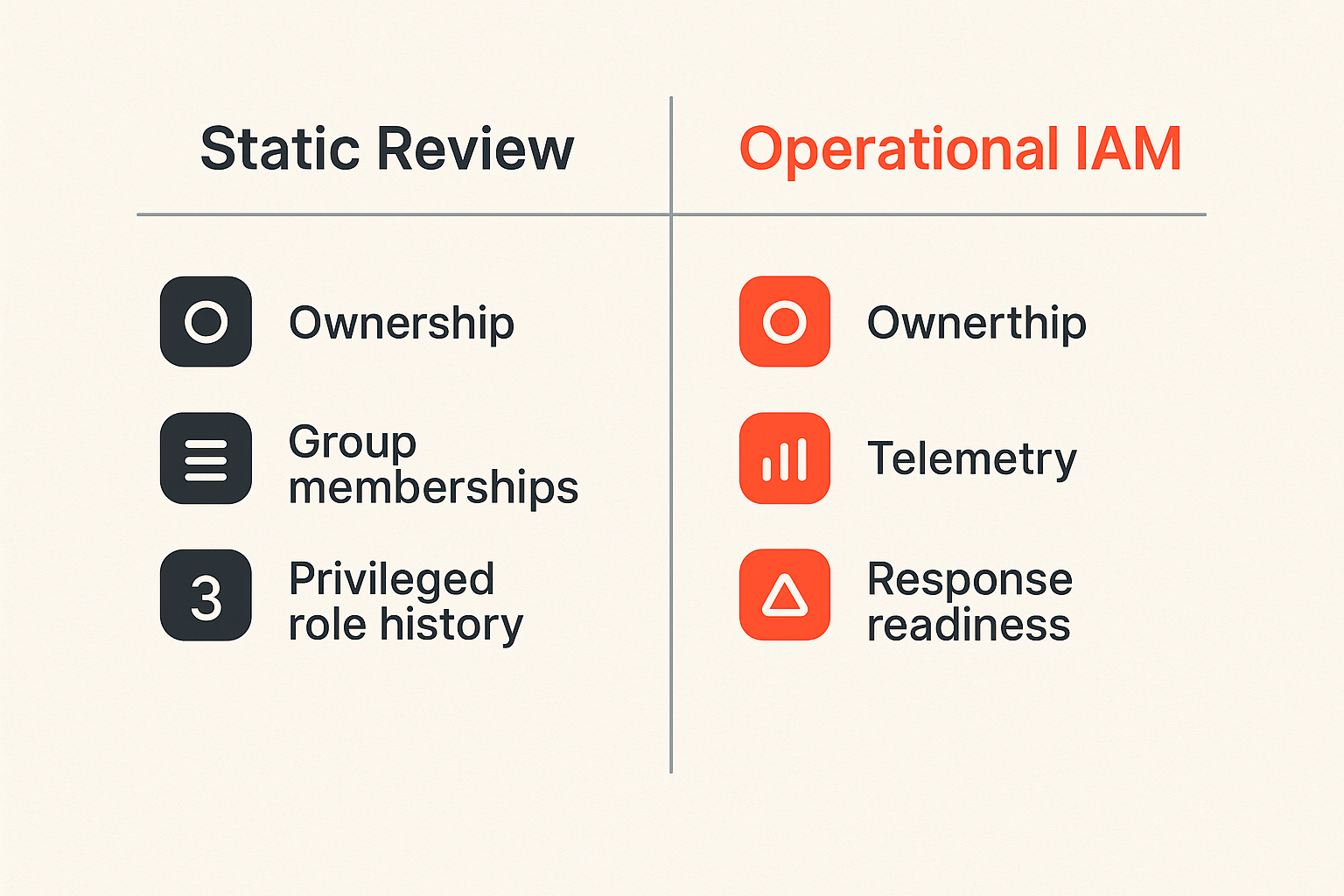
Human identities
Human users are the easiest category to understand and the easiest category to over-focus on. Yes, MFA, conditional access, SSO, and joiner-mover-leaver workflows matter. But in many cloud incidents, human access is only the first hop.
For SOC workflows, the minimum map for human identities should include:
- User identity and source identity provider.
- Group and role memberships.
- Privileged role eligibility and activation history.
- Recent authentication context: device, geography, network, session age.
- Administrative actions performed in the cloud control plane.
- Linked break-glass or emergency access paths.
The goal is not to build a perfect org chart. The goal is to answer whether the person, session, role, and action make sense together.
Workload and service identities
Workload identities are where many teams lose visibility. Service accounts, managed identities, instance profiles, Kubernetes service accounts, CI/CD deploy keys, and automation roles often have broad permissions because they need to make systems work.
That is understandable. It is also dangerous.
A workload identity should have an owner, a purpose, an expected execution environment, an expected permission set, and an expected behavior pattern. If a role normally reads a storage bucket from a build runner and suddenly enumerates secrets from an unfamiliar region, the SOC should not need three teams and two days to identify whether it matters.
For detection engineers, workload identities require a different baseline than humans. You are not looking for impossible travel. You are looking for new API families, unusual resource scope, new network egress, privilege escalation calls, and deviations from deployment windows.
Federation and trust relationships
Federation is where IAM becomes graph-shaped. A cloud account may trust an identity provider, another cloud account, a vendor account, a CI/CD system, or an external role assumption path. Each relationship may be valid. Each one also expands the paths an attacker can use.
The practical question is: “What identities can become other identities?”
That means tracking:
- SAML and OIDC providers.
- Cross-account role trusts.
- External IDs and vendor assumptions.
- CI/CD identity federation.
- Kubernetes-to-cloud identity mappings.
- Conditional trust requirements.
This mapping does not need to start fancy. A simple graph of principal, trusted entity, allowed action, condition, owner, and last-used timestamp is enough to expose most obvious failure modes.
Turn IAM telemetry into security signals
Control-plane logs are not enough
Cloud control-plane logs are necessary, but they are not sufficient. They tell you what API action occurred. They may not tell you whether the identity was expected to do it, whether the resource was sensitive, whether the source was trustworthy, or whether the action completed a known attack path.
For practical cloud detection, IAM telemetry should be joined with:
- Identity provider sign-in logs.
- Endpoint and device posture where humans are involved.
- Cloud asset inventory and tags.
- Vulnerability and exposure context.
- Network telemetry and egress patterns.
- Secrets management activity.
- CI/CD pipeline events.
- Threat intelligence for IPs, domains, infrastructure, and actor tradecraft.
If you want a broader model for connecting these steps, the ThreatCrush guide to threat analysis workflows that actually work is useful because IAM alerts fail for the same reason many SOC workflows fail: the signal is present, but the context is somewhere else.
Normalize the minimum useful fields
Normalization sounds boring until an incident depends on it. If one cloud provider calls it a principal, another calls it an actor, and your identity provider calls it a subject, your investigation slows down.
At minimum, normalize these fields across IAM events:
identity_event:
  timestamp: "2026-06-01T12:00:00Z"
  cloud_provider: "aws|azure|gcp|other"
  account_or_tenant: "production-payments"
  principal_id: "role/app-deploy-prod"
  principal_type: "human|workload|vendor|service"
  source_identity: "user@example.com"
  action: "AssumeRole|CreateAccessKey|SetIamPolicy"
  target_resource: "resource identifier"
  source_ip: "203.0.113.10"
  user_agent: "cli|sdk|browser|automation"
  auth_context: "mfa|federated|key|token"
  result: "success|failure"
  owner: "team or service owner"
  sensitivity: "low|medium|high|critical"
You do not need a perfect schema on day one. You need enough consistency that detections, searches, and playbooks do not break every time a provider changes terminology.
Separate policy change from privilege use
Policy changes and privilege use are different signal types.
A policy change tells you the attack surface changed. Privilege use tells you someone acted inside that surface. If you alert on both the same way, analysts drown in noise or miss the important sequence.
Examples:
- A role gaining
secretsmanager:GetSecretValueis an exposure event. - That same role reading a production secret at 03:00 from a new source is a behavior event.
- A user attaching an admin policy is a control-plane change.
- That user creating new access keys afterward is escalation plus persistence.
Practical rule: Treat IAM policy changes as exposure signals and privilege use as behavior signals. The highest fidelity comes from correlating the two.
Build detection logic around behavior and blast radius
High-value detection patterns
Identity and access management for cloud security produces too many raw events to alert on everything. Detection logic has to focus on behaviors that imply abuse, persistence, lateral movement, or destructive capability.
High-value patterns include:
- New access key created for a privileged identity.
- Role assumption from an unusual source or identity provider.
- Privilege escalation API sequence after a suspicious login.
- Policy attachment granting administrative or wildcard access.
- Disabling or modifying logging, monitoring, or security services.
- Secrets enumeration or bulk secret reads.
- New trust relationship added to a privileged role.
- Cross-account access into production from an unrecognized account.
- Service identity using APIs outside its normal function.
- Failed authorization bursts followed by successful privilege use.
The best detections are rarely single-event rules. They are small behavior chains.
For example:
IF principal_type = workload
AND action IN (ListSecrets, GetSecretValue, Decrypt)
AND target_environment = production
AND action_family NOT IN principal_baseline.last_30_days
AND source_network NOT IN approved_runtime_networks
THEN severity = high
That rule is not magic. It is useful because it combines identity type, action, environment, baseline, and runtime context.
Context that reduces noise
A detection without context creates a ticket. A detection with context creates a decision.
Useful enrichment includes:
- Is the identity privileged?
- Is the target resource internet-facing, regulated, or production-critical?
- Has this principal used this API family before?
- Was the action performed through SSO, access key, token, or assumed role?
- Did the source IP match a known corporate, VPN, CI/CD, or cloud NAT range?
- Did a recent deployment or approved change explain the behavior?
- Is the source infrastructure associated with threat activity?
Threat intelligence matters here, but it should not be used as a blunt severity multiplier. A suspicious IP touching a low-privilege dev role is not the same as that IP assuming a production admin role. Context decides priority.
For adjacent reading from our network: teams working on content and discovery infrastructure face a similar context problem in SaaS AEO architecture, where raw visibility is less useful than structured signals that systems can interpret consistently.
What fails in detection engineering
What breaks in practice is rule sprawl. A team starts with good intent, writes dozens of IAM alerts, and soon every policy update, role assumption, and failed login becomes analyst noise.
Common failures:
- Alerting on all privileged actions without asset sensitivity.
- Ignoring workload identities because they are “expected automation.”
- Treating every failed login as suspicious but missing successful abuse.
- Failing to distinguish deployment windows from interactive changes.
- Using static allowlists that no one owns.
- Not versioning detection logic as IAM patterns evolve.
The fix is not fewer detections. The fix is better detection objects: each rule should define the threat behavior, required fields, enrichment dependencies, expected false positives, response path, and validation method.
Design the IAM investigation workflow
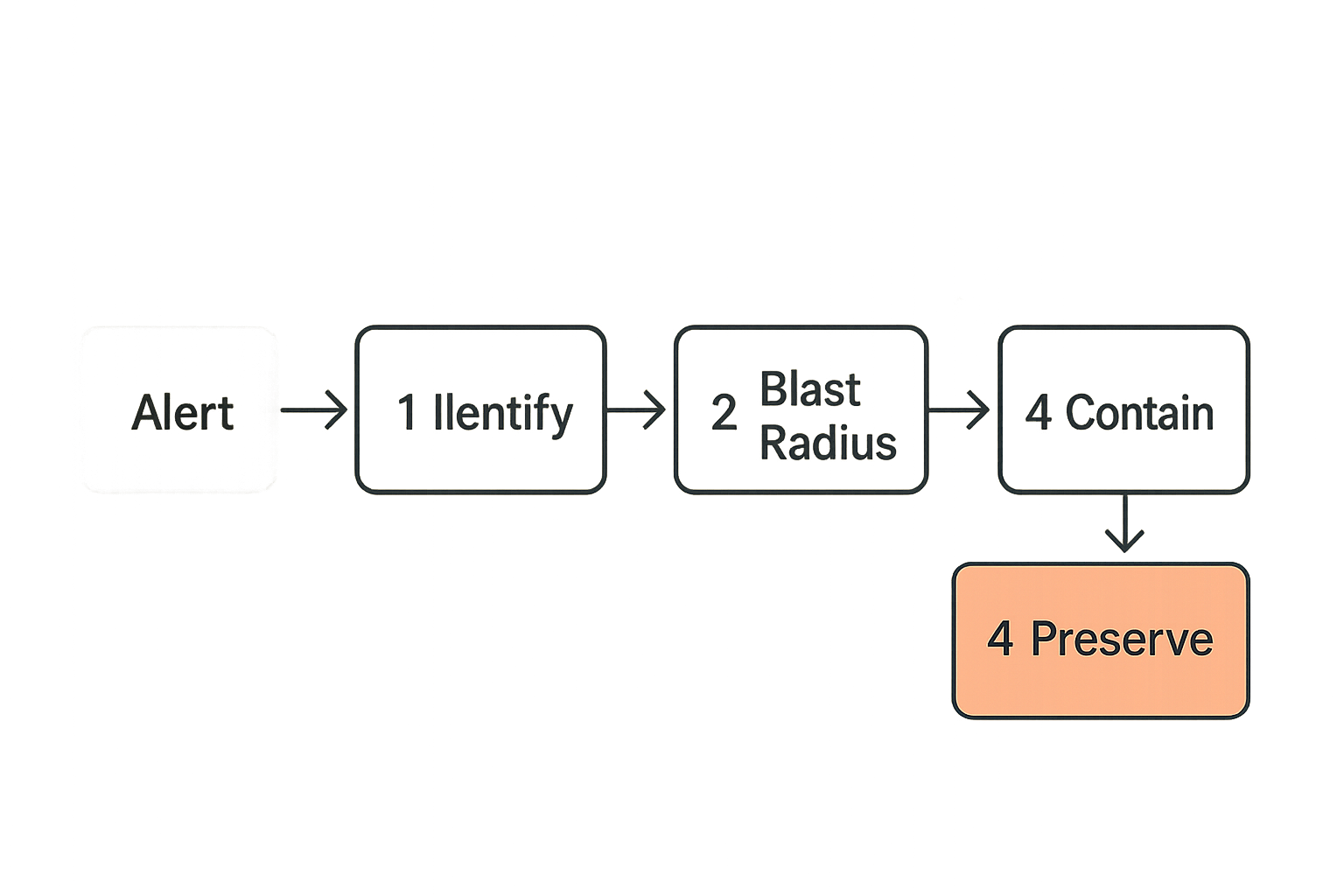
The first five questions
When an IAM alert fires, analysts need a path that gets them to risk quickly. The first five questions should be consistent:
- Who or what is the principal?
- What action happened, and did it succeed?
- What resource or permission boundary changed?
- Is this behavior expected for the principal and environment?
- What is the maximum blast radius if the identity is compromised?
These questions sound basic. They are often hard to answer because identity data lives in one system, cloud logs in another, asset inventory in another, and ownership in a spreadsheet.
The investigation workflow should collapse that search time.
A repeatable triage sequence
A practical IAM investigation sequence looks like this:
- Identify the principal. Resolve the user, role, service account, session name, source identity, and owner.
- Classify the identity. Human, workload, vendor, automation, break-glass, or unknown.
- Confirm authentication context. SSO, MFA, access key, federated token, instance metadata, or CI/CD OIDC.
- Review recent behavior. Last 24 hours, last seven days, and last 30 days for new API families, regions, resources, and source networks.
- Check recent policy changes. Look for attached policies, trust policy edits, permission boundary changes, group additions, and role grants.
- Estimate blast radius. Determine reachable accounts, resources, secrets, data stores, and administrative capabilities.
- Correlate external context. Match source IPs, domains, infrastructure, tooling, and user agents against threat intelligence and known corporate patterns.
- Choose containment. Disable key, revoke session, remove policy, quarantine workload, restrict trust, or escalate for approval.
- Document evidence and assumptions. Preserve event IDs, timestamps, role chains, affected resources, and analyst rationale.
This sequence should be encoded in the case template, not left to analyst memory.
Evidence to preserve
IAM investigations can get messy because containment actions change the same objects you need to analyze. Preserve evidence early.
Capture:
- Raw control-plane event records.
- Identity provider sign-in events.
- Session context and role chain.
- Current and previous policy documents.
- Access key creation and last-used data.
- Trust relationships before modification.
- Target resource metadata and sensitivity.
- Analyst notes on approved change windows.
Practical rule: Before changing a cloud identity, snapshot the identity, policies, trust relationships, and recent activity. Containment without evidence creates recovery and legal problems.
Response automation without locking out the business
Containment tiers
Automation is useful, but IAM response automation can break production quickly. The right model is tiered containment.
Tier examples:
- Tier 0: Enrich only. Add owner, sensitivity, baseline, threat intel, and suggested actions.
- Tier 1: Low-risk restriction. Revoke a suspicious session, require re-authentication, or disable a newly created key for a non-critical identity.
- Tier 2: Conditional containment. Remove a newly attached policy, block a source IP, or quarantine a workload after approval.
- Tier 3: Emergency action. Disable a privileged principal, remove cross-account trust, or isolate production credentials during active compromise.
The mistake teams make is jumping from no automation to destructive automation. Start with enrichment and reversible action. Then move to conditional containment when confidence and ownership are mature.
Guardrails for automated action
Automated IAM response needs guardrails:
- Do not disable break-glass accounts automatically.
- Do not remove production deployment roles without checking change windows.
- Require approval for actions affecting shared platform identities.
- Prefer session revocation over account deletion.
- Prefer narrowing policy scope over removing all access.
- Log every response action as a security event.
- Notify the owner and incident channel automatically.
- Build rollback into the playbook before enabling enforcement.
A useful pattern is “detect broadly, contain narrowly.” You can alert on many suspicious identity paths, but automated action should target the specific credential, session, trust path, or policy delta that created risk.
Break-glass and rollback
Break-glass access is necessary. It is also one of the most dangerous identity categories if poorly monitored.
Break-glass roles should be:
- Rare.
- Strongly authenticated.
- Logged with high retention.
- Alerted on every use.
- Time-bound where possible.
- Reviewed after every activation.
- Excluded from unsafe automation but included in high-severity paging.
Rollback matters just as much. If an automated playbook removes a policy attachment, the system should know what it removed, why it removed it, who approved it, and how to restore it if the action was wrong.
For adjacent reading from our network: product teams face a similar rollback problem during a SaaS product launch workflow, where shipping safely depends on instrumentation, readiness checks, and recovery paths rather than a single launch event.
Common IAM failure modes in cloud security
Standing privilege that never expires
Standing privilege is convenient until it becomes invisible. Admin roles, broad service permissions, and long-lived access keys often survive because no one wants to break something that currently works.
The problem is cumulative risk. Every identity with standing privilege is a latent incident path.
What works:
- Just-in-time privilege activation.
- Time-bound access grants.
- Permission boundaries.
- Privileged access reviews tied to actual usage.
- Alerts when dormant privileged identities become active.
What fails:
- Annual reviews that do not include last-used evidence.
- Removing access without understanding workload dependencies.
- Assuming MFA solves authorization risk.
Machine identities no one owns
Machine identities are often created by projects, not by durable teams. The project ships, people move, and the identity remains. Six months later, it still has access to production secrets.
Every workload identity should answer:
- What service owns it?
- Who is the human escalation owner?
- Where is it allowed to run?
- What resources should it access?
- What behavior would be suspicious?
- How is it rotated or revoked?
If you cannot answer those questions, you do not have an identity. You have an unmanaged credential with a friendly name.
Cross-account trust drift
Cross-account trust is necessary in multi-account cloud architecture. It is also one of the easiest places for drift to hide.
Trust drift happens when:
- A vendor role remains after the contract ends.
- A development account can assume production roles.
- A CI/CD trust policy accepts too broad a subject claim.
- External IDs are missing or reused.
- Wildcard principals appear in trust policies.
- Conditions are removed to fix a deployment issue.
Cross-account trust should be monitored as an attack path, not just a configuration item. If a low-security account can become a high-security identity, the effective security level of the high-security account is lower than the diagram suggests.
What works versus what fails
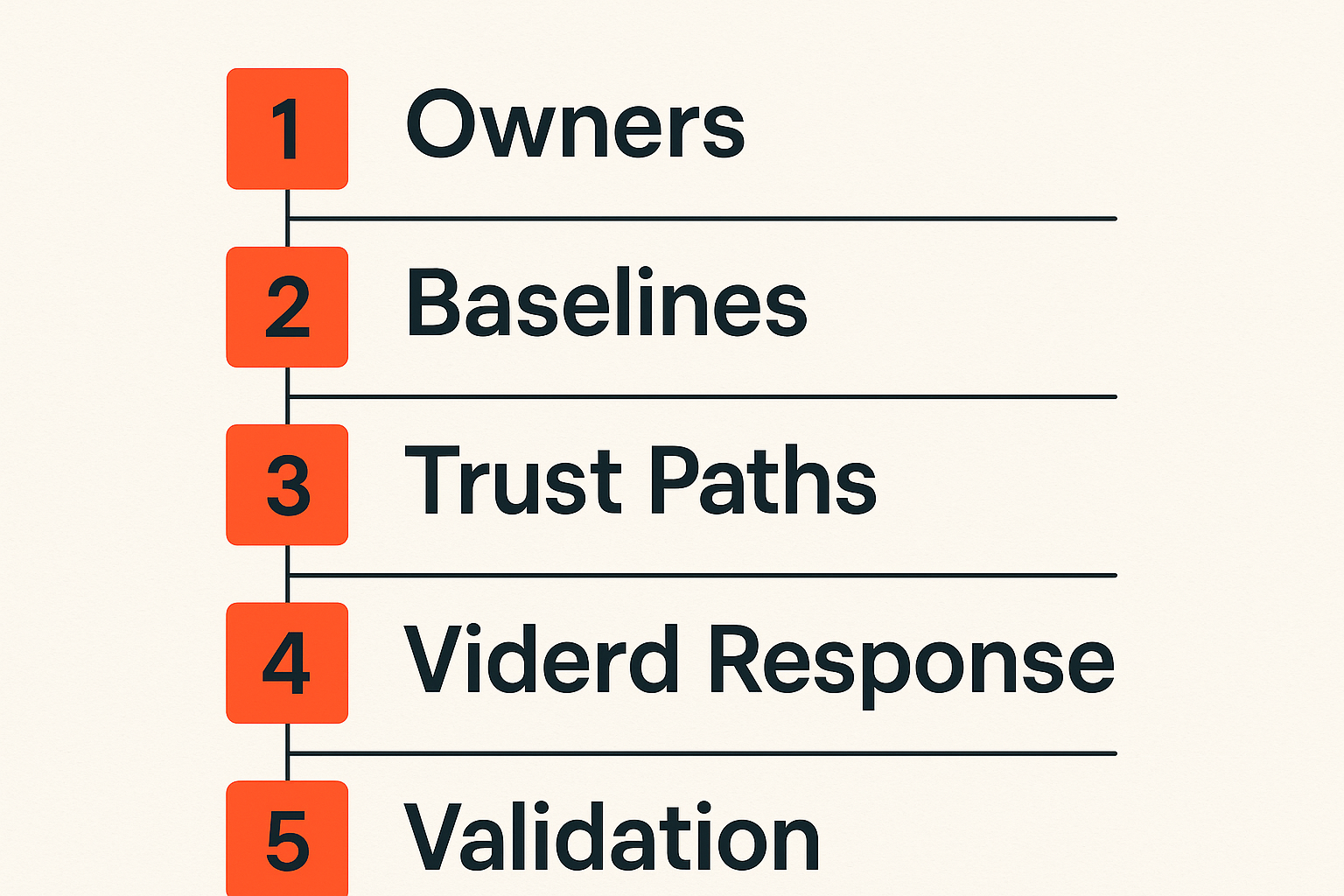
Comparison table
| Area | What works | What fails |
|---|---|---|
| Identity inventory | Principal, owner, purpose, environment, last-used, sensitivity | A list of users and roles with no ownership or behavior context |
| Detection | Behavior chains enriched with blast radius and asset context | Single-event alerts on every IAM change |
| Workload identities | Baselines by service, runtime, API family, and deployment window | Treating automation as trusted by default |
| Response | Tiered containment with rollback and approvals | Disabling broad access during business-critical operations |
| Access review | Usage-based review tied to actual privilege and risk | Quarterly checkbox reviews with no telemetry |
| Trust relationships | Graph of who can assume what, with conditions and owners | Static trust policies no one monitors after deployment |
| Metrics | Investigation time, stale privilege, unmanaged identities, risky deltas | Counting raw IAM alerts as a success metric |
The table is intentionally operational. IAM programs often fail because they measure control existence instead of workflow performance.
Metrics that actually help
Metrics should tell you whether identity risk is becoming easier to manage. Useful measures include:
- Mean time to identify an IAM principal owner.
- Mean time to estimate blast radius for a privileged identity alert.
- Number of privileged identities with no recent use.
- Number of workload identities without an owner.
- Number of cross-account trusts without conditions.
- Percentage of high-risk IAM changes reviewed within a defined window.
- Percentage of IAM detections with complete enrichment.
- Number of automated containment actions rolled back.
Do not turn these into vanity dashboards. Use them to find bottlenecks. If analysts spend 40 minutes finding the owner of a role, the problem is not analyst skill. The problem is architecture.
Adjacent operator lessons
Security teams are not the only operators dealing with trust and routing. Community and publishing teams also have to preserve context across many handoffs. For adjacent reading from our network: AI publishing community building is a useful comparison because it treats content not as isolated output, but as coordination infrastructure. IAM should be treated the same way inside security operations.
That may sound far from cloud security, but the pattern is familiar: disconnected systems create local truth, local truth creates bad routing, and bad routing creates slow response.
Implementation plan for 2026 SOC teams
Phase one inventory and ownership
Start with the identities that can hurt you most.
- Export privileged human roles, workload identities, service accounts, managed identities, access keys, and cross-account trusts.
- Tag each identity with owner, environment, business service, identity type, and sensitivity.
- Identify identities with no owner or unclear purpose.
- Pull last-used data and recent control-plane activity.
- Flag identities with standing administrative access, wildcard permissions, or broad trust.
- Create a remediation queue, but do not remove access blindly.
The output should be a usable identity risk register, not a PDF. It should feed detections, tickets, and incident workflows.
If your SOC is also trying to connect application delivery signals into cloud detection, the same ownership issue appears in DevSecOps and application security for SOC teams: pipeline events are only useful when they resolve to systems, owners, and risk.
Phase two detections and enrichment
Once inventory exists, build detections around high-risk behavior.
Prioritize:
- New privileged access key creation.
- Policy changes granting admin, wildcard, or sensitive service access.
- Trust policy changes on privileged roles.
- Unusual role assumption into production.
- Service identity behavior outside baseline.
- Logging and monitoring tampering.
- Secrets access from unusual identity or source.
For each detection, define:
detection_contract:
  name: "privileged_role_new_access_key"
  threat_behavior: "persistence via long-lived credential"
  required_logs:
    - cloud_control_plane
    - identity_provider
  required_enrichment:
    - principal_owner
    - role_sensitivity
    - source_ip_reputation
    - recent_policy_changes
  severity_logic: "depends on privilege, environment, and source"
  response_options:
    - revoke_key
    - force_reauth
    - notify_owner
    - open_incident
  validation: "simulate key creation in test account monthly"
This format forces the conversation away from “Should this alert be high?” and toward “What decision does this alert enable?”
Phase three response and validation
Response playbooks should be tested before an incident. IAM response that has never been exercised is a theory.
Run tabletop and technical drills:
- Compromised developer session assumes production role.
- CI/CD OIDC trust policy is broadened accidentally.
- Vendor role is used from suspicious infrastructure.
- Workload identity begins reading secrets outside its baseline.
- Break-glass role activates during a real outage.
For each drill, measure whether the SOC can identify the identity, owner, trust path, policy delta, affected resources, and containment option quickly.
Validation should include safe simulation. Create test identities and controlled events that exercise detection logic without touching production privileges. If detections only work in slide decks, they do not work.
Practical rule: A cloud IAM control is not operational until it has a detection path, an owner, a response option, and a validation method.
Bringing identity signals into ThreatCrush workflows
Where threat intelligence fits
Threat intelligence is most useful in IAM workflows when it helps prioritize and explain identity behavior. A bad IP alone is a weak signal. A bad IP used to assume a privileged production role after a suspicious SSO event is a different incident.
Identity and access management for cloud security becomes stronger when external context is joined to internal context:
- Known malicious infrastructure tied to role assumption.
- Threat actor tooling patterns matched to API sequences.
- Vulnerability exposure combined with identity privilege.
- Attack surface changes mapped to cloud accounts and owners.
- Emerging campaigns used to tune detections around likely abuse paths.
This is also where CTEM and SOC workflows should meet. Exposure management tells you what could be abused. IAM telemetry tells you whether someone is trying to abuse it. Detection and response connect the two.
How to avoid another disconnected tool
The last thing most SOC teams need is another dashboard that analysts must check manually. Identity context has to move into the systems where decisions happen: SIEM, case management, SOAR, ticketing, cloud posture workflows, and incident channels.
ThreatCrush is built around real-time threat intelligence, vulnerability tracking, attack surface monitoring, and operational context. The product fit is not “replace your IAM.” It is helping SOC teams connect identity events with external threat signals and exposure context so investigations move faster and alerts carry more meaning.
If you are evaluating where this fits in your stack, the ThreatCrush documentation is the right place to see how feeds, integrations, and operational workflows can be connected without turning identity security into another isolated console.
The practical question is simple: when an identity alert fires, can your analyst see whether the source, target, privilege, exposure, and threat context are related? If not, your IAM program may be configured, but it is not yet operationalized.
Try threatcrush.com
ThreatCrush publishes for security operations professionals building and scaling SOC capabilities. If you are connecting identity and access management for cloud security to detection, threat intelligence, and response workflows, Try threatcrush.com.
Try ThreatCrush
Real-time threat intelligence, CTEM, and exposure management — built for security teams that move fast.
Get started →