Fleet Response in 2026: Architecture, Workflows, and SOC Ownership

A compromised workstation is manageable. Fifty possibly exposed laptops across three regions is where the SOC starts to feel the limits of dashboards, ticket comments, and manual endpoint clicks.
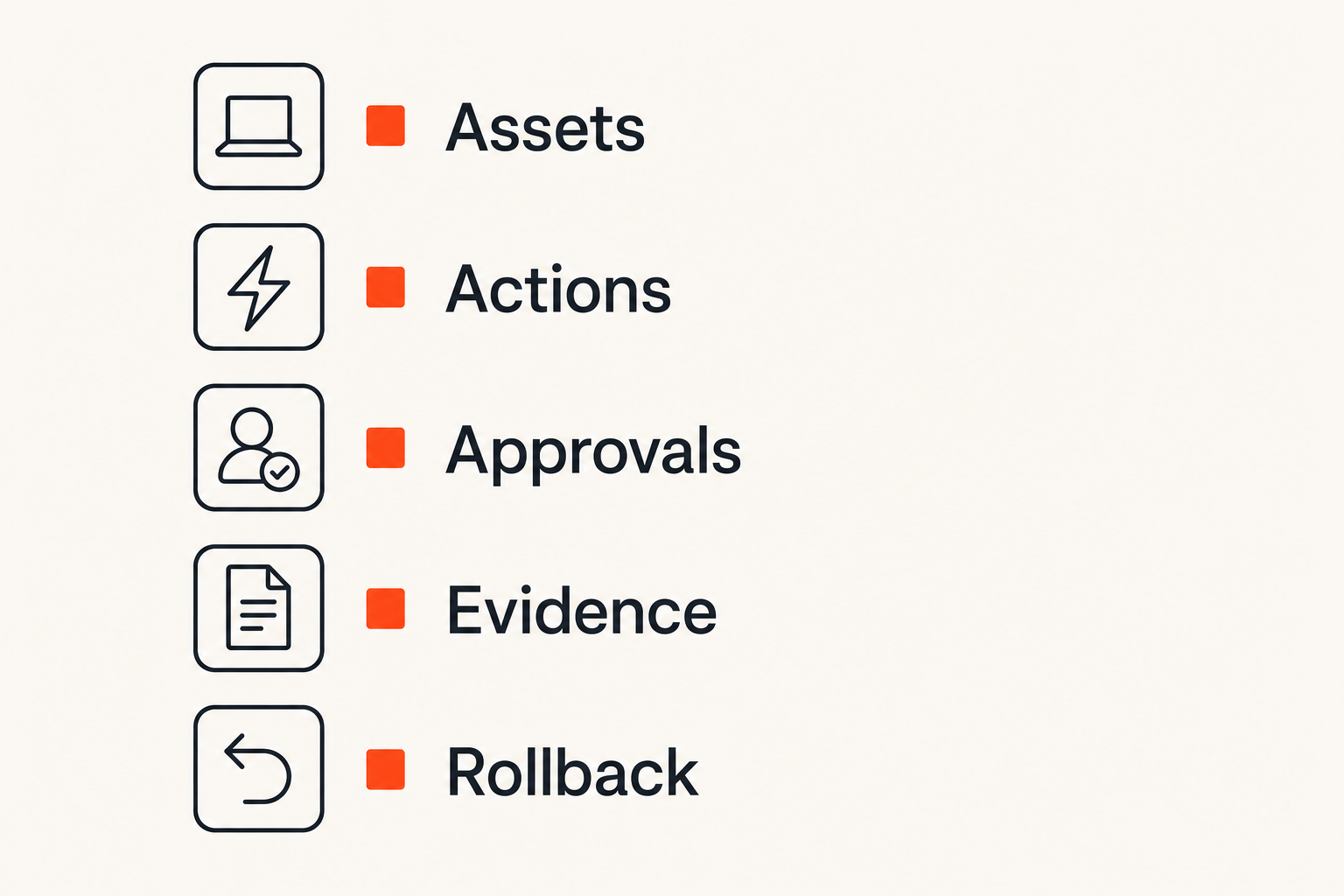
Fleet response is the moment security operations stops being a queue of investigations and becomes a control plane problem. You are not just asking whether one host is infected. You are asking which assets need action, which actions are safe, who can approve them, how you prove completion, and what breaks if the action is wrong.
Teams think the problem is endpoint access. The real problem is coordinated, accountable action across a changing fleet.
That changes the conversation. Fleet response is not a feature checkbox in EDR, SOAR, or an agent console. It is an architecture decision that connects detections, asset context, ownership, automation, evidence, rollback, and incident command. If you already think about the SOC as a set of workflows rather than a tool shelf, this is the next layer; our broader guide to security operations in 2026 frames the same problem at the SOC architecture level.
Table of contents
- What fleet response is really solving
- Fleet response architecture starts with scope
- Signals that should trigger fleet response
- The fleet response workflow that survives production
- Fleet response tooling comparison
- What breaks when fleet response is implemented badly
- Detection engineering for fleet response
- Incident response playbooks for fleet-scale action
- Metrics that make fleet response accountable
- Product fit: fleet response in a ThreatCrush-style SOC
What fleet response is really solving
Fleet response is the ability to take safe, targeted security action across many assets based on operational context. That sounds simple until the first real incident.
One laptop has suspicious PowerShell. Another has the same parent process but belongs to a developer running test automation. A third is offline. A fourth is a domain controller where isolation would create a worse outage than the threat. The practical question is not whether the SOC can push a command. It is whether the SOC can decide, execute, measure, and explain the action.
From endpoint action to operational control
Endpoint response usually starts with actions like isolate host, kill process, collect file, delete artifact, quarantine binary, reset credential, or retrieve timeline. Fleet response adds a coordination layer.
A useful way to think about it is:
- Endpoint response answers: what can I do to this device?
- Fleet response answers: what should we do across this population, in what order, under whose authority?
The mistake teams make is treating fleet response as bulk remote execution. Bulk execution without asset context is just a faster way to create operational damage.
Practical rule: never run a fleet action unless the target set, action type, approval path, evidence capture, and rollback expectation are explicit.
Why 2026 SOCs care
In 2026, the SOC is dealing with more remote assets, more SaaS identity paths, more unmanaged edge cases, and more pressure to move quickly. Endpoint telemetry is richer, but investigation queues are not getting smaller. Attackers use commodity tooling, legitimate admin utilities, signed binaries, and cloud tokens. By the time an analyst confirms one machine, the affected set may have changed.
Fleet response matters because the gap between detection and action is where incidents expand. If the SOC can identify a pattern, derive a target set, and act safely, it shortens the window where the attacker can move laterally or reestablish access.
That does not mean everything should be automatic. It means the decision path should be prebuilt.
The ownership problem
Fleet response crosses boundaries. SOC owns detection. IT owns endpoint stability. Identity owns account actions. Legal may care about evidence. Business owners care about downtime. Incident command cares about consistency.
What breaks in practice is ownership ambiguity. The SOC can see the risk but cannot isolate an executive laptop. IT can manage the device but lacks the threat context. Identity can reset credentials but does not know which accounts are linked to the host. Everyone waits, or worse, everyone acts separately.
Related reading from our network: teams responsible for CI/CD face a similar behavior-change problem when response must be embedded into daily engineering work, not bolted on after training; see security awareness training for CI/CD and software supply chain teams.
Fleet response architecture starts with scope
Before tools, define scope. Scope is the difference between a controlled response workflow and a remote shell with a nice interface.
Good scope answers three questions: which assets are in the fleet, which actions are allowed, and which situations justify emergency handling.
Define the fleet
Most organizations do not have one fleet. They have several overlapping populations:
- Corporate workstations
- Servers
- Cloud workloads
- Developer machines
- Executive devices
- OT or restricted systems
- Jump boxes and privileged admin hosts
- Unmanaged or partially managed assets
Each population needs different response rules. Isolating a salesperson laptop is not the same as isolating a payment database server. Pulling memory from a developer workstation is not the same as doing it on a regulated system.
Start by tagging assets in operational categories:
| Category | Example assets | Response posture |
|---|---|---|
| Standard endpoints | Laptops, desktops | Broad automated actions allowed |
| Critical servers | Domain controllers, databases | Human approval required |
| Privileged systems | Admin workstations, jump hosts | Faster containment, stronger evidence capture |
| Restricted environments | OT, regulated workloads | Preapproved playbooks only |
| Unknown assets | Incomplete inventory | Investigate before destructive action |
The tag is not decorative. It should drive permissions, approvals, and playbook branching.
Define allowed actions
Not every response action has the same blast radius. A file hash lookup is low risk. Network isolation is high impact. Credential reset may be necessary but disruptive. Process termination can crash business workflows.
Define actions by risk level:
- Observe: collect metadata, fetch logs, query process tree
- Preserve: capture file, memory, registry, timeline, packet sample
- Contain: isolate host, block hash, disable account, suspend token
- Remove: delete file, kill process, remove persistence
- Restore: reconnect host, reverse block, re-enable account
A minimal policy can look like this:
fleet_response_policy:
  standard_endpoint:
    observe: analyst
    preserve: analyst
    contain: incident_lead
    remove: incident_lead
  critical_server:
    observe: analyst
    preserve: incident_lead
    contain: security_manager_and_system_owner
    remove: change_window_required
The point is not the syntax. The point is making the workflow executable before the incident.
Separate emergency actions from routine actions
Some actions need speed. Others need change control. If you force every action through the same approval path, analysts will bypass the process during a serious incident. If you allow every action as emergency response, you will create unnecessary outages.
Use two lanes:
- Emergency lane: limited actions, strict logging, post-action review
- Routine lane: richer approval, scheduled execution, change tracking
Related reading from our network: secure communication systems deal with a similar split between urgent operational use and governance requirements; the architecture tradeoffs are outlined in secure messaging apps in 2026.
Signals that should trigger fleet response
Fleet response should not wait until an incident commander declares a major event. It should start when signals indicate that a single-case investigation is no longer enough.
The practical question is: when does the SOC move from host investigation to fleet-level scoping?
Detection signals
Detection signals are alerts or hunting results that imply a repeatable pattern. Examples:
- Same suspicious command line on multiple hosts
- Same file hash seen across endpoints
- Same parent-child process anomaly
- Same credential used from unusual locations
- Same outbound destination across unrelated machines
- Same persistence artifact created on multiple systems
The mistake teams make is opening separate tickets for each alert. If the same detection logic fires across the fleet, response should pivot from alert handling to pattern handling.
A mature workflow links the detection to the investigation path. Our guide on threat analysis workflows goes deeper on connecting signals, enrichment, and analyst decisions so the SOC is not rebuilding context for every case.
Exposure signals
Not every fleet response starts with malware. Sometimes it starts with exposure:
- A critical vulnerability affects a known software version
- A stolen credential dump includes corporate accounts
- A vendor compromise affects an installed agent
- A cloud misconfiguration exposes keys or workloads
- A risky browser extension is discovered across endpoints
Exposure-driven response often requires querying the fleet, not isolating it. You need to identify who is affected, what version they run, whether compensating controls exist, and which assets are business critical.
Practical rule: exposure-driven fleet response should begin with scoping and validation, not mass remediation. Remediate fast, but do not guess the target set.
Human signals
Human-reported signals matter. Help desk tickets, employee reports, IT admin observations, and business unit complaints often reveal patterns before detections are tuned.
Examples:
- Multiple users report MFA prompts they did not initiate
- IT notices repeated endpoint management failures
- Developers report unexpected credential prompts
- Finance reports unusual browser behavior after a document exchange
SOC teams often underuse these signals because they arrive outside the SIEM. The better approach is to convert human reports into structured fleet questions: who else saw it, which systems match, what artifact can we query, and what action is safe?
The fleet response workflow that survives production
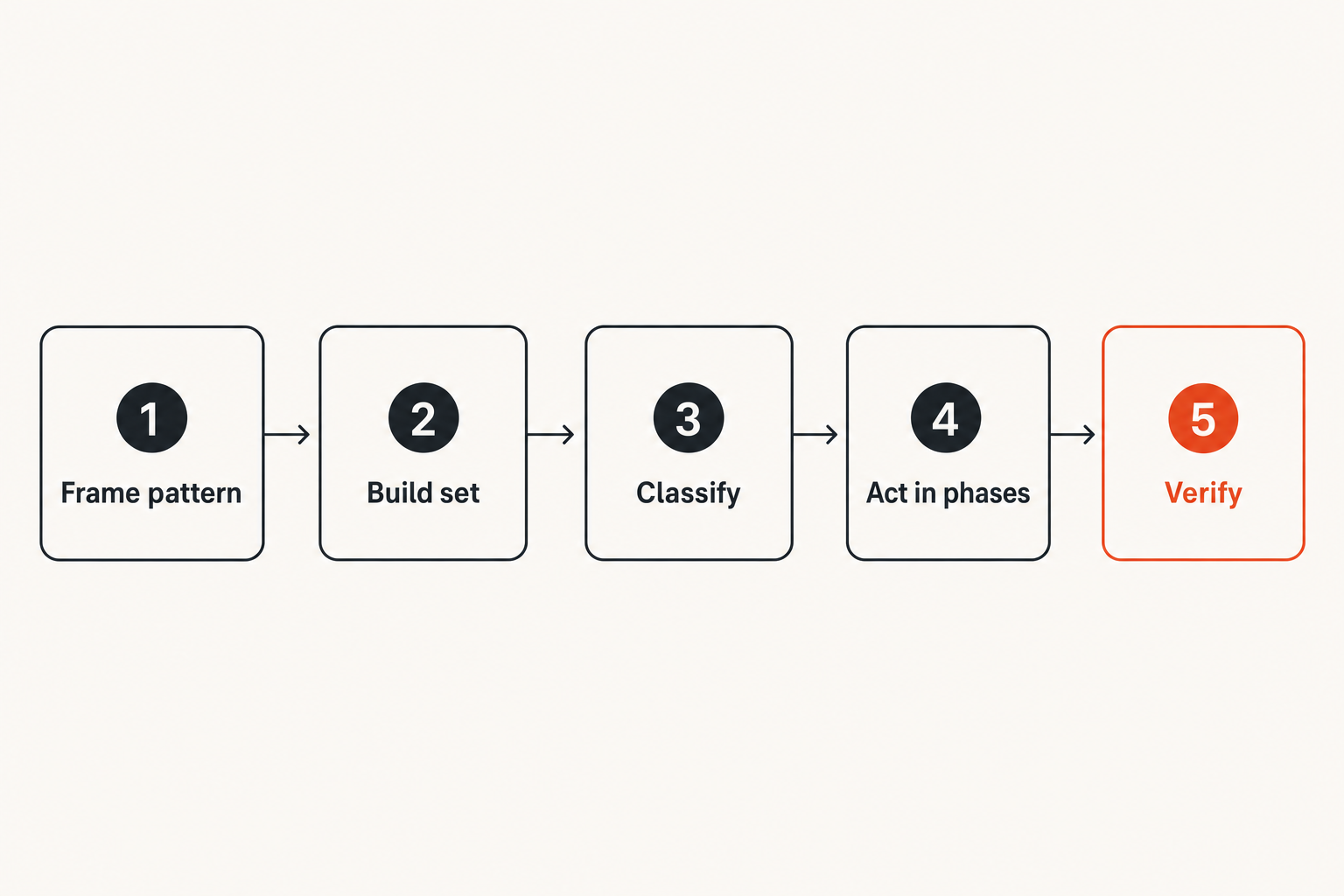
A production workflow must handle uncertainty. You rarely know the perfect target set at the start. The workflow has to narrow the population, act in phases, and preserve evidence while the incident is still moving.
The five-step sequence
A workable fleet response sequence looks like this:
- Frame the pattern. Define the observable that links assets: hash, command, destination, account, vulnerability, registry key, service, package, or behavior.
- Build the candidate set. Query inventory, EDR telemetry, identity logs, vulnerability data, and network signals to identify likely affected assets.
- Classify the target set. Split assets by business criticality, owner, geography, online status, privilege level, and response restrictions.
- Execute phased action. Start with observe or preserve actions, then contain or remove based on confidence and blast radius.
- Verify and record outcome. Confirm action success, collect final evidence, update tickets, and document exceptions.
This is boring by design. Boring workflows survive incidents.
Where automation belongs
Automation is useful when the decision is repetitive and the failure mode is understood. Good automation examples:
- Query all hosts for a file path
- Pull a process listing from affected endpoints
- Attach asset owner and criticality to a case
- Create a target set from matching telemetry
- Apply a block rule after approval
- Retry failed collection from offline machines
- Notify system owners with a consistent message
Automation fails when it makes hidden decisions. If a playbook quietly expands from ten endpoints to three thousand because of a loose query, the SOC has created a new incident.
Related reading from our network: operational tooling in developer environments has the same control problem; schemas, permissions, events, and audits are discussed in vim tools for editor-native agent workflows.
Where humans stay in the loop
Humans should stay in the loop for high-blast-radius actions, ambiguous signals, critical systems, legal or HR-sensitive cases, and business disruption decisions.
That does not mean humans should copy and paste commands all night. It means the human approves a structured action against a clear target set with visible risk. The system should handle execution, logging, retries, and evidence packaging.
Practical rule: keep humans in control of judgment, not clerical execution.
A useful approval screen should show:
- Why this target set was selected
- How many assets are included
- Which assets are critical or privileged
- What action will run
- What evidence will be captured first
- What rollback or restoration path exists
- Who approved and when
Fleet response tooling comparison
No single tool owns fleet response. EDR, SOAR, SIEM, IT management, identity platforms, vulnerability scanners, and custom agents all touch part of the workflow.
The architecture decision is whether you let one tool dominate the process or create a control plane that coordinates them.
EDR response
EDR is usually the fastest path to endpoint action. It already has telemetry and an agent on many endpoints. It can isolate hosts, collect files, kill processes, and run response scripts.
What works:
- Fast containment on managed endpoints
- Strong process and file context
- Analyst-friendly host timelines
- Built-in evidence collection
What fails:
- Limited coverage outside managed endpoints
- Weak context for business ownership
- Risky bulk actions if target selection is loose
- Tool-specific workflows that do not translate to identity or cloud
SOAR orchestration
SOAR can coordinate approvals, tickets, notifications, enrichment, and multi-tool execution. It is useful when response crosses endpoint, identity, firewall, ticketing, and chat systems.
What works:
- Repeatable playbooks
- Human approval gates
- Case management integration
- Cross-tool workflows
What fails:
- Fragile integrations
- Overbuilt playbooks nobody maintains
- Automation that hides important decisions
- Poor handling of partial failure
Agent-based fleet control
Some teams use a general-purpose agent or management plane for fleet queries and actions. This can be powerful because the agent can support security, IT, compliance, and operations workflows.
What works:
- Flexible querying
- Broad operational use
- Strong customization
- Consistent execution layer
What fails:
- Dangerous if permissions are broad
- Requires strong audit logging
- Needs careful command allowlisting
- Can become shadow IT if not governed
| Approach | Best use | Main risk | Operator advice |
|---|---|---|---|
| EDR response | Fast endpoint containment | Tool tunnel vision | Use for high-confidence endpoint actions |
| SOAR | Cross-tool coordination | Brittle playbooks | Keep playbooks small and observable |
| IT management | Patch and configuration response | Slow security context | Pair with detection-driven target sets |
| Custom agent | Flexible fleet control | Over-permissioned execution | Use strict schemas and audit trails |
| Manual response | Edge cases and judgment | Slow and inconsistent | Reserve for exceptions, not the default |
The best architecture usually combines these. EDR handles endpoint-native actions. SOAR coordinates approvals and tickets. Asset inventory supplies ownership. Identity tools handle account actions. The SOC owns the response logic.
What breaks when fleet response is implemented badly
Fleet response failures are usually not dramatic technical failures. They are workflow failures that become visible under pressure.
No asset context
If the SOC cannot tell whether an asset is a domain controller, executive device, developer laptop, production workload, or unmanaged system, response becomes guesswork.
No asset context causes:
- Over-containment of critical systems
- Under-response on privileged assets
- Slow owner notification
- Confusion during incident command
- Weak post-incident reporting
The fix is not a perfect CMDB. The fix is enough operational context to make safe decisions: owner, criticality, environment, device type, management status, and response restrictions.
Unbounded commands
Remote execution is useful. Unbounded remote execution is a liability. A command that can run anywhere, as anyone, with arbitrary parameters, creates risk even when used by trusted analysts.
Better patterns:
- Allowlisted actions instead of arbitrary shell
- Parameter validation
- Target set limits
- Approval thresholds by action risk
- Dry-run mode for scoping queries
- Mandatory evidence capture before destructive actions
A dangerous pattern looks like this:
action: run_command
target: all_windows_hosts
command: analyst_supplied
approval: none
A safer pattern looks like this:
action: collect_suspicious_file
target: scoped_candidate_set
parameters:
  file_path: validated_path
  hash: expected_sha256
approval: incident_lead
evidence_before_action: true
The difference is not syntax. The difference is control.
Evidence disappears
Fleet response can destroy evidence. Killing a process, deleting a file, resetting credentials, or isolating a host may be necessary, but each action changes the scene.
Before destructive action, capture what you can:
- Process tree
- Network connections
- Command line
- File hash and copy
- Registry or persistence location
- User session
- Relevant logs
- Detection that triggered the action
Practical rule: contain fast, but preserve enough evidence to explain what happened, what changed, and why the action was justified.
Evidence also needs to be attached to the case automatically. If analysts have to download files, rename them, and upload them manually, evidence quality will degrade during a real incident.
Detection engineering for fleet response
Detections should not only create alerts. They should define possible response paths.
A detection that cannot tell the SOC what to investigate next is incomplete. A detection that recommends a high-impact action without confidence and scope is dangerous.
Map detections to response options
For each meaningful detection, define likely actions by confidence level:
| Detection pattern | Initial response | Escalated response | Notes |
|---|---|---|---|
| Known malware hash | Collect file and isolate host | Remove artifact after evidence capture | High confidence if hash is reliable |
| Suspicious PowerShell | Pull script block logs | Isolate if lateral movement indicators exist | Avoid mass isolation on weak signal |
| Credential misuse | Disable session and reset password | Disable account temporarily | Coordinate with identity owner |
| Vulnerable package | Query installed versions | Patch or remove package | Treat as exposure response |
| C2 destination | Pull network telemetry | Block destination and contain hosts | Validate false positives |
This mapping turns detection engineering into response design. The detection engineer is not just tuning noise. They are defining what the SOC can safely do next.
Tune by blast radius
Detection severity is not the same as response severity. A high-severity alert on a critical server may require careful evidence preservation before containment. A medium-confidence signal across many workstations may justify rapid scoping but not isolation.
Tune by blast radius:
- How many assets match?
- Are any assets critical?
- Are privileged users involved?
- Is the signal high confidence?
- Is attacker activity active or historical?
- Can the action be reversed?
What works is progressive response: query first, preserve second, contain third, eradicate fourth. What fails is jumping from alert to destructive action without understanding the target set.
Validate outcomes
A response action is not complete because the command was sent. It is complete when the outcome is verified.
Validation examples:
- Host isolation status confirmed
- File no longer present
- Process terminated and did not respawn
- Credential sessions revoked
- Vulnerable version no longer installed
- Network connection stopped
- Detection no longer fires after expected delay
Build validation into the detection lifecycle. If a detection recommends an action, define how the SOC proves the action worked.
Incident response playbooks for fleet-scale action
Incident response playbooks often describe phases: identify, contain, eradicate, recover. Fleet response makes those phases operational across many assets.
The problem is not writing a playbook. The problem is making it executable under stress.
Containment playbooks
Containment should be tiered. Not every asset gets the same action at the same time.
Example containment tiers:
- Tier 1: high-confidence compromised endpoints, isolate immediately after evidence capture.
- Tier 2: likely affected endpoints, collect evidence and monitor for active behavior.
- Tier 3: exposed but no activity, patch, block, or notify owner.
- Tier 4: critical systems, require incident lead and owner approval before isolation.
This prevents the common failure where the SOC either under-reacts to avoid disruption or over-reacts and takes down important systems.
Eradication playbooks
Eradication is where fleet response can become messy. Removing persistence from ten systems is different from proving persistence is gone across hundreds.
Eradication playbooks should specify:
- Artifact list
- Removal method
- Pre-removal evidence
- Required privileges
- Expected side effects
- Validation query
- Exception handling
Do not rely on a single removal action. Attackers often use multiple persistence paths. Your playbook should remove known artifacts and query for related indicators.
Recovery playbooks
Recovery is not just reconnecting hosts. It includes restoring service, confirming user access, closing exceptions, and watching for recurrence.
Recovery should include:
- Reconnection criteria
- Owner notification
- User communication
- Monitoring window
- Detection suppression rules if needed
- Post-response validation
- Lessons learned updates
The mistake teams make is ending the incident when containment succeeds. In reality, the fleet response workflow ends when affected assets are verified, business owners are informed, and the detection-response mapping is improved.
Metrics that make fleet response accountable
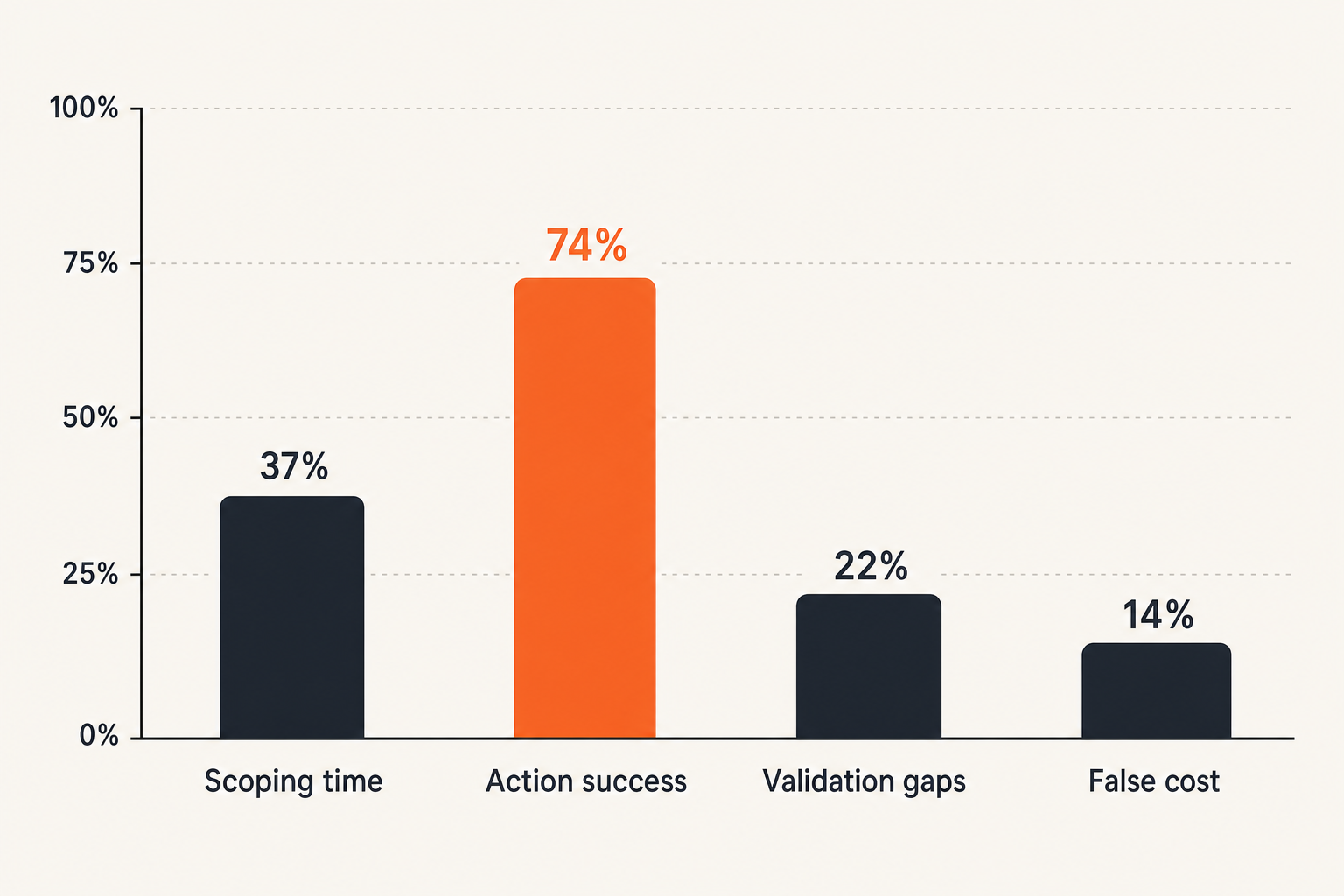
You cannot improve fleet response if you only measure alert volume. The useful metrics show whether the SOC can move from signal to safe action quickly and consistently.
Time to identify affected assets
This is the time between the first meaningful signal and a defensible affected-asset list.
It exposes weaknesses in:
- Asset inventory
- Telemetry coverage
- Query performance
- Enrichment pipelines
- Analyst workflow
If this metric is high, do not start by buying another response tool. Start by asking why the SOC cannot build a target set.
Action success rate
Action success rate measures whether response actions actually completed on intended targets.
Break it down by reason:
- Host offline
- Agent unhealthy
- Permission denied
- Action timed out
- Approval expired
- Tool integration failed
- Validation failed
This is where many teams discover their fleet is less manageable than they assumed. That is useful information. Failed actions should create follow-up tasks, not disappear into logs.
False containment cost
False positives are usually discussed as analyst noise. In fleet response, false positives can become business disruption.
Track false containment cost qualitatively if you cannot measure it precisely:
- Number of mistakenly isolated assets
- Business processes interrupted
- Executive or critical-system impact
- Hours spent reversing action
- Trust impact with IT and business owners
This metric keeps the SOC honest. Speed matters, but speed without control burns organizational trust.
Product fit: fleet response in a ThreatCrush-style SOC
Fleet response fits naturally into a SOC architecture that connects proactive and reactive work. Threat intelligence, vulnerability tracking, exposure monitoring, detection engineering, and incident response should not be separate islands.
The useful product question is not whether a platform has a button labeled response. The useful question is whether it helps your team convert signals into scoped, validated, auditable action.
Connect proactive and reactive work
A practical fleet response program connects:
- Threat intelligence to indicators and actor behaviors
- Vulnerability intelligence to affected software and assets
- Attack surface monitoring to exposed systems
- Detection engineering to response options
- Incident response to approvals and evidence
- SOC reporting to measurable outcomes
That changes the conversation. Fleet response is not only for active compromise. It is also for emerging exposures, risky configurations, suspicious identity behavior, and repeated patterns that deserve fleet-level action.
Keep integrations boring
The best integrations are predictable:
- Read from asset inventory
- Read from detection sources
- Write to case management
- Trigger approved response actions
- Capture evidence automatically
- Log every decision and outcome
Avoid architectures where every playbook is a snowflake. Boring schemas, boring approvals, boring audit trails, and boring retries are what make fleet response dependable.
ThreatCrush publishes for security operations professionals building and scaling SOC capabilities. The product direction is aligned with that operating model: fewer disconnected tools, stronger operational context, and workflows that help teams move from signal to action without losing control.
Try threatcrush.com
ThreatCrush is for security operations professionals building and scaling SOC capabilities. If you are tightening detection, response, and threat intelligence workflows around fleet response, Try threatcrush.com.
Try ThreatCrush
Real-time threat intelligence, CTEM, and exposure management — built for security teams that move fast.
Get started →