Entry Level Cybersecurity Jobs: How SOC Leaders Should Design the Work, Not Just Fill Seats

Entry level cybersecurity jobs are usually discussed like a hiring market problem. Too many applicants. Not enough experience. Too many certifications. Too few people who can work an alert queue without hand-holding.
That framing is incomplete. Teams think the problem is finding juniors who are already productive. The real problem is that many SOCs have not designed work that a junior analyst can safely perform, learn from, and improve over time.
If your entry level role is just a seat in front of the noisiest alerts, you do not have a talent pipeline. You have a burnout pipeline. The practical question is not whether entry level cybersecurity jobs exist. They do. The question is whether your SOC architecture can absorb junior operators without increasing risk, noise, and senior analyst load.
In 2026, this matters because security operations teams are being asked to do more with tighter staffing, broader telemetry, more identity-driven attacks, and less tolerance for slow response. Hiring juniors can help, but only if the work is structured as a system: signals, evidence, escalation, feedback, tooling, and ownership.
Table of contents
- Entry level cybersecurity jobs are a SOC architecture problem
- What entry level cybersecurity jobs should own in a modern SOC
- The entry level SOC operating model
- Skills to hire for and skills to teach
- Workflows that make junior analysts useful safely
- What breaks when teams implement entry level cybersecurity jobs badly
- Tooling and access design for entry level roles
- Metrics that show entry level cybersecurity jobs are working
- Career path design from entry level to detection engineering
- Product fit for threatcrush.com in the junior SOC workflow
- Closing checklist for entry level cybersecurity jobs
Entry level cybersecurity jobs are a SOC architecture problem

Hiring is not the same as onboarding
The mistake teams make is treating hiring as the hard part and onboarding as a calendar event. They post an entry level SOC analyst role, screen for basic knowledge, assign a SIEM login, and expect output within a few weeks.
That is not onboarding. That is exposure.
A useful way to think about it is this: junior analysts should inherit a workflow, not a mystery. They need clear inputs, known decision points, examples of good evidence, and escalation paths that do not depend on interrupting the same senior analyst all day.
If the role depends on tribal knowledge, the candidate is not the bottleneck. Your operating model is.
Junior work must be production shaped
Entry level does not mean toy work. It means constrained production work. The analyst should touch real alerts, real evidence, and real business context, but with safe boundaries.
Good junior work has four properties:
- It is repeatable enough to train.
- It has a clear definition of done.
- It produces evidence that another operator can review.
- It has escalation rules before destructive action is taken.
Bad junior work is vague: monitor alerts, investigate suspicious activity, support incident response. Those phrases are not wrong, but they are not operating instructions.
Practical rule: If a senior analyst cannot describe the junior workflow in five minutes, the workflow is not ready for an entry level hire.
Why this matters in 2026
Modern SOC work is less about staring at one SIEM and more about joining signals across endpoint, identity, cloud, SaaS, vulnerability data, network telemetry, and threat intelligence. That changes the conversation.
The junior analyst is no longer just a filter in front of Tier 2. They can become the person who normalizes evidence, validates enrichment, identifies repetitive noise, and converts recurring investigations into better detection logic.
But only if the team designs the role around systems. The broader security operations model matters, and teams building that foundation should treat entry level hiring as part of SOC capability planning, not as a separate HR exercise. For a wider operating model, see this guide to security operations in 2026.
What entry level cybersecurity jobs should own in a modern SOC
Triage and enrichment
Triage is the obvious starting point, but most teams define it too loosely. A junior analyst should not simply decide true positive or false positive. They should enrich the alert until the next decision is obvious.
For example, an endpoint alert may require:
- Host owner and business function.
- User identity, department, and recent login pattern.
- Process tree and command line.
- File hash reputation and first seen time.
- Network destinations and DNS history.
- Related alerts in the previous 24 hours.
The output is not a guess. The output is an evidence packet.
Detection QA and tuning
Junior analysts are close to alert noise. That is useful if you capture it. A well-run SOC lets entry level analysts flag bad detections, missing fields, weak severity, duplicate alerts, and enrichment failures.
This is not the same as letting juniors edit production rules on day one. It means giving them a structured path to report detection quality problems.
A simple detection QA form might include:
| Field | Purpose | Owner |
|---|---|---|
| Detection name | Identifies the rule or analytic | Analyst |
| Expected behavior | What the rule should catch | Detection engineer |
| Observed issue | Noise, missing context, duplicate, stale logic | Analyst |
| Evidence sample | Case link, event IDs, screenshots if needed | Analyst |
| Recommended change | Suppression, severity change, enrichment, rewrite | Reviewer |
| Review decision | Accept, reject, backlog, monitor | Detection lead |
This creates a feedback loop between operations and engineering.
Asset and exposure context
Many alerts are not hard because the attacker is sophisticated. They are hard because the SOC does not know what the asset is, who owns it, or whether it is internet-facing.
Entry level analysts can add real value by improving context quality:
- Mapping unknown hosts to owners.
- Confirming whether a system is production, test, or abandoned.
- Checking whether vulnerable assets are externally reachable.
- Tagging crown-jewel systems in cases.
- Noting stale inventory or conflicting CMDB data.
This is operationally boring work. It is also the kind of work that makes every future investigation faster.
The entry level SOC operating model
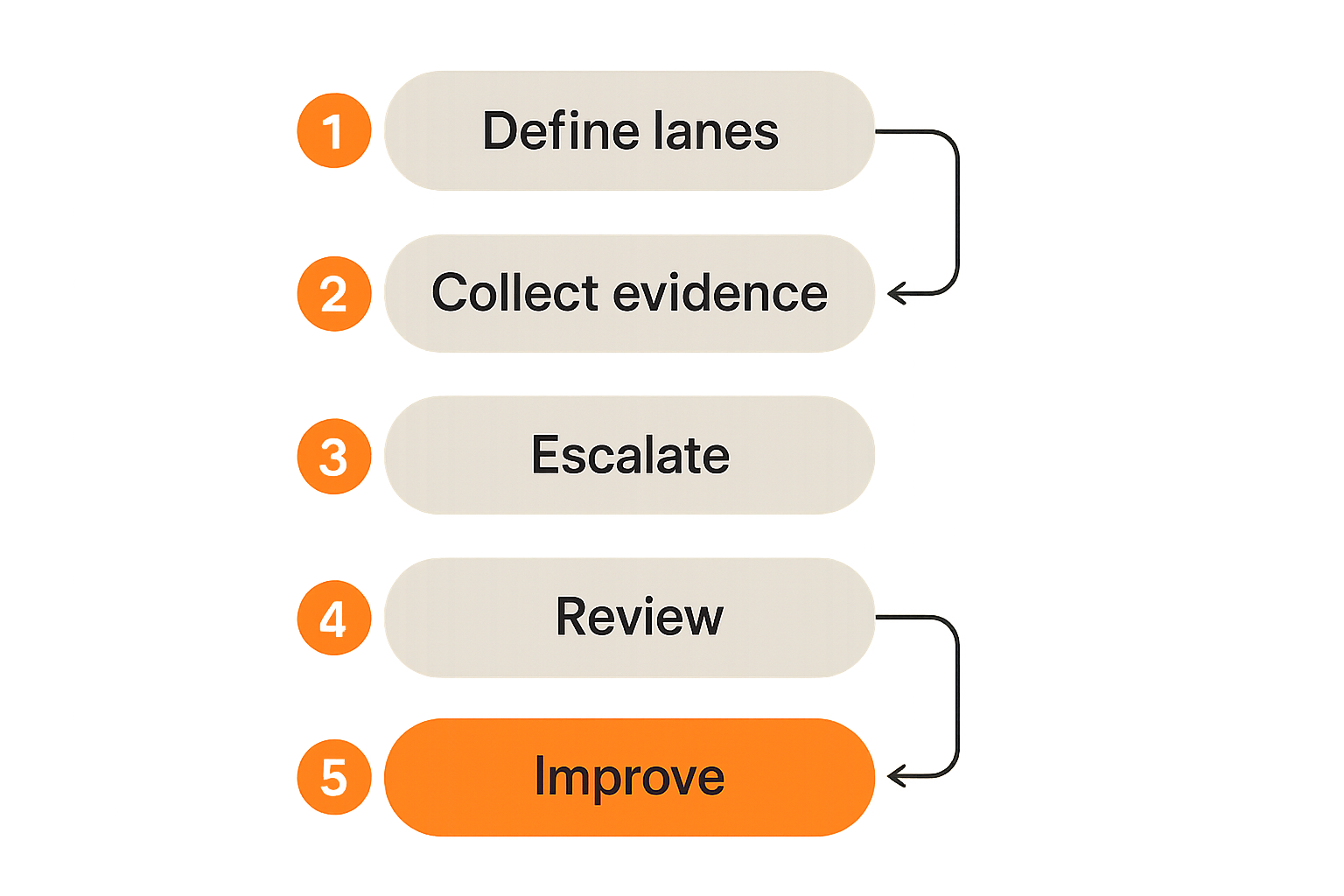
Define lanes before titles
Job titles are less useful than lanes of work. Before hiring, define what the person can do without approval, what they can do with approval, and what they cannot do.
A practical entry level SOC lane might look like this:
| Work item | Allowed independently | Requires approval | Not allowed |
|---|---|---|---|
| Enrich alerts | Yes | No | No |
| Close known benign alerts | Yes, with documented reason | For new patterns | No |
| Escalate suspected compromise | Yes | No | No |
| Disable user account | No | Yes | No |
| Isolate endpoint | No | Yes | No |
| Edit detection rule | No | Yes, in dev | Production direct edit |
| Contact business owner | Yes, using template | For executive or legal cases | No |
This prevents two common failures: juniors doing too much because nobody stopped them, and juniors doing too little because nobody trusts them.
Create escalation contracts
Escalation should not mean send to Tier 2 and hope. It should be a contract.
A useful escalation includes:
- What triggered the escalation.
- What evidence was collected.
- What decision is needed.
- What action is recommended.
- What time sensitivity exists.
Example:
- Trigger: impossible travel followed by MFA fatigue and successful login.
- Evidence: user login history, ASN, device compliance, mailbox rule check, related EDR events.
- Decision needed: confirm account containment.
- Recommended action: revoke sessions and require password reset.
- Time sensitivity: active session still present.
That format gives senior responders something to act on. It also teaches juniors how good investigations are structured.
Make evidence the unit of work
The unit of SOC work should not be the alert. It should be the evidence bundle that supports a decision.
This matters for entry level cybersecurity jobs because junior analysts often see fragmented data. One tool says suspicious PowerShell. Another says unusual login. Another shows a risky endpoint. The job is to connect evidence without overclaiming.
Practical rule: A junior analyst should be allowed to say unknown, but not allowed to escalate without showing what is known, what is missing, and what should happen next.
Skills to hire for and skills to teach
Hire for investigation habits
You can teach a SIEM query language. You can teach your EDR console. You can teach your internal severity model.
It is harder to teach curiosity, precision, and disciplined note-taking.
For entry level roles, screen for investigation habits:
- Do they ask what normal looks like before declaring abnormal?
- Do they separate facts from assumptions?
- Do they preserve timestamps, identifiers, and source data?
- Do they understand that one indicator rarely proves compromise?
- Do they know when to stop digging and escalate?
The best junior analysts are not the ones who know the most acronyms. They are the ones who can follow evidence without inventing certainty.
Teach tools and telemetry
Tool knowledge is local. Your stack may include one SIEM, another team uses a data lake, another uses managed EDR, another has cloud-native logs and a thin case system.
Teach telemetry in layers:
- Endpoint: process, parent process, command line, file, registry, network connections.
- Identity: authentication, MFA, session, device posture, privilege changes.
- Network: DNS, proxy, firewall, netflow, TLS metadata.
- Cloud: control plane events, IAM changes, storage access, workload identity.
- SaaS: mailbox rules, OAuth grants, file sharing, admin actions.
Then teach how your tools expose those layers. This avoids creating button-clickers who cannot operate when the interface changes.
Test judgment not trivia
A good interview exercise is a small case packet, not a quiz. Give the candidate a handful of events and ask them to write a short escalation note.
Look for:
- Did they identify the most important evidence?
- Did they avoid unsupported conclusions?
- Did they ask for missing context?
- Did they recommend a proportional next step?
- Did they communicate clearly?
The goal is not to hire a finished incident responder. The goal is to identify someone who can be safely developed inside your operating model.
Workflows that make junior analysts useful safely
Alert triage workflow
A simple alert triage workflow should be explicit enough that two analysts produce similar outputs.
- Confirm alert integrity. Is the alert complete, deduplicated, and mapped to the right asset or identity?
- Gather baseline context. Who owns the asset, what is normal behavior, and how critical is it?
- Enrich technical indicators. Check hashes, domains, IPs, process lineage, and related alerts.
- Decide disposition. Benign known, benign unknown, suspicious, confirmed malicious, or needs senior review.
- Document evidence and next action. Close with reason, escalate with packet, or create tuning feedback.
This workflow does not require the junior analyst to be brilliant. It requires the system to make the right next step visible.
For teams formalizing threat analysis beyond first-line triage, this related ThreatCrush guide on threat analysis workflows goes deeper into connecting signals, ownership, and response.
Phishing and identity workflow
Phishing is a good entry level workflow because it combines repetitive patterns with real risk. But it must be bounded.
Junior analysts can own:
- Header and sender analysis.
- URL and attachment detonation in approved sandboxes.
- User reporting classification.
- Mailbox search for similar messages.
- Initial identity checks for clicked users.
- Escalation when credentials, MFA prompts, OAuth grants, or suspicious sessions are involved.
They should not independently approve tenant-wide purge rules, disable executives, or make legal-sensitive user communications without review.
Related reading from our network: teams dealing with automated CI/CD workflows face similar permission and secret-boundary problems in AI agents GitHub Actions security.
Vulnerability and exposure workflow
Vulnerability work is often separated from SOC work, but entry level analysts can bridge the gap if the workflow is narrow.
They can validate whether a high-severity finding is:
- Actually present on the asset.
- Internet-facing or internal-only.
- Covered by compensating controls.
- Linked to active exploitation intelligence.
- Owned by a team with a remediation path.
This is not vulnerability management replacement. It is operational prioritization. It helps the SOC understand which exposures matter during detection and response.
Threat intel intake workflow
Threat intelligence can overwhelm junior analysts if it arrives as raw feeds. The workflow should force operational translation.
A junior-friendly intake looks like:
- Identify source and confidence.
- Extract indicators, behaviors, affected products, and actor claims.
- Map to internal exposure or telemetry.
- Search for recent matches.
- Escalate only if there is internal relevance.
- Create detection or hunting request if appropriate.
Related reading from our network: the same routing and ownership issue appears in local-agent systems, where AI agents asks and offers only work when trust and follow-up are explicit.
What breaks when teams implement entry level cybersecurity jobs badly
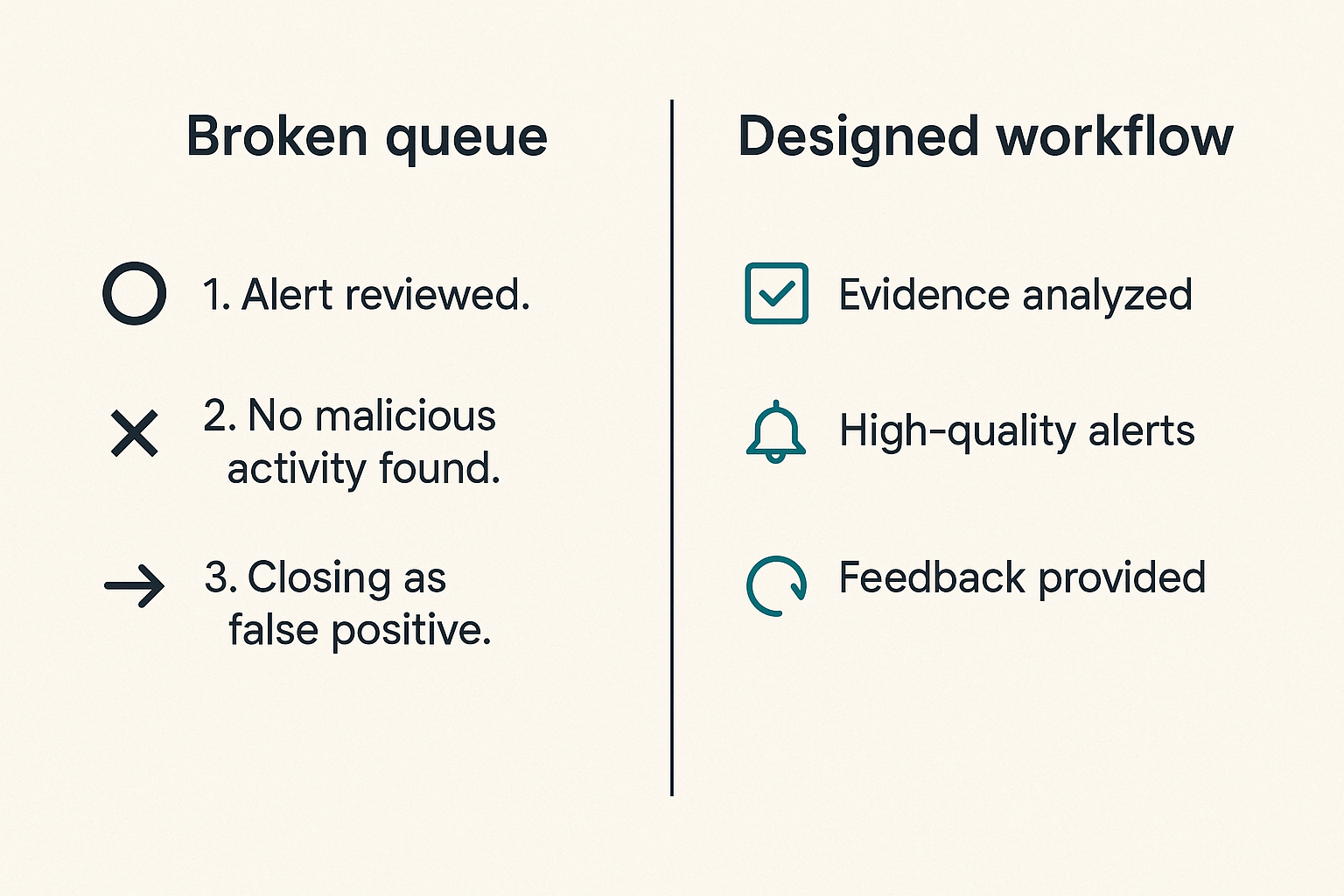
The ticket conveyor belt
What breaks in practice is that juniors become a ticket conveyor belt. They close low-quality alerts to hit volume targets, escalate anything uncomfortable, and learn to survive the queue rather than understand the environment.
You can usually spot this pattern by reading case notes. They are short, repetitive, and decision-poor:
- Alert reviewed.
- No malicious activity found.
- Closing as false positive.
That tells you almost nothing. It does not improve future detection. It does not help response. It does not build analyst skill.
The shadow admin problem
The opposite failure is giving entry level staff too much operational power because the SOC is understaffed. Suddenly juniors can disable accounts, isolate machines, block indicators globally, or edit production detections because it is faster.
This feels efficient until it creates an outage or destroys evidence.
Entry level roles need authority, but authority should be staged. Read access, enrichment, case updates, and escalation can come early. Destructive controls should require approval, pairing, or automation with guardrails.
The no feedback detection loop
The quiet failure is a SOC where juniors see the same bad alerts every day but have no path to change them. Detection engineers do not see the pain. Managers only see queue size. Analysts learn that quality does not matter.
That kills both morale and detection maturity.
Practical rule: Every recurring false positive should have an owner, a review date, and a decision. Ignore that, and entry level work becomes noise management.
Tooling and access design for entry level roles
Least privilege that still works
Least privilege is often implemented as no useful privilege. Then juniors cannot see process ancestry, cannot query identity logs, cannot view asset tags, and cannot validate a case without asking someone else.
The better model is task-based access:
| Capability | Entry level default | Rationale |
|---|---|---|
| View SIEM events | Yes | Required for triage |
| Run approved queries | Yes | Enables repeatable investigation |
| Create ad hoc broad queries | Limited | Prevents expensive or risky searches |
| View EDR details | Yes | Required for endpoint evidence |
| Take containment action | Approval required | Prevents business disruption |
| View identity logs | Yes | Required for account investigations |
| Modify detection rules | Dev only | Supports learning without production risk |
| Export sensitive data | Restricted | Reduces data handling risk |
Access should map to workflow, not ego.
Case management and audit trails
If your SOC relies on chat threads and memory, entry level analysts will struggle. Case management is where the role becomes teachable.
A useful case template includes:
- Alert summary.
- Affected asset or identity.
- Business context.
- Evidence collected.
- Timeline.
- Disposition.
- Escalation reason.
- Detection feedback.
- Reviewer notes.
This creates a training corpus. It also gives managers a way to inspect quality without hovering.
Related reading from our network: private media processing teams face a similar operational issue around job state, verification, and clean handoffs in encrypted messaging video transcoding.
Automation guardrails
Automation should remove repetitive steps, not hide decisions. For entry level analysts, automation works best when it enriches cases, suggests next actions, and validates required fields.
Good automation:
- Adds asset owner and criticality.
- Pulls recent authentication history.
- Retrieves related endpoint events.
- Checks indicators against approved sources.
- Blocks case closure if evidence fields are empty.
Risky automation:
- Auto-closes alerts without explainable evidence.
- Auto-isolates hosts based on weak signals.
- Lets analysts run arbitrary scripts from case notes.
- Suppresses detections without review.
The mistake teams make is automating before they understand the decision model. That just scales confusion.
Metrics that show entry level cybersecurity jobs are working
Measure learning velocity
Entry level cybersecurity jobs should improve over time. If an analyst is handling the same work at the same quality after six months, either the person is stuck or the system is.
Useful learning metrics include:
- Time to independent handling of defined alert types.
- Percentage of cases requiring rework.
- Number of accepted detection feedback submissions.
- Number of escalations accepted without major missing evidence.
- Ability to explain environment-specific baselines.
Do not reduce learning to certifications completed. Certifications can help, but production judgment is visible in cases.
Measure escalation quality
Escalation quality is more important than escalation volume. A junior analyst who escalates fewer but better cases is often more valuable than one who sends everything upward.
Track:
- Escalations with complete evidence packets.
- Escalations that led to containment or confirmed investigation.
- Escalations rejected due to missing context.
- Repeat questions from senior analysts.
- Time from alert to actionable escalation.
This also protects senior staff. If juniors are escalating noise, senior analysts become the real queue.
Measure analyst load and queue health
A junior hiring plan is failing if queue health improves only because people close more alerts with less evidence.
Track queue health with quality controls:
| Metric | Good signal | Bad signal |
|---|---|---|
| Mean time to triage | Faster with stable quality | Faster with weak notes |
| Reopen rate | Low and explainable | Rising after closures |
| False positive trend | Falling through tuning | Flat or rising |
| Senior interruptions | Declining over time | Constant dependency |
| Case completeness | Improving | Empty closure fields |
That changes the conversation from are juniors fast to is the SOC getting healthier.
Career path design from entry level to detection engineering
Rotate without creating chaos
Rotation is useful, but only when the receiving lane has a defined scope. Do not rotate a junior analyst into cloud detection, incident response, or threat hunting as an observer with no output.
Give each rotation a deliverable:
- Identity rotation: document three common account compromise patterns and required evidence.
- Endpoint rotation: build a process tree review checklist.
- Cloud rotation: map five high-risk control plane events to investigation steps.
- Detection rotation: write a tuning proposal for one noisy rule.
- Incident response rotation: produce a timeline from a closed incident.
The deliverable makes learning concrete and reviewable.
Build a skills matrix
A skills matrix prevents career growth from becoming vague encouragement.
Example levels:
| Capability | Level 1 | Level 2 | Level 3 |
|---|---|---|---|
| Alert triage | Follows playbooks | Handles known variants | Improves playbooks |
| Identity analysis | Reviews login history | Identifies compromise patterns | Designs identity detections |
| Endpoint analysis | Reads process trees | Correlates endpoint and network | Builds hunt hypotheses |
| Communication | Writes basic notes | Produces escalation packets | Leads incident updates |
| Detection feedback | Reports noisy alerts | Proposes tuning | Writes tested logic |
This gives entry level analysts a path that leads somewhere real.
Convert repeated investigations into detections
The bridge from entry level SOC work to detection engineering is repetition. If analysts investigate the same pattern weekly, that pattern should become a better detection, enrichment rule, suppression, or hunt.
A good junior-to-detection path looks like:
- Analyst identifies recurring investigation pattern.
- Analyst collects three to five representative cases.
- Detection engineer reviews signal quality.
- Team decides tuning, enrichment, new detection, or documentation.
- Analyst observes or assists in testing.
- Analyst validates the change in production cases.
This is how juniors learn engineering thinking without being dropped into production rule ownership too early.
Product fit for threatcrush.com in the junior SOC workflow
Where threat intelligence helps
Threat intelligence is useful for entry level cybersecurity jobs when it answers operational questions:
- Is this indicator known, current, and relevant?
- Is this vulnerability being actively discussed or exploited?
- Is this domain or IP tied to infrastructure that matters to our environment?
- Should this alert be escalated, watched, or closed as low relevance?
Raw intel feeds do not help juniors by themselves. Context does. The product fit is strongest when threat intelligence enriches the case at the point of decision, rather than living in a separate portal nobody checks during triage.
Where automation should stop
For junior workflows, automation should stop before irreversible action unless the control is mature and reviewed. It can recommend containment. It can prefill evidence. It can compare indicators. It can raise confidence.
But the SOC still needs a decision boundary. Human review matters when the action can disrupt users, delete evidence, or create legal and compliance consequences.
How to pilot without disrupting the SOC
A practical pilot should not start with every alert and every analyst. Start narrow.
- Pick two alert types with high volume and clear escalation rules.
- Define the evidence packet required for each.
- Add threat intelligence enrichment to those cases.
- Measure escalation quality, time to triage, and senior rework.
- Review misses and false positives weekly.
- Expand only after the workflow improves.
This is the right way to introduce new context into junior analyst work. Tooling should make the workflow clearer, not add another tab to check.
Closing checklist for entry level cybersecurity jobs
What works
Entry level cybersecurity jobs work when the SOC treats them as designed operating lanes. The analyst gets real work, but the work has rails.
What works:
- Clear triage workflows.
- Evidence-based escalation.
- Read access to the data required for decisions.
- Detection feedback loops.
- Case templates and reviewer notes.
- Skills matrices tied to production work.
- Automation that enriches instead of blindly acts.
This model respects the junior analyst and protects the environment.
What fails
What fails is hiring juniors into chaos and calling it opportunity.
Failure patterns include:
- Noisy alert queues with no tuning owner.
- Vague playbooks that do not define evidence.
- Access so restricted that analysts cannot investigate.
- Access so broad that analysts can break production.
- Metrics that reward closure volume over decision quality.
- Senior analysts used as an interrupt-driven help desk.
- No career path beyond survive the queue.
The practical question is not whether a junior can learn cybersecurity. Many can. The question is whether your SOC gives them a system worth learning.
Final implementation checklist
Before opening the next req, make sure you can answer these questions:
- What exact workflows will the entry level analyst own in the first 30 days?
- What evidence is required to close or escalate each workflow?
- Which actions are independent, approval-based, or prohibited?
- Which tools and data sources are required to do the work?
- How will detection quality feedback reach the right owner?
- Which metrics show learning and quality, not just volume?
- What is the path from triage to deeper engineering or response work?
If those answers are clear, entry level cybersecurity jobs become a force multiplier. If they are not, you are just adding people to a broken queue.
Try threatcrush.com
threatcrush.com is for security operations professionals building and scaling SOC capabilities. If your team is connecting threat intelligence, vulnerability context, and detection workflows, Try threatcrush.com.
Try ThreatCrush
Real-time threat intelligence, CTEM, and exposure management — built for security teams that move fast.
Get started →