Encrypted Messaging Security Operations: A Practical SOC Architecture for 2026

Encrypted messaging security operations usually becomes visible to the SOC after something has already gone wrong. A stolen account is used to coordinate payroll fraud. A sensitive screenshot leaves a private channel. An executive asks whether a disappearing-message thread can be preserved for an investigation.
Teams think the problem is encrypted messaging. The real problem is that communication has become part of the attack surface, while the SOC still treats it as a productivity layer owned by IT, legal, or the business.
That changes the conversation. You are not building a tool to read every message. You are building an operating model for identity, device posture, metadata, retention, abuse detection, and response when message content is intentionally unavailable.
The practical question is not whether encryption is good or bad. The practical question is how a security team can protect private communication without pretending privacy controls do not exist.
Table of contents
- Why encrypted messaging is now a SOC workflow problem
- Define the operating boundary for encrypted messaging security operations
- Map signals without pretending you can inspect content
- Build detection logic around behavior, not message text
- Incident response when the chat body is unavailable
- Automation and SOAR patterns that hold up
- Governance that does not break user trust
- What works and what fails in production
- Metrics for encrypted messaging security operations
- Product fit: connecting secure communication to SOC context
- Implementation checklist for 2026
Why encrypted messaging is now a SOC workflow problem
The mistake teams make is treating encrypted messaging as a policy exception. They write a rule, publish an acceptable-use paragraph, and assume the business will stay inside the lines.
In production, people use the tools that let them move fast. Sales teams coordinate with customers. Engineering teams triage incidents. Executives discuss acquisitions. Incident responders themselves may use private channels during a breach. Some of those channels are sanctioned. Some are tolerated. Some are invisible until an investigation touches them.
This post is a guest contribution from the team at qrypt.chat, so the bias is practical: protect private communication without asking the SOC to become a message-reading machine.
The communication layer became evidence
For years, SOC architecture was built around networks, endpoints, identity, and cloud control planes. Messaging sat nearby, but not always inside the investigation path.
That line no longer holds. Messaging now carries:
- Approval chains for payments and access requests
- Links to cloud documents and file shares
- Screenshots of dashboards, credentials, and customer records
- Social engineering attempts against finance, HR, and executives
- Out-of-band coordination during intrusions
- Insider risk indicators that rarely appear in a firewall log
The SOC does not need to inspect every sentence to care about this layer. It needs enough operational context to answer basic questions quickly: who communicated, from which device, through which workspace, at what time, after which identity event, and before which business action.
Privacy controls changed visibility
End-to-end encryption, disappearing messages, local-only storage, private groups, and external federation all reduce default visibility. That is often the point. The security problem is not that these features exist. The problem is that many SOC processes were written for systems where logs, content, and admin visibility were assumed.
Practical rule: If a workflow depends on reading message content by default, it is not an encrypted messaging security operations workflow. It is an exception process waiting to fail.
A useful way to think about it is this: content is only one evidence type. In encrypted environments, the SOC has to get better at the other evidence types.
Define the operating boundary for encrypted messaging security operations
Encrypted messaging security operations starts with scope. If the SOC cannot say which systems are managed, which are tolerated, and which are prohibited, every later detection rule becomes political.
The boundary is not just application inventory. It is ownership, logging, policy, support, and escalation.
Managed versus unmanaged messaging
A managed messaging environment has a business owner, an admin model, documented retention behavior, identity integration, and an incident response path. An unmanaged environment may still be used for business, but the SOC has little leverage until something breaks.
| Area | Managed encrypted messaging | Unmanaged encrypted messaging |
|---|---|---|
| Identity | SSO, MFA, lifecycle controls | Personal accounts or weak linkage |
| Devices | MDM, EDR, device posture | Unknown or mixed personal devices |
| Logs | Admin, access, group, and audit events | Sparse or unavailable logs |
| Retention | Documented and reviewed | Assumed, misunderstood, or absent |
| Response | Owner and escalation path | Ad hoc user cooperation |
| Risk | Reducible through controls | Mostly handled through policy |
The practical decision is not whether users will ever use unmanaged tools. They will. The decision is which business processes are allowed to depend on them.
Endpoint, identity, and metadata are the control plane
In encrypted messaging, the control plane is usually outside the message body. It is the identity provider, device management layer, endpoint telemetry, network egress, SaaS audit logs, CASB events, and ticketing system.
For each messaging platform, document:
- Authentication method and MFA requirements
- Account provisioning and deprovisioning flow
- Device enrollment requirements
- Admin roles and auditability
- Group creation and external invite policy
- Export, retention, and legal hold capabilities
- Available APIs, webhooks, and rate limits
- Incident response owner and backup owner
Practical rule: If nobody owns the admin console, the SOC does not own the risk. It only inherits the incident.
This is where security architecture matters more than policy language. A perfect policy with no identity lifecycle, no device control, and no audit path will not survive contact with an incident.
Map signals without pretending you can inspect content
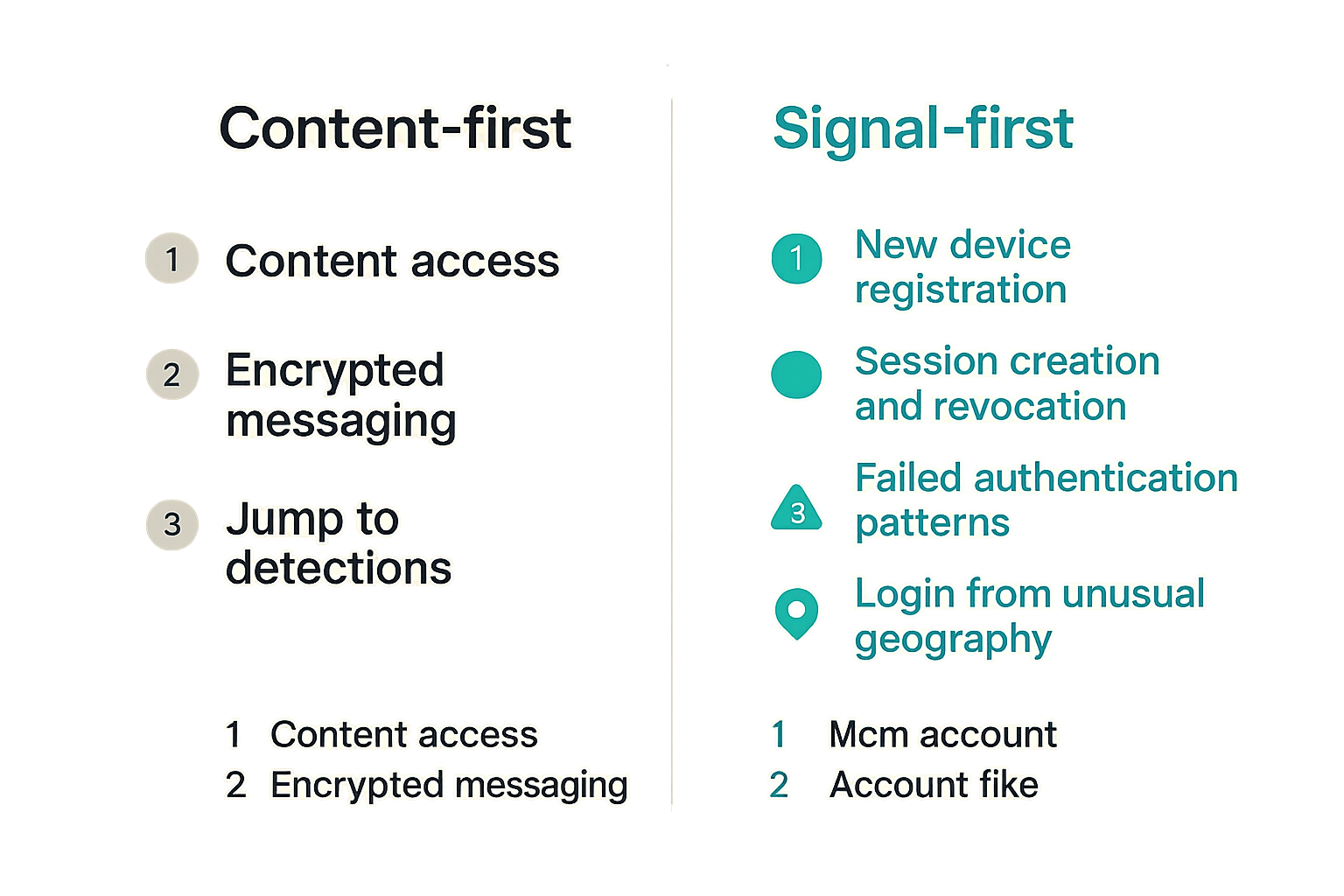
The next step is signal mapping. Teams often jump from encrypted messaging to content access. That is the wrong starting point.
Start with the signals that are legitimate, available, and operationally useful. Then decide which detections, investigations, and response actions those signals can support.
Signals the SOC can actually use
Useful signals often include:
- New device registration
- Session creation and session revocation
- Failed authentication and MFA challenge patterns
- Login from unusual geography or ASN
- Group creation and membership changes
- External user invitations
- Message volume anomalies without message content
- File attachment metadata where available
- Link sharing events where available
- Admin role changes
- Export attempts or retention policy changes
- Endpoint clipboard, screenshot, or file movement telemetry
- Browser extension and desktop app execution telemetry
- Network destination and TLS SNI where visible and lawful
None of these signals is magic. Together, they provide enough context to investigate many abuse patterns.
A basic event model might look like this:
event_source: secure_messaging_admin
event_type: external_invite_created
actor: user_id
actor_department: finance
target: external_identity_hash
device_id: mdm_device_id
ip_asn: asn_value
group_id: group_hash
time: event_time
risk_context:
  recent_password_reset: true
  impossible_travel: false
  endpoint_alert_last_24h: true
response_hint: verify_user_intent
The point is not to build a surveillance system. The point is to preserve enough structure for correlation.
Signals that create false confidence
What breaks in practice is assuming that any single signal proves intent.
Common traps include:
- Treating high message volume as malicious without business context
- Treating external communication as suspicious by default
- Treating encryption as a risk score by itself
- Assuming no logs means no incident
- Assuming admin audit logs cover user-side behavior
- Assuming retention equals recoverability
- Assuming a screenshot cannot leave an encrypted channel
Message privacy does not eliminate risk. It changes where evidence appears.
Practical rule: Build detections around observable behavior and control changes. Do not build them around frustration that the message body is unavailable.
Build detection logic around behavior, not message text
Detection engineering for encrypted messaging needs to look more like identity threat detection than keyword monitoring. The best rules connect multiple weak signals into a pattern the SOC can verify.
A single external invite may be normal. An external invite from a newly registered device, after an MFA reset, from a finance user, followed by a payment approval request in another system, deserves attention.
Account takeover and impossible patterns
Account takeover is the cleanest starting use case because it produces signals outside the encrypted content.
Useful patterns include:
- New device registration followed by group enumeration
- Login from new geography followed by external invitations
- MFA reset followed by session creation from an unmanaged device
- Disabled endpoint protection followed by messaging app activity
- Password reset followed by high-volume direct messaging
- User active in messaging while badge access or endpoint telemetry suggests otherwise
A detection can be intentionally simple:
rule: messaging_account_takeover_suspected
when:
  - new_device_registered within 2h
  - mfa_reset within 24h
  - external_invite_created within 2h
  - user_risk_score >= medium
action:
  - create_case
  - enrich_with_idp_events
  - enrich_with_edr_device_state
  - ask_user_manager_for_business_context
  - require_analyst_approval_before_session_revocation
The last line matters. Automated session revocation can be useful, but messaging often supports live business operations. Bad automation can interrupt an incident bridge, a customer escalation, or a legal negotiation.
Data movement and external coordination
Data movement is harder because encrypted channels intentionally obscure content. The SOC has to correlate adjacent systems.
Look for combinations such as:
- Sensitive document access followed by new external chat membership
- Bulk download followed by unmanaged messaging app execution
- Screenshot activity followed by unusual outbound messaging volume
- Clipboard events from a secrets vault followed by desktop chat activity
- Cloud storage sharing followed by private group creation
- DLP event in email followed by migration to encrypted messaging
This is not about proving exfiltration from one alert. It is about creating an investigation package that asks the right question: did sensitive data move from a governed system into a less governed communication path?
The mistake teams make is trying to make the messaging platform carry the entire detection load. It usually cannot. The better architecture distributes detection across identity, endpoint, SaaS, and messaging metadata.
Incident response when the chat body is unavailable
Incident response plans often assume logs can be pulled, messages can be searched, and artifacts can be preserved. Encrypted messaging forces the team to be more precise.
If you wait until an executive impersonation incident to discover that messages are unrecoverable, the failure is not technical. It is architectural.
Triage questions that reduce ambiguity
The first responder needs a checklist that does not depend on content access.
Ask:
- Is the messaging platform sanctioned for the business process involved?
- Is the account corporate-managed or personal?
- Was the user authenticated through the enterprise identity provider?
- Which devices had active sessions at the relevant time?
- Were there recent MFA, password, or recovery changes?
- Were new groups, external users, or devices added?
- Did adjacent systems show data access, payment changes, or admin actions?
- Is user consent, legal approval, or HR involvement required before deeper review?
- Can sessions be revoked without destroying evidence or disrupting response?
- Who owns the business decision if the content cannot be recovered?
These questions sound basic. In a live incident, they prevent a Slack thread full of guesses from becoming the investigation record.
Preservation, consent, and legal handoffs
Encrypted messaging creates predictable tension between privacy, employment policy, regulatory obligations, and investigation needs. The SOC should not improvise this.
Define ahead of time:
- Who can approve account suspension
- Who can request device collection
- Who can request user cooperation
- Whether screenshots provided by participants are acceptable evidence
- Whether local backups exist and who may access them
- Whether admin metadata can be exported
- Whether legal hold applies to the platform
- What to do when retention is intentionally short
Practical rule: If content recovery requires user cooperation, document that as a dependency. Do not bury it in an incident runbook as if it were a button.
A mature IR process separates security facts from legal authority. The SOC can say what is technically visible. Legal, HR, and business owners decide what should be accessed and under which conditions.
Automation and SOAR patterns that hold up
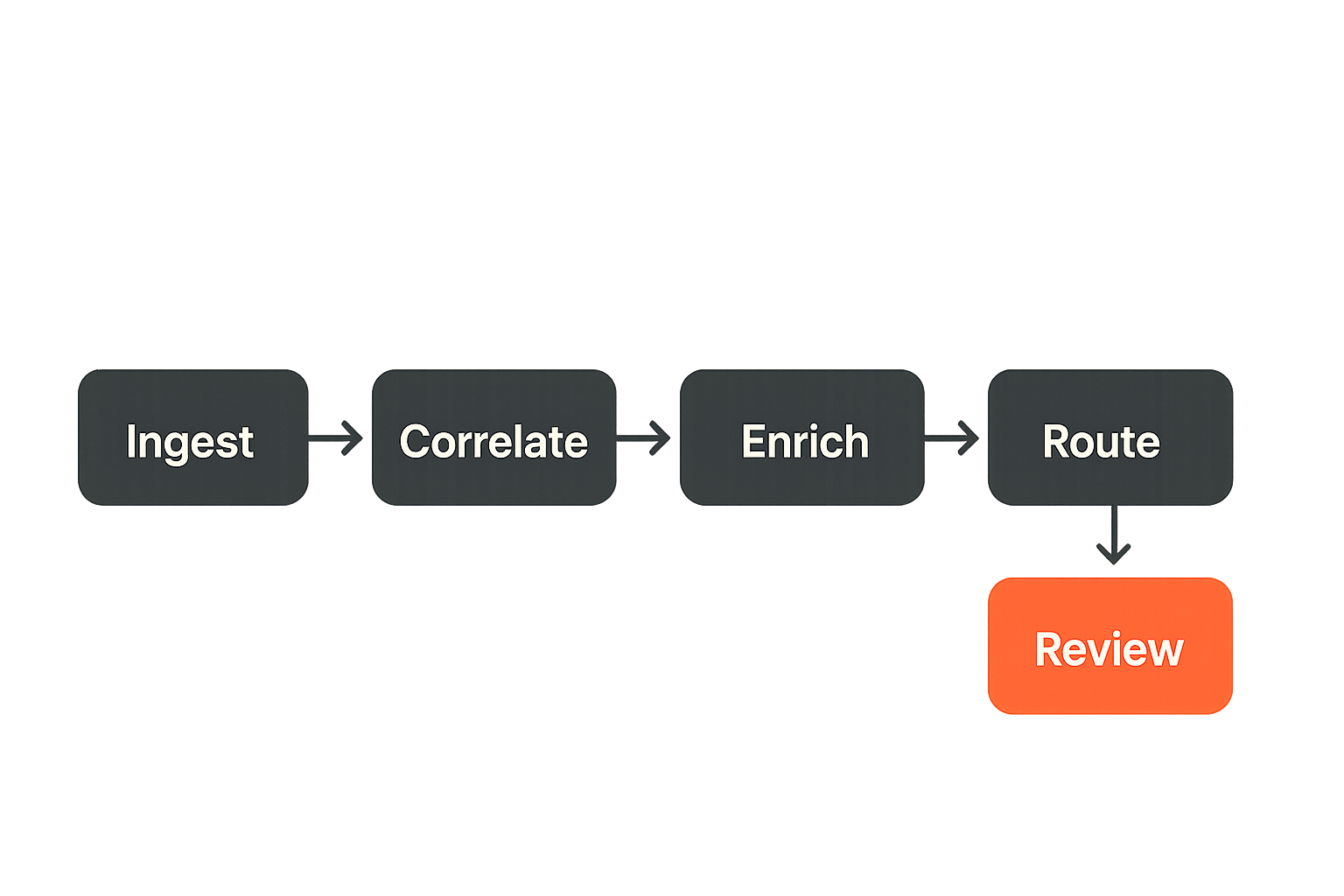
Automation helps when it reduces analyst assembly work. It hurts when it takes irreversible actions based on weak signals.
Encrypted messaging security operations benefits from case-building automation more than aggressive enforcement automation.
Normalize messaging events into cases
A good workflow pulls messaging events into the same case context as identity and endpoint signals.
A practical sequence:
- Ingest admin and audit events from managed messaging tools.
- Normalize actor, device, group, external identity, and timestamp fields.
- Correlate with identity provider events for MFA, password, risk, and session changes.
- Correlate with EDR and MDM for device posture and process execution.
- Enrich with business context such as department, role, VIP status, and system ownership.
- Create a case only when a meaningful combination appears.
- Route to the owner who can validate business context.
- Require analyst approval for disruptive response actions.
That workflow keeps the SOC focused on decisions, not log hunting.
The case should answer:
- What changed?
- Why is it unusual?
- Which controls were involved?
- What is the likely business impact?
- What action is safe now?
- What action requires approval?
Rate limits, retries, and human approval
Messaging APIs are not built solely for SOC automation. They may rate-limit exports, delay events, omit content, or require elevated scopes.
Plan for:
- API quotas and backoff logic
- Webhook delivery failures
- Duplicate events and idempotency keys
- Missing historical data
- Delayed audit events
- Partial user identifiers across systems
- Permission scopes that security cannot hold permanently
- Break-glass access that must be logged
What fails is brittle automation that assumes every event arrives once, in order, with a complete payload. That is not how production systems behave.
Use a defensive pattern:
ingest_pattern:
  dedupe_key: source_event_id
  retry_policy: exponential_backoff
  max_retry_window: 24h
  late_event_handling: reopen_or_append_case
  destructive_actions: analyst_approval_required
  audit_log: required
The boring details matter. Duplicate external-invite events should not create five incidents. A late admin-role-change event should still attach to the case. A failed session revocation should not disappear into a SOAR job history.
Governance that does not break user trust
Security teams lose this debate when governance sounds like covert monitoring. Users understand risk. They do not accept vague surveillance.
Good governance makes the boundary explicit: which tools are approved for which work, what the company can see, what it cannot see, what happens during an investigation, and who approves exceptions.
Acceptable use needs operational teeth
An acceptable-use policy should not just say use approved tools. It should map communication types to approved channels.
For example:
| Communication type | Approved channel requirement | Reason |
|---|---|---|
| Incident response coordination | Managed, logged, access-controlled room | Preservation and accountability |
| Customer secrets or credentials | Prohibited in messaging | Use vault or ticket workflow |
| Payroll or bank changes | Dual approval outside chat | Reduce impersonation risk |
| Executive travel or personal details | Restricted private channel | Safety and privacy |
| External vendor coordination | Approved workspace with owner | Clear access lifecycle |
| Legal or HR matters | Designated system only | Privilege and retention rules |
The goal is to route high-risk workflows into systems with appropriate controls. It is not to ban private communication everywhere and then act surprised when users route around security.
Admin access and retention must be explicit
Retention is one of the most misunderstood parts of encrypted messaging security operations. Users assume deletion means deletion. Legal may assume discoverability. Security may assume logs exist. Product teams may assume encryption makes everything unreachable.
Write down the truth for each platform:
- What metadata is retained?
- What message content, if any, is retained?
- Who can access admin logs?
- Can the company revoke sessions?
- Can the company recover messages?
- Are disappearing messages allowed?
- Are exports possible?
- Does legal hold work?
- Are external users covered by the same rules?
This documentation is not bureaucracy. It is incident preparation.
Practical rule: User trust improves when visibility is explicit. Hidden assumptions create worse outcomes than clear limits.
What works and what fails in production
Most encrypted messaging programs do not fail because the SOC lacks clever detections. They fail because ownership, evidence, and response authority are unclear.
A useful way to think about it is to separate control design from investigation design. Control design asks what should be allowed. Investigation design asks what happens when reality disagrees.
What works
Patterns that hold up:
- Approved messaging tiers by business use case
- Identity-managed access for corporate communication
- Device posture requirements for sensitive rooms
- External-user approval and expiration
- Admin action logging into the SIEM or data lake
- Correlation with IdP, EDR, MDM, and SaaS events
- Clear incident authority for suspension and collection
- User-facing documentation of visibility and limits
- Playbooks that do not assume content recovery
- Case workflows that preserve context and decisions
The strongest programs treat encrypted messaging as part of the enterprise nervous system. They do not isolate it from SOC workflows, and they do not pretend it is just another chat app.
What fails
Failure modes are predictable:
- Blanket bans with no usable approved alternative
- Keyword monitoring plans that conflict with encryption reality
- No owner for messaging admin consoles
- Personal accounts used for business-critical approvals
- No deprovisioning for external guests
- Retention assumptions copied from email
- SOAR actions that revoke sessions during live response
- Legal and HR pulled in after evidence is already lost
- Detection rules that fire on privacy features instead of risk
- Executive exceptions that become the real operating model
What breaks in practice is the handoff. The SOC sees a suspicious pattern but cannot validate ownership. IT owns the tool but not the investigation. Legal owns the authority but not the logs. The business owns the decision but not the technical context.
Fixing that handoff is the work.
Metrics for encrypted messaging security operations
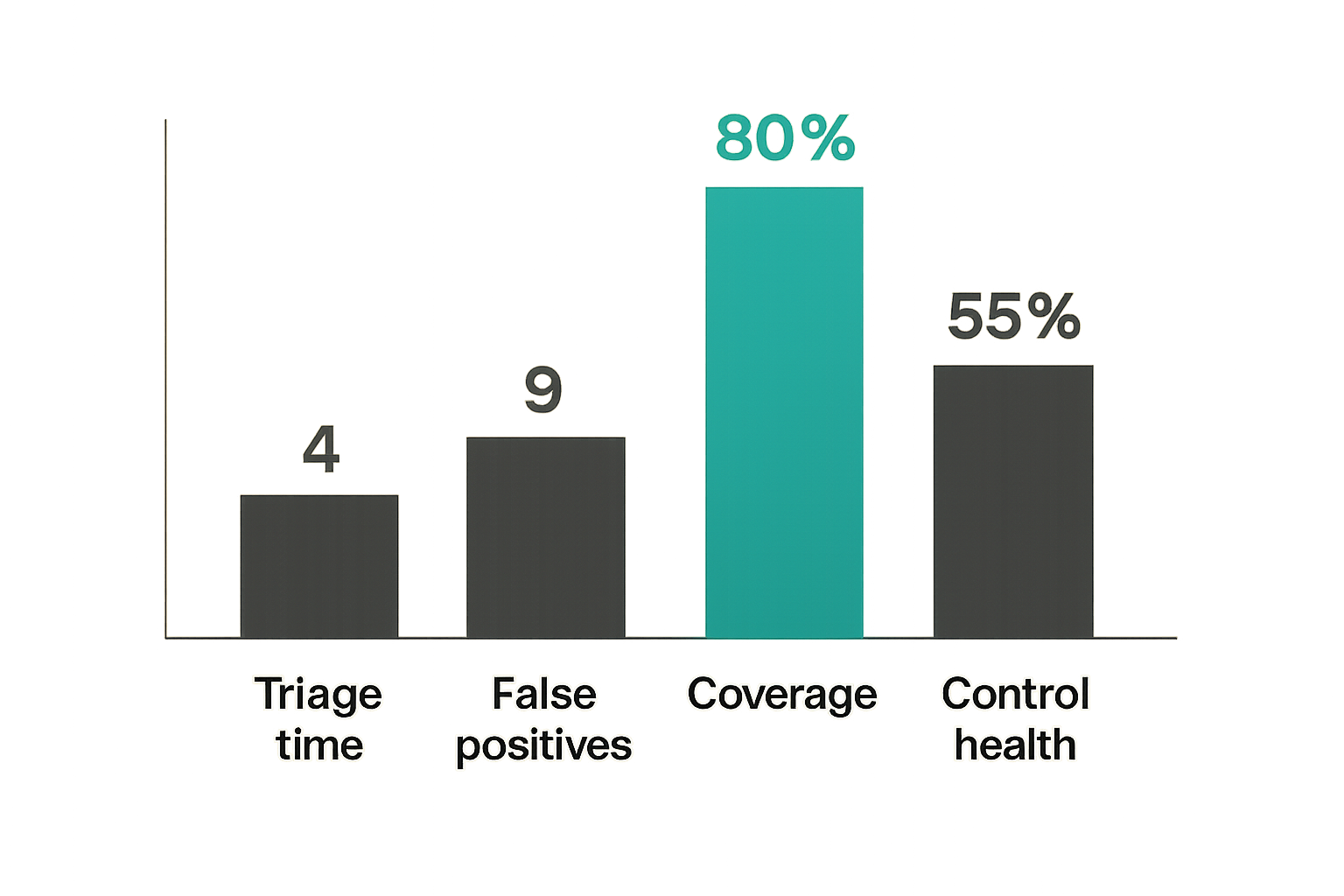
Metrics should tell you whether the operating model is improving. They should not reward the SOC for collecting more private data than necessary.
The right metrics focus on time, coverage, quality, and control health.
Measure investigation quality
Useful metrics include:
- Time from messaging signal to correlated case
- Time from case creation to business-owner validation
- Percentage of cases enriched with identity context
- Percentage of cases enriched with endpoint posture
- False positive rate by detection type
- Number of cases requiring legal or HR approval
- Number of incidents where content was requested but unavailable
- Number of incidents where unavailable content blocked a decision
- Mean time to revoke risky sessions after approval
- External guest accounts without recent owner validation
This gives leadership a real view of operational maturity. It also shows where privacy-preserving controls are working versus where process gaps remain.
Track control health, not surveillance volume
Avoid vanity metrics such as total messages scanned. In an encrypted system, that metric is either unavailable, misleading, or a sign that the architecture is not actually private.
Better control-health metrics include:
- Percentage of corporate users on managed messaging accounts
- Percentage of sensitive groups requiring managed devices
- Percentage of external guests with expiration dates
- Percentage of admin roles reviewed in the last quarter
- Percentage of messaging audit sources successfully ingested
- Webhook delivery failure rate
- Average delay between platform event and SIEM availability
- Number of break-glass admin actions
That changes the conversation with leadership. You are no longer arguing about whether security should read messages. You are showing whether the organization can govern, detect, and respond around secure communication.
Product fit: connecting secure communication to SOC context
Product fit in this space is not about buying one more dashboard. It is about connecting private communication with the evidence graph the SOC already uses.
If encrypted messaging sits outside detection, case management, and response, it becomes a blind spot. If it is forced into content-centric monitoring, it becomes a trust problem. The useful middle is operational context.
Where private messaging belongs in the architecture
Private messaging belongs in the architecture as a governed communication plane with defined telemetry and defined limits.
That means:
- Identity integration for corporate use
- Device and session controls for sensitive communication
- Metadata and admin logs routed into SOC workflows
- Clear boundaries for content availability
- Documented retention behavior
- Business ownership for rooms, groups, and external access
- Response actions that are safe, logged, and reversible where possible
The SOC should be able to ask a platform: tell me what changed, who changed it, which account and device were involved, and what response actions are available. The SOC should not need to ask: can I silently read everything?
Where ThreatCrush fits
ThreatCrush is useful when encrypted messaging signals need to become part of a broader security operations workflow. The value is not in treating chat as a standalone alert source. The value is in correlating messaging activity with identity risk, endpoint behavior, threat intelligence, and incident context.
For SOC teams, the practical fit looks like this:
- Bring messaging metadata into the same workflow as other detections
- Reduce duplicate investigations across identity, endpoint, and SaaS tools
- Attach ownership and business context to suspicious communication events
- Route response decisions to the right team
- Validate whether controls are actually reducing investigation time
That is the architecture that works: privacy-respecting communication on one side, operationally useful security context on the other.
Implementation checklist for 2026
If you are starting from a messy environment, do not begin with a grand platform migration. Begin with the workflows that create the most risk: executive communication, incident response, finance approvals, customer data, privileged engineering, and external vendor coordination.
Then build from the control plane outward.
A 30-day rollout sequence
A practical 30-day sequence:
- Inventory sanctioned and commonly used encrypted messaging tools.
- Classify business workflows that currently depend on each tool.
- Identify which tools are managed by corporate identity and which are not.
- Document retention, export, admin, and legal-hold realities.
- Pick three high-risk workflows: finance approvals, incident response, and external vendor coordination are common starting points.
- Define approved channels and prohibited uses for those workflows.
- Connect available admin and audit events into the SIEM or case workflow.
- Build two behavior-based detections: account takeover and risky external invitation.
- Create an IR checklist that assumes message content may be unavailable.
- Review the model with legal, HR, IT, and business owners.
- Run a tabletop exercise where content cannot be recovered.
- Tune detections based on analyst feedback and business context.
This sequence is intentionally plain. It creates ownership, visibility, and response muscle before the team argues about edge cases.
Closing the loop
Encrypted messaging is not going away, and it should not. Private communication is part of modern business and, in many cases, part of good security practice.
The SOC still needs a model. Not a fantasy model where every message is visible. Not a policy-only model where everyone promises to behave. A real model that connects identity, devices, metadata, governance, detection, response, and validation.
The best encrypted messaging security operations programs are clear about what they can see, honest about what they cannot see, and fast at turning weak signals into accountable decisions.
That is the work: reduce noise, shorten investigation time, preserve trust, and make encrypted messaging security operations part of the SOC architecture instead of an exception folder.
Try threatcrush.com
ThreatCrush helps security teams connect detection, investigation, and response workflows around real operational context. Try threatcrush.com.
Try ThreatCrush
Real-time threat intelligence, CTEM, and exposure management — built for security teams that move fast.
Get started →