Emergency Response Guidebook for SOC Teams: Build the Workflow Before the Incident

An emergency response guidebook usually appears after the first ugly incident. A ransomware alert lands at 2:13 a.m., the SIEM has evidence, EDR has a different story, nobody knows who can approve containment, and the bridge call turns into a live debate about process.
Teams think the problem is missing documentation. The real problem is missing operating architecture.
A PDF with policy language will not help an analyst decide whether to isolate a domain controller, wake legal, preserve volatile memory, or downgrade a false positive. What helps is a guidebook that connects severity, signal quality, ownership, communications, automation, and recovery into one response workflow.
That changes the conversation. The practical question is not whether your SOC has an emergency response guidebook. The practical question is whether the guidebook can survive the first 30 minutes of a real incident in 2026, when alerts move faster than meetings and attackers do not wait for approval chains to become clear.
Table of contents
- Why an emergency response guidebook is an operating system
- Define severity before the incident
- Build the response workflow
- Assign ownership that survives pressure
- Connect signals to actions
- Write runbooks operators will use
- Make communications part of the system
- Test the emergency response guidebook before the real incident
- Implementation sequence for 2026 SOCs
- Product fit: where ThreatCrush belongs
Why an emergency response guidebook is an operating system
The guidebook is not the incident response plan
Most organizations already have an incident response plan. It names phases, lists contacts, references compliance requirements, and describes governance. Useful, but not enough.
An emergency response guidebook is different. It is the operating layer between policy and the keyboard. It tells responders what to do when evidence is incomplete, which systems are authoritative, who owns which decision, and how the team moves from alert to containment without inventing the process live.
A useful way to think about it is this:
| Document | Primary audience | Purpose | Failure mode |
|---|---|---|---|
| IR policy | Executives, auditors, legal | Define obligations and governance | Too abstract for operators |
| IR plan | Security leadership and responders | Describe phases and roles | Too broad during live response |
| Runbook | Analysts and engineers | Execute a scenario-specific action | Too narrow without escalation logic |
| Emergency response guidebook | SOC, IR, IT, legal, leadership | Coordinate decisions, workflow, evidence, and communications | Becomes stale if not tested |
The guidebook does not replace those documents. It binds them together.
Practical rule: If an analyst cannot use the guidebook during a bridge call with five people talking, it is not a guidebook. It is reference material.
Why now: faster incidents, more tools, thinner context
In production, incident response is being squeezed from both sides. Attackers compress dwell time and chain identity, endpoint, cloud, and SaaS abuse. Defenders add more telemetry, more alerts, more automations, and more dashboards. The volume goes up, but shared context often goes down.
This is why many SOC teams are revisiting their response model as part of broader modern security operations architecture. The issue is not only better detection. It is whether detection becomes a coordinated response before the window closes.
Related reading from our network: teams dealing with software delivery risk face similar workflow pressure in cyber security software for CI/CD and supply chain defense, where ownership and enforcement timing matter as much as tooling.
The decision it should force
A real guidebook forces decisions before the incident:
- What severity triggers a bridge?
- Who can approve isolation of business-critical systems?
- Which evidence is required before declaring compromise?
- Which containment actions are pre-approved?
- Which stakeholders receive updates, and on what cadence?
- Which systems of record own incident state?
The mistake teams make is treating these as administrative details. They are response architecture. If they are unresolved, the first hour becomes a negotiation.
Define severity before the incident
Severity is a routing problem
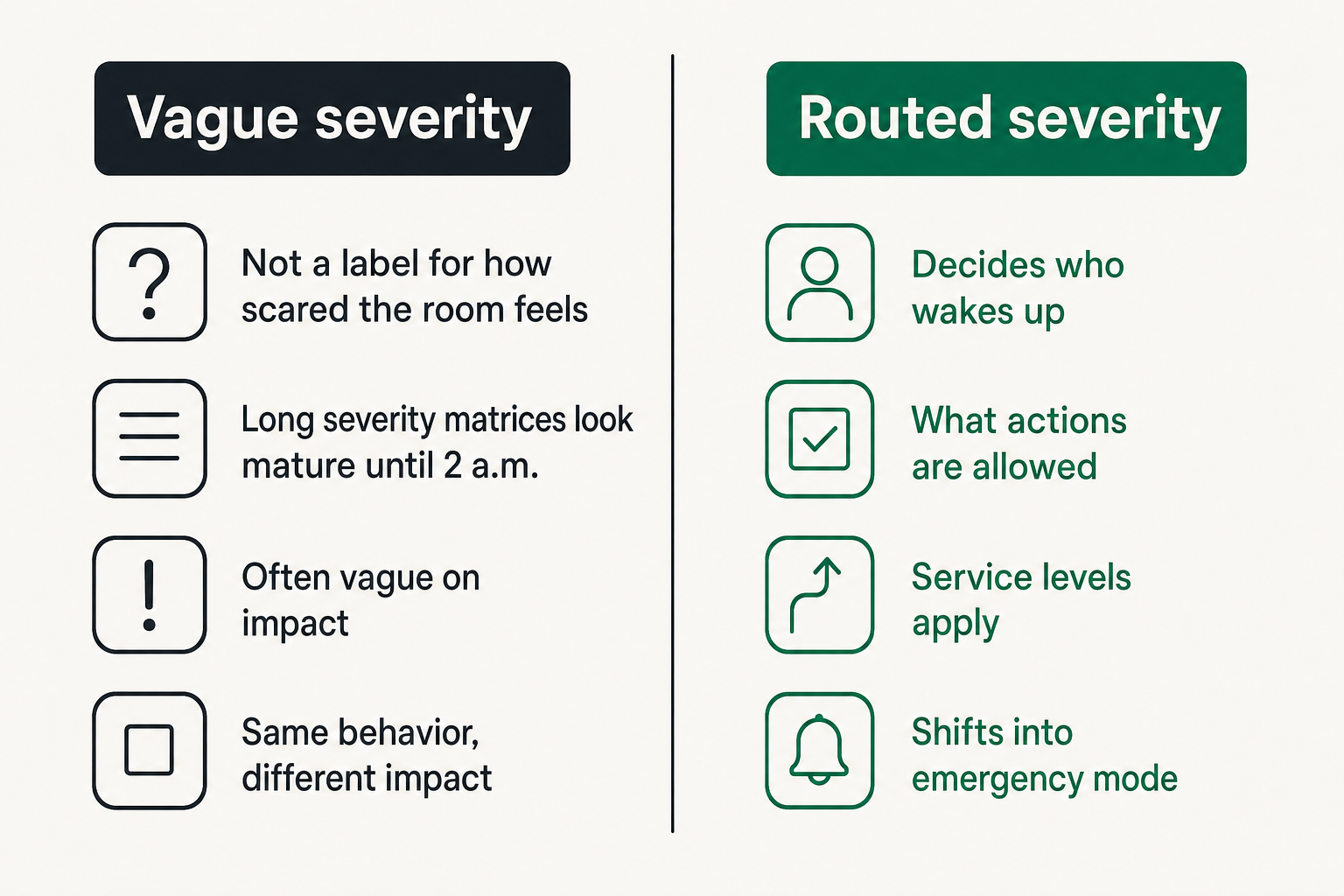
Severity is not a label for how scared the room feels. It is a routing mechanism. It decides who wakes up, what actions are allowed, which service levels apply, and whether the organization shifts from normal operations into emergency mode.
A useful severity model maps technical evidence to business impact:
| Severity | Example condition | Routing | Response posture |
|---|---|---|---|
| SEV-4 | Low-confidence suspicious activity on noncritical asset | SOC queue | Investigate during shift |
| SEV-3 | Confirmed malware on user endpoint, no spread | SOC plus endpoint owner | Contain and monitor |
| SEV-2 | Credential theft, lateral movement, cloud admin abuse | Incident commander, IAM, IT, legal notified | Active containment |
| SEV-1 | Material business disruption, ransomware, data exposure, critical infrastructure impact | Executive bridge, legal, comms, IR leadership | Emergency response |
Keep the model short. Long severity matrices look mature until an analyst has to use them at 2 a.m.
Make impact explicit
Impact is where security teams often get vague. Do not define severity only by attacker behavior. Define it by the asset, identity, data, customer exposure, operational dependency, and recoverability.
For example, a single suspicious PowerShell event on a kiosk is not the same as the same behavior on a jump host. A token theft alert against a dormant test account is not the same as a privileged identity with production access.
Your emergency response guidebook should require responders to record:
- Affected identity or asset
- Business owner
- Data classification
- Internet exposure
- Privilege level
- Evidence confidence
- Known blast radius
- Current containment status
Practical rule: Severity should route action, not decorate a ticket. If severity does not change ownership, urgency, or authority, it is not doing work.
What fails when severity is vague
What breaks in practice is escalation inconsistency. One analyst wakes everyone for a noisy alert. Another waits too long on a real intrusion because the evidence is not perfect. Leadership loses trust, and the SOC starts optimizing for avoiding embarrassment instead of reducing risk.
Vague severity also damages automation. If your SOAR playbook cannot distinguish low-confidence enrichment from confirmed compromise, it either does too little or too much. Both are expensive.
Build the response workflow
Intake and verification
The first workflow in the guidebook is intake. This is where alerts, reports, threat intel, user complaints, managed service notifications, and vendor advisories enter the response system.
Define the intake contract:
- Source of the report
- Timestamp and timezone
- Initial evidence
- Affected entity
- Current detection rule or case ID
- Confidence level
- Immediate risk if no action is taken
- Required next verification step
Verification should not mean endless investigation. It means reaching the minimum evidence threshold for the next decision. For example, a phishing report may require header review, URL detonation, mailbox search, and identity sign-in checks. A cloud token alert may require session review, audit logs, impossible travel context, and privilege inspection.
Containment and eradication
Containment actions need pre-approval boundaries. Do not make the analyst guess whether they are allowed to disable a user, isolate a host, block an IP, revoke sessions, rotate keys, suspend a workload, or quarantine email.
A simple model works:
- Low-risk reversible actions are pre-approved for SOC execution.
- Medium-risk actions require incident commander approval.
- High-risk business-impacting actions require named business and technical approval.
- Emergency actions can bypass normal approval if SEV-1 criteria are met, with after-action review required.
Eradication should be treated separately from containment. Containment stops spread. Eradication removes persistence, closes exploited paths, resets credentials, patches exposed systems, and validates that the adversary no longer has access.
Recovery and handoff
Recovery is where security and operations collide. The SOC may want logs preserved and systems held offline. The business may want services restored immediately. The guidebook should define recovery gates before that tension appears.
Recovery gates might include:
- Forensic preservation completed or waived by incident commander
- Root cause understood enough to avoid immediate reinfection
- Credentials and secrets rotated where required
- Clean image or known-good state confirmed
- Monitoring temporarily increased
- Business owner accepts residual risk
Related reading from our network: product teams have the same handoff problem after launch incidents, and the operating model in product operations shipping systems is a useful adjacent lens for building repeatable coordination.
Assign ownership that survives pressure
Roles that matter in the first hour
The guidebook should name roles, not just teams. Team names create ambiguity. Roles create accountability.
At minimum, define:
- Incident commander: owns the response process and decisions
- SOC lead: owns triage quality and detection context
- Investigation lead: owns evidence collection and hypothesis tracking
- Containment owner: owns technical control actions
- Communications owner: owns status updates and message discipline
- Business owner: owns operational impact decisions
- Legal or privacy representative: owns regulatory and privilege-sensitive guidance
One person can hold multiple roles in smaller organizations, but the roles still need to exist.
Decision rights and escalation paths
Decision rights should be boring and explicit. Who can declare an incident? Who can upgrade severity? Who can take customer-facing systems offline? Who can engage outside counsel or a retainer? Who can approve public statements?
The mistake teams make is assuming seniority equals authority. In a real incident, the senior person may be unavailable, uninformed, or focused on a different part of the response. The guidebook should define primary and backup decision owners.
Practical rule: Every critical decision needs a named owner, a backup owner, and a timeout rule. If nobody decides within the timeout, the guidebook should say what happens next.
Shift handoffs without context loss
Long incidents cross shifts. Context loss becomes a defect in the response system.
A handoff should include:
- Current severity and why
- Timeline of confirmed facts
- Open hypotheses
- Actions completed
- Actions pending
- Evidence locations
- Stakeholders notified
- Decisions made and by whom
- Next checkpoint time
Do not rely on chat scrollback. Chat is useful for coordination, but it is a poor system of record. The guidebook should define where the canonical incident timeline lives.
Connect signals to actions
Alert sources and evidence standards
A guidebook cannot assume every alert is equal. EDR, SIEM correlation, identity logs, cloud audit events, NDR, user reports, vulnerability intelligence, and third-party notifications all have different confidence and latency profiles.
Define evidence standards by response type. For example:
- Host isolation may require endpoint telemetry plus suspicious process ancestry.
- Account disablement may require impossible travel plus risky session behavior or confirmed phishing.
- External blocking may require indicator confidence, recency, and business impact review.
- Breach declaration may require confirmed unauthorized access to protected data or systems.
This is where good threat analysis workflows matter. A guidebook should not ask analysts to manually rebuild context from scratch every time the same class of incident appears.
Threat intelligence in the guidebook
Threat intelligence belongs in the guidebook only if it changes decisions. Indicator lists are not enough. The useful questions are:
- Is this indicator active, stale, or low-confidence?
- Is it associated with a campaign targeting our sector?
- Does it match observed behavior in our environment?
- Does it raise or lower severity?
- Does it justify containment, hunting, blocking, or monitoring?
A practical guidebook maps intelligence to action. For example, a new C2 domain tied to active exploitation of a technology you run should trigger exposure checks, historical log searches, network blocks if safe, and a hunt package. A random hash from an unscored feed should not trigger emergency response by itself.
Automation boundaries
Automation is useful when the decision is clear, reversible, and well-scoped. It is dangerous when the evidence is thin and the blast radius is large.
Good automation candidates:
- Enrich indicators with reputation, age, and source confidence
- Pull asset criticality and owner data
- Open an incident case with normalized fields
- Notify the on-call responder
- Collect volatile endpoint triage data
- Revoke sessions for confirmed compromised low-risk accounts
Poor automation candidates:
- Declaring breach status
- Disabling high-privilege production accounts without context
- Blocking broad IP ranges based on unverified intelligence
- Deleting evidence during cleanup
- Sending customer communications
The guidebook should define which automations are advisory, which are pre-approved, and which require human approval.
Write runbooks operators will use
Page structure for a usable runbook
A runbook should be short enough to use and specific enough to matter. The best structure is repetitive:
- Scenario name
- Trigger conditions
- Minimum evidence threshold
- Severity mapping
- First 15 minute actions
- Containment options
- Evidence to preserve
- Escalation criteria
- Recovery gates
- Validation steps
- Known false positives
- Owner and last tested date
Do not hide operational content behind prose. Operators need checklists, decision trees, commands, queries, and links to the systems they actually use.
What works
What works is scenario-based guidance. Identity compromise, ransomware precursor activity, cloud key exposure, suspected data exfiltration, malicious email campaign, endpoint malware, SaaS account takeover, and critical vulnerability exploitation each need different response paths.
A useful runbook includes example queries and action snippets. For example:
Identity compromise quick checks
- Review recent sign-ins for the identity
- Confirm MFA changes and device registrations
- Revoke active sessions
- Reset password or rotate secret
- Search for inbox rules and OAuth grants
- Check privilege changes in the last 24 hours
- Hunt for use of the same source IP against other accounts
The content is not fancy. It is executable.
What fails
What fails is the 40-page runbook nobody opens. Also failing: runbooks that assume tools are always available, credentials work, logs are complete, or the original author is online.
Runbooks fail when they do not include edge cases:
- Logging outage during the incident
- EDR agent offline on the affected host
- Cloud audit delay
- Privileged user on vacation
- Business system with no clear owner
- Conflicting evidence from multiple tools
- Third-party system outside your control
The guidebook should treat these as normal response conditions, not exceptions.
Make communications part of the system
Internal status updates
Communications are not a soft skill add-on. They are part of incident control. If stakeholders do not know what is happening, they will create parallel channels, ask analysts for ad hoc updates, and slow the response.
Define a status format:
- Current severity
- Confirmed facts
- Current impact
- Actions completed
- Actions in progress
- Decisions needed
- Next update time
Use the same format every time. Consistency reduces interpretation errors.
Executive and legal coordination
Executives need impact, decision points, and confidence. They do not need raw alert dumps. Legal needs privilege-sensitive handling, notification implications, and evidence preservation. Privacy may need data subject and jurisdiction context.
The guidebook should define when legal joins, when outside counsel is contacted, and how privileged communications are separated from operational chatter. This is not bureaucracy. It protects the organization from turning a technical incident into a governance failure.
Related reading from our network: coordination problems are not unique to security, and the operating model in community operations consulting for local networks is a useful reminder that routing, trust, and follow-up are infrastructure.
Customer and partner messaging
Customer messaging should never be improvised by the SOC. But the SOC must provide the factual substrate: what happened, when it started, what systems are affected, what data may be involved, what actions are complete, and what remains unknown.
The guidebook should define a clean interface between responders and communications teams. Security owns technical accuracy. Communications owns audience fit. Legal owns disclosure risk. Leadership owns final approval.
Practical rule: If the response bridge is also drafting customer language from scratch, the communications workflow failed before the incident began.
Test the emergency response guidebook before the real incident
Tabletop design
A tabletop is not a theater exercise. It is a controlled way to find workflow defects before an attacker finds them for you.
Design tabletops around decisions, not stories. A good scenario forces the team to answer:
- Do we declare an incident?
- What severity applies?
- Who is incident commander?
- What evidence is enough for containment?
- Which business owner must approve downtime?
- What do we say internally?
- When do legal and privacy join?
- What happens if the first containment action fails?
Keep the injects realistic. Logs arrive late. The asset owner is unknown. An executive asks for certainty. A vendor provides partial information. The affected system is business-critical. This is where the guidebook earns its keep.
Detection and response validation
Testing should include technical validation, not just conversation. If the guidebook says the SOC can detect token abuse, revoke sessions, isolate hosts, and search historical logs, prove it.
Validation methods include:
- Atomic tests mapped to common attack techniques
- Purple team exercises
- Benign command execution to validate detection logic
- Simulated phishing and mailbox search drills
- Cloud audit log retrieval tests
- Backup restoration tests
- On-call notification tests
The goal is not to generate perfect scores. The goal is to expose broken assumptions. If a detection fires but nobody owns the next action, the response still fails.
Metrics that are useful
Avoid vanity metrics. Count things that improve response quality:
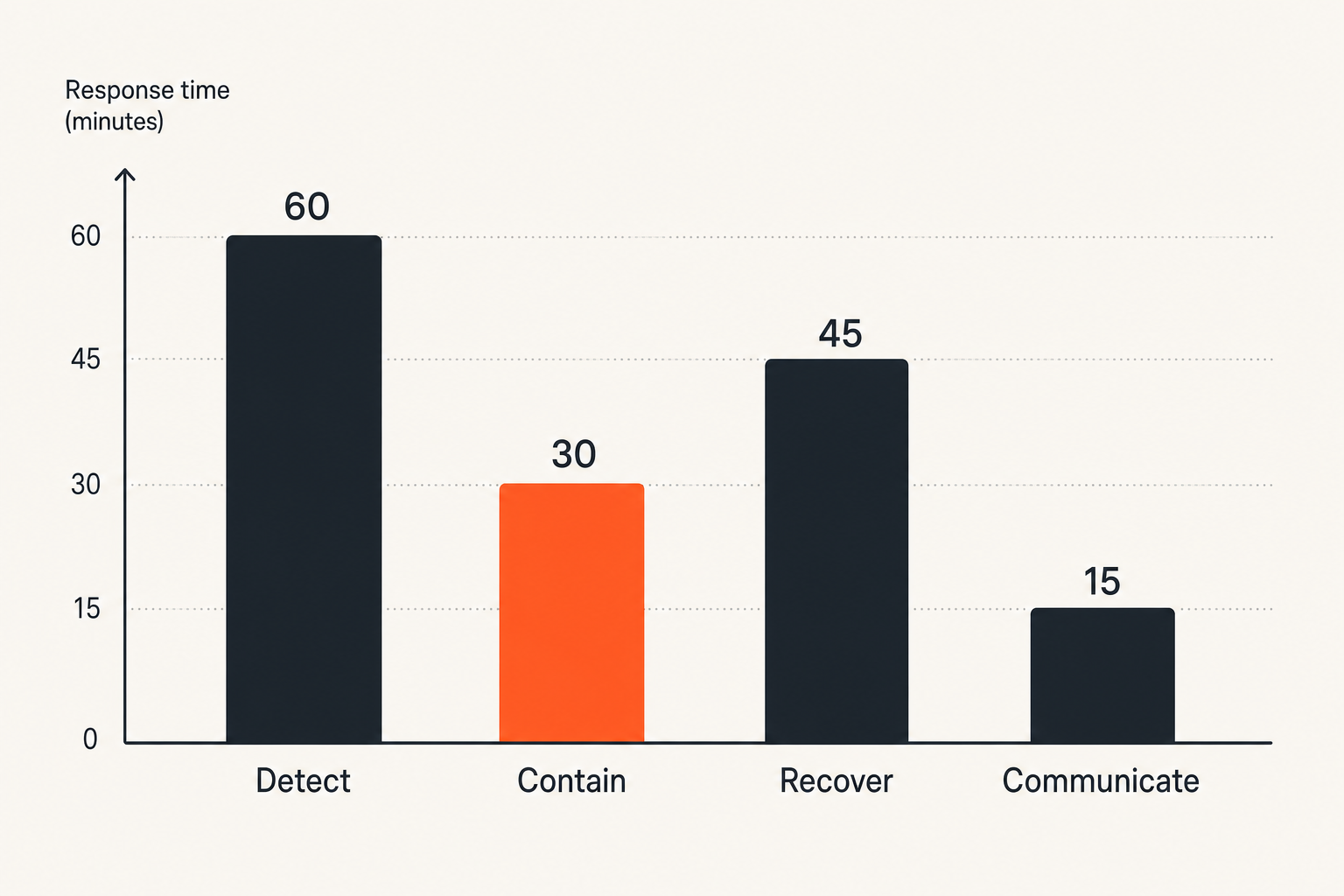
- Time from alert to ownership
- Time from ownership to severity decision
- Time from severity decision to containment action
- Number of handoff defects
- Number of stakeholder update misses
- Percentage of runbooks tested in the last quarter
- Number of automations disabled due to poor confidence
- Reopen rate after recovery
These metrics are not about blaming analysts. They show where the workflow is brittle.
Implementation sequence for 2026 SOCs
The 30 day build
Start narrow. Do not try to document every incident type. Build the emergency response guidebook around the incidents most likely to hurt the business.
- Identify the top five emergency scenarios for your environment.
- Define severity criteria and routing for each scenario.
- Name response roles and backups.
- Inventory current detection sources and evidence gaps.
- Draft first-hour runbooks for each scenario.
- Define status update format and cadence.
- Choose the incident system of record.
At the end of 30 days, you should have a usable guidebook, not a perfect one.
The 60 day integration
The second month is about connecting the guidebook to tools and workflows.
Integrate:
- SIEM cases or alerts
- EDR response actions
- IAM controls
- Cloud audit and containment paths
- Ticketing or case management
- On-call paging
- Threat intelligence enrichment
- Evidence storage
- Communications templates
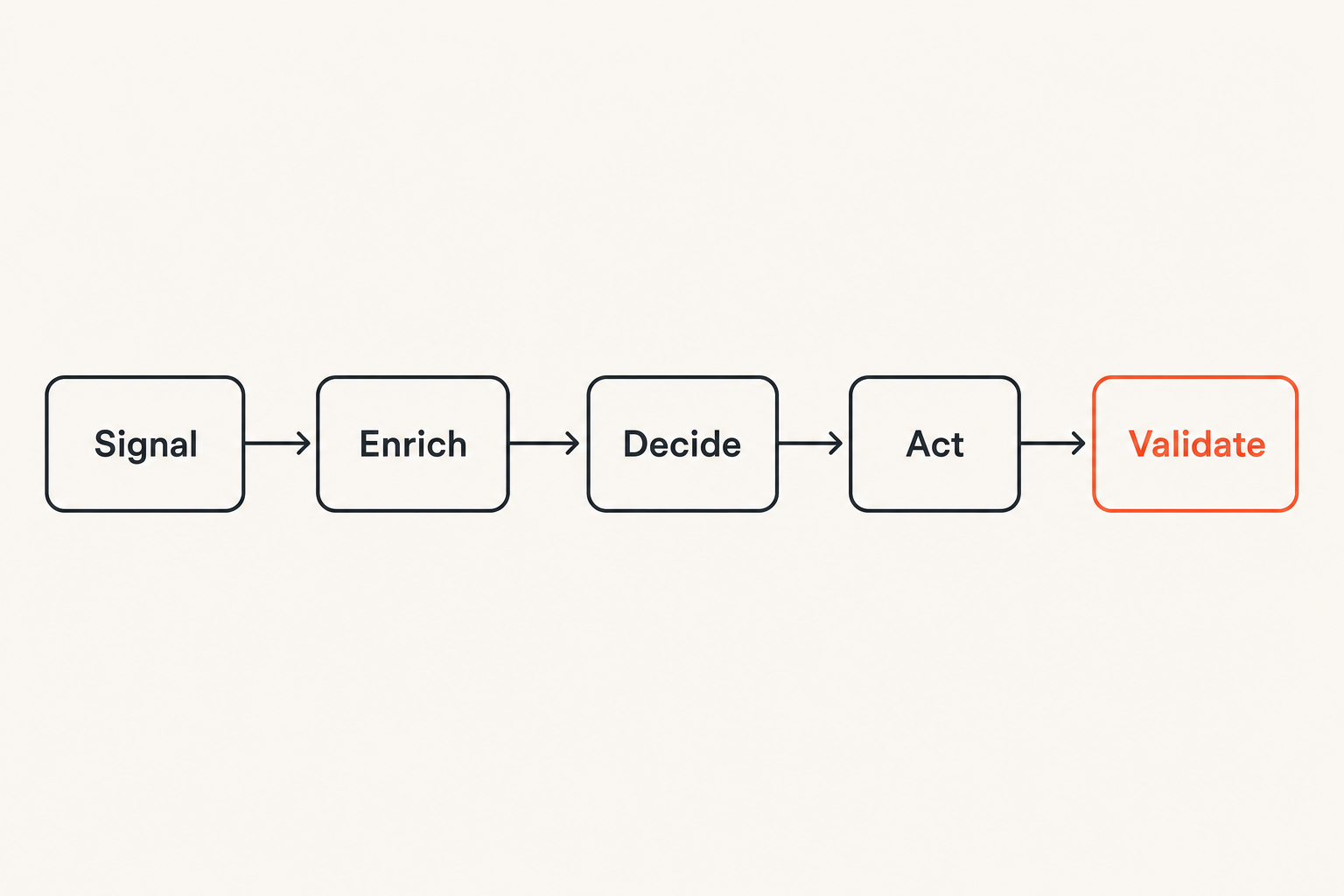
The practical question is whether the analyst can move from signal to action without retyping context across five systems. If the answer is no, fix the workflow before adding more content.
The 90 day validation loop
By day 90, test the guidebook end to end.
Run one tabletop and one technical validation exercise for each priority scenario. Record every defect. Assign owners. Update the guidebook. Repeat quarterly.
A simple defect log is enough:
| Defect | Example | Owner | Fix |
|---|---|---|---|
| Missing authority | Nobody can approve host isolation for finance server | Security leadership | Add approval path and emergency exception |
| Missing context | Asset criticality not available in case | IT operations | Sync CMDB field into SIEM case |
| Broken automation | Session revocation fails for federated accounts | IAM team | Add IdP-specific playbook |
| Weak communication | Executives receive inconsistent updates | Incident commander | Standardize update template |
The mistake teams make is treating validation as an annual compliance event. It should be a response engineering loop.
Product fit: where ThreatCrush belongs
What threat context should automate
ThreatCrush fits best where threat context needs to become response context. In an emergency response guidebook, that means enriching alerts with indicator confidence, vulnerability exposure, attacker context, asset relevance, and campaign recency so analysts can make faster severity and containment decisions.
The product should not replace the incident commander. It should reduce the time responders spend asking basic questions:
- Is this indicator known and current?
- Is this vulnerability relevant to assets we expose?
- Is this activity associated with an active threat actor or campaign?
- Have we seen related infrastructure before?
- Which signals should move from monitoring to action?
That is the useful place for intelligence in response: not a separate portal, but a decision layer inside the workflow.
Where humans should stay in control
Humans should own judgment-heavy decisions: breach declaration, public communications, materiality, destructive containment, legal escalation, and business-risk tradeoffs. Tools can prepare the evidence and recommend paths. They should not silently take responsibility for business impact.
For teams building and scaling SOC capabilities, the architecture matters more than the buzzwords. Connect proactive intelligence to reactive response. Make severity operational. Keep ownership explicit. Validate the workflow before the incident.
A good emergency response guidebook is not finished when it is published. It is working when the next incident is shorter, cleaner, and less dependent on whoever happens to be online.
Try threatcrush.com
You are writing for security operations professionals building and scaling SOC capabilities. If your emergency response guidebook needs real-time threat intelligence, vulnerability context, and attack surface monitoring connected to SOC workflows, Try threatcrush.com.
Try ThreatCrush
Real-time threat intelligence, CTEM, and exposure management — built for security teams that move fast.
Get started →