Cybersecurity Certifications for SOC Teams: Build Skills Into the Workflow
A SOC can spend a lot of money on cybersecurity certifications and still have the same queue, the same noisy detections, and the same slow incident handoffs.
That is usually when the argument starts. Managers ask which credential to fund. Engineers ask which one will help their career. Recruiters add acronym filters to job descriptions. None of that is wrong, but it is incomplete.
Teams think the problem is choosing the best cybersecurity certifications. The real problem is connecting skills, ownership, and operational evidence to the work the SOC actually performs.
That changes the conversation. A certification is not a trophy. It is a signal. The practical question is whether that signal maps to triage quality, detection coverage, response speed, threat analysis, cloud visibility, or some other capability the team needs to operate better in 2026.
Table of contents
- Cybersecurity certifications are a workflow decision
- Build the certification map around SOC jobs
- What certifications prove versus what they miss
- A practical certification matrix for security operations
- Design a team learning pipeline, not a badge collection
- Hiring and promotion rules for certifications
- Implementation workflow for a SOC certification program
- Common failure modes in certification programs
- What works and what fails in 2026
- Where ThreatCrush fits in the certification conversation
- Cybersecurity certifications closing checklist
Cybersecurity certifications are a workflow decision
Cybersecurity certifications get treated like individual career assets. For an engineer, that is true. For a SOC leader, it is not enough.
A SOC is a production system. Alerts arrive. Signals are enriched. Cases are routed. Detections are tuned. Incidents are escalated. Lessons become new controls. If a certification does not improve one of those loops, the badge may still be personally valuable, but it is not yet an operating improvement.
A useful way to think about it is simple: certifications should reduce uncertainty about whether someone can own a defined slice of security operations. That slice might be endpoint triage, cloud investigation, malware analysis, SIEM content engineering, threat intelligence analysis, or incident command.
Certs should map to ownership
The mistake teams make is mapping certifications to job titles instead of responsibilities.
A SOC analyst title can mean queue monitoring, log review, EDR triage, user behavior investigation, phishing response, cloud alert handling, or all of the above. A security engineer title can mean detection content, pipeline reliability, tool integration, automation, or vulnerability context.
Before choosing credentials, define the ownership map:
- Who owns alert intake quality?
- Who owns detection tuning?
- Who owns escalation criteria?
- Who owns incident containment playbooks?
- Who owns adversary tracking and threat context?
- Who owns post-incident control changes?
If the work is unclear, certification planning becomes a proxy war for budget and status.
Practical rule: Fund certifications against named operational ownership, not vague professional development.
Credentials do not replace operating evidence
A certification can show study discipline and baseline knowledge. It cannot prove that an analyst will make the right call at 2:17 a.m. when EDR telemetry, identity logs, and threat intel disagree.
For that, you need operating evidence: cases closed well, detections shipped, false positives reduced, investigations documented, escalations handled, and post-incident fixes completed.
If you are rebuilding a SOC maturity model, it helps to start with the larger operating picture. ThreatCrush has a broader guide to security operations architecture and SOC workflows that pairs well with this certification planning model.
Build the certification map around SOC jobs
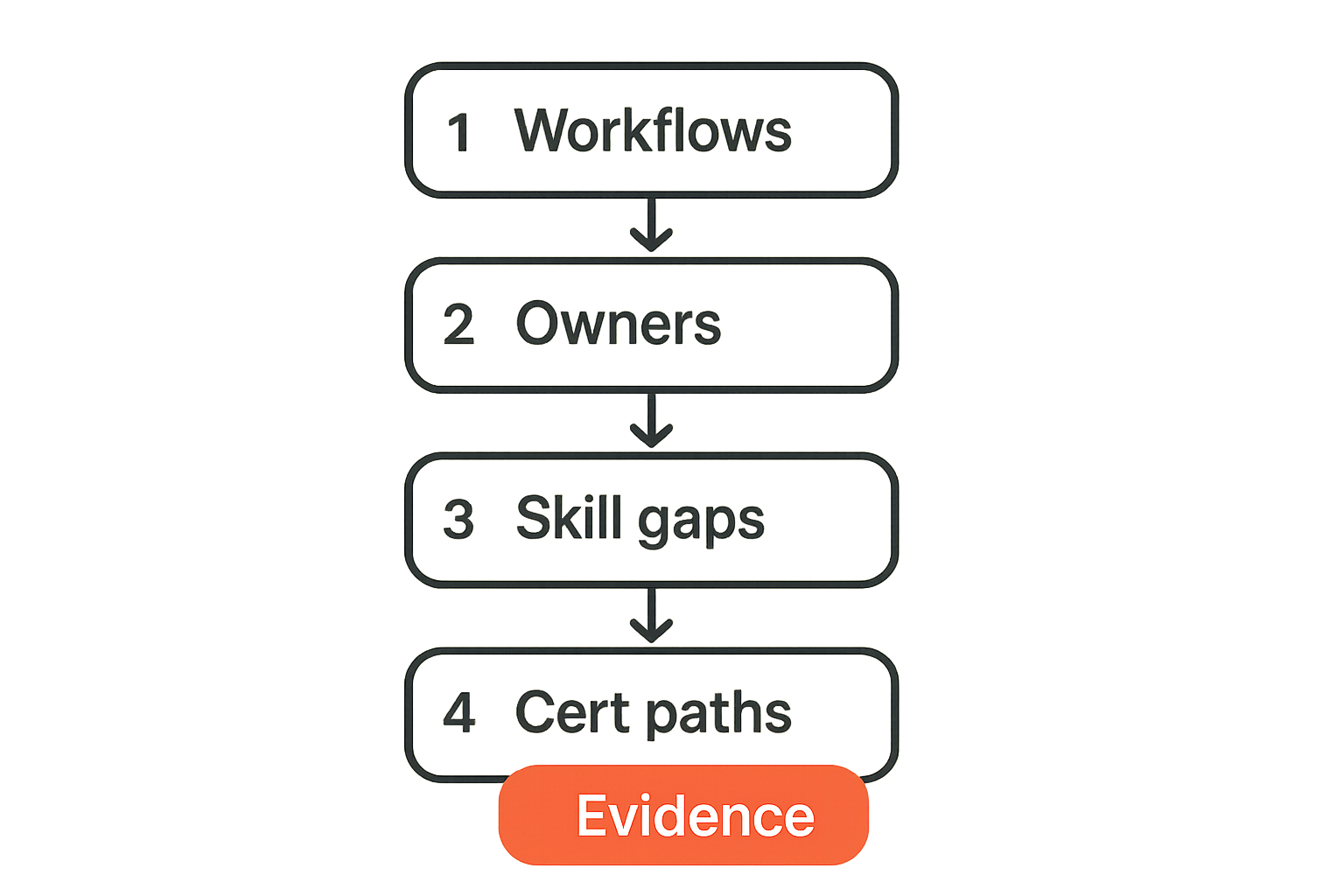
Certifications become useful when they are attached to job families and expected work products. Do not start with a catalog of exams. Start with the SOC workflow.
Tier one triage and alert handling
For tier one analysts, the certification goal is not advanced exploitation knowledge. The goal is reliable signal handling.
Useful capability areas include:
- Networking fundamentals
- Windows and Linux basics
- Identity concepts
- Log interpretation
- Alert severity and confidence
- Basic incident documentation
- Phishing and endpoint triage
Entry-level security certifications can help here if they build common language. But they should be paired with internal exercises: classify this alert, enrich this indicator, decide whether to escalate, write the case note, and identify what data is missing.
What breaks in practice is that junior analysts are sent to memorize security terms, then return to a queue where the real challenge is ambiguity. The certification gave vocabulary. The workflow still needs decision rules.
Detection engineering and content ownership
Detection engineers need a different certification path. They live between adversary behavior, telemetry quality, query language, deployment pipelines, and SOC feedback.
A strong detection engineer should understand:
- ATT&CK-style behavior mapping without treating frameworks as a checkbox
- SIEM query structure and performance tradeoffs
- Endpoint, identity, network, email, and cloud telemetry
- Version control and content review
- False-positive analysis
- Alert routing and severity design
- Validation with real or emulated behavior
General certifications may help, but practical output matters more. A detection engineer should be able to show a rule, explain the data source, justify the logic, describe known gaps, and prove that the detection was tested.
For adjacent detail on connecting analysis steps instead of leaving them as disconnected habits, see the ThreatCrush guide to threat analysis workflows that actually work.
Incident response and threat hunting
Incident responders and hunters need deeper investigative judgment. Certifications in incident response, forensic analysis, cloud security, and malware analysis can be useful, but only when the team has a place to apply them.
A responder needs to answer operational questions quickly:
- What happened?
- What systems and identities are affected?
- Is the activity still active?
- What containment action is safe?
- What evidence must be preserved?
- What detections or controls failed?
Threat hunting adds another layer: hypothesis design, data access, enrichment, and disciplined documentation. A certification may teach methodology. The SOC must provide the data, tooling, and time to execute it.
What certifications prove versus what they miss
Cybersecurity certifications are neither useless nor magical. They are compressed signals. The mistake is treating one signal as a complete assessment.
Knowledge signals
Certifications can prove several useful things:
- The person can follow a structured learning path.
- The person understands common terminology.
- The person has been exposed to a body of practice.
- The person may satisfy customer, partner, or compliance expectations.
- The person has enough persistence to prepare and pass an exam.
For early-career analysts, that signal matters. It can reduce onboarding friction. It can also help teams standardize vocabulary across shifts and regions.
For experienced operators, certifications are more useful when they indicate a specialization: cloud security, incident response, forensics, detection engineering, penetration testing, malware analysis, governance, or architecture.
Execution gaps
The gap is execution under constraints.
Exams rarely reproduce production conditions: incomplete telemetry, broken parsers, stale asset inventory, noisy alerts, business pressure, tool latency, unclear ownership, and executives asking for certainty before the evidence supports it.
A person can pass an exam and still struggle to:
- Distinguish suspicious from merely unusual behavior
- Write a useful escalation note
- Tune a detection without deleting the signal
- Understand how an alert maps to business impact
- Communicate containment risk to IT owners
- Document lessons learned in a way engineering teams can act on
That does not make the certification bad. It means the certification must be paired with workflow validation.
Practical rule: Treat a certification as evidence of preparation, not evidence of production readiness.
The evidence portfolio
The best SOCs ask for a portfolio of evidence, not just a badge list. That portfolio can be lightweight:
- Example detection logic with explanation
- Sanitized incident timeline
- Threat hunt hypothesis and findings
- Case note showing escalation quality
- Post-incident action plan
- Lab write-up with assumptions and limitations
- Automation script with rollback notes
This changes hiring and promotion. Instead of asking whether someone has a credential, you ask what the credential enabled them to build, investigate, improve, or own.
A practical certification matrix for security operations
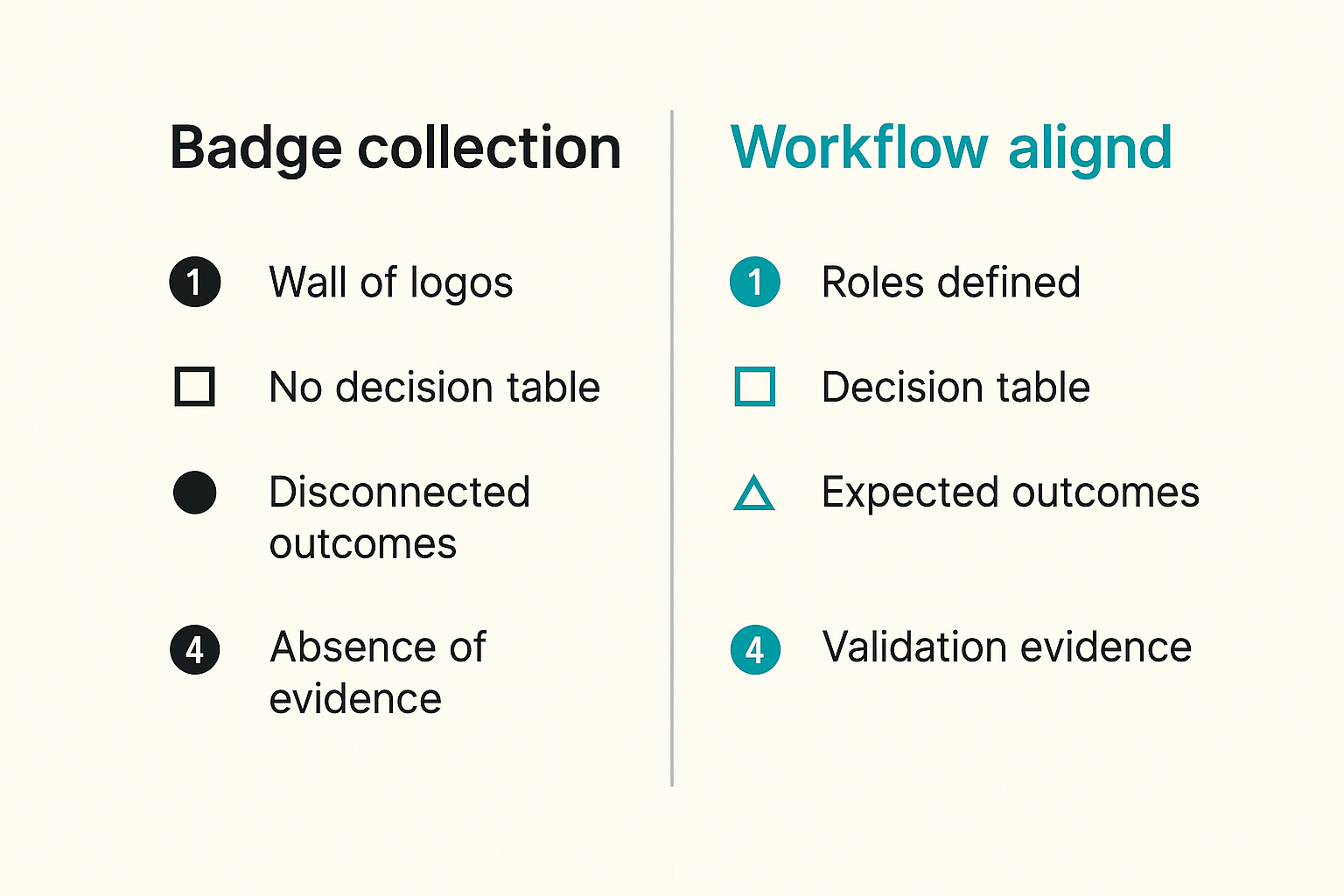
A certification matrix should not be a wall of logos. It should be a decision table that connects roles, expected outcomes, and validation evidence.
Role to certification fit
Use this kind of table as a starting point. The certification examples are categories, not endorsements of one vendor or body over another.
| SOC role | Useful certification focus | What it should improve | Validation evidence |
|---|---|---|---|
| Tier one analyst | Security fundamentals, networking, endpoint basics | Alert classification and escalation quality | Sample triage notes, closed case review |
| Tier two analyst | Incident handling, identity, cloud logs, threat intel | Investigation depth and faster scoping | Timeline, affected asset list, containment recommendation |
| Detection engineer | Detection logic, SIEM, cloud security, adversary behavior | Higher signal quality and testable coverage | Rule repo, test results, false-positive analysis |
| Incident responder | Forensics, malware, IR process, cloud response | Better containment and evidence handling | Incident report, evidence plan, recovery checklist |
| Threat hunter | Hypothesis-driven hunting, data analysis, adversary tradecraft | Better proactive discovery | Hunt plan, findings, detection candidates |
| SOC architect | Security architecture, logging strategy, governance | Better tooling and ownership design | Reference architecture, integration map, data source plan |
| SOC manager | Risk, governance, operations, incident command | Better prioritization and staffing | Operating model, metrics review, budget rationale |
The matrix forces a useful discussion: what operational behavior should change after the certification?
When senior certifications make sense
Senior certifications make sense when the person is responsible for architecture, governance, risk decisions, incident leadership, or cross-functional security programs.
They are less useful as automatic filters for hands-on SOC roles. A senior credential may indicate breadth, but a detection engineer still needs to write and maintain detections. An incident responder still needs to work evidence. A security architect still needs to understand how telemetry lands in the SOC.
Use senior certifications to support roles that require judgment across teams:
- Security architecture review
- Control strategy
- Incident command
- Executive communication
- Audit and compliance translation
- Budget and roadmap planning
Do not use them as a substitute for technical evaluation.
When vendor certifications matter
Vendor certifications matter when the tool is operationally central. If your SOC depends on a specific EDR, SIEM, cloud platform, identity provider, SOAR, or case management system, vendor-specific training can shorten ramp time.
But there is a trap. Vendor certification often teaches the intended product path. Production environments do not always follow that path. Logs are missing. APIs rate-limit. Agents drift. Cloud accounts are inconsistent. Parsers break. Licensing boundaries shape visibility.
Vendor certifications are best for administrators and power users who will configure, troubleshoot, automate, and integrate the platform. They are weaker as proof of general security judgment.
Design a team learning pipeline, not a badge collection
Most certification programs fail because they are managed like reimbursements. Someone requests a course. Someone approves it. Months later, a badge appears. Nothing in the SOC workflow changes.
The better model is a learning pipeline: baseline, practice, validation, production ownership, and review.
Baseline capability
Set a baseline for each role. Keep it concrete.
For a tier one analyst, baseline might mean:
- Read common logs without guessing
- Enrich IPs, domains, hashes, users, and hosts
- Apply severity and confidence consistently
- Escalate with enough context for tier two
- Avoid closing alerts without evidence
For detection engineers, baseline might mean:
- Write maintainable queries
- Document data requirements
- Test detections before deployment
- Track false positives
- Link detections to known behaviors
- Handle rule rollback safely
The certification is one input into this baseline. It is not the baseline by itself.
Practice loops
Training sticks when it is used quickly. Build short practice loops after certification milestones.
Examples:
- After a fundamentals course, assign five real historical alerts for triage review.
- After an incident response course, run a tabletop with incomplete evidence.
- After a cloud security course, ask the engineer to investigate suspicious identity activity.
- After a detection engineering course, require one detection improvement with test notes.
Remote and distributed teams need deliberate coordination around these loops. Related reading from our network: remote teams face the same problem of building the workflow, not just scheduling the call.
Review gates
Review gates keep training from becoming performative.
A useful gate asks three questions:
- What did the person learn?
- What SOC workflow did it improve?
- What evidence shows the improvement?
Do not make the review a ceremony. Make it operational. If an analyst completes a phishing course, inspect their phishing triage notes. If an engineer completes a cloud security certification, review a cloud investigation or detection change.
Practical rule: Every funded certification should have a follow-on work product within 30 to 60 days.
Hiring and promotion rules for certifications
Certifications are common in hiring screens because they are easy to search. Easy does not mean accurate.
Screen for signal, not initials
Use certifications to understand exposure, not to reject every candidate without the right acronym. Many strong operators came through IT, networking, systems administration, software engineering, intelligence, military, fraud, compliance, or self-directed lab work.
A better screen combines:
- Relevant certifications
- Hands-on projects
- Investigation examples
- Writing quality
- Tool experience
- Curiosity about evidence
- Ability to explain tradeoffs
The mistake teams make is using certification filters to hide uncertainty in the hiring process. If the job requires cloud incident response, test cloud incident response. If the job requires detection engineering, review detection logic.
Interview around workflows
Ask candidates to walk through the work.
For analysts:
- Here is an alert. What do you check first?
- What would make you escalate?
- What evidence would let you close it?
- What would you include in the case note?
For detection engineers:
- What data source do you need?
- How would you avoid excessive false positives?
- How would you test this rule?
- How would you monitor it after deployment?
For responders:
- What is your containment sequence?
- What evidence do you preserve?
- What teams do you involve?
- What do you communicate when confidence is incomplete?
Incident communications also need secure channels and clear retention expectations. Related reading from our network: end-to-end encrypted messaging workflows have similar trust and operations tradeoffs.
Promotion should track production ownership
Promotions should not be automatic after a certification. They should track expanded ownership.
Good promotion evidence includes:
- Reduced escalation rework
- Ownership of a detection category
- Better incident timelines
- Fewer stale cases
- Improved handoff quality
- Mentoring junior analysts
- Documented playbook improvements
- Better post-incident control changes
A certification can support the case. It should not be the case.
Implementation workflow for a SOC certification program
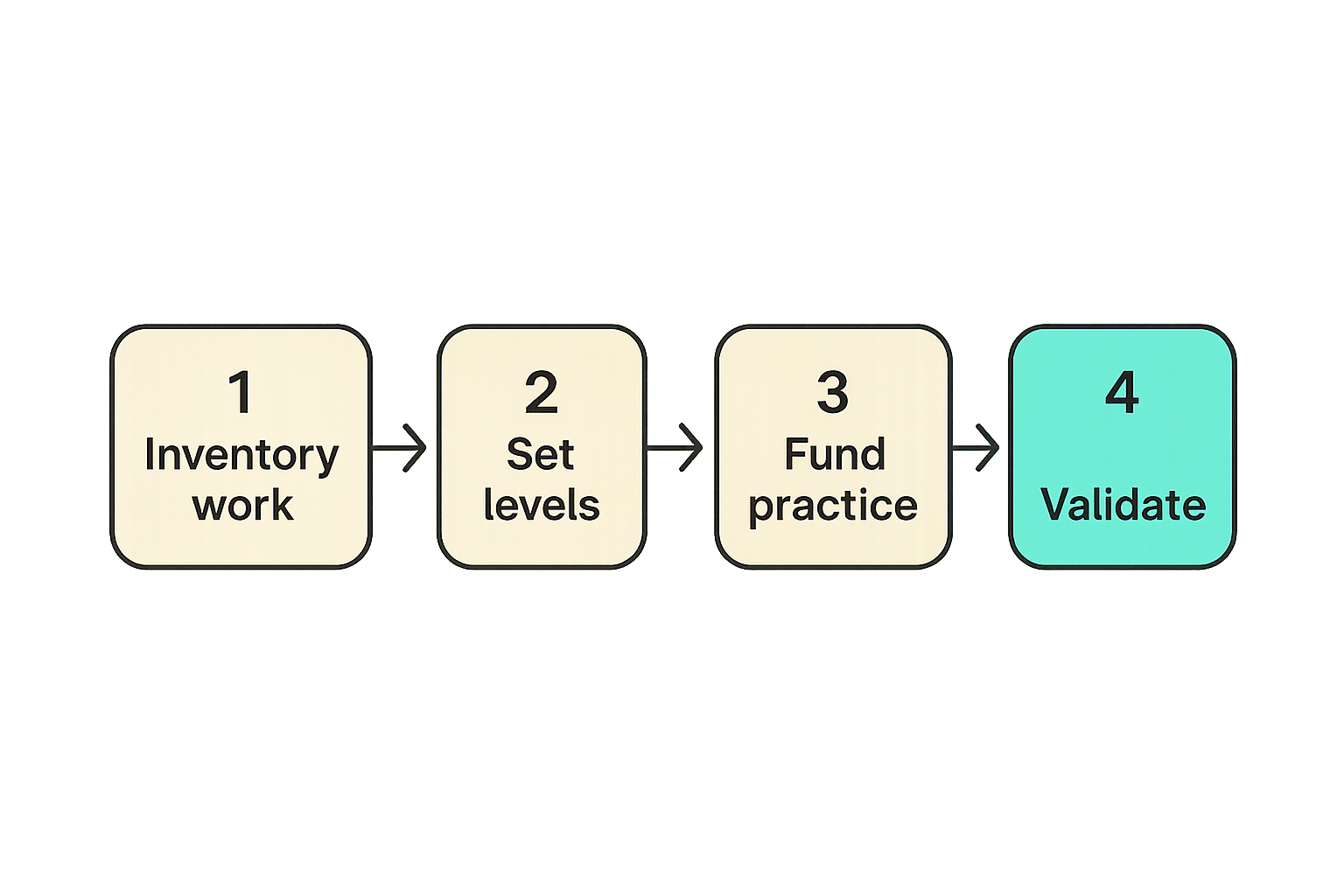
The practical question is how to turn this into a program without creating another administrative burden. Keep it simple enough that managers, leads, and engineers can use it during planning.
Step one inventory the work
Start with the work, not the credentials.
- List recurring SOC workflows: alert triage, phishing, endpoint investigation, identity investigation, cloud alert review, threat intel enrichment, detection tuning, incident response, threat hunting, reporting.
- Assign owners for each workflow.
- Identify where quality breaks: slow triage, weak notes, poor enrichment, noisy detections, missed cloud context, unclear containment, bad handoffs.
- Rank the gaps by operational pain.
This becomes your training demand signal.
Step two assign capability levels
Define capability levels for each workflow. Avoid vague labels like beginner and expert unless you define them.
Example for identity investigation:
- Level 1: Can identify user, source, target, time, and basic anomaly.
- Level 2: Can correlate identity activity with endpoint, VPN, email, and cloud logs.
- Level 3: Can scope blast radius, recommend containment, and identify detection gaps.
- Level 4: Can improve identity detections, update playbooks, and mentor others.
Now map certifications to the level they support. A fundamentals credential may support Level 1. A cloud or identity credential may support Level 2 or 3. Production ownership proves Level 4.
Step three fund and schedule practice
Certification funding should include time. If the SOC is permanently overloaded, training becomes unpaid evening labor or abandoned ambition.
Build a lightweight schedule:
- Study block approved
- Lab or practice assignment defined
- Exam target date set
- Production work product assigned
- Review owner named
Coordination matters here. Related reading from our network: local network operating models use intake, routing, follow-up, and metrics to keep distributed work from stalling.
Step four validate on real scenarios
Validation should use real scenarios where possible, sanitized when necessary.
Examples:
- Re-triage a noisy detection and propose tuning.
- Build a timeline from historical incident data.
- Investigate a known benign alert and explain why it is benign.
- Create a hunt hypothesis from threat intelligence.
- Write a containment plan for suspected credential compromise.
Keep the output small but concrete. One good case note is better than a long slide deck nobody uses.
Common failure modes in certification programs
Bad certification programs create the appearance of maturity while leaving the SOC unchanged.
The paper expert problem
The paper expert problem appears when certified staff are treated as production-ready in areas they have not operated.
This creates risk. A person may know the IR lifecycle but have no experience preserving evidence under pressure. They may understand malware terminology but be unable to interpret endpoint telemetry. They may know cloud security concepts but not the organization’s cloud logging gaps.
The fix is not cynicism. The fix is supervised ownership. Give the certified person a real task, bounded scope, review, and feedback.
The vendor console trap
The vendor console trap appears when teams equate tool familiarity with security capability.
A console can make investigation feel structured. It can also hide assumptions. If an analyst only knows which button to click, they may miss what data is absent, delayed, normalized incorrectly, or not collected at all.
Vendor training should be paired with data literacy:
- What telemetry does this platform collect?
- What does it not collect?
- How fresh is the data?
- How is severity calculated?
- How are entities correlated?
- How do we export evidence?
- What happens when the agent is offline?
The training backlog
The training backlog is familiar: everyone has a course, nobody has time, and managers feel good because a spreadsheet says learning is planned.
What breaks in practice is capacity. If the queue is burning, people will prioritize alerts over training. If training has no follow-up work product, it will drift. If the program has no owner, approvals become random.
Fix it by limiting active training. It is better to complete three certification-to-workflow loops than approve twenty courses that produce no operational change.
Practical rule: A certification program with no capacity plan is just another backlog.
What works and what fails in 2026
The market for cybersecurity certifications keeps expanding. That does not mean SOC teams need more badges. They need better skill-to-workflow alignment.
What works
What works is boring and effective:
- Map credentials to SOC workflows.
- Define capability levels by work product.
- Pair study with labs and historical cases.
- Review output with senior operators.
- Track whether the workflow improved.
- Use vendor training for platform operators, not as general proof of judgment.
- Keep a portfolio of evidence for hiring and promotion.
This approach respects the value of certifications without pretending they solve the whole skills problem.
What fails
What fails is also predictable:
- Requiring unrelated senior credentials for hands-on roles
- Funding courses without practice time
- Treating multiple-choice exams as incident readiness
- Promoting people based only on badge accumulation
- Letting vendors define the entire skill model
- Ignoring writing, documentation, and handoff quality
- Training people on tools without teaching data limitations
The SOC pays for these mistakes through rework: repeated escalations, missed context, brittle detections, slow containment, and frustrated analysts.
Metrics worth tracking
Avoid vanity metrics like total certifications earned unless they are paired with operational outcomes.
Better metrics include:
- Percentage of funded certifications with completed work products
- Triage rework rate before and after training
- Detection false-positive review outcomes
- Mean time from alert intake to confident escalation
- Number of playbook updates tied to training
- Number of analysts validated on specific workflows
- Coverage improvements tied to new skills
You do not need perfect measurement. You need enough evidence to know whether the program is improving the SOC or just decorating resumes.
Where ThreatCrush fits in the certification conversation
Certifications teach concepts. SOC platforms expose whether those concepts survive contact with live signals.
Use certifications to strengthen workflows
ThreatCrush is built for security operations teams that need real-time threat intelligence, vulnerability tracking, attack surface monitoring, and threat actor context in the workflows they already run.
That matters for certification planning because many skill gaps appear at the connection points:
- An analyst knows indicators but lacks enrichment context.
- A detection engineer writes logic but needs current adversary behavior.
- A responder scopes an incident but needs external threat context.
- A SOC lead wants to connect proactive exposure work to reactive investigations.
Training should make those handoffs better. Tooling should make the context available when the work is happening.
Connect learning to live threat context
A useful certification program creates operators who can ask better questions. A useful platform gives them the context to answer those questions faster.
For example, after a threat intelligence or detection engineering certification, the follow-on work product might be:
- Convert a threat actor behavior into a detection hypothesis.
- Enrich a suspicious domain during triage.
- Link a vulnerability exposure to active exploitation context.
- Update a playbook with better escalation criteria.
- Validate whether a detection still matches current tradecraft.
That is the point where learning becomes operations.
Cybersecurity certifications closing checklist
Cybersecurity certifications are worth funding when they improve the SOC’s ability to detect, investigate, respond, and learn. They are a weak investment when they become a detached badge program.
Questions to ask before funding a course
Before approving the next certification request, ask:
- Which workflow will this improve?
- Who owns that workflow today?
- What capability level are we trying to reach?
- What work product will follow the training?
- Who will review it?
- What production metric or quality signal should move?
- Is this credential for baseline knowledge, specialization, vendor operation, leadership, or compliance?
- What happens if the person passes but cannot execute the workflow yet?
If you cannot answer those questions, pause the purchase. The certification may still be good, but the program is not ready.
Final operating principle
The best SOCs do not ask whether cybersecurity certifications matter. They ask where certifications reduce uncertainty, improve ownership, and produce better operational evidence.
That is the practical frame. Choose credentials that help people do the work. Validate them against real cases. Promote based on production ownership. Keep the badge, but make the workflow the source of truth.
Try threatcrush.com
You are writing for security operations professionals building and scaling SOC capabilities. Try threatcrush.com.
Try ThreatCrush
Real-time threat intelligence, CTEM, and exposure management — built for security teams that move fast.
Get started →