Cyber Security Services in 2026: How to Architect Them Around Real SOC Workflows
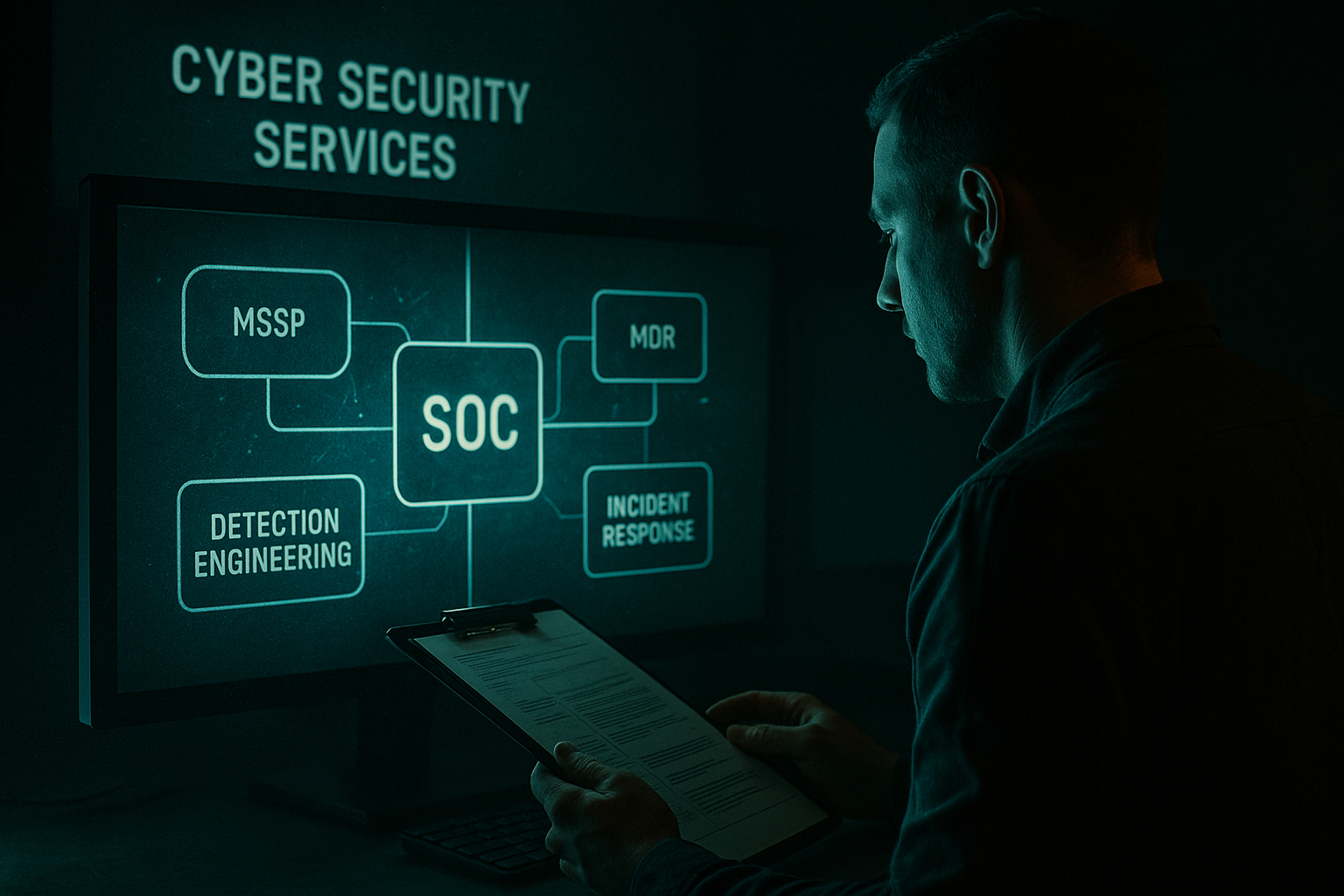
Cyber security services often get bought when the SOC is already under pressure. Alert queues are growing. Analysts are context-switching between SIEM, EDR, ticketing, vuln data, cloud logs, and threat intel. Leadership asks for better coverage, faster response, and clearer risk reduction without adding headcount.
Teams think the problem is buying the right cyber security services provider. The real problem is designing the right operating model for outside help to plug into your detection, investigation, response, and validation workflows.
That changes the conversation. A service is not useful because it has a polished dashboard or a large analyst pool. It is useful when it changes what happens at 02:00 when an alert fires, when a vulnerability is weaponized, when an endpoint is isolated, or when an executive asks whether a new campaign affects the business.
The practical question is not whether you need cyber security services. Most organizations use them somewhere. The practical question is where the service owns work, where your SOC keeps ownership, what signals flow between both sides, and how you prove the arrangement reduces noise instead of creating another queue.
Table of contents
- Cyber security services are an operating model
- Where cyber security services fit in the SOC
- Compare the main cyber security services models
- Build the signal layer before the service starts
- Design the investigation workflow
- Make detection engineering part of the service
- Automate carefully or you will scale bad decisions
- Measure the service like an operational system
- Common failure modes when teams buy cyber security services
- Implementation plan for cyber security services in 2026
- Product fit for threatcrush.com
Cyber security services are an operating model

Why the category is confusing
Cyber security services is a broad label. It can mean managed SIEM, managed EDR, managed detection and response, incident response retainers, penetration testing, attack surface management, threat intelligence, vulnerability management, cloud security engineering, compliance support, or advisory work.
That breadth is the problem. The label tells you almost nothing about the workflow. A provider can say it offers 24x7 monitoring, but that does not answer who tunes detections, who validates suspicious identity activity, who contacts the cloud team, who approves containment, or who updates the runbook after a near miss.
The mistake teams make is buying the category before mapping the job. They ask, do we need MDR, an MSSP, or a retainer? A better first question is, what work is currently failing because we lack capacity, context, tooling, or authority?
The architecture question behind the purchase
A useful way to think about it is this: cyber security services are an extension point in the SOC architecture. They connect to telemetry, tickets, assets, identities, threat intel, response controls, and human decision paths.
If those connection points are weak, the service degrades. If endpoints are unnamed, cloud accounts are not mapped to business owners, detections are duplicated, and escalations happen in chat without durable records, the provider can only add more surface area. The result is not better security operations. It is outsourced confusion.
Practical rule: Do not evaluate a service only by its capabilities. Evaluate it by the decisions it will make, the data it will need, and the handoffs it will create.
What useful services actually change
Useful services change operational outcomes. They reduce false positives, shorten investigation time, improve coverage, validate exposure, and give the internal team more time for engineering work. They also make responsibility clearer.
In practice, that means the provider should not just send alerts. They should enrich events, suppress known noise, document evidence, recommend action, and feed learnings back into detections. Your internal team should not just receive tickets. They should set priorities, approve high-impact actions, own business context, and maintain the architecture.
Related reading from our network: teams hiring for security roles face the same workflow shift, especially when analyst work touches CI/CD and supply chain systems, as described in Cyber Security Analyst Jobs in 2026.
Where cyber security services fit in the SOC
Detection and triage ownership
The first fit question is detection ownership. Who writes rules? Who tunes them? Who decides that a noisy analytic is still worth keeping because it catches a high-risk behavior? Who closes the loop when an alert is confirmed benign?
Many services are strong at first-level triage. That is valuable, but it is not the same as detection engineering. Triage asks whether this event is suspicious. Detection engineering asks whether the analytic should exist, whether it is mapped to adversary behavior, whether it has enough context, and whether it produces actionable output.
For a deeper architecture view of connected investigation steps, see ThreatCrush guidance on threat analysis workflows, especially where signal enrichment and ownership boundaries are treated as one system.
Incident response escalation paths
Incident response is where vague contracts fail. An MDR provider may identify suspicious PowerShell, but who isolates the host? Who checks whether the user is a domain admin? Who searches for lateral movement? Who notifies legal or customer support if data exposure is possible?
The escalation path must be written down before the incident. It should include severity levels, response authority, named teams, communication channels, evidence preservation rules, and fallback contacts. If the service can take containment actions, define exactly which actions are pre-approved and which require confirmation.
Continuous exposure and threat context
Modern SOC work is not only reactive. Teams need to know which exposed systems matter, which vulnerabilities are being exploited, which identities have risky access, and which threat actor behaviors are relevant to their environment.
This is where cyber security services overlap with CTEM, threat intelligence, vulnerability management, and attack surface monitoring. The provider should help connect proactive exposure findings to reactive detections. If a new exploit affects an internet-facing system, the SOC should not wait for a weekly report. It should get routed context, detection coverage, and response guidance.
Compare the main cyber security services models
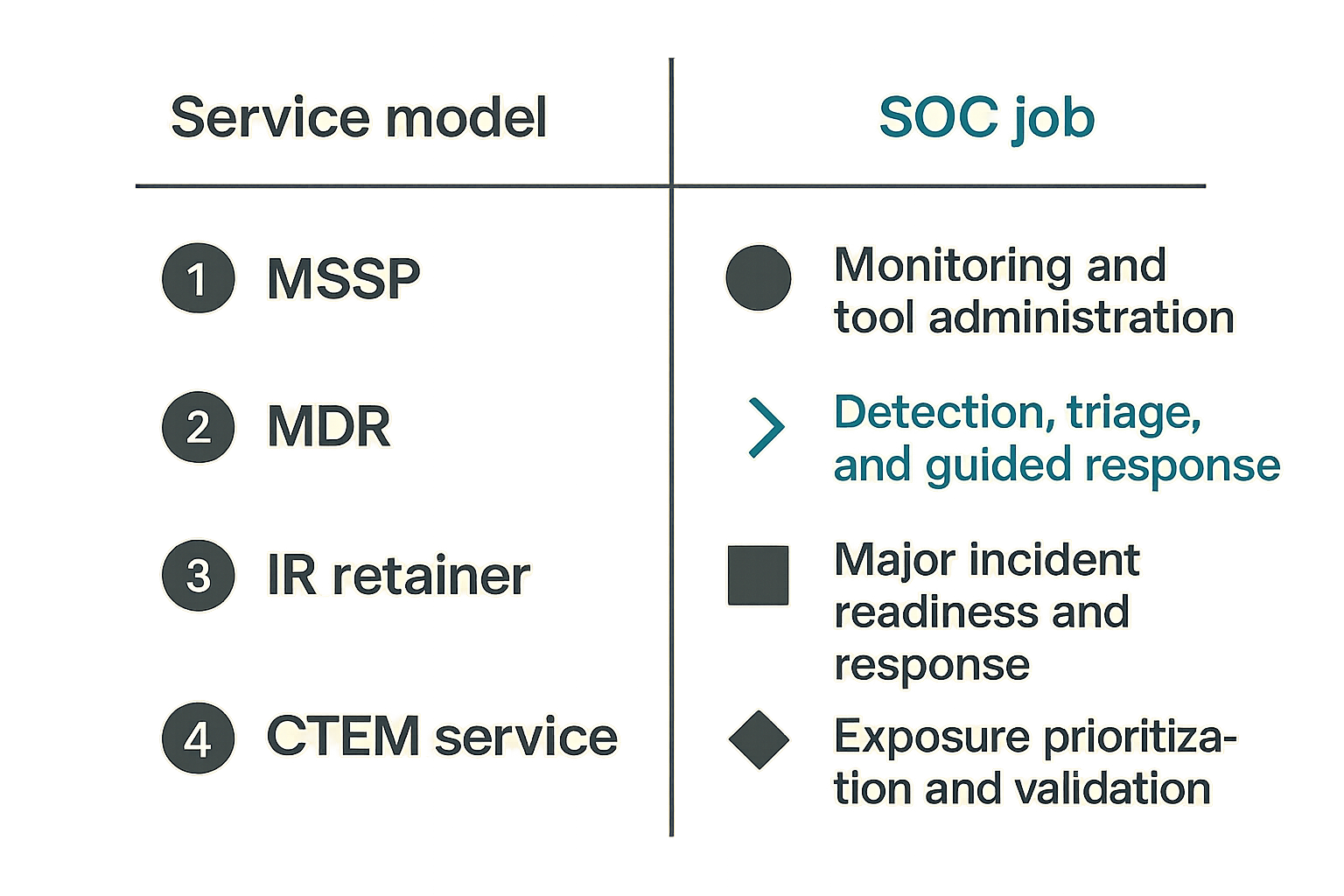
MSSP versus MDR versus IR retainer
Different service models solve different problems. The names are not always used consistently, so treat this table as a practical comparison rather than a strict definition.
| Service model | Best for | Typical output | What breaks in practice |
|---|---|---|---|
| MSSP | Monitoring and tool administration | Alerts, reports, basic tickets | Becomes a remote console watcher with limited context |
| MDR | Detection, triage, and guided response | Enriched incidents, containment recommendations, threat hunting | Escalates too much if detections and assets are messy |
| IR retainer | Major incident readiness and response | Response hours, forensics, executive guidance | Sits unused until a crisis if not integrated into runbooks |
| CTEM service | Exposure prioritization and validation | Risk-ranked findings, exploit context, remediation guidance | Produces lists that do not reach owners or detections |
| Advisory | Architecture, maturity, and program improvement | Roadmaps, designs, assessments | Creates documents that are not tied to implementation |
The mistake teams make is assuming these are interchangeable. They are not. An MSSP may help run your SIEM. MDR may investigate endpoint activity. An IR retainer may help during a breach. CTEM may identify exploitable exposure before an alert fires. Advisory may help redesign the operating model.
CTEM and exposure management services
CTEM and exposure management services are increasingly relevant because attackers do not care how your org chart separates vulnerability management, cloud security, threat intelligence, and SOC triage. They care whether exploitable paths exist.
A good exposure service should answer operational questions. Is this vulnerability reachable? Is there exploit activity? Is the affected asset tied to a critical business service? Is there detection coverage? Has the asset owner accepted or remediated the risk?
If exposure findings stop at a dashboard, they become another backlog. If they feed detection priorities, response plans, and remediation tickets, they become useful.
Advisory services and security engineering help
Advisory work is useful when the internal team needs architectural leverage. That might include SIEM migration planning, detection coverage mapping, cloud logging design, IAM hardening, incident response tabletop design, or SOC metric redesign.
Advisory fails when it is disconnected from operators. A 90-page maturity report does not help if the SOC cannot translate it into queue changes, rule changes, runbook updates, and engineering tasks.
Practical rule: Buy advisory when you need design decisions and implementation sequencing. Do not buy advisory as a substitute for operational ownership.
Build the signal layer before the service starts
Telemetry quality beats tool count
Services depend on signals. More tools do not automatically mean better signals. A provider cannot investigate what you do not collect, and it cannot reliably prioritize events if telemetry lacks asset, identity, and business context.
Start with the basics: endpoint events, identity provider logs, cloud control plane logs, DNS, firewall or network metadata, email security events, SaaS audit logs, vulnerability data, and asset inventory. Then check whether the data is complete enough to answer investigation questions.
For example, an authentication alert is weak if it lacks device, location, MFA state, session history, user role, and recent privilege changes. An endpoint alert is weak if the hostname cannot be mapped to owner, function, criticality, and recent vulnerability state.
Normalize identity asset and network context
Normalization is not glamorous, but it determines whether outside services can work at SOC speed. Asset names should resolve to owners. Cloud accounts should map to environments. Identities should map to human users or service accounts. Network ranges should map to business functions.
A simple context object can be enough:
asset_context:
  hostname: fin-prod-app-07
  owner_team: finance-platform
  criticality: high
  environment: production
  internet_exposed: true
  edr_status: healthy
  vuln_priority: urgent
identity_context:
  user: j.smith
  role: finance-admin
  mfa: enabled
  privileged: true
  recent_password_reset: false
The point is not perfect CMDB purity. The point is to give analysts enough context to decide whether an event matters and who should act.
Threat intelligence needs operational routing
Threat intelligence is often purchased separately from cyber security services, then pasted into reports. That is a waste. Intelligence should route work.
If a threat actor is exploiting a product you run, the SOC needs affected assets, relevant indicators, detection logic, hunting queries, and remediation ownership. If a malware family is associated with specific command and control patterns, those indicators should be evaluated against telemetry and suppression logic should be explicit.
Related reading from our network: secure communications teams face similar routing and metadata tradeoffs, where privacy depends on workflow design rather than the messaging interface alone, in Secure Messaging Apps in 2026.
Design the investigation workflow
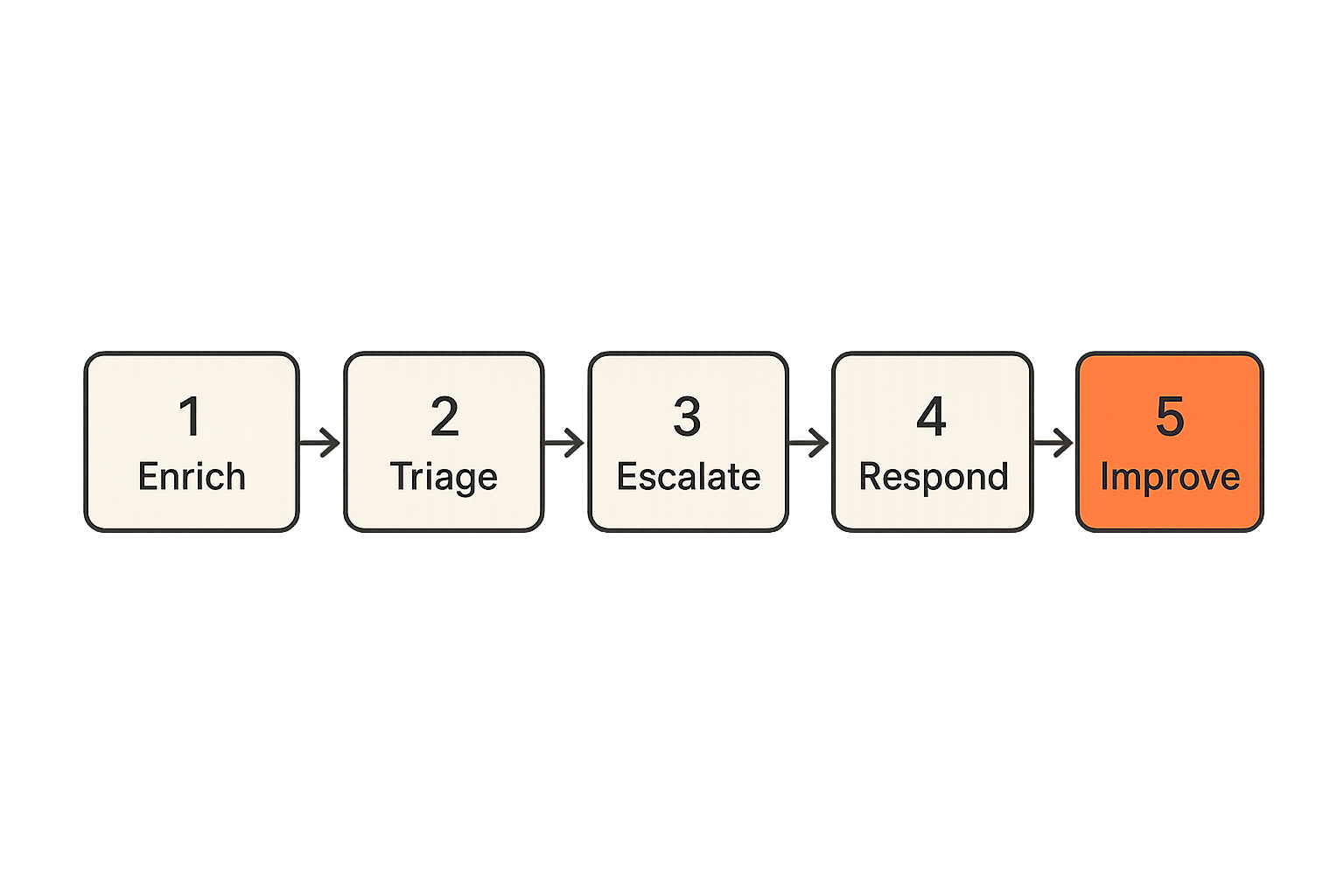
What a good handoff contains
A good provider handoff should reduce work for the receiving team. It should not say suspicious login observed. It should say what happened, why it matters, what evidence supports the assessment, what was ruled out, what response is recommended, and what owner is needed.
Minimum useful handoff fields:
- Summary of suspicious behavior
- Affected assets and identities
- Evidence links and raw event references
- Timeline of relevant activity
- Severity and confidence
- Recommended next action
- Business owner or resolver group
- Related detections, vulnerabilities, or threat intel
- Required decision from the customer team
What breaks in practice is ambiguity. If the internal responder must redo the investigation just to trust the ticket, the service did not reduce workload.
Case management is the source of truth
Chat is useful for speed, but it is not a system of record. Case management should hold the timeline, evidence, decisions, approvals, containment actions, and post-incident updates.
This matters because cyber security services often involve multiple organizations and teams. If the provider investigates in its portal, the SOC tracks in Jira, IT acts in ServiceNow, and executives communicate in Slack, the incident fragments. Nobody can reconstruct the decision path.
The practical fix is to decide which system owns the case and which systems mirror updates. Use ticket IDs across systems. Require closure reasons. Keep evidence links durable. Make sure escalations are visible to both the provider and internal owners.
Use severity as a workflow control
Severity should control workflow, not just reporting color. A high severity incident might require immediate phone escalation, pre-approved containment, executive notification, and a post-incident review. A low severity event might require daily batch review and detection tuning.
Define severity with impact, confidence, and required action. Do not let providers assign severity based only on vendor rule labels. A commodity malware alert on an isolated lab machine is different from suspicious identity activity on a privileged production administrator.
Practical rule: Severity is not a description of how scary an alert sounds. It is a routing decision that determines time, authority, and evidence requirements.
Make detection engineering part of the service
Rules without feedback decay quickly
Detection rules decay. Environments change, attackers change, software changes, and business processes change. A rule that was precise six months ago can become noisy after a new deployment pipeline, admin tool, or SaaS integration appears.
If the provider only triages alerts, the SOC still owns detection debt. That may be acceptable, but it must be explicit. Better models include a feedback loop where confirmed benign patterns become tuning proposals, missed behaviors become new detection candidates, and incident learnings become coverage updates.
This is where service and internal engineering should meet. The provider sees alert volume and investigation outcomes. The internal team understands architecture and business process. Together, they can decide which detections to tune, retire, or strengthen.
Validation closes the gap between coverage and reality
Coverage claims are easy. Validation is harder. A provider may say it detects credential dumping, but does that apply to your EDR configuration, your Windows logging, your identity stack, and your cloud workloads?
Validation can be lightweight. Run safe simulations, replay known test events, review detection mappings, and check whether expected alerts appear with useful context. For high-risk techniques, validate end to end: signal collection, analytic firing, enrichment, triage, escalation, response, and closure.
For broader SOC architecture planning, ThreatCrush has a practical 2026 guide to security operations that covers how SIEM, EDR, SOAR, and workflow ownership should fit together.
A simple detection change workflow
Use a small, repeatable workflow instead of ad hoc tuning debates:
- Capture the detection issue from an incident, false positive, missed signal, or threat intel update.
- Classify the issue as tune, retire, enrich, suppress, or create new analytic.
- Assign ownership between provider, internal detection engineer, and platform owner.
- Test the change against recent data and known edge cases.
- Deploy with a rollback path and expected behavior notes.
- Review volume, fidelity, and investigation outcomes after a defined period.
This sequence keeps detection work tied to real operational pain. It also prevents silent suppression, where teams remove noisy rules without understanding what coverage they lost.
Automate carefully or you will scale bad decisions
What works for automation
Automation works best when the decision is low-risk, repeatable, and backed by enough context. Enrichment is usually safe. Pulling asset context, identity details, geolocation, vulnerability state, and related alerts can save analysts minutes per case without making irreversible changes.
Good automation candidates include:
- Attach asset and identity context to new cases
- Query recent authentication history
- Check whether an IP or domain appears in threat intelligence
- Open remediation tickets for validated exposure
- Notify a service owner with a structured summary
- Collect volatile evidence before containment
Automation should make analysts faster and decisions more consistent. It should not hide uncertainty.
What fails in production
What fails in practice is automating response before trust exists. Blocking IPs, disabling accounts, quarantining hosts, or closing tickets automatically can be useful, but only when the inputs are reliable and the rollback path is clear.
Bad automation usually has one of four causes: weak context, poor exception handling, no human approval point, or no audit trail. A provider may recommend auto-containment, but the internal team must decide which business systems can tolerate false positives.
Related reading from our network: even outside security, coordination systems fail when routing and ownership are implicit; this local network operating model in Community Connections is a useful adjacent example of why follow-up infrastructure matters.
Guardrails for response actions
Use guardrails before enabling automated response actions:
- Pre-approve actions by asset class and severity
- Exclude critical systems unless explicitly allowed
- Require confidence thresholds and evidence fields
- Log every action with actor, reason, and source case
- Define rollback steps for each action type
- Review automated actions weekly during rollout
Practical rule: Automate enrichment first, containment second, and closure last. Closing the wrong case silently is often worse than leaving it open.
Measure the service like an operational system
Metrics that matter to SOC operators
Cyber security services should be measured by operational outcomes, not vanity dashboards. Alert counts alone are weak. A provider can reduce alerts by suppressing too much or increase alerts by adding noisy rules.
Track metrics that reveal workflow health:
- Mean time to acknowledge by severity
- Mean time to triage by severity
- Escalation precision and false escalation rate
- Reopened case rate
- Percentage of cases with complete evidence
- Detection changes driven by incident feedback
- Time from exposure discovery to owner assignment
- Time from threat intel update to detection or hunting action
Do not overfit to one metric. Fast triage with poor evidence is not good. Low alert volume with blind spots is not good. High closure rate with repeated reopenings is not good.
Contracts should define workflow outcomes
Service contracts often define hours, tools, and reporting. Better contracts define operational outcomes and responsibilities.
Examples of useful contract language include the provider must enrich high severity cases with asset owner and identity context when available, the provider must escalate critical severity incidents by phone within the agreed window, the customer must maintain log source health, and both sides must attend monthly detection review.
This is not legal decoration. It prevents the common argument where the provider says it delivered alerts and the customer says the alerts were not actionable. Both may be correct if the workflow was never defined.
Review cadence keeps the service honest
A service should have a review rhythm. Weekly during onboarding, monthly once stable, and immediate review after high severity incidents. The review should cover case quality, missed expectations, tuning backlog, automation changes, threat updates, and unresolved ownership issues.
The useful question is not did the provider meet the SLA. The useful question is what changed in the SOC because of this service. If the answer is only more reports, the operating model is weak.
Common failure modes when teams buy cyber security services
The service becomes another alert inbox
The most common failure mode is adding a provider portal that analysts must check alongside everything else. Now the SOC has SIEM alerts, EDR alerts, cloud alerts, email alerts, vulnerability tickets, chat pings, and provider escalations.
This usually happens because integration was treated as an implementation detail. It is not. Routing, deduplication, ownership, and evidence linking are the service.
What works is centralizing cases, linking back to provider evidence, and pushing only actionable escalations into the SOC queue. What fails is asking analysts to swivel-chair between portals and reconcile state manually.
Nobody owns the last mile
Providers can investigate and recommend. Internal teams usually own the last mile: patching, disabling access, contacting users, changing firewall rules, updating IAM policies, or accepting risk.
If nobody owns that last mile, the service produces accurate findings that do not reduce risk. This is especially common with exposure management. The provider finds a serious issue, but remediation depends on an app team that never sees the ticket or does not understand the urgency.
Assign resolver groups, escalation paths, and aging rules. If a finding is urgent, someone must be accountable for either remediation, mitigation, or explicit risk acceptance.
The provider lacks business context
Outside analysts rarely know which systems are crown jewels unless you tell them. They may not know that a low-volume authentication event on one service account is more serious than hundreds of commodity scans against a decoy host.
Give providers business context in structured form. Critical assets, privileged identities, sensitive SaaS apps, production networks, acquisition environments, executive accounts, and regulated data systems should be tagged. Update those tags as the environment changes.
The provider does not need every detail of your business. It needs enough context to prioritize work correctly.
Implementation plan for cyber security services in 2026
Sequence the rollout in phases
Do not turn on every service capability at once. Use phases.
- Define scope, ownership, severity model, and escalation paths.
- Connect core telemetry and validate log health.
- Normalize asset, identity, and business context.
- Route cases into the agreed system of record.
- Run triage in observe mode before enabling response actions.
- Review case quality and tune detections.
- Add automation for enrichment and low-risk routing.
- Enable controlled response actions with guardrails.
- Review outcomes and update the contract or runbooks.
This approach is slower than a dashboard demo, but it prevents the common launch failure where the provider starts sending escalations before the SOC can consume them.
Run a 30 day operating test
A 30 day operating test is more useful than a feature checklist. During the test, evaluate real cases, handoff quality, response speed, evidence completeness, integration reliability, and tuning behavior.
Pick several representative scenarios: suspicious login, malware alert, exposed critical vulnerability, cloud privilege change, phishing escalation, and threat intel match. For each scenario, check whether the service produces a usable outcome.
Ask operators to score the service on trust. Would they act on the provider recommendation without redoing the investigation? If not, identify the missing context or evidence.
Decide what to keep in house
Not everything should be outsourced. Internal teams should usually keep ownership of business context, risk decisions, critical response authority, detection strategy, architecture, and final accountability. Providers can extend capacity and expertise, but they cannot own your environment for you.
Keep in-house the work that depends heavily on business nuance or long-term architecture. Use services for continuous monitoring, specialized analysis, surge capacity, validation, threat intelligence operations, and areas where internal hiring would be slow or inefficient.
A healthy model is not provider versus internal SOC. It is shared operations with explicit boundaries.
Product fit for threatcrush.com
Where ThreatCrush fits in the architecture
ThreatCrush is relevant when cyber security services need better threat context, exposure awareness, vulnerability tracking, attack surface monitoring, and threat actor intelligence connected to SOC action. The value is not another generic feed. The value is routing intelligence into the workflows where analysts and service providers make decisions.
A provider can triage faster when indicators, exploited vulnerabilities, affected assets, and actor context are available in the same operational path as the case. An internal SOC can push back on vague escalations when it has its own context layer and can verify whether the threat actually intersects with the environment.
How teams use it with service providers
Teams can use ThreatCrush as a shared intelligence and exposure layer between internal operators and external services. For example, when a new campaign appears, the SOC can check affected technologies, exposed assets, relevant indicators, and detection coverage. The provider can use that same context to prioritize hunts and escalations.
The architecture pattern is simple: keep the case system as the source of truth, keep response authority explicit, and use ThreatCrush to improve the quality of context flowing into investigations. If your team wants implementation details, the ThreatCrush documentation is the right place to start mapping integrations and operational usage.
The final decision rule
Cyber security services work when they become part of the SOC operating system. They fail when they sit beside it. Before buying or renewing, ask whether the service improves signal quality, investigation speed, detection feedback, response ownership, and exposure prioritization.
If the answer is yes, the service is probably worth expanding. If the answer is no, the service may still be busy, but busy is not the same as useful. In 2026, cyber security services should help your SOC make better decisions faster, with clearer ownership and less noise.
Try threatcrush.com
ThreatCrush is for security operations professionals building and scaling SOC capabilities with real-time threat intelligence, vulnerability tracking, attack surface monitoring, and threat actor context. Try threatcrush.com.
Try ThreatCrush
Real-time threat intelligence, CTEM, and exposure management — built for security teams that move fast.
Get started →