Cyber Security Analyst Jobs in 2026: The SOC Workflow Guide for Operators

Cyber security analyst jobs are often described like a shopping list: SIEM, EDR, tickets, alerts, certifications, maybe some cloud. That framing is convenient for job boards. It is not how the work breaks in production.
The analyst role sits at the point where telemetry, business risk, attacker behavior, and response authority collide. If that workflow is badly designed, even a strong analyst becomes a ticket router. If it is designed well, the analyst becomes the system that turns weak signals into validated action.
Teams think the problem is finding people who know the right tools. The real problem is building a SOC workflow where analysts can make good decisions quickly, prove those decisions, and feed what they learn back into detection and response.
That changes the conversation. Cyber security analyst jobs are not just career paths. They are architecture decisions for how a security team absorbs uncertainty.
Table of contents
- Cyber security analyst jobs are workflow roles, not tool roles
- The 2026 analyst job market rewards operational range
- Map cyber security analyst jobs to SOC workflows
- Skill matrix for analyst roles
- What entry-level analyst roles actually require
- Senior analyst and detection engineering paths
- Hiring architecture: how teams should define the role
- Failure modes in cyber security analyst jobs
- Implementation plan for building analyst capability
- Where ThreatCrush fits in analyst workflows
Cyber security analyst jobs are workflow roles, not tool roles
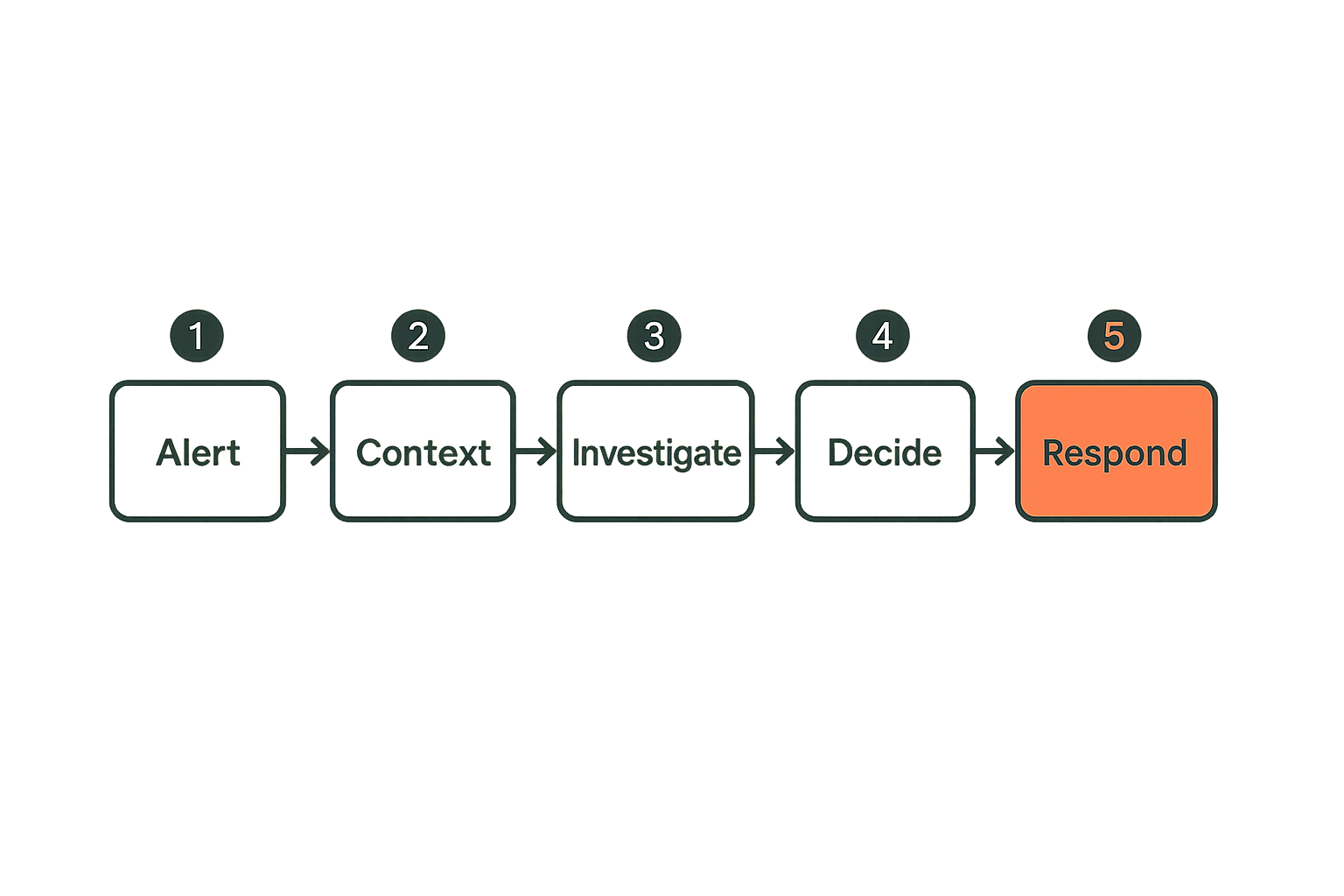
The mistake teams make is treating analyst work as a queue-processing function. The job description says the analyst monitors alerts, escalates incidents, and documents findings. Fine. But the real work is deciding whether a signal matters, what business system it touches, who can act, and what evidence is enough to justify response.
A useful way to think about it is this: an analyst is a control point in the security operating system. The analyst turns raw events into decisions.
The alert queue is only the visible layer
The queue is where work appears. It is not where the work is created.
Before an analyst sees an alert, several design choices already happened:
- Which telemetry sources were collected
- Which detections were enabled
- Which assets were tagged as critical
- Which identities were mapped to business owners
- Which threat intelligence was attached or ignored
- Which response actions are allowed without approval
If those layers are weak, the analyst pays the tax. They open ten browser tabs, search three consoles, ask in Slack, and make a confidence call with incomplete context.
Practical rule: If an analyst needs tribal knowledge to triage a common alert, the workflow is under-designed.
Why job titles lie
A SOC analyst title can mean very different things depending on the environment.
In one company, a Level 1 analyst closes phishing tickets and follows runbooks. In another, the same title requires identity investigation, cloud log review, endpoint containment, and executive incident notes. Some cyber security analyst jobs are closer to incident response. Some are closer to detection QA. Some are really compliance evidence roles with a security label.
This is why title matching fails. You need to map the job to decision rights:
| Role label | Common reality | Decision rights | Risk if unclear |
|---|---|---|---|
| SOC Analyst L1 | Triage and routing | Low | Alert fatigue and shallow closure |
| SOC Analyst L2 | Investigation and escalation | Medium | Slow containment |
| Senior Analyst | Incident lead and detection feedback | High | Unowned response gaps |
| Detection Analyst | Rule tuning and validation | Medium to high | No link to real incidents |
| Threat Analyst | Actor, campaign, and exposure context | Medium | Intelligence stays theoretical |
What hiring teams really test
Good teams are not only testing tool familiarity. They are testing how a candidate thinks under ambiguity.
Can they distinguish noisy behavior from suspicious behavior? Can they explain what evidence would change their mind? Can they write a concise escalation? Can they identify missing telemetry without blaming the tooling? Can they avoid over-escalating every anomaly?
The practical question is not whether someone has used your exact SIEM. The practical question is whether they can reason from signal to decision in your operating environment.
The 2026 analyst job market rewards operational range
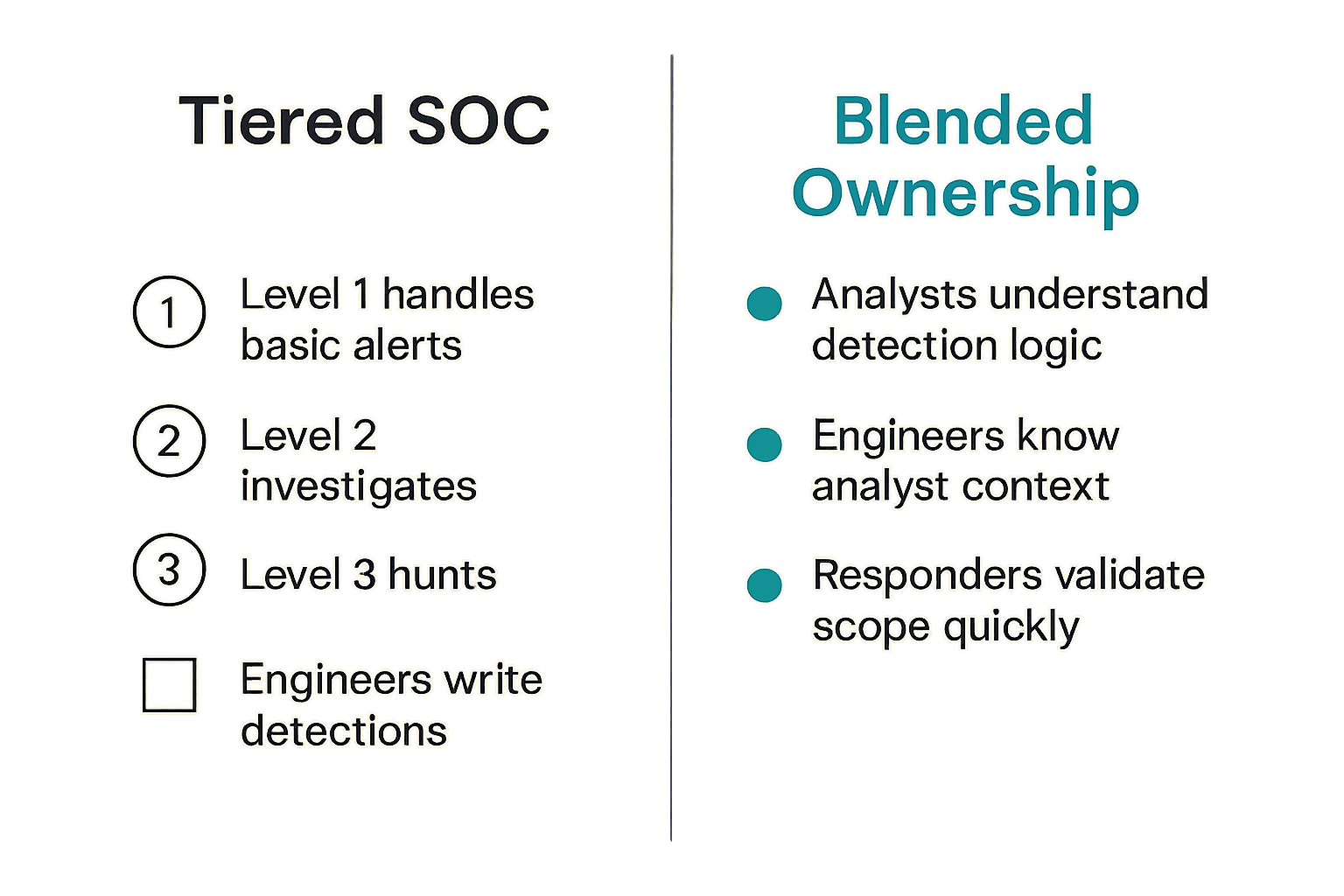
By 2026, many SOC teams have moved away from clean, rigid tiers. The old model assumed Level 1 analysts handled basic alerts, Level 2 investigated, Level 3 hunted, and engineers wrote detections. That model still exists, but it is less clean in cloud-heavy, SaaS-heavy, identity-heavy environments.
What breaks in practice is the handoff. If every alert needs three queues and two approvals, response speed dies.
From tiered SOC to blended ownership
Modern analyst work is increasingly blended. Analysts need enough engineering literacy to understand detection logic. Detection engineers need enough analyst context to know which rules waste time. Incident responders need enough SOC telemetry context to validate scope quickly.
This does not mean every analyst must do everything. It means the workflow cannot depend on one narrow specialist being available at the exact right moment.
For a broader operating model, the ThreatCrush guide to security operations in 2026 is a useful companion because analyst roles only make sense inside the larger SOC architecture.
Cloud identity and SaaS changed the analyst surface
A decade ago, many analyst workflows centered on endpoint alerts, firewall logs, domain controllers, and email gateways. Those still matter. But the center of gravity has shifted.
Analysts now investigate:
- Suspicious OAuth grants
- Impossible travel and risky sign-ins
- MFA fatigue patterns
- Cloud control plane changes
- SaaS data sharing events
- API key creation and abuse
- Workload identity behavior
- Endpoint activity that only matters because of identity context
This changes hiring. An analyst who can read process trees but cannot reason about identity risk will struggle. An analyst who understands cloud audit logs but cannot validate endpoint execution will also struggle. Range matters.
Related reading from our network: teams pushing detection earlier in engineering pipelines face similar workflow design pressure in ADT security for CI/CD, where triage has to happen before risky changes merge.
Automation did not remove judgment
SOAR, enrichment, and AI-assisted triage can remove repetitive work. They do not remove accountability.
Automation can add asset context, threat intel, geo data, user risk, and previous alert history. It can open a ticket and suggest severity. But someone still has to decide whether the evidence supports containment, whether the business impact is acceptable, and whether the alert exposes a detection gap.
Practical rule: Automate enrichment and routing first. Be careful automating containment before you understand false-positive modes and business blast radius.
Map cyber security analyst jobs to SOC workflows
The best way to evaluate cyber security analyst jobs is to map them to the SOC workflow they support. This applies whether you are hiring, applying, or redesigning your team.
Do not start with tools. Start with the lifecycle of a signal.
Intake and triage
Intake answers: what arrived, why did it fire, and what is the initial priority?
A useful triage record includes:
- Alert name and detection logic summary
- Source telemetry and time range
- Asset and identity context
- Known benign explanations
- Related alerts or recent incidents
- Initial severity and confidence
- Next action or closure reason
Bad triage is just status movement. Good triage reduces uncertainty.
Investigation and enrichment
Investigation answers: what happened, what else is connected, and what evidence supports the hypothesis?
This is where analysts earn their value. They pivot from one signal into related telemetry: endpoint events, identity logs, DNS, proxy, cloud audit logs, email headers, vulnerability exposure, threat intelligence, and business ownership.
The workflow should make common pivots fast. If an analyst has to manually copy indicators across tools all day, you do not have analyst productivity. You have browser gymnastics.
For deeper workflow design, see the ThreatCrush article on threat analysis workflows, which breaks down how to connect signals, enrichment, and action instead of leaving them as disconnected steps.
Containment and validation
Containment answers: what action reduces risk now? Validation answers: did it work?
Common actions include disabling accounts, revoking sessions, isolating hosts, blocking indicators, resetting credentials, removing malicious email, suspending tokens, or escalating to infrastructure owners.
Validation is often skipped. That is a mistake. If you isolate a host but do not validate command-and-control stopped, you have an action, not a result. If you disable a user but do not check active sessions and OAuth grants, you may only have partial containment.
Skill matrix for analyst roles
A practical analyst skill matrix should connect skills to workflow outcomes. The question is not whether a candidate knows a term. The question is whether that skill helps the SOC reduce time to decision.
Detection skills
Analysts do not need to be full detection engineers on day one, but they should understand what detections are doing.
Useful detection skills include:
- Reading rule logic in Sigma, KQL, SPL, SQL, or vendor query languages
- Understanding data source limitations
- Recognizing brittle indicators versus behavioral logic
- Knowing how false positives are introduced
- Writing feedback that helps tune detections
An analyst who can say, this rule fires because of parent-child process behavior and a suspicious command-line pattern, is more useful than one who only says, EDR marked it high severity.
Incident response skills
Incident response skill is not only for the IR team. Analysts are often the first responders in the early minutes.
They need to preserve evidence, avoid destructive actions too early, understand scope, and communicate urgency without drama. They should know when to contain immediately and when to collect more information first.
Practical rule: Train analysts on response tradeoffs, not just response buttons.
Threat intelligence and context skills
Threat intelligence is useful when it changes a decision. It is noise when it becomes a second alert queue.
Analysts should know how to use intelligence to answer practical questions:
- Is this indicator associated with active exploitation?
- Does this actor target our sector or technology stack?
- Is this vulnerability present on exposed assets?
- Does the behavior match a known technique?
- Should this change severity, scope, or response urgency?
This is where cyber security analyst jobs increasingly overlap with continuous threat exposure management and attack surface awareness.
Communication and evidence skills
The analyst output is not just closure. It is a decision record.
Good evidence writing is concise and reproducible. It explains what was observed, why it matters, what was ruled out, what remains unknown, and what action is recommended.
A bad escalation says: suspicious login, please review.
A good escalation says: user account authenticated from a new ASN, created an OAuth grant for a high-risk app, and accessed finance documents within 11 minutes. MFA was satisfied via push after three denied prompts. Recommend session revocation, token review, and user verification.
What entry-level analyst roles actually require
Entry-level does not mean no judgment. It means the workflow should have guardrails.
The mistake candidates make is trying to collect every tool logo. The mistake hiring teams make is asking for three years of experience for a role that mostly follows runbooks. Both are symptoms of unclear operating design.
Lab experience that proves judgment
A useful lab is not a screenshot of a SIEM dashboard. It is a small investigation with evidence.
Good entry-level lab projects include:
- Generate suspicious Windows process activity in a test environment.
- Collect endpoint logs and relevant command-line data.
- Write a detection query or rule.
- Trigger the detection and document expected output.
- Add false-positive notes and tuning recommendations.
- Write a mock escalation with evidence and next steps.
This shows more than tool exposure. It shows operational thinking.
Portfolio artifacts that matter
For candidates, the strongest artifacts are simple and specific:
- A detection rule with explanation and test data
- A phishing analysis write-up with headers and verdict
- A cloud identity incident walkthrough
- A short runbook for a common alert type
- A timeline reconstruction from multiple log sources
- A post-incident detection improvement note
Do not publish sensitive data. Do not overdo theatrical malware branding. Show how you think.
Related reading from our network: even outside SOC hiring, privacy-conscious teams run into similar evidence and trust tradeoffs when choosing secure communications; see this practical guide to coupon codes for encrypted messaging apps as an adjacent example of operational privacy decisions hiding under a simple user-facing workflow.
Certifications without cargo culting
Certifications can help, especially for entry-level screening. But they are not a substitute for investigation skill.
Use certifications to build structure: networking, operating systems, cloud basics, incident handling, and detection logic. Avoid treating them as a career conveyor belt. A hiring manager who has operated a SOC will notice the difference between someone who memorized attack names and someone who can explain why a specific log event matters.
Senior analyst and detection engineering paths
Senior analyst roles are where the job stops being mostly reactive. The analyst becomes part investigator, part workflow designer, part detection feedback system.
This is the path many SOC engineers, detection engineers, and incident responders care about because it determines whether analyst work scales or collapses under volume.
When analysis becomes engineering
Analysis becomes engineering when the same question appears repeatedly and the analyst builds a repeatable mechanism to answer it faster.
Examples:
- Turning repeated manual pivots into enrichment automation
- Converting incident findings into detection tests
- Building dashboards for exposure-linked alerts
- Creating severity logic based on asset criticality
- Writing runbooks with clear containment thresholds
- Adding suppression rules for validated benign behavior
The senior analyst does not just close the case. They improve the system that produced the case.
Ownership signals
Strong senior analysts show ownership in specific ways:
- They reduce ambiguity for junior analysts.
- They identify broken detections and fix the feedback loop.
- They know when to escalate and when to contain.
- They can brief engineering, legal, executives, and IT differently.
- They track recurring alert classes and push root-cause work.
- They challenge severity inflation.
Weak seniority is just more years in the queue.
Metrics senior teams care about
Do not measure analysts only by ticket count. Ticket count rewards shallow closure.
Better measures include:
- Mean time to qualify an alert
- Mean time to containment for validated incidents
- Reopen rate or missed-scope rate
- Percentage of escalations with complete evidence
- Detection feedback submitted and accepted
- Runbook coverage for high-volume alerts
- False-positive reduction without visibility loss
Metrics should reveal workflow health, not create perverse incentives.
Hiring architecture: how teams should define the role
Most bad cyber security analyst jobs start as bad job descriptions. The posting asks for SIEM, EDR, cloud, forensics, malware analysis, Python, threat hunting, vulnerability management, and governance. Then the actual job is closing email tickets.
That mismatch creates churn.
Write the workflow before the job description
Before writing the role, define the work:
- What alert classes will this analyst own?
- What telemetry will they access?
- What decisions can they make without approval?
- What containment actions can they trigger?
- What evidence must they document?
- What teams do they hand off to?
- What feedback are they expected to send to detection engineering?
- What does success look like after 30, 60, and 90 days?
Only then write the job description.
Separate must-have skills from local tool preferences
Tool familiarity matters less than transferable reasoning. If your SOC uses one SIEM, do not reject every candidate who used another. Query languages differ, but investigation logic transfers.
Separate requirements into three buckets:
| Category | Examples | Hiring use |
|---|---|---|
| Must-have fundamentals | Networking, identity, logs, incident judgment | Screen strongly |
| Workflow skills | Triage, evidence writing, escalation, containment logic | Test with scenarios |
| Local tool preferences | Specific SIEM, EDR, ticketing, SOAR | Train if fundamentals are strong |
This makes the talent pool larger without lowering standards.
Interview with operational scenarios
Ask candidates to work through realistic cases. Do not turn the interview into trivia.
A good scenario might be: An impossible travel alert fires for a finance user. MFA succeeded. Ten minutes later, a new OAuth app is granted mailbox access. The user says they were asleep. What do you check, what do you do first, and what evidence do you need?
The answer should reveal priority setting, identity knowledge, containment judgment, and communication ability.
Related reading from our network: coordination problems show up in odd places; this piece on coupon codes in local networks is a useful reminder that state, ownership, and trust boundaries matter even when the surface workflow looks simple.
Failure modes in cyber security analyst jobs
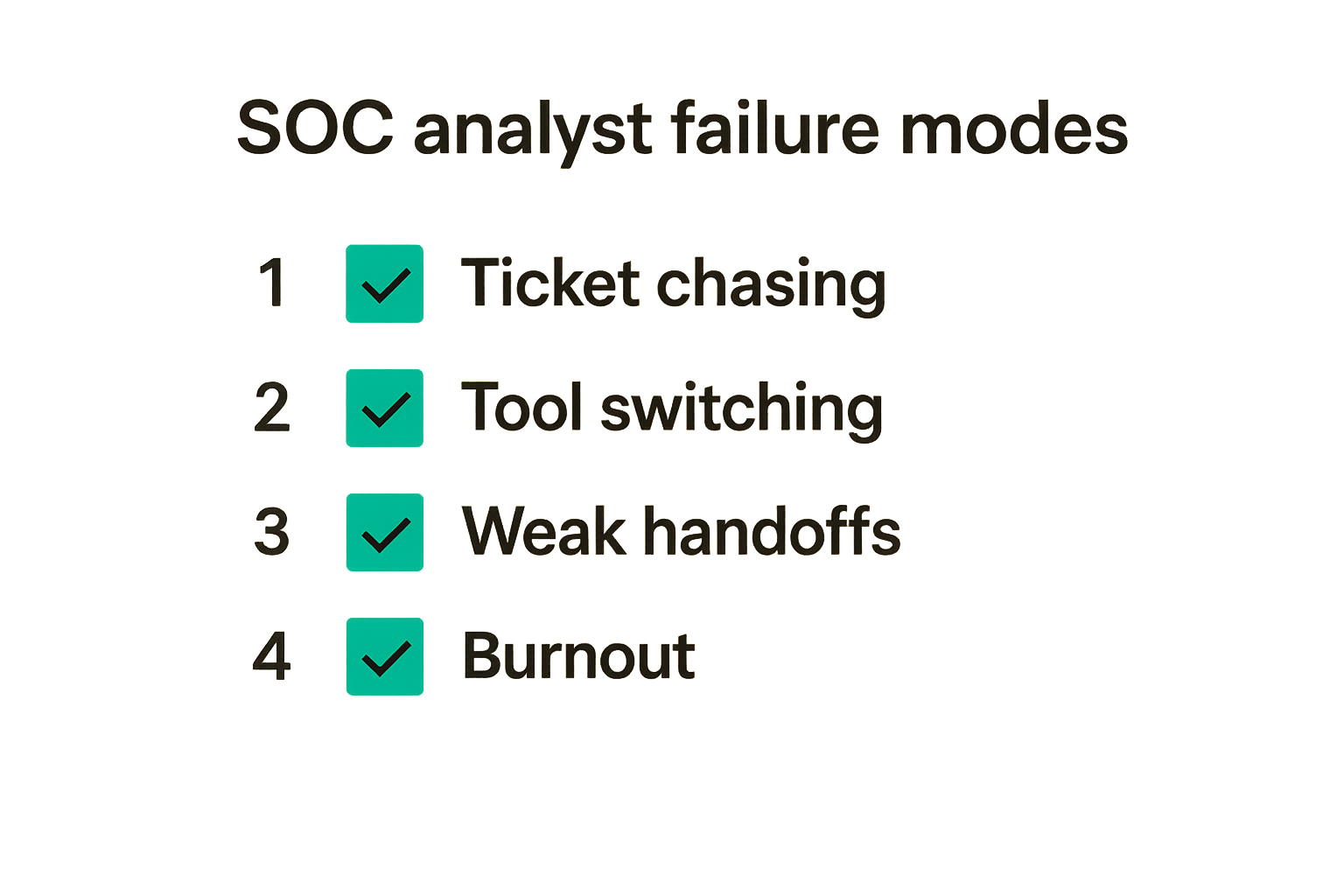
Failure in cyber security analyst jobs usually looks like a people problem from the outside. In practice, it is often a workflow problem.
Analysts burn out because the system asks them to absorb noise without authority, context, or feedback.
The ticket closer trap
The ticket closer trap happens when analysts are rewarded for volume instead of decision quality.
Symptoms include:
- High closure counts with weak notes
- Copy-paste verdicts
- Escalations missing key evidence
- Repeated false positives that never get tuned
- Incidents reopened because scope was incomplete
- Analysts afraid to spend time on deeper investigation
What fails is the incentive model. If you measure only throughput, you get throughput.
The disconnected tooling trap
Disconnected tools turn every investigation into manual correlation.
A typical broken flow looks like this: alert in SIEM, endpoint details in EDR, user risk in IAM, asset owner in CMDB, vulnerability data in another platform, threat intel in a portal, ticket in ITSM, chat discussion in Slack. The analyst becomes the integration layer.
That is expensive and fragile.
Practical rule: If the analyst has to manually assemble the same context more than twice, build the integration or change the workflow.
The burnout trap
Burnout is not only about alert volume. It is about low-control, high-consequence work.
Analysts burn out when they cannot tune bad detections, cannot get asset owners to respond, cannot contain without approvals, cannot trust inventory, and cannot see whether their work improved anything.
The fix is not pizza, swag, or another dashboard. The fix is authority, context, feedback, and sane escalation paths.
Implementation plan for building analyst capability
Hiring better analysts helps. Building a better analyst system helps more.
The practical question is: how do you create an environment where analysts can make faster, better, more defensible decisions?
A ninety-day ramp
Use a structured ramp instead of throwing new analysts into the queue.
- Days 1-15: environment and telemetry. Teach the network, identity model, critical assets, log sources, and escalation paths.
- Days 16-30: shadow triage. Have the analyst observe common alert classes and write draft evidence notes.
- Days 31-45: supervised ownership. Assign low-to-medium severity cases with review before closure.
- Days 46-60: response participation. Let the analyst perform defined containment actions with approval.
- Days 61-75: detection feedback. Require tuning notes, false-positive analysis, and missing-telemetry observations.
- Days 76-90: independent workflow ownership. Assign an alert class, runbook section, or recurring investigation area.
This ramp creates capability, not just access.
Runbooks, feedback loops, and handoffs
Runbooks should not be legal documents. They should be decision aids.
A good runbook includes:
- Trigger conditions
- Required context
- Investigation pivots
- Known benign patterns
- Severity rules
- Containment thresholds
- Escalation path
- Evidence template
- Detection feedback notes
Handoffs should be explicit. If the analyst escalates to cloud engineering, what exactly should that team do? If IR takes over, what evidence transfers? If a detection needs tuning, who owns the backlog?
What works and what fails
What works:
- Clear alert ownership
- Fast access to asset and identity context
- Evidence templates that reduce writing friction
- Detection feedback tied to real incidents
- Review sessions for closed cases
- Containment authority matched to risk
What fails:
- Tool-first hiring
- Ticket-count incentives
- Intelligence feeds with no decision path
- Runbooks nobody updates
- Escalations without evidence standards
- Automation that hides uncertainty
The goal is not a perfect SOC. The goal is a workflow that gets better every time analysts touch it.
Where ThreatCrush fits in analyst workflows
Threat intelligence, vulnerability tracking, attack surface monitoring, and actor context are useful only when they arrive at the point of decision. If they live in a separate portal that analysts check when they remember, they become shelfware.
Product fit without another console tax
ThreatCrush is relevant to analyst workflows when it helps answer operational questions faster:
- Is this indicator connected to active infrastructure or known campaigns?
- Is the affected asset externally exposed?
- Is the vulnerability being tracked in attacker activity?
- Does this alert match actor tradecraft we care about?
- Should severity change because business exposure changed?
The fit is architectural: reduce context switching, connect proactive exposure data with reactive SOC investigation, and make analyst decisions easier to defend. Teams evaluating integration options can start with the ThreatCrush platform documentation to understand how threat data can be wired into existing workflows.
When threat intelligence should enter the workflow
Threat intelligence should enter at three points:
- Before detection: to prioritize coverage for relevant actors, exploited vulnerabilities, and exposed services.
- During triage: to enrich indicators, assets, identities, and behaviors with context that changes severity.
- After response: to validate whether the incident reveals a broader exposure or detection gap.
That is the difference between intelligence as a feed and intelligence as part of the SOC operating model.
Cyber security analyst jobs will keep changing, but the durable skill is the same: turning uncertain signals into reliable action. Tools will shift. Titles will drift. The teams that win are the ones that design analyst workflows around context, authority, validation, and feedback.
Try threatcrush.com
You are writing for security operations professionals building and scaling SOC capabilities. Try threatcrush.com to connect threat intelligence, exposure context, and analyst workflows without adding another disconnected queue.
Try ThreatCrush
Real-time threat intelligence, CTEM, and exposure management — built for security teams that move fast.
Get started →