Critical Incident Stress Debriefing for SOC Teams: Build the Workflow Before the Burnout
Critical incident stress debriefing usually enters the SOC after something has already gone wrong. A ransomware weekend. A major customer-impacting breach. A false negative that turned into an executive escalation. The alert cleared, the timeline was written, and the team still feels like it is running hot.
Teams think the problem is stress. The real problem is unmanaged recovery inside a system that immediately pushes responders back into the queue.
That changes the conversation. Critical incident stress debriefing is not a motivational session, a therapy substitute, or a checkbox after a hard case. In a modern SOC, it is an operating workflow: when to trigger it, who owns it, what gets captured, what stays private, and how lessons become better detection, cleaner escalation, and safer on-call rotation.
The practical question is not whether people were tough enough. The practical question is whether your SOC architecture has a recovery path after high-impact work.
Table of contents
- Why critical incident stress debriefing belongs in SOC architecture
- What critical incident stress debriefing should and should not do
- Build critical incident stress debriefing into the incident workflow
- Ownership and roles for incident stress debriefing
- What to capture without turning it into surveillance
- Signals that a SOC needs a debriefing process
- What breaks when teams implement critical incident stress debriefing badly
- Connect debriefing to detection engineering and CTEM
- A lightweight implementation plan for SOC teams
- Make critical incident stress debriefing part of SOC architecture
Why critical incident stress debriefing belongs in SOC architecture
It is not a therapy feature
The mistake teams make is treating critical incident stress debriefing as a soft add-on. It gets delegated to whoever is good with people, scheduled when calendars open, and disconnected from incident review, detection tuning, and on-call planning.
That is how it becomes theater.
A useful way to think about it is this: the SOC has many workflows for technical evidence and very few workflows for human load. You have ticket states, SIEM rules, enrichment, escalation paths, severity labels, and post-incident reports. But after a prolonged intrusion, credential theft investigation, destructive malware event, or executive-facing outage, the people who absorbed the pressure often get one instruction: catch up.
Critical incident stress debriefing should create a safe operational pause after high-pressure response. It should help responders normalize reactions, identify what made the work harder than necessary, and route real risk to the right support channel.
It is not group therapy. It is not a performance review. It is not a place to extract confessions for a root cause report.
Practical rule: If responders believe the debrief can be used against them, the debrief is already broken.
Why 2026 SOC work makes this harder
SOC stress in 2026 is not only alert volume. It is ambiguity under time pressure.
Cloud identity incidents cross IAM, endpoint, SaaS, and business process boundaries. Extortion events involve legal, communications, insurance, executives, and sometimes law enforcement. Detection engineers are pulled into response because the best telemetry context lives in their heads. Incident commanders coordinate across Slack, ticketing, EDR, cloud logs, threat intel, and customer updates.
What breaks in practice is context switching. Responders move from packet-level details to executive summaries to containment decisions to vendor coordination. Then they return to a normal shift and handle low-confidence alerts as if nothing happened.
The result is not just burnout. It is degraded detection quality. Analysts miss nuance. Engineers write brittle rules. Incident notes become sparse. Handoffs get defensive. People avoid escalating because escalation feels like another emotional tax.
Critical incident stress debriefing belongs in the architecture because fatigue changes how the architecture is used.
What critical incident stress debriefing should and should not do
The objective is operational decompression
A good debrief gives people a structured way to come down from high-stakes work. The goal is to reduce isolation, surface immediate support needs, and identify operational friction that increased load.
It should answer practical questions:
- Did the response cadence create unnecessary pressure?
- Were roles clear or did people improvise under stress?
- Did tooling add noise during the worst hour?
- Did leadership communication help or create more churn?
- Does anyone need schedule relief, peer support, or professional support?
This is not the same as a technical postmortem. A postmortem asks what happened in the system. A stress debrief asks what the work did to the humans operating the system and what the system did to amplify or reduce that load.
| Practice | Works | Fails |
|---|---|---|
| Timing | Soon after stabilization, before everyone disappears | Weeks later when details and emotion are stale |
| Facilitation | Neutral facilitator with clear boundaries | Incident commander interrogating the room |
| Notes | Operational themes and support actions | Personal disclosures attached to names |
| Output | Recovery actions and workflow improvements | Vague wellness language with no owner |
| Follow-up | Checked in at defined intervals | One meeting and no change |
Where formal mental health support fits
Security leaders should be careful here. Critical incident stress debriefing can help teams process difficult work, but it should not pretend to replace professional care. Some responders may need employee assistance resources, clinical support, time off, or a private conversation outside the SOC chain.
The debrief should make those paths visible without forcing public disclosure. The facilitator can say what support exists, how to access it, and what is confidential. The team does not need to diagnose anyone.
Practical rule: A SOC debrief should create access to support, not require people to prove they deserve support.
This matters for trust. If the organization treats distress as weakness, responders will hide it. If it treats every hard reaction as a medical event, responders may avoid the process. The middle path is operational: normalize the impact, protect privacy, and route serious needs to qualified help.
Related reading from our network: teams designing secure collaboration channels face similar privacy and metadata tradeoffs in end-to-end encrypted messaging workflows, especially when sensitive conversations must be useful without becoming unnecessary records.
Build critical incident stress debriefing into the incident workflow
Trigger criteria for a debrief
Do not make the trigger purely subjective. If every debrief depends on whether a manager noticed people looked tired, you will miss the teams that mask stress well.
Use a simple trigger model. A critical incident stress debrief is required or strongly recommended when one or more of these conditions are met:
- Severity 1 or Severity 2 incident
- Customer, patient, public, or regulated data exposure suspected
- Destructive action, extortion, ransomware, or active hands-on-keyboard intrusion
- Response lasted longer than a defined threshold, such as six hours of continuous coordination
- Overnight or weekend bridge with multiple responders
- Executive, legal, media, or regulator involvement
- A responder requests it
- A manager observes conflict, confusion, or unusual emotional load
The responder request trigger is important. Some incidents are technically small but personally heavy. A child safety case, insider investigation, harassment-related evidence review, or repeated exposure to disturbing content can justify a debrief even when the incident severity label is low.
A practical sequence that does not slow response
The debrief should not interrupt containment. It should be wired into the closeout path once the incident is stable.
A practical workflow looks like this:
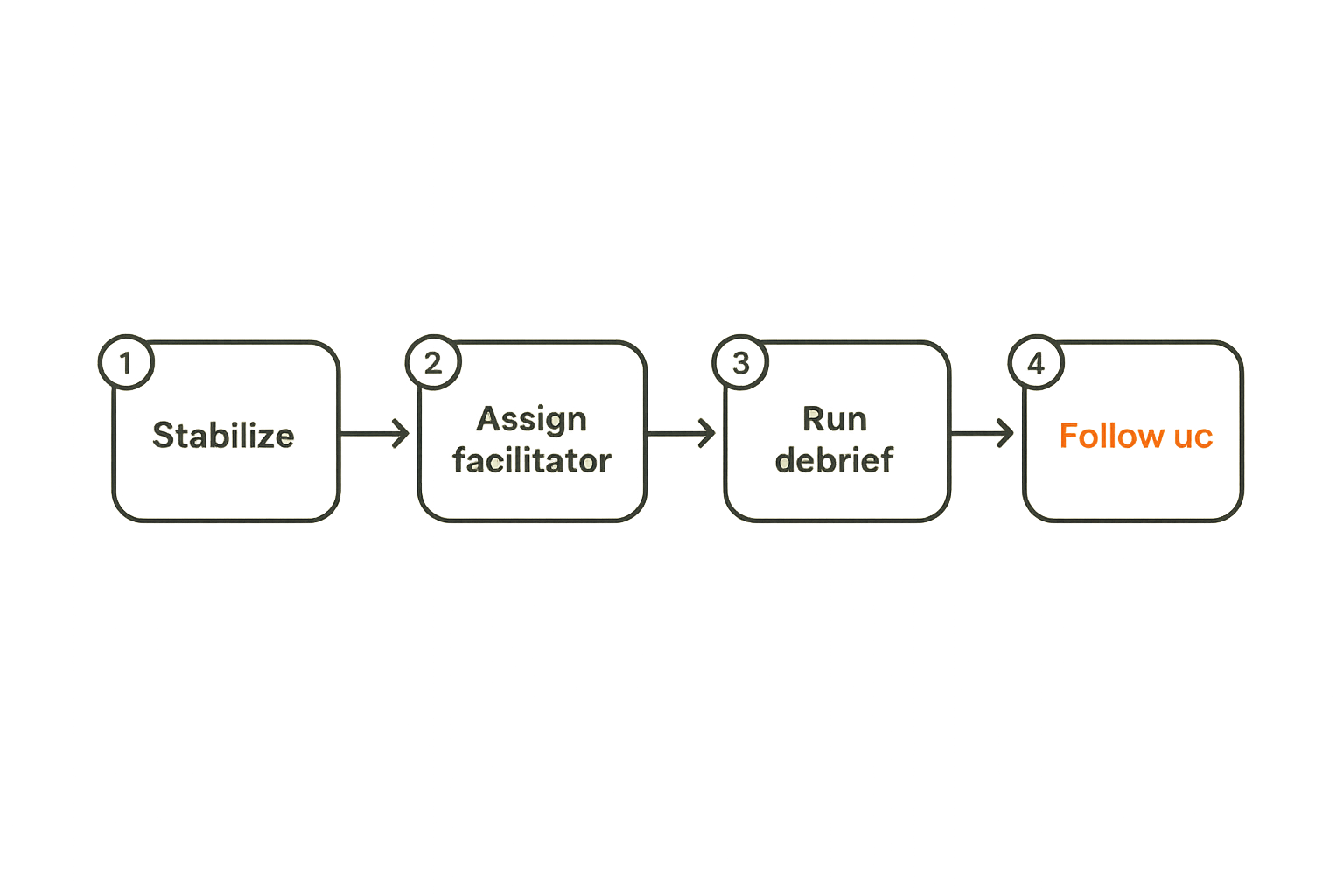
- Stabilize the incident. Containment is complete enough that the bridge can move from active response to monitoring or recovery.
- Assign a debrief facilitator. This should happen before the team disperses, ideally by the incident commander or SOC lead.
- Send a short expectation note. State the purpose, time box, privacy boundary, and what will not be recorded.
- Run a 30 to 45 minute session. Keep it focused on operational experience, immediate needs, and friction.
- Capture themes only. Record process issues, tooling gaps, support needs, and owners. Do not capture personal disclosures by name unless explicitly needed for support coordination.
- Create follow-up actions. Route technical fixes to detection, response, tooling, or leadership owners.
- Check back. Follow up with affected responders within a defined window, often 24 to 72 hours, then again after the next on-call cycle if needed.
Practical rule: Debriefing belongs after stabilization, not after everyone has already absorbed the damage alone.
This sequence is lightweight enough to run in a small SOC and structured enough for enterprise incident management.
Ownership and roles for incident stress debriefing
Separate the facilitator from the incident commander
The incident commander has authority during response. That authority is useful when decisions must be made quickly. It is less useful when responders need to discuss confusion, frustration, overload, or avoidable pressure.
Separate the roles where possible. The facilitator can be a trained SOC lead, peer responder, security operations manager from another team, or trusted incident response coordinator. The key requirement is not a certificate. It is neutrality, confidentiality discipline, and enough operational literacy to understand what responders are saying.
A facilitator should be able to say:
- We are not deciding blame in this session.
- We are not rewriting the technical timeline here.
- We are identifying what made the work harder and what support is needed.
- If someone raises a safety concern, I will help route it appropriately.
This protects the incident commander too. The commander can participate as a responder without owning the emotional temperature of the room.
Keep managers out of the wrong parts
Managers have legitimate responsibilities: staffing, recovery time, tooling investment, escalation hygiene, and access to professional support. But management presence changes what people say.
There are two workable models.
First, run a responder-only debrief and provide managers with anonymized operational themes and required actions. Second, split the debrief into two parts: a short group decompression with limited management presence, then private follow-ups and a separate leadership action review.
The bad model is a large meeting where executives, legal, HR, the incident commander, and exhausted analysts all sit together while someone asks how everyone is feeling.
Related reading from our network: coordination problems are not unique to security teams, and local network operating systems for community coordination are a useful adjacent example of how trust, routing, and follow-up matter more than another meeting.
What to capture without turning it into surveillance
Operational notes versus personal notes
Documentation is necessary. Surveillance is not.
The debrief record should capture operational themes and action items. It should not become a psychological dossier. If someone says they are struggling, the facilitator can help them access support privately. The shared debrief notes should say something like schedule recovery needed for primary responders, not Analyst A was visibly distressed and said they could not sleep.
A useful note format:
incident_id: IR-2026-0712
trigger: sev1-ransomware-response
participants: response-team
record_type: operational-themes
keep_private: personal-disclosures
follow_up:
  - owner: soc-manager
    action: adjust-on-call-rotation
    due: 2026-07-15
  - owner: detection-engineering
    action: reduce duplicate identity-alerts
    due: 2026-07-22
  - owner: incident-response
    action: update executive-briefing-template
    due: 2026-07-19
This is enough to make the process real without creating unnecessary personal records.
Privacy boundaries and retention
Security teams are good at logging. Sometimes too good.
Do not record debrief sessions by default. Do not dump transcripts into collaboration tools. Do not store sensitive personal disclosures in the same ticketing system used for incident artifacts. If notes are needed, define where they live, who can read them, and when they expire.
The practical question is: who needs this information to reduce risk or provide support?
If the answer is everyone in the incident channel, do not capture it. If the answer is the SOC manager needs an action to rotate people off the next shift, capture the action, not the personal detail. If the answer is HR or a clinical resource needs to support someone, move that conversation to the proper confidential channel.
This is especially important in regulated environments. Your SOC may already retain incident evidence for legal or compliance reasons. Do not accidentally attach human recovery notes to long-retention breach records unless counsel and HR have explicitly designed that process.
Signals that a SOC needs a debriefing process
Human signals after the alert clears
Many teams wait for attrition before admitting the response model is unhealthy. That is expensive and slow.
Look for smaller signals:
- Analysts stop volunteering for complex cases.
- Senior responders become short or cynical after major incidents.
- People over-document defensively because they fear blame.
- On-call handoffs become colder and less complete.
- Engineers resist tuning because every change feels like reopening the incident.
- The same few people are always pulled into crisis work.
- People joke about burnout, but nobody changes the schedule.
One signal alone does not prove the team needs a formal process. A pattern does.
A debriefing workflow gives the SOC a way to handle these signals before they become staffing problems or detection quality problems.
Workflow signals in tickets and handoffs
Stress also shows up in the work product.
After hard incidents, review the operational artifacts. You may see missing decision records, duplicate containment actions, unclear ownership, or long Slack threads that never made it into the incident ticket. You may see detection changes made in a hurry without validation. You may see follow-up tasks assigned to the same exhausted people who carried the response.
This is where debriefing connects to architecture. If the team repeatedly says the same thing made incidents harder, that is a workflow defect.
For adjacent security operations architecture, we have written about connecting signals, ownership, and investigation steps in threat analysis workflows that actually work. The same principle applies here: disconnected steps create noise, delay, and unnecessary human load.
What breaks when teams implement critical incident stress debriefing badly
Forced disclosure creates silence
Bad debriefing is worse than no debriefing because it teaches people that the process is unsafe.
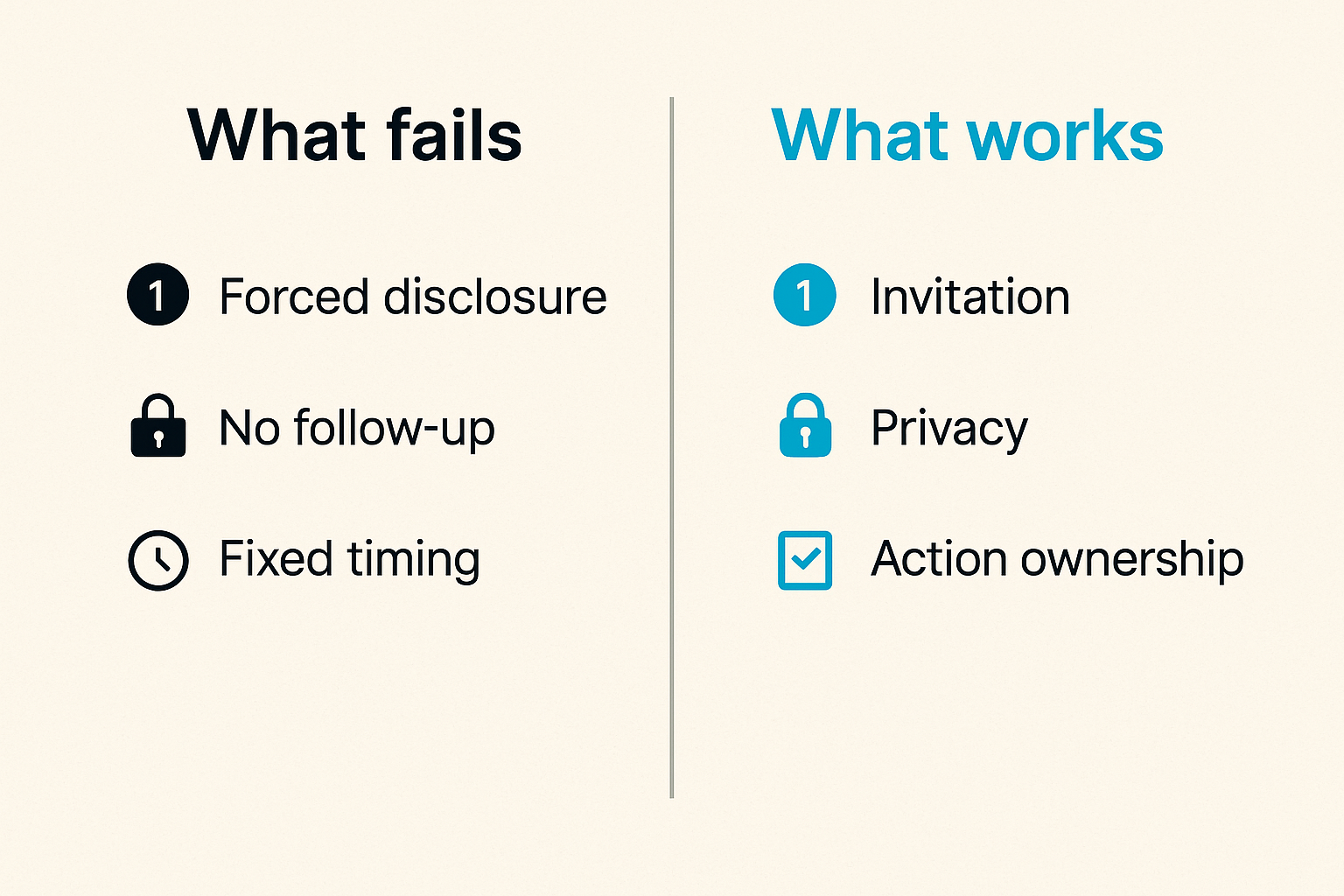
The most common failure mode is forced disclosure. A facilitator goes around the room and asks each person to describe how they felt. Some people may welcome that. Others will shut down, especially in teams where promotion, clearance, assignment, or reputation is tied to perceived resilience.
Do not require emotional disclosure. Offer multiple ways to participate:
- Speak in the group.
- Send private notes to the facilitator.
- Request a one-on-one follow-up.
- Opt out of personal sharing while still contributing operational friction points.
What works is invitation. What fails is extraction.
Another failure mode is running the session too soon. During active containment, people are still in execution mode. During the first quiet hour, some may need food, sleep, childcare, or a break before they can participate usefully. The facilitator should read the room and choose the earliest responsible time, not the earliest available calendar slot.
Blameless language without blameless systems fails
Many organizations say blameless. Fewer operate that way.
If the post-incident process still rewards heroics, punishes escalation, and quietly labels people as weak for needing recovery time, the debrief will not fix it. Responders notice the gap between language and consequences.
Common bad patterns:
- A debrief says people need recovery, but the schedule does not change.
- A team identifies alert noise as a stress amplifier, but no one funds tuning work.
- A manager asks for honesty, then quotes the conversation in performance feedback.
- A major incident exposes unclear ownership, but leadership calls it a communication issue and moves on.
- The same senior analyst is praised for saving the day and then left on call again.
Practical rule: A debrief without follow-up actions is just another meeting responders had to survive.
Related reading from our network: public cloud mistakes often look technical but are really workflow failures, which is the same lesson in security public storage CI/CD controls when teams open buckets before building review, monitoring, and rollback paths.
Connect debriefing to detection engineering and CTEM
Turn stress into workflow fixes
Critical incident stress debriefing should not live in a separate wellness silo. The output should influence detection engineering, incident response, continuous threat exposure management, and threat intelligence operations.
If responders say the identity alerts were impossible to prioritize, that is a detection and enrichment problem. If they say external scanning data created panic because no one knew whether an exposed asset was internet-facing, that is an asset context problem. If they say the incident commander had to ask five teams for ownership, that is an operational routing problem.
Turn debrief themes into engineering work:
- Reduce duplicate alerts from the same campaign.
- Add business context to high-severity assets.
- Improve identity escalation thresholds.
- Prebuild executive update templates.
- Add runbook steps for legal and communications handoff.
- Create a responder rotation rule after long incidents.
- Update threat intel watchlists based on what actually mattered.
This is where the conversation gets concrete. Stress was not only caused by the attacker. It was amplified or reduced by the environment your team operated inside.
Validate whether changes reduced load
Do not assume a fix worked because a ticket closed.
Validation can be simple. Compare the next similar incident or simulation against the old friction points. Did triage take fewer handoffs? Did the team have cleaner ownership? Did alert clustering reduce duplicate review? Did responders get recovery time without negotiating for it?
Useful metrics are directional, not theatrical:
- Time from incident stabilization to debrief scheduled
- Percentage of required follow-up actions closed on time
- Number of duplicate alerts reviewed during the incident
- Number of responders exceeding on-call hour thresholds
- Handoff completeness in the incident record
- Repeat friction themes across incidents
Be careful with individual-level metrics. The goal is not to score emotional performance. The goal is to see whether the operating system is getting safer and more reliable.
A lightweight implementation plan for SOC teams
Start with a one page policy
You do not need a large program to start. You need a clear policy that responders believe.
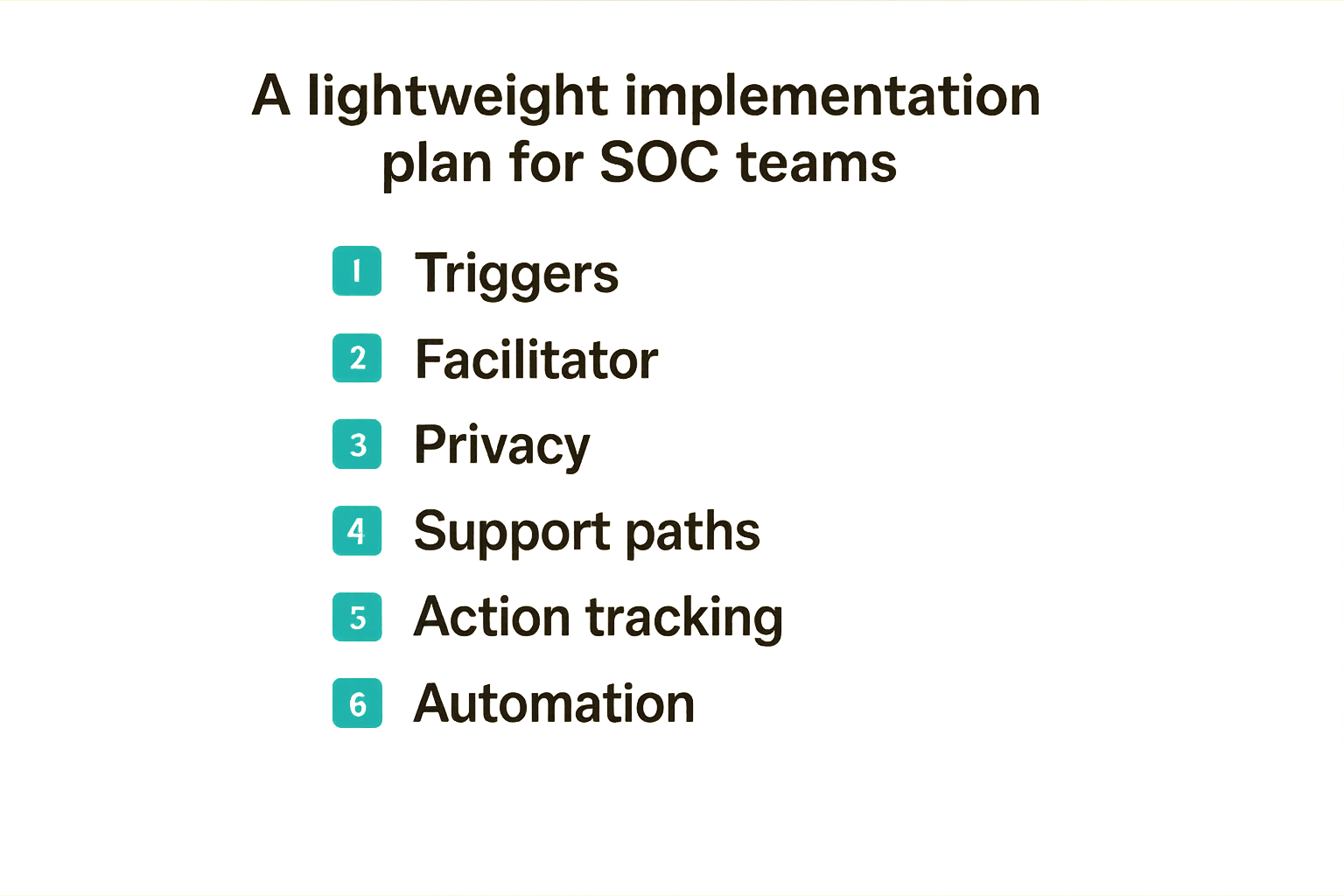
A one page policy should define:
- What triggers a debrief
- Who can request one
- Who facilitates it
- When it happens
- What is recorded
- What is not recorded
- How support resources are offered
- How action items are tracked
- How privacy and retention work
Keep the language plain. SOC teams are allergic to vague HR language because it usually means no operational change is coming. Say exactly what happens.
Example policy language:
After any Severity 1 incident, destructive malware event, prolonged overnight response, or responder request, the SOC will schedule a critical incident stress debrief within one business day of stabilization. The session is not a performance review. Personal disclosures are not recorded in the incident ticket. Operational themes and follow-up actions are tracked by the SOC lead. Responders may request private follow-up or support resources at any time.
This is not perfect. It is usable. Usable beats aspirational.
Automate prompts without automating empathy
Automation helps with consistency. It should not pretend to care.
Use ticketing or incident management automation to prompt the process:
if incident.severity in [sev1, sev2]
  or incident.tags contains ransomware
  or incident.duration_hours > 6
  or incident.responder_requested_debrief == true:
    create_task: schedule-stress-debrief
    owner: soc-lead
    due: next-business-day
    template: debrief-operational-themes
The automation should create a task, not send a canned emotional message into the incident channel. A human should still decide timing, facilitator, and support path.
If your SOC uses APIs and modular workflows, document the trigger and ownership cleanly. Teams evaluating how to connect telemetry, enrichment, and response workflows can use the ThreatCrush documentation as a reference point for thinking about integrations as operating paths, not isolated tools.
What works:
- Automatic task creation after trigger conditions
- Templates for facilitator notes
- Private channel for support coordination
- Follow-up reminders for action owners
- Reporting on unresolved operational friction
What fails:
- Bot-generated empathy
- Public tagging of distressed responders
- Recording sessions by default
- Closing the debrief task without action review
- Treating the process as HR-only
Make critical incident stress debriefing part of SOC architecture
Product fit for ThreatCrush
ThreatCrush is not a therapy platform, and it should not pretend to be one. The product-fit angle is architectural: reduce avoidable responder load by improving the signal environment around incidents.
Security teams building SOC capability need fewer disconnected tools and clearer operational context. Real-time threat intelligence, vulnerability tracking, attack surface monitoring, and threat actor context are useful because they shorten uncertainty. When responders know which exposed systems matter, which indicators are relevant, and which threats align with observed activity, the incident becomes more manageable.
That does not remove the need for critical incident stress debriefing. It makes the debrief more actionable. Instead of hearing only that the incident was chaotic, the SOC can identify which missing context created chaos and route it into detection, exposure management, or response automation.
A good platform should help answer:
- What signals mattered during the incident?
- Which alerts created noise?
- Which exposures increased urgency?
- Which threat intelligence changed decisions?
- Which workflow gaps should be fixed before the next event?
That is the useful connection. Better signal architecture reduces unnecessary stress. A real debriefing workflow catches the stress that remains and turns recurring friction into system improvement.
The closing test
Here is the test for your SOC.
After the next severe incident, can you point to a defined recovery workflow for the people who handled it? Not a vague check-in. Not a manager saying take care of yourself. A real workflow with triggers, ownership, privacy boundaries, support paths, action tracking, and engineering feedback loops.
If the answer is no, critical incident stress debriefing is not a wellness initiative you might add later. It is a missing part of your incident response architecture.
The mistake teams make is waiting until someone leaves, breaks down, or refuses another on-call rotation before they build the process. Build it earlier. Keep it lightweight. Protect trust. Connect the output to detection and response work.
Critical incident stress debriefing should help the SOC recover after hard incidents and make the next hard incident less punishing to operate.
Try threatcrush com
ThreatCrush is for security operations professionals building and scaling SOC capabilities. Try threatcrush.com
Try ThreatCrush
Real-time threat intelligence, CTEM, and exposure management — built for security teams that move fast.
Get started →