Critical Incident Approach: A Practical SOC Architecture Guide for 2026

A critical incident approach sounds like something every SOC already has. There is a severity matrix somewhere. There are incident response playbooks. There is an on-call rotation. There may even be a war-room template.
Then a real critical incident lands and the system behaves differently than the document promised. Alerts arrive out of order. Asset ownership is unclear. Executives want confidence before analysts have evidence. Containment decisions get delayed because nobody wants to break production.
Teams think the problem is incident response procedure. The real problem is operating architecture.
The practical question is not whether your team has a critical incident approach. The practical question is whether your detection, enrichment, ownership, communication, containment, and validation workflows can switch modes when severity changes. That changes the conversation from documentation to system design.
Table of contents
- Critical incident approach is an operating model, not a playbook
- Build a severity model that triggers the right machine
- Assign ownership before the incident
- Signal architecture for critical incidents
- Critical incident approach workflow from detection to containment
- What works and what fails in implementation
- Metrics that prove your critical incident approach is improving
- Automation boundaries in high-severity response
- Product fit: connecting intelligence to response
Critical incident approach is an operating model, not a playbook
A useful way to think about a critical incident approach is this: it is the mode switch for the SOC. Normal operations optimize for queue throughput, accuracy, and sustainable analyst effort. Critical incident operations optimize for decision speed, containment confidence, and coordinated action across teams.
That distinction matters because the same tools can produce different outcomes depending on how they are wired. A SIEM rule that creates another ticket is normal-mode behavior. The same rule that triggers enrichment, incident grouping, service-owner lookup, on-call paging, executive notification, and containment review is critical-mode behavior.
Where normal incident response stops working
Normal response assumes time. Analysts can triage, pivot, ask follow-up questions, wait for asset owners, and enrich context manually. That works for suspicious logins, malware detections, anomalous outbound traffic, and low-confidence indicators.
Critical incidents compress the timeline. The business impact may already be visible, or the adversary may have enough access that every hour matters. What breaks in practice is not analyst skill. What breaks is dependency management.
Common pressure points include:
- Identity evidence is in one console, endpoint data in another, cloud logs in a third.
- The team does not know who owns the affected workload.
- Legal, communications, and leadership ask for updates before technical scope is known.
- Containment would disrupt revenue, operations, or customer systems.
- Analysts cannot tell whether alerts are separate events or one campaign.
Practical rule: if a critical incident requires manual discovery of ownership, communication paths, or containment authority, the response architecture is incomplete.
The decision loop that matters
For critical incidents, the core loop is not detect, investigate, close. That is a ticket lifecycle. The operational loop is:
- Detect a plausible severe condition.
- Establish business and technical scope.
- Decide whether to activate critical mode.
- Assign accountable owners.
- Contain the highest-risk path.
- Validate that the adversary path is broken.
- Communicate status with confidence levels.
The mistake teams make is treating severity as a label analysts apply after investigation. In a mature critical incident approach, severity is an input that changes routing, enrichment, collaboration, and approval behavior immediately.
Build a severity model that triggers the right machine
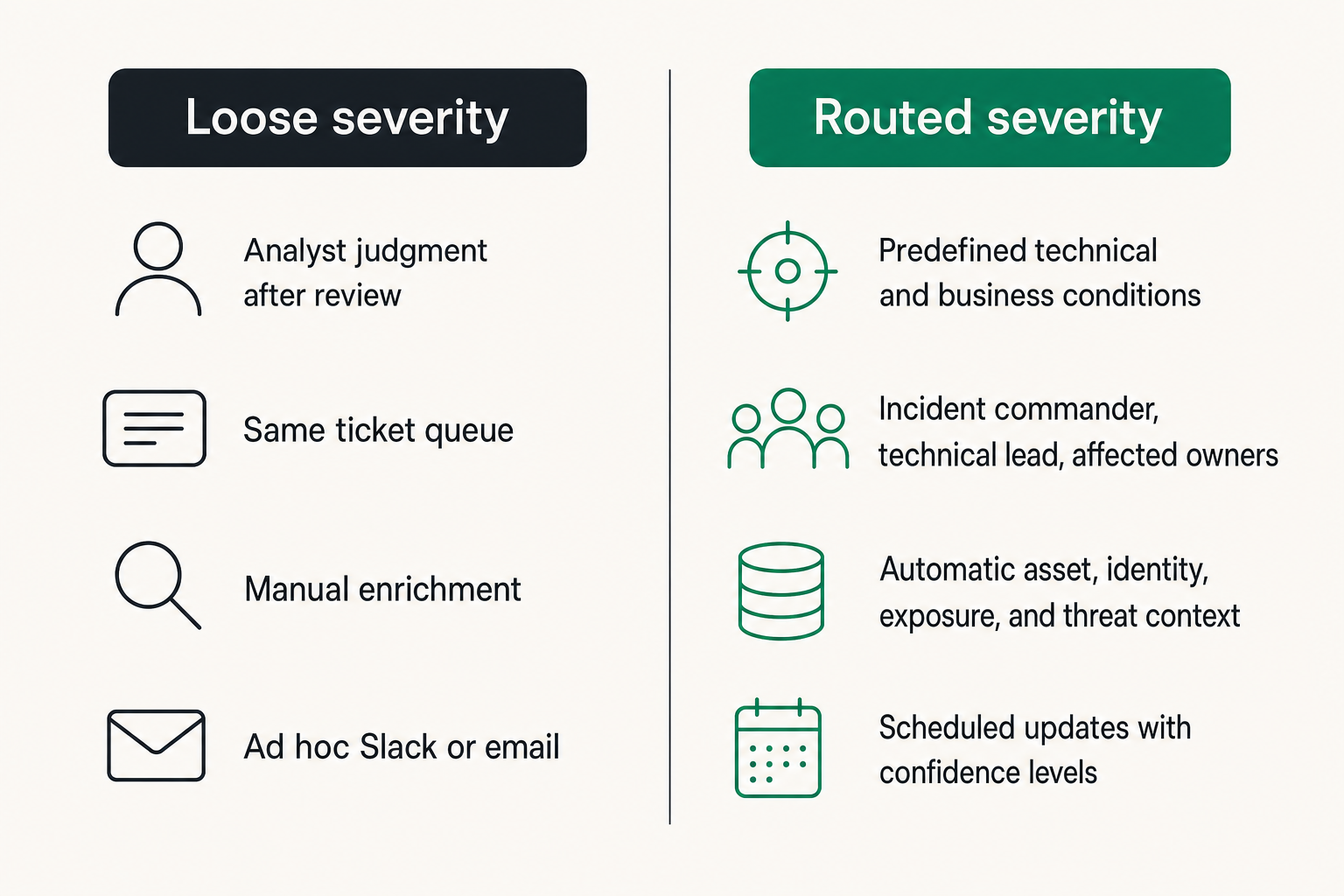
Severity models are usually written as if they are classification schemes. Low, medium, high, critical. Impact and likelihood. Maybe a few examples. Useful, but not enough.
For SOC operations, severity is a control plane. It decides who gets paged, what data gets pulled, what SLA applies, which containment actions are allowed, and how often leadership receives updates.
Severity is a routing decision
A critical incident should not mean the alert looks scary. It should mean the organization must switch from analyst-owned triage to coordinated incident command.
A simple comparison helps:
| Area | Weak severity model | Operational severity model |
|---|---|---|
| Trigger | Analyst judgment after review | Predefined technical and business conditions |
| Routing | Same ticket queue | Incident commander, technical lead, affected owners |
| Context | Manual enrichment | Automatic asset, identity, exposure, and threat context |
| Communication | Ad hoc Slack or email | Scheduled updates with confidence levels |
| Containment | Discussed late | Prepared options reviewed early |
| Closure | Alert resolved | Attack path validated as broken |
The severity model should be boring enough to apply under stress. If the team needs a debate to decide whether something is critical, the criteria are too vague.
Suggested critical incident criteria
You do not need a perfect model on day one. You need criteria that map to actual business risk and response needs.
Strong critical triggers include:
- Confirmed compromise of privileged identity.
- Active exploitation of internet-facing critical service.
- Ransomware behavior or destructive action on production systems.
- Exfiltration from regulated, customer, or crown-jewel data stores.
- Lateral movement across trust boundaries.
- Compromise of build, deployment, or signing infrastructure.
- Material outage caused by suspected security activity.
Weak triggers include:
- Any alert with a high vendor score.
- Any IOC match without asset or behavior context.
- Any vulnerability with a public exploit, regardless of exposure.
- Any executive device alert, regardless of confidence.
Practical rule: critical severity should be based on attacker capability, business impact, and blast radius, not alert drama.
A minimal policy can look like this:
critical_incident_activation:
  require_any:
    - privileged_identity_compromise
    - confirmed_data_exfiltration
    - active_ransomware_behavior
    - exploited_internet_facing_critical_asset
    - ci_cd_or_signing_system_compromise
  enrich_with:
    - asset_owner
    - business_service
    - exposure_status
    - identity_privilege
    - known_threat_actor_or_tooling
  route_to:
    - incident_commander
    - soc_technical_lead
    - affected_service_owner
    - executive_security_owner
The exact labels matter less than the behavior they trigger. A severity model that does not change workflow is just decoration.
Assign ownership before the incident
Critical incidents expose vague ownership faster than any tabletop exercise. During normal operations, a ticket can wait while someone asks who owns a server. During a critical incident, that delay becomes a risk decision nobody formally approved.
Ownership is not only about people. It is about authority. Who can approve isolation? Who can disable accounts? Who can pause a deployment? Who can accept downtime? Who can speak externally?
Roles that cannot be ambiguous
At minimum, define these roles before the first alert fires:
- Incident commander: owns coordination, cadence, and decisions.
- SOC technical lead: owns investigation quality and evidence synthesis.
- Detection lead: owns alert logic, telemetry gaps, and new detections.
- Containment owner: owns approved actions and rollback paths.
- Service owner: owns business impact and operational constraints.
- Communications owner: owns internal and external messaging.
- Executive sponsor: owns risk acceptance when tradeoffs exceed technical authority.
Related reading from our network: teams building any operational network face similar vocabulary problems, and the same applies to incident roles; this guide on operating vocabulary for local networks is a useful adjacent lens for naming asks, owners, routing, and follow-up.
The role map should be tied to systems, not stored only in a wiki. If the alert knows the affected asset, the workflow should be able to resolve the service owner, on-call contact, escalation path, and business criticality.
Escalation paths and executive comms
Executive communication fails when responders try to report certainty they do not have yet. A better pattern is to communicate what is known, what is likely, what is unknown, and what decision is needed.
Use a consistent update format:
- Status: investigating, contained, monitoring, recovered.
- Confidence: low, medium, high.
- Scope: affected identities, assets, services, data, regions.
- Business impact: observed impact and plausible impact.
- Current action: what the team is doing now.
- Next decision: what may require approval.
- Next update time: when leadership will hear again.
Related reading from our network: secure collaboration matters during response, and this architecture guide to secure messaging apps in 2026 is relevant when teams are choosing out-of-band channels, retention rules, and verification workflows for incident comms.
Practical rule: the first executive update should not promise root cause. It should establish control, scope boundaries, decision needs, and the next communication cadence.
Signal architecture for critical incidents
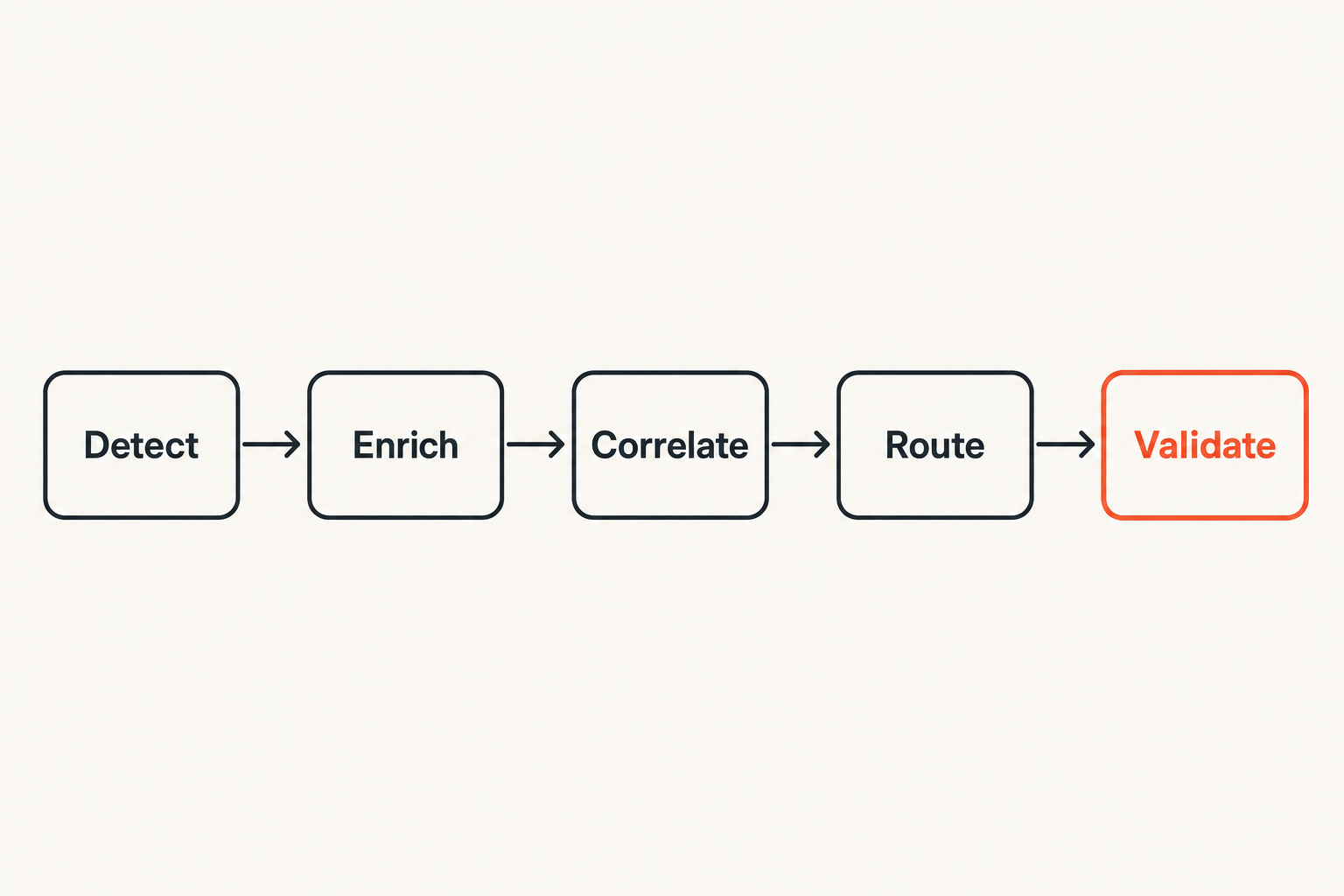
A critical incident approach is only as good as the signals it can trust quickly. More telemetry is not automatically better. In a critical incident, noisy telemetry can be worse than missing telemetry because it creates false branches in the investigation.
The practical question is: which signals can change a decision in the first 15 to 60 minutes?
Start with the failure mode, not the tool
Many teams start by asking which SIEM rules they need. Start with failure modes instead.
For example:
- Privileged account takeover.
- Exposed edge service exploitation.
- Cloud control plane abuse.
- Endpoint ransomware execution.
- Data staging and exfiltration.
- CI/CD pipeline compromise.
- Credential dumping followed by lateral movement.
For each failure mode, define the minimum signal set needed to confirm, scope, and contain. That usually means combining identity, endpoint, network, cloud, vulnerability, and asset context.
If your team is still connecting triage steps manually, the architecture patterns in threat analysis workflows for SOC teams are directly relevant because critical incidents magnify every disconnected handoff.
Enrichment and context gates
Critical response should not wait for analysts to copy IP addresses between tools. Enrichment should happen automatically, but not blindly.
Useful enrichment gates include:
- Asset criticality: is the affected system tied to a critical service?
- Exposure: is it internet-facing, partner-facing, internal-only, or isolated?
- Identity privilege: does the user have admin, production, or data access?
- Vulnerability state: is the asset affected by known exploited vulnerabilities?
- Threat context: are indicators associated with active campaigns or tooling?
- Data sensitivity: does the system process regulated or customer data?
A good enrichment pipeline reduces the number of questions humans must answer before making a containment decision.
Related alerts versus one incident
What breaks in practice is alert fragmentation. One adversary campaign creates an identity alert, an EDR alert, a cloud alert, a DNS alert, and a vulnerability alert. Five queues treat them as five events.
For critical incidents, the incident object should become the center of gravity. Alerts attach to the incident. Evidence attaches to the incident. Decisions attach to the incident. Owners attach to the incident.
A lightweight correlation model can use:
- Shared identity.
- Shared host or workload.
- Shared network destination.
- Shared process lineage.
- Shared cloud principal.
- Shared time window.
- Shared threat actor infrastructure or tooling.
Do not wait for perfect graph correlation. Even basic grouping prevents duplicate investigation and conflicting containment actions.
Critical incident approach workflow from detection to containment
The critical incident approach workflow should be explicit enough that an on-call team can run it at 02:00 without inventing process. It should also be flexible enough that responders can adapt to messy evidence.
The goal is not to turn humans into checklist operators. The goal is to remove avoidable coordination overhead so experts can focus on judgment.
A practical seven-step sequence
A workable implementation sequence looks like this:
- Activate critical mode. Apply predefined criteria, create the incident object, assign incident commander and technical lead, and start the communication cadence.
- Freeze the investigation frame. Record the initial trigger, affected entities, timestamp range, confidence, and immediate assumptions.
- Pull required context. Enrich assets, identities, vulnerabilities, exposure, service ownership, recent changes, and threat intelligence.
- Scope the active path. Identify how the adversary entered, what they touched, what privileges they used, and what they can still reach.
- Choose containment options. Compare reversible and irreversible actions, expected business impact, approval requirements, and rollback path.
- Execute containment. Disable, isolate, block, rotate, patch, segment, or pause based on the approved plan.
- Validate and monitor. Confirm the path is broken, deploy compensating detections, monitor recurrence, and document evidence gaps.
That sequence should exist in your case management system, not only in a PDF. Every step should have owners, timestamps, artifacts, and decision notes.
Evidence handling while moving fast
Critical response often creates tension between speed and evidence quality. If the team moves too slowly, the adversary keeps operating. If the team moves too fast without preserving evidence, root cause and legal review suffer later.
A balanced approach:
- Snapshot relevant logs before retention windows roll over.
- Preserve endpoint triage packages before reimaging.
- Record containment decisions and approvers.
- Keep command history for cloud and identity actions.
- Export volatile evidence when systems may be isolated or shut down.
- Separate facts from assumptions in incident notes.
The mistake teams make is treating documentation as post-incident cleanup. During a critical incident, decision records are operational assets. They prevent repeated debates and make handoffs safer.
What works and what fails in implementation
Most critical incident approach projects fail for boring reasons. The team creates a beautiful process that is not connected to alert routing, asset data, on-call schedules, or containment tooling. When the incident happens, responders revert to chat, memory, and heroics.
A useful way to think about it is that implementation must change the default path. If the critical workflow requires someone to remember to use it, it is not implemented.
What works in production
The strongest implementations tend to share a few properties:
- The activation criteria are simple and visible.
- Incident commander assignment is automatic or obvious.
- Asset ownership data is maintained because other workflows depend on it too.
- Enrichment happens before the first human handoff.
- Communications use a fixed cadence and format.
- Containment options are pre-approved by scenario.
- Detection engineers join early when signal quality is uncertain.
- Post-incident actions feed backlog items with owners and due dates.
A practical critical incident approach also reuses existing SOC muscle. Do not create a parallel universe. Extend your alert triage, case management, detection engineering, vulnerability management, and threat intelligence workflows so they can switch into critical mode.
What fails when teams overbuild
Overbuilt incident systems look mature until they meet production reality.
| Failure mode | What it looks like | Why it breaks |
|---|---|---|
| Too many severity levels | Analysts debate labels | Routing is unclear |
| Manual owner lookup | People search docs during response | Containment waits |
| Tool-first automation | SOAR runs actions without context | Business impact increases |
| Chat-only command | Decisions disappear in threads | Handoffs and audits suffer |
| Executive over-notification | Leaders get every technical update | Responders lose focus |
| No validation step | Incident closes after action taken | Recurrence is missed |
The goal is not maximum process. The goal is minimum reliable structure.
Practical rule: if a control does not reduce uncertainty, shorten decision time, or prevent a known failure mode, do not add it to the critical path.
Metrics that prove your critical incident approach is improving
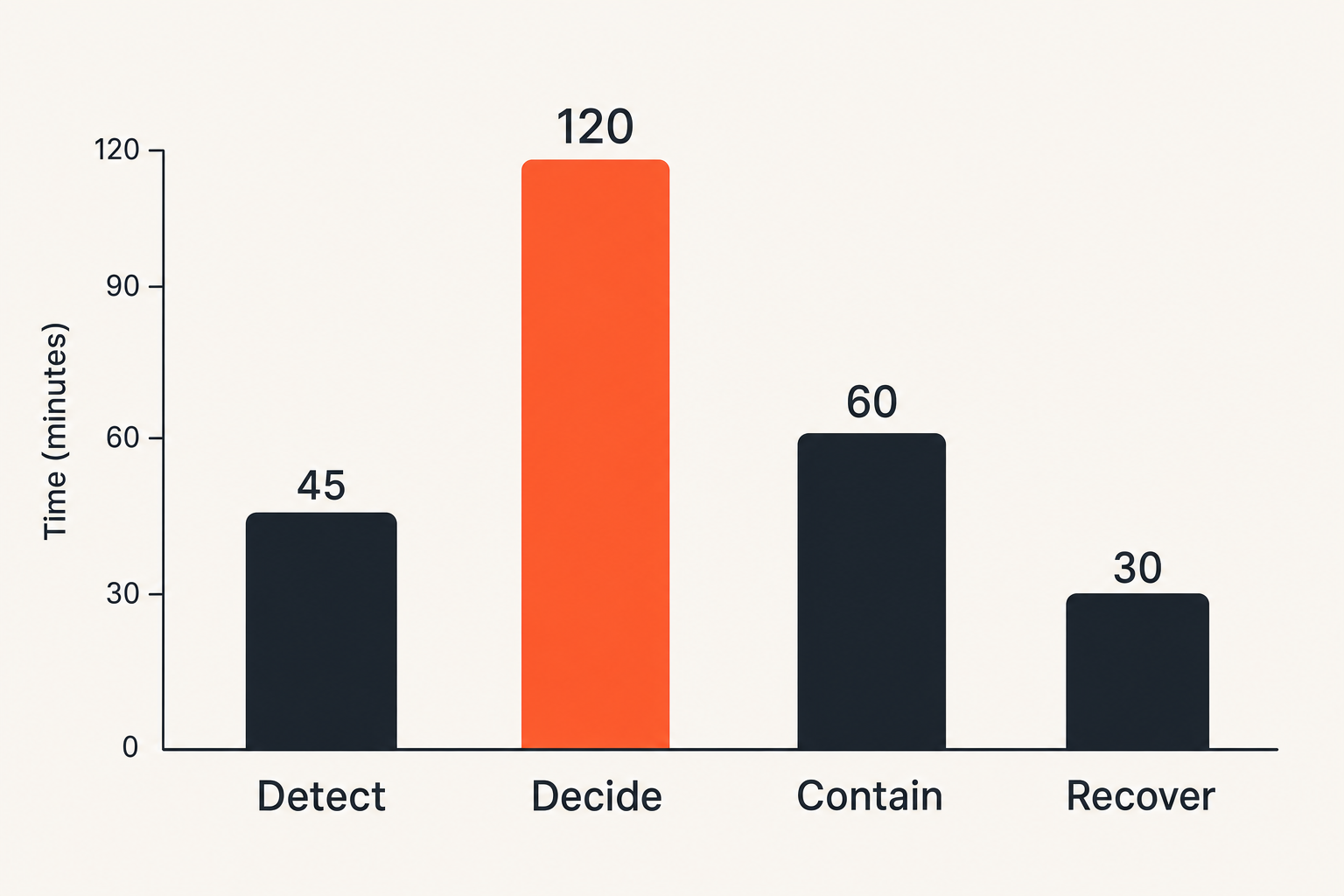
Metrics for critical incidents are tricky because the sample size is small and the events are not uniform. Do not pretend you can benchmark every incident cleanly. Measure the workflow properties that should improve across real incidents and exercises.
The best metrics focus on decision latency, signal quality, containment effectiveness, and recurrence.
Measure decision latency
Mean time to detect and mean time to respond are too blunt for critical incidents. Break the timeline into operational decisions.
Useful measurements include:
- Time from first signal to critical activation.
- Time from activation to incident commander assigned.
- Time from activation to affected owner identified.
- Time from activation to first executive update.
- Time from activation to containment options documented.
- Time from containment approval to action executed.
- Time from containment to validation signal.
These metrics reveal workflow drag. If owner identification takes 45 minutes, you have an asset ownership problem. If containment approval takes two hours, you have an authority problem. If validation never happens, you have a detection coverage problem.
Track containment quality and recurrence
Speed alone can create bad incentives. A fast containment action that misses the real path is not success.
Track quality indicators:
- Did the action break the confirmed attack path?
- Were there unplanned business impacts?
- Did the adversary reappear through the same path?
- Were related alerts grouped correctly?
- Did the team identify the earliest known activity?
- Were new detections created for the observed behavior?
- Were exposure or vulnerability fixes completed after response?
This is where proactive and reactive security need to connect. Incident response should not end with a closed case. It should update detection logic, hardening priorities, attack surface monitoring, and control validation.
Automation boundaries in high-severity response
Automation is useful in a critical incident approach, but only if the team is honest about blast radius. The mistake teams make is automating dramatic actions before automating context collection and decision support.
Critical incidents need faster humans, not uncontrolled robots.
Automate preparation and reversible actions
Automation works best where the action is low-risk, reversible, or purely informational.
Good candidates:
- Create the incident object.
- Attach related alerts.
- Enrich affected assets and identities.
- Pull recent authentication, endpoint, cloud, and network activity.
- Resolve owners and on-call contacts.
- Start evidence preservation tasks.
- Open a controlled communication channel.
- Apply temporary blocks for known malicious indicators where policy allows.
- Generate a containment option summary.
For teams integrating application and pipeline signals, the operating model in DevSecOps and application security for SOC teams is useful because CI/CD incidents often cross security, engineering, and release ownership boundaries. Related reading from our network: the same trust-transition problem appears in this guide to arrow security for CI/CD, especially where unsafe changes move from pull request to production.
Keep irreversible actions human-approved
Some actions should require explicit approval because they can cause outages, data loss, legal exposure, or operational disruption.
Usually human-approved:
- Isolating production database servers.
- Disabling broad identity groups.
- Rotating high-volume service credentials.
- Blocking business-critical network paths.
- Pausing deployment pipelines.
- Shutting down customer-facing services.
- Reimaging systems before evidence capture.
The approval process should still be fast. Predefine who can approve by scenario. Predefine rollback requirements. Predefine how business impact is communicated.
A good automation boundary looks like this:
automation_policy:
  auto_execute:
    - enrich_entities
    - group_related_alerts
    - preserve_logs
    - notify_incident_roles
    - block_known_bad_ioc_low_blast_radius
  require_approval:
    - isolate_production_asset
    - disable_privileged_group
    - rotate_shared_service_secret
    - pause_release_pipeline
  approval_record:
    - approver
    - reason
    - expected_impact
    - rollback_plan
That model keeps the SOC moving without pretending every containment decision is safe to delegate to a playbook.
Product fit: connecting intelligence to response
A critical incident approach depends on context arriving before responders burn time chasing it. Threat intelligence, vulnerability state, exposure, and asset ownership are not side panels. They are decision inputs.
If those inputs live in disconnected tools, the incident commander gets fragments instead of options. The SOC technical lead spends time reconciling evidence instead of answering the practical question: what can the attacker still do, and what should we stop first?
Where ThreatCrush fits in the workflow
ThreatCrush is built around the operational side of security intelligence: real-time threat feeds, vulnerability tracking, attack surface monitoring, and threat actor context that security teams can connect into detection and response workflows.
In a critical incident workflow, that context helps with:
- Prioritizing exposed assets that match active exploitation.
- Enriching indicators with campaign and tooling context.
- Connecting vulnerability signals to affected services.
- Giving responders a faster view of likely adversary intent.
- Feeding detection engineering after the incident with better context.
This is not about replacing incident command or analyst judgment. It is about reducing the time spent assembling context that should already be available when critical mode starts.
A mature critical incident approach makes severity actionable, ownership explicit, signals connected, automation bounded, and validation mandatory. That is the difference between having a playbook and having an operating model that works under pressure.
Try threatcrush.com
You are writing for security operations professionals building and scaling SOC capabilities. Try threatcrush.com.
Try ThreatCrush
Real-time threat intelligence, CTEM, and exposure management — built for security teams that move fast.
Get started →