CPI Security for SOC Teams: Turning Critical Program Information Into Detectable Workflows
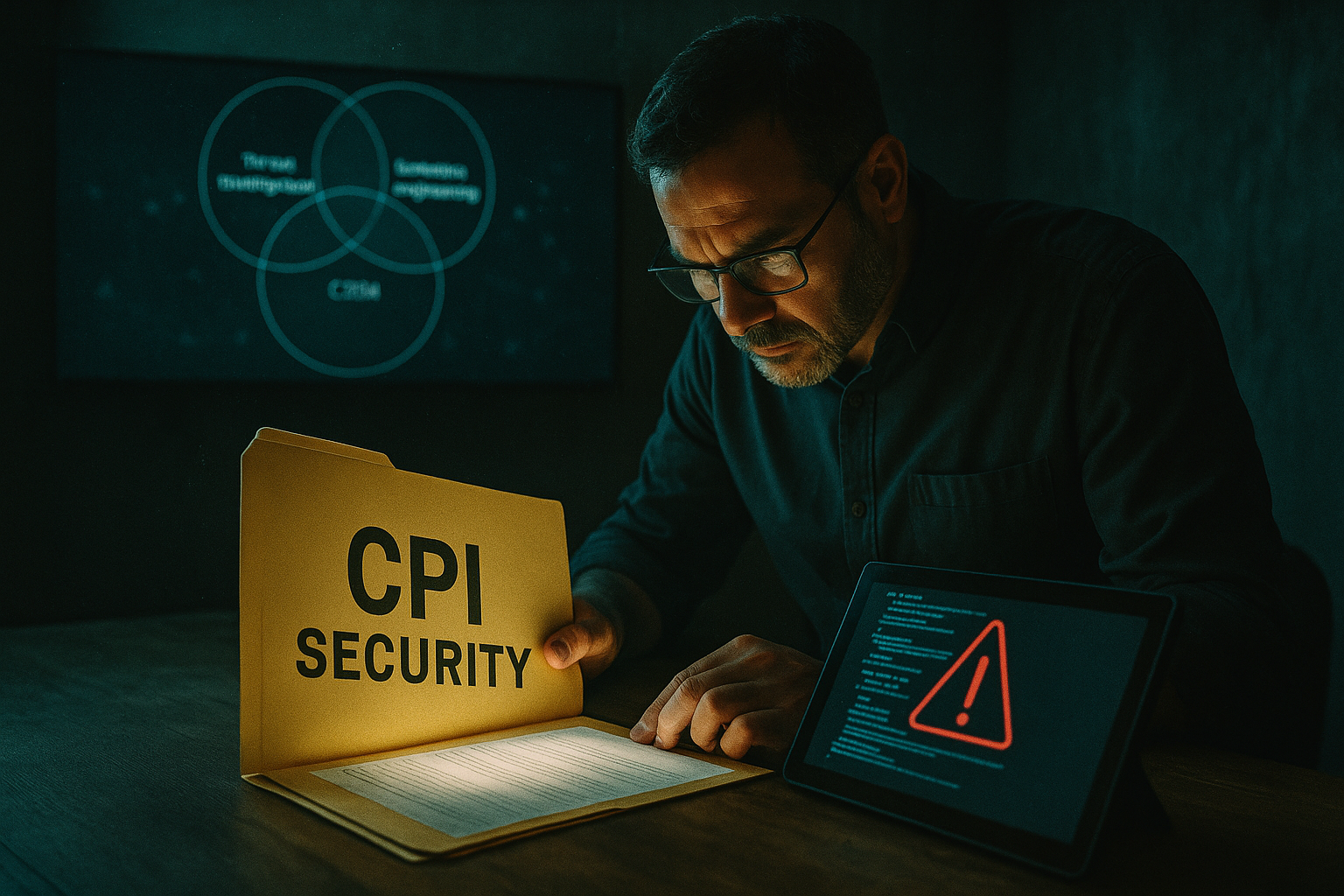
CPI security usually shows up after something has already gone wrong. A sensitive engineering repository is cloned from an unmanaged endpoint. A contractor account touches restricted design files from an unusual location. A build pipeline exposes credentials that can reach the program environment.
Teams think the problem is CPI classification. The real problem is operationalization.
If your SOC cannot tell which identities, hosts, repositories, pipelines, SaaS folders, and network paths can touch Critical Program Information, then CPI security is mostly a document exercise. The labels may be correct. The control language may be correct. The audit package may even look mature. But the people watching alerts at 2 a.m. do not have the context required to make a decision.
The practical question is not whether CPI matters. It does. The practical question is how to turn CPI security into a workflow that detection engineers, incident responders, security architects, and program owners can actually run in production.
Table of contents
- CPI security is an operating model, not a label
- Build the CPI asset graph before writing detections
- Translate CPI risk into SOC signals
- Prioritize CPI security without drowning analysts
- Implement CPI security as a workflow
- Detection engineering patterns for CPI security
- Incident response when CPI is touched
- Common CPI security failure modes
- Measure whether CPI security is working
- Where ThreatCrush fits in a CPI security architecture
CPI security is an operating model, not a label
Why CPI breaks normal SOC assumptions
Most SOC workflows assume that an alert is evaluated against a technical asset: endpoint, user, IP, domain, container, SaaS object, or cloud workload. CPI security changes the unit of consequence.
A normal alert says a user downloaded many files. A CPI-aware alert says a non-program identity downloaded files from a repository mapped to a restricted design package, from an unmanaged device, after a new OAuth grant, within 24 hours of a foreign travel login. That changes the conversation.
The mistake teams make is treating CPI like a tag that can be sprinkled onto data stores. Tags help, but they do not create operational context by themselves. The SOC needs to know what CPI is connected to, who can access it, what normal access looks like, and what downstream systems can move it.
Practical rule: If an analyst cannot see CPI relevance inside the alert record, CPI security is not operational yet.
The difference between classified and operationally protected
CPI may live in environments with formal controls, but the operational risk often sits around the edges: collaboration platforms, ticket attachments, CI artifacts, contractor endpoints, source control mirrors, cloud storage exports, test data, simulation outputs, and support bundles.
This is why CPI security is not only a compliance concern. It is a detection and response architecture problem. The SOC has to watch the systems that can expose CPI indirectly, not only the canonical system of record.
A useful way to think about it is this: CPI has primary locations, access paths, and leakage paths. Primary locations are where teams intentionally store the information. Access paths are the identities, services, and networks used to reach it. Leakage paths are places where CPI can appear as a side effect of work.
A comparison that changes the conversation
| Approach | What it optimizes for | What breaks in practice | Better operating model |
|---|---|---|---|
| Policy-only CPI security | Audit evidence | Analysts cannot triage CPI events | Map CPI to alerts and response paths |
| Data classification only | Label coverage | Labels do not explain access risk | Combine labels with identity and asset context |
| Tool-centric DLP | Blocking known patterns | Engineering data rarely fits simple patterns | Monitor movement, privilege, and exposure together |
| Program-owner memory | Local knowledge | Knowledge disappears during incidents | Maintain a shared CPI asset graph |
The goal is not to replace policy. The goal is to make policy executable by the SOC.
Build the CPI asset graph before writing detections
Start with the paths to CPI, not only the CPI itself
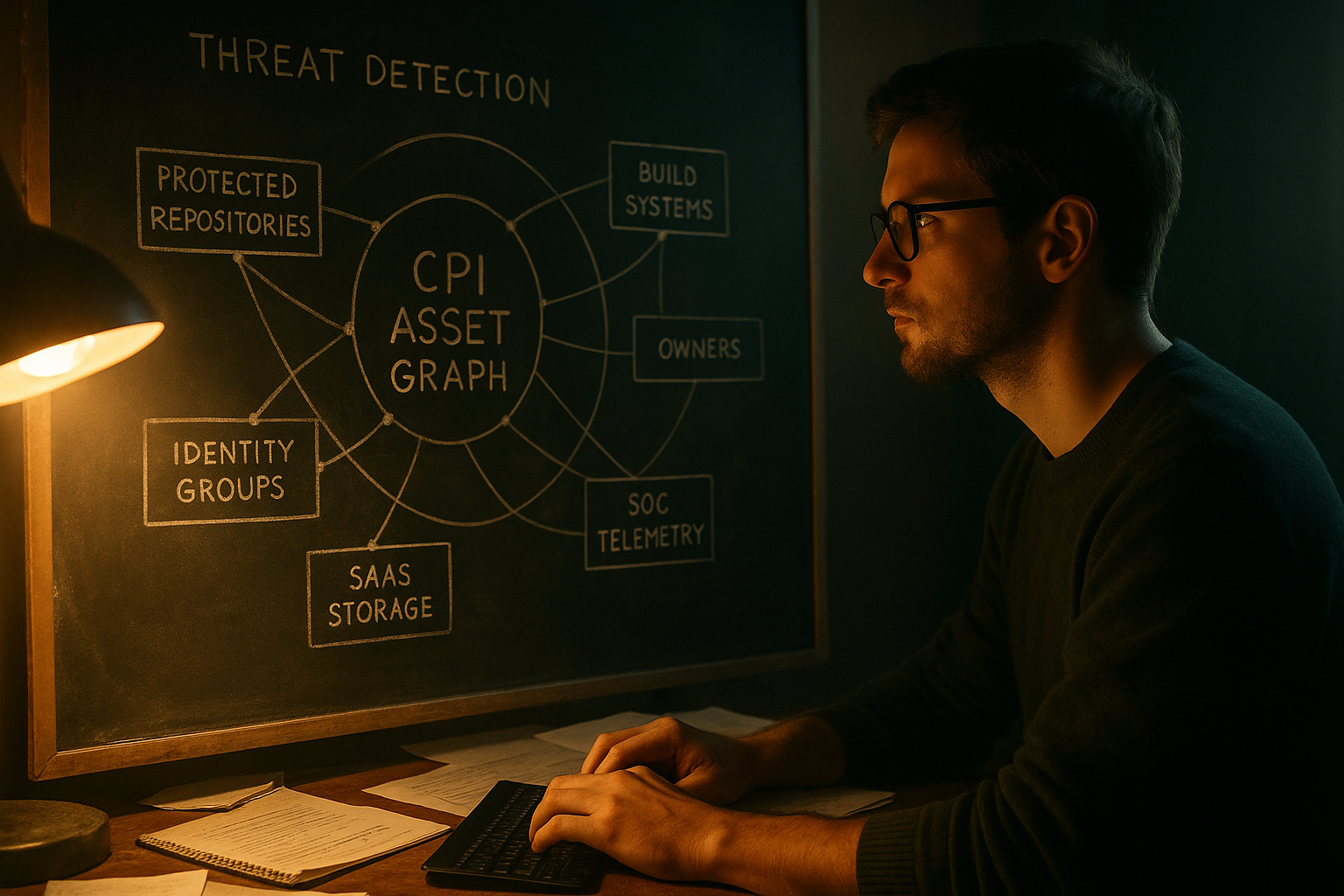
Before writing detection logic, build a small asset graph that answers four questions:
- Where does CPI reside?
- Who and what can access it?
- Which systems can move it elsewhere?
- Which external exposures would make access easier?
Do not start with every theoretical artifact. Start with the top programs, repositories, engineering folders, privileged groups, build systems, and SaaS workspaces. If the graph becomes too broad, nobody will maintain it. If it is too narrow, analysts will miss the lateral path that matters.
A CPI asset graph does not need to be fancy. Many teams begin with a table that links program name, data location, owner, identity group, logging source, detection coverage, and response contact. The point is not visualization. The point is usable context.
Related reading from our network: teams making remote tooling decisions face a similar workflow problem, where access paths and ownership matter more than the tool label itself, as discussed in remote access software workflow guide.
Map ownership at the same time as technology
CPI security fails when ownership is separated from telemetry. The SOC sees suspicious activity but does not know whether it is expected program work. The program team knows the context but does not understand the signal. The identity team controls access but does not own the business consequence.
Every CPI node should have three owners:
- Technical owner: accountable for the system or repository.
- Program owner: accountable for the information and mission consequence.
- Security owner: accountable for monitoring, detection, and response.
This sounds basic. In production, it is usually where the program either starts working or collapses into ticket archaeology.
Practical rule: Every CPI asset without an incident contact is an untriageable asset.
Keep the graph small enough to use
The graph should support fast questions during triage. For example:
- Is this user expected to touch this CPI location?
- Is this endpoint managed and healthy?
- Is this access path normal for this program?
- Can this system export CPI to unmanaged locations?
- Has this asset been linked to current threat activity?
If the graph cannot answer those questions quickly, simplify it. Add depth only where incidents or validation exercises prove that more context is needed.
Translate CPI risk into SOC signals
Identity signals matter more than file names
File names are weak signals. CPI does not always announce itself with obvious names, and teams rename or package sensitive information constantly. Identity behavior is often stronger.
Useful CPI security signals include:
- New access to CPI groups or repositories.
- Privilege escalation on systems that store or process CPI.
- Access from unmanaged or newly enrolled endpoints.
- Access after impossible travel or suspicious authentication.
- OAuth grants that allow file read or mailbox export.
- Service accounts accessing CPI outside normal job windows.
The detection question is not only did a file move. It is who had the authority to move it, whether that authority was expected, and whether the session looked trustworthy.
Data movement is the core detection surface
CPI loss is usually a movement problem. The movement may be direct, such as a bulk download from a repository. It may be indirect, such as copying logs, exporting design metadata, syncing folders to personal storage, or generating support bundles.
Watch for changes in movement volume, destination, protocol, and tool. A developer downloading thousands of files before a build may be normal. The same developer downloading the same files to an unmanaged device after adding a personal cloud integration is not normal.
Strong signals often combine several weak events:
- Repository clone plus new SSH key.
- SaaS export plus risky sign-in.
- Build artifact download plus external network upload.
- New contractor account plus immediate access to historical design folders.
Use program context to suppress weak alerts
CPI security should reduce noise, not inflate it. Program context lets detection engineers suppress alerts that are technically suspicious but operationally expected.
For example, a weekly simulation job may create large downloads from a protected storage bucket. Without context, that becomes a recurring high-severity alert. With context, it becomes a monitored baseline with constraints: expected service account, expected time window, expected destination, expected artifact size, and expected approval record.
This is where CPI security becomes useful to analysts. It turns generic anomaly detection into program-aware detection.
Prioritize CPI security without drowning analysts
Severity should follow consequence, not tool default
Tool severity is rarely CPI-aware out of the box. A medium identity alert may be a major CPI incident if the identity can access protected design data. A high malware alert may be less urgent if it sits on an isolated kiosk with no CPI path.
Build severity around consequence:
| Signal | No CPI path | CPI-adjacent | Direct CPI access |
|---|---|---|---|
| Risky sign-in | Low | Medium | High |
| New privileged grant | Medium | High | Critical |
| Bulk download | Medium | High | Critical |
| External exposure | Medium | High | Critical |
| Confirmed malware | High | Critical | Critical |
This table is not a universal scoring model. It is a forcing function. It makes teams ask whether the alert can affect CPI.
Escalation rules need CPI context
Escalation should not depend on an analyst remembering a program acronym from a spreadsheet. CPI context should be embedded in the alert, case, or enrichment panel.
Minimum useful enrichment:
- CPI relevance: none, adjacent, direct.
- Program or data owner.
- Primary system and access group.
- Expected user population.
- Last validation date.
- Response contact and containment constraints.
If a tool cannot carry that context, push it into the case management workflow or enrichment service. Do not rely on chat history.
What good prioritization looks like
Good prioritization feels almost boring. Analysts see fewer CPI alerts, but each one is richer. Cases route faster. Program owners receive better questions. Detection engineers can tune noisy rules without weakening real coverage.
Related reading from our network: prioritization is also a multi-objective problem in other operational domains, and the tradeoff framing in multi-objective optimization for AEO maps surprisingly well to balancing coverage, precision, analyst time, and business consequence.
Practical rule: CPI security should increase alert fidelity before it increases alert volume.
Implement CPI security as a workflow
A practical implementation sequence
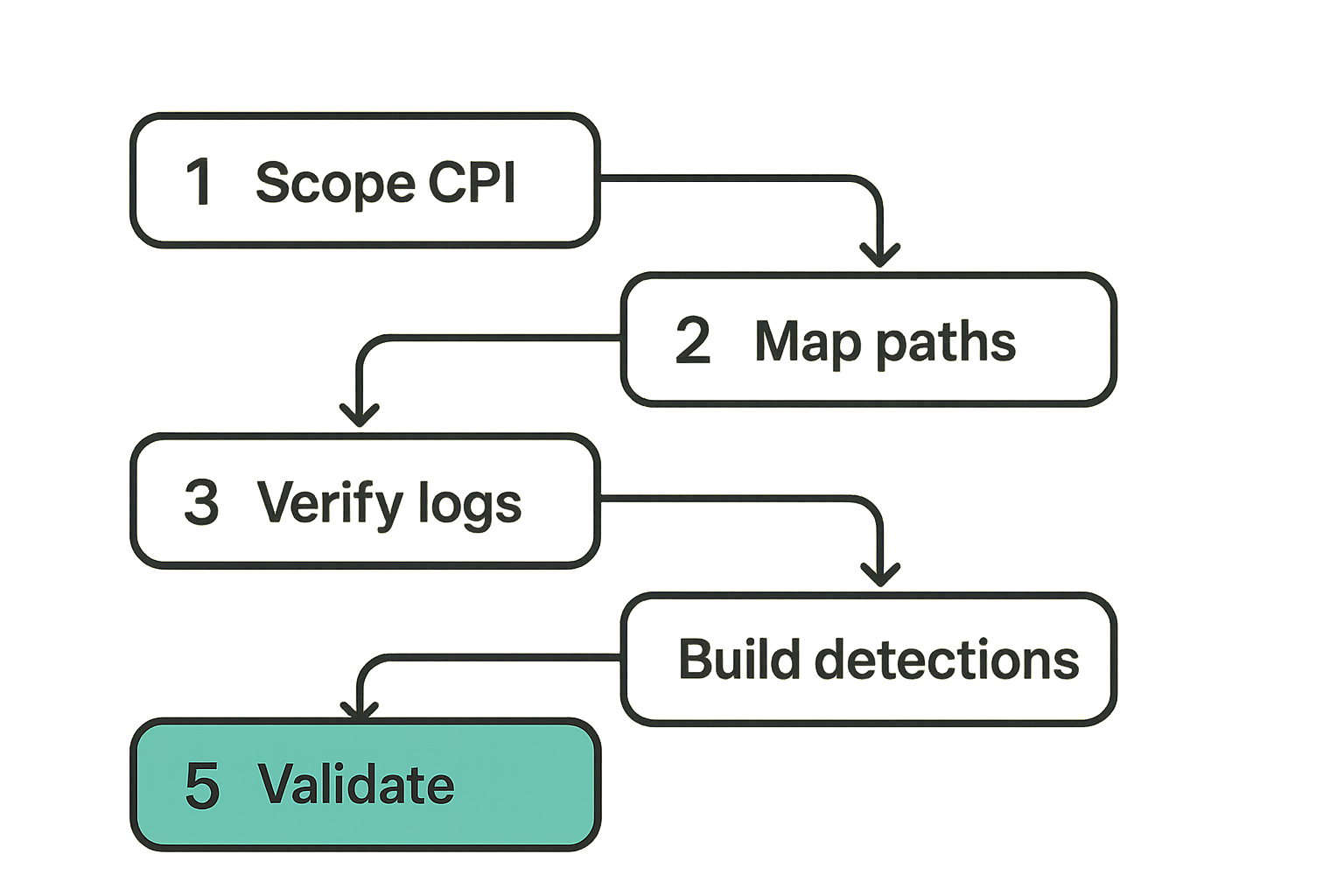
The practical implementation sequence looks like this:
- Select the first CPI program scope. Choose a real program with active engineering work, not a stale archive.
- Identify primary CPI locations. Include repositories, storage, SaaS workspaces, build systems, and document platforms.
- Map access paths. Capture identity groups, service accounts, privileged roles, network paths, and third-party access.
- Confirm logging coverage. Verify that access, admin actions, exports, and authentication events are actually collected.
- Build CPI enrichment. Add program, owner, access path, and consequence fields to alerts or cases.
- Write detections around movement and privilege. Start with a small number of high-confidence detections.
- Define response playbooks. Specify who can disable accounts, isolate systems, revoke sessions, and approve emergency containment.
- Run validation. Test expected and suspicious scenarios, then tune.
- Expand to the next program. Reuse the model, not the assumptions.
Teams that skip steps three and four usually regret it. They write detections without knowing whether the necessary telemetry exists or whether the access path is even understood.
For adjacent workflow design, the same principle applies to broader SOC analysis: connect the steps before adding more tools, as covered in threat analysis workflows that actually work.
Where automation helps and where it creates risk
Automation helps with enrichment, routing, repetitive containment, and validation. It becomes dangerous when it takes irreversible action without program context.
Good automation examples:
- Add CPI owner and access-path context to alerts.
- Raise severity when an identity has direct CPI access.
- Open a program-owner review task for unusual access.
- Revoke suspicious OAuth grants after analyst approval.
- Isolate unmanaged endpoints that touch CPI repositories.
Risky automation examples:
- Blocking all bulk downloads from engineering repositories.
- Disabling build service accounts during active release windows.
- Quarantining CPI storage without understanding mission impact.
- Auto-closing alerts because the user belongs to an approved group.
The mistake teams make is assuming automation is either good or bad. It depends on reversibility, confidence, and consequence.
The handoff model between SOC and program teams
CPI security requires a clean handoff model. The SOC should not ask vague questions like is this normal. Program teams should not respond with vague answers like probably.
Use structured prompts:
- Was this identity expected to access this CPI location today?
- Is this endpoint approved for program work?
- Is this export tied to a known ticket, build, release, or partner transfer?
- Should this service account have interactive login capability?
- Are there containment constraints before disabling access?
Related reading from our network: local coordination systems have similar trust-routing and follow-up problems, which makes supreme community operating model a useful adjacent read for thinking about ownership loops rather than broadcast communication.
Detection engineering patterns for CPI security
Pattern one privileged access to CPI systems
Privileged access is the highest-leverage detection surface. A compromised admin can change logs, grant access, export data, or weaken controls.
Detection logic should look for:
- New membership in CPI access groups.
- Privileged role activation outside expected hours.
- Admin action from unmanaged endpoint.
- Service account privilege change.
- Emergency access without corresponding approval.
A simple rule shape:
rule: cpi_privileged_access_change
when:
  event_type: group_membership_change
  target_group_tag: cpi_direct_access
conditions:
  actor_not_in: identity_admin_allowlist
  or:
    - source_device_health: unmanaged
    - actor_risk: high
    - change_window: outside_approved_window
actions:
  severity: critical
  enrich:
    - cpi_program
    - program_owner
    - response_contact
The exact syntax will vary by stack. The important part is the join between privilege change and CPI relevance.
Pattern two bulk movement from protected repositories
Bulk movement detection should avoid naive thresholds. Engineering work can generate legitimate bulk movement. Use baselines and constraints.
Better signals include:
- First-time bulk clone by an identity.
- Bulk export to unmanaged endpoint.
- Download volume outside the user baseline.
- Download followed by external upload.
- Download immediately after access grant.
- Access by dormant account.
What breaks in practice is a single global threshold. It either misses slow exfiltration or creates constant noise during legitimate builds.
Pattern three external exposure of CPI-adjacent services
CPI can be exposed through services that do not store the final information but provide a path to it: VPN portals, artifact registries, CI runners, package mirrors, remote access gateways, and misconfigured object storage.
Detection engineers should monitor:
- Newly internet-exposed services linked to CPI systems.
- Vulnerabilities on CPI-adjacent infrastructure.
- Authentication changes on remote access paths.
- Secrets in public repositories that can reach CPI assets.
- DNS or certificate changes for program-related infrastructure.
This is where proactive and reactive work connect. Attack surface changes should feed detection priority before an incident begins.
Incident response when CPI is touched
Scope the blast radius before debating intent
When CPI is touched by a suspicious identity, do not start with a philosophical debate about intent. Start with blast radius.
Ask:
- Which CPI locations were accessed?
- Which files, objects, repositories, or artifacts moved?
- Which identities and devices were involved?
- Which sessions, tokens, keys, and OAuth grants remain active?
- Which downstream systems received copies?
Intent matters later. During the first hour, scope and containment matter more.
Preserve program evidence without blocking containment
CPI incidents often involve sensitive program material, legal constraints, contractual obligations, and export considerations. Evidence handling needs to be deliberate.
Preserve:
- Authentication logs.
- Repository audit logs.
- File access logs.
- Endpoint process and network telemetry.
- Cloud activity trails.
- Chat, ticket, and approval context.
But do not let evidence preservation block obvious containment. If a suspicious token can still access CPI, revoke it. If an unmanaged endpoint is actively downloading, isolate it. Capture what you can, then stop the bleeding.
Practical rule: Preserve evidence aggressively, but never preserve attacker access for the sake of a cleaner timeline.
Recovery includes control validation
Recovery is not complete when the account is re-enabled or the ticket is closed. Recovery should validate that the path used in the incident is no longer open.
Post-incident validation should include:
- Can the same identity regain access through another group?
- Are tokens and keys fully revoked?
- Did copied data land in unmanaged storage?
- Are detections tuned for the observed technique?
- Did the CPI asset graph change?
- Did ownership or approval workflow fail?
The best CPI security programs treat incidents as graph updates. Every incident teaches the program something about where CPI really flows.
Common CPI security failure modes
What fails in practice
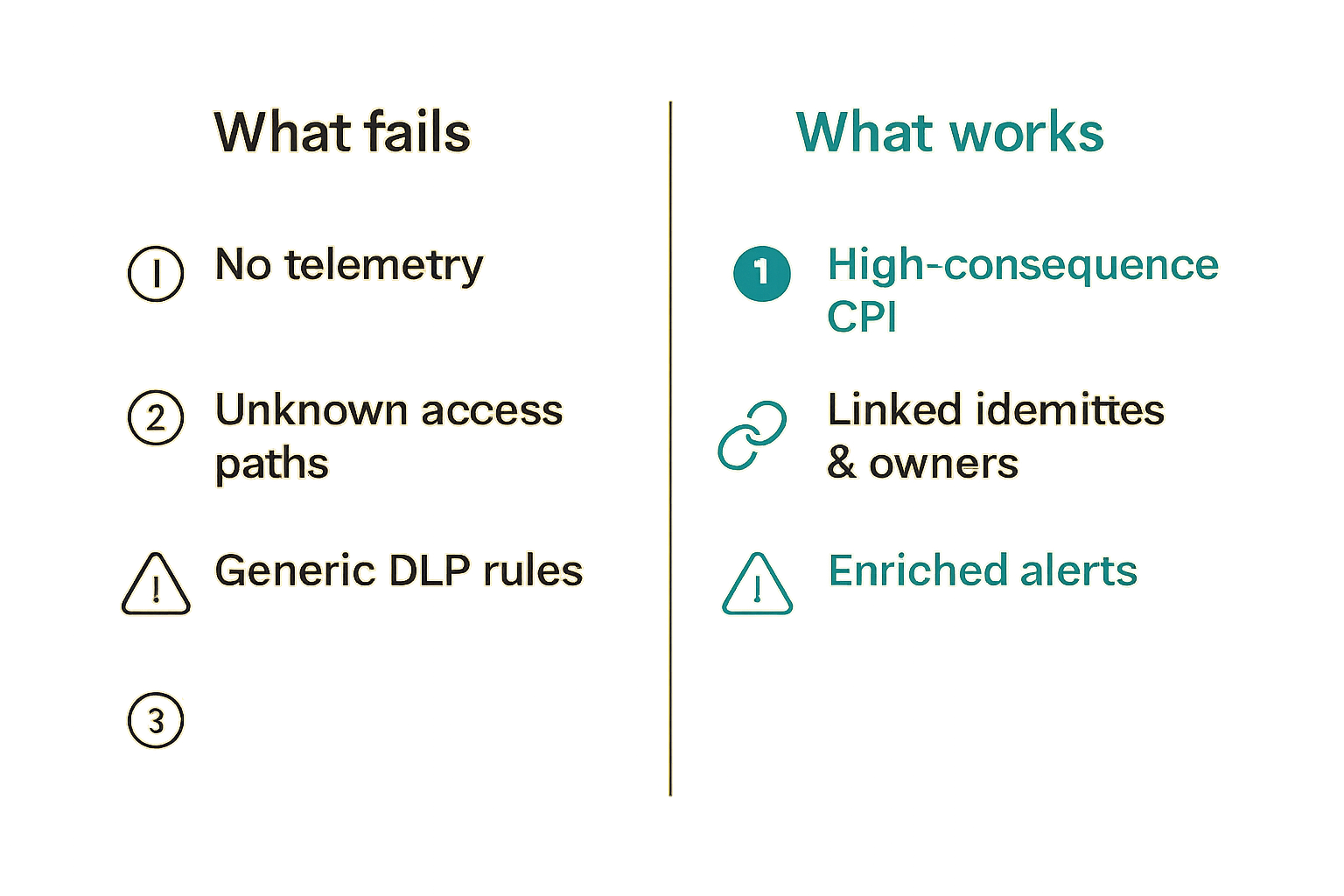
The most common failure modes are predictable:
- CPI inventory exists but is not connected to telemetry.
- Labels exist but access paths are unknown.
- DLP rules trigger on generic patterns and miss engineering movement.
- Alerts do not include program ownership.
- Contractors and service accounts are treated as exceptions forever.
- Build systems and artifact stores are ignored.
- Program teams are contacted too late.
- Response playbooks assume containment actions that nobody is authorized to take.
The painful part is that none of these failures look dramatic during planning. They only become obvious during an incident.
What works in production
What works is smaller and more operational:
- Maintain a short list of high-consequence CPI locations.
- Link each location to identities, devices, services, and owners.
- Enrich alerts with CPI relevance.
- Prioritize movement, privilege, and exposure.
- Validate detections with realistic scenarios.
- Keep response contacts current.
- Review drift monthly or after major program changes.
This is less glamorous than buying another platform. It is also closer to how CPI security actually improves.
How to detect that the program is drifting
CPI programs drift when engineering changes faster than security context. Watch for drift signals:
- New repositories without CPI classification review.
- New identity groups with access to protected locations.
- New SaaS integrations with export permissions.
- Logging gaps after platform migrations.
- Service accounts with expanding privileges.
- Response contacts that bounce or go unanswered.
Drift detection is not administrative hygiene. It is security monitoring for the control plane around CPI.
Measure whether CPI security is working
Operational metrics that matter
Avoid vanity metrics like number of CPI labels applied. Better metrics measure whether the SOC can act.
Useful CPI security metrics include:
| Metric | Why it matters |
|---|---|
| Percent of CPI locations with verified logging | Shows whether detection is possible |
| Percent with current owner and response contact | Shows whether triage can route |
| Mean time to identify CPI relevance | Shows whether analysts have context |
| Mean time to revoke risky access | Shows containment speed |
| Number of unapproved CPI access paths found | Shows drift and unknown exposure |
| Detection validation pass rate | Shows whether controls work, not just exist |
The metric should drive a decision. If nobody changes behavior after seeing it, remove it.
Validation beats dashboard theater
Dashboards are useful, but validation is harder to fake. Run controlled scenarios:
- A new user is added to a CPI group.
- A managed device performs expected bulk access.
- An unmanaged device attempts repository clone.
- A service account accesses CPI outside its job window.
- A CPI-adjacent service becomes externally exposed.
For each scenario, confirm whether the signal appears, whether it is enriched, whether it routes correctly, and whether responders know what to do.
Use metrics to tune ownership
Metrics should expose ownership problems, not hide them. If CPI alerts wait for program confirmation for hours, the issue may not be detection. It may be contact quality, authority, or unclear containment rules.
A useful operating review asks:
- Which CPI assets generated the most ambiguous alerts?
- Which owners responded slowly?
- Which access paths were unknown before investigation?
- Which detections were noisy but low consequence?
- Which containment actions required unnecessary approval chains?
That review turns CPI security from a static control into an operating loop.
Where ThreatCrush fits in a CPI security architecture
Connect threat intelligence to CPI exposure
CPI security gets stronger when threat intelligence is connected to the assets and paths that matter. If a vulnerability is being exploited against a product used in a CPI-adjacent remote access path, that should affect priority. If a threat actor is targeting a sector, supplier, or technology stack tied to a program, that context should reach the SOC before a generic alert fires.
This is where security operations teams need fewer disconnected feeds and more usable context. Threat intelligence should help answer: does this external signal change risk to our CPI paths today?
Make CPI context available during investigation
ThreatCrush is built for security operations teams that need to connect external threat signals, vulnerability context, attack surface changes, and investigation workflows. The practical fit for CPI security is not replacing your SIEM or EDR. It is enriching the decisions around what matters and why.
Teams can use ThreatCrush-style workflows to connect CPI-adjacent assets to threat actor intelligence, vulnerability tracking, attack surface monitoring, and analyst triage. For implementation details and integration patterns, the ThreatCrush documentation is the natural place to map those feeds into your existing SOC workflow.
CPI security is not a separate universe from security operations. It is a higher-consequence slice of the same SOC problem: signals, ownership, prioritization, response, and validation.
Try threatcrush.com
ThreatCrush publishes practical guidance for security operations professionals building and scaling SOC capabilities. If you are turning CPI security into real detection and response workflows, Try threatcrush.com.
Try ThreatCrush
Real-time threat intelligence, CTEM, and exposure management — built for security teams that move fast.
Get started →