Community Building Incident Response: Turning Local Trust Into Faster SOC Workflows

Incident response is supposed to be a disciplined workflow. In production, it often becomes a contact-hunt under pressure. The SOC has alerts, tickets, playbooks, and dashboards. What it does not have is the right human network ready when a supplier is compromised, a regional office loses connectivity, or a sector-specific campaign starts moving laterally across peers.
Teams think the problem is community building incident response as a soft collaboration activity. The real problem is incident response architecture without pre-built trust paths.
That changes the conversation. Community building is not a side project for conferences and Slack channels. It is an operational layer that determines how fast you can validate signals, route context, coordinate containment, and recover without inventing relationships during the worst hour of the quarter.
The practical question is not whether security teams should have a community. The practical question is what parts of incident response get measurably better when trusted people, shared norms, and local knowledge are already in place.
Table of contents
- Community building incident response is an operating model
- Map the communities that influence response
- Design trust before the incident
- Connect community signals to SOC workflows
- Build a community-enabled incident workflow
- What works and what fails in practice
- Measure community building incident response without vanity metrics
- Failure modes that break community-driven response
- Make the model sustainable for 2026 SOCs
- Where ThreatCrush fits in the architecture
Community building incident response is an operating model
Community building incident response starts with a blunt assumption: the organization will need help, context, or confirmation from people who are not sitting inside the SOC. That may include IT administrators in remote sites, application owners, suppliers, peer security teams, local responders, legal contacts, cloud support, managed service providers, or sector-specific sharing groups.
The mistake teams make is treating those relationships as optional. They build playbooks that assume perfect escalation paths and complete telemetry. Then an incident arrives through a channel the playbook does not cover. Someone saw unusual authentication failures at a regional office. A partner reports suspicious API calls. A customer shares a screenshot before your detections fire. If the SOC does not know how to validate and route that context, the incident becomes slower and noisier.
A useful way to think about it is this: incident response has a technical plane and a social plane. The technical plane includes alerts, logs, cases, malware samples, EDR timelines, SIEM searches, and containment actions. The social plane includes trust, language, roles, disclosure, escalation, and accountability. Mature response requires both.
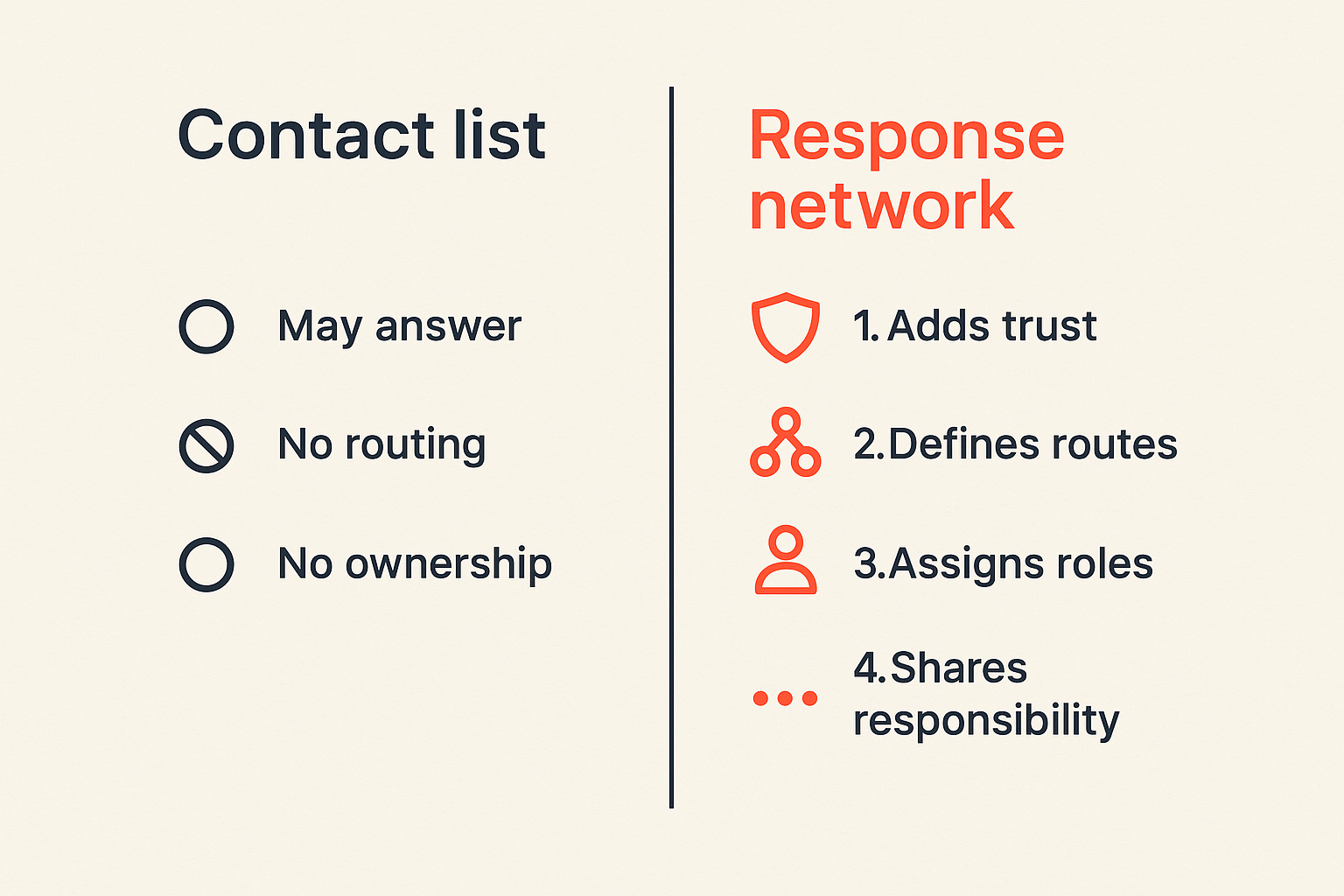
The gap between a contact list and a response network
A contact list tells you who might answer. A response network tells you who can act, what they are allowed to know, how fast they can move, and how their information should enter the incident workflow.
That distinction matters. Many teams have distribution lists, vendor portals, emergency phone trees, and shared chats. Those are not the same as a response network. A response network has tested paths. It has named owners. It has known confidentiality boundaries. It has a way to separate rumor from evidence.
A useful comparison:
| Capability | Contact list | Response network |
|---|---|---|
| Purpose | Find a person | Coordinate action |
| Trust level | Assumed | Established and maintained |
| Evidence handling | Ad hoc | Routed into case workflow |
| Escalation | Depends on availability | Predefined backups and owners |
| Security value | Limited during pressure | Shortens validation and response |
Practical rule: If a relationship has never been tested before an incident, do not count it as response capacity.
Why local context changes triage
SOC triage is often missing local context. A detection engineer can see an impossible travel alert. A site administrator may know that the affected user is on emergency travel, using a temporary device, or working from a shared facility. A cloud team may know that a suspicious deployment was part of a maintenance window. A peer organization may know that the same phishing kit hit them two hours earlier.
None of that replaces evidence. It changes which evidence you prioritize.
Local community context can reduce investigation time because it answers questions telemetry cannot answer quickly: Is this behavior expected for this office? Did a partner change their integration? Are other organizations in the same region seeing the same lure? Is the affected system actually business-critical, or is it a stale asset with bad ownership metadata?
Community is not a substitute for logging. It is a way to close the context gap that logging exposes.
Map the communities that influence response
Most incident response plans define internal roles: incident commander, SOC lead, forensics, legal, communications, IT operations, business owner. That is necessary, but incomplete. Real incidents cross organizational edges. Community building incident response requires mapping every group that can accelerate or obstruct a response.
This is where the work becomes architectural. You are not just listing people. You are mapping dependencies, trust boundaries, response latency, and decision rights.
Internal communities inside the business
Start inside the organization. Internal communities are often the most underused response asset because they are treated as ticket queues instead of operational partners.
Key internal communities include:
- Regional IT teams that understand site-specific behavior.
- Application owners who know normal deployment patterns.
- Identity administrators who can validate privilege changes.
- Help desk teams who hear user reports before the SOC does.
- Fraud, abuse, or trust and safety teams with customer-facing signals.
- Legal, privacy, and communications teams with disclosure constraints.
- Executive assistants and office managers who understand VIP travel and local disruptions.
What breaks in practice is that these groups are contacted late, with vague asks. The SOC sends a ticket that says investigate suspicious activity. The local team does not know severity, evidence standards, or expected turnaround. The SOC then assumes no one is responsive.
Better design is explicit. Define what each community can contribute during each incident phase. Help desk can surface clusters of user reports. App owners can verify release activity. Regional IT can confirm local outages or physical access events. Legal can define what can be shared outside the organization.
External communities outside your control
External communities are more complex because you do not control their priorities. That does not make them optional.
Examples include:
- Sector information sharing communities.
- Local security practitioner groups.
- Managed detection and response providers.
- Cloud and SaaS support teams.
- Law enforcement or national cyber centers where appropriate.
- Peer organizations with similar exposure.
- Open-source intelligence researchers.
- Vendor security response teams.
As a guest contributor, the team at d0rz.com spends a lot of time thinking about how real communities and local networks survive beyond announcements, which is exactly the discipline SOC teams need when they depend on trust during incidents.
External relationships require more discipline, not less. You need disclosure rules. You need a way to share indicators without exposing regulated data. You need a path for urgent validation that does not turn every incident into a public conversation.
Practical rule: Treat external communities as semi-trusted inputs until evidence is validated inside your own environment.
Design trust before the incident
Trust is not a feeling in incident response. It is a set of operating constraints. Who can receive what information? Who can approve disclosure? Which channels are allowed? What is the minimum evidence required before action? Who can speak on behalf of the organization?
If those decisions are made during an incident, they will be made inconsistently. People will either overshare because they want help or undershare because they fear consequences. Both slow the response.
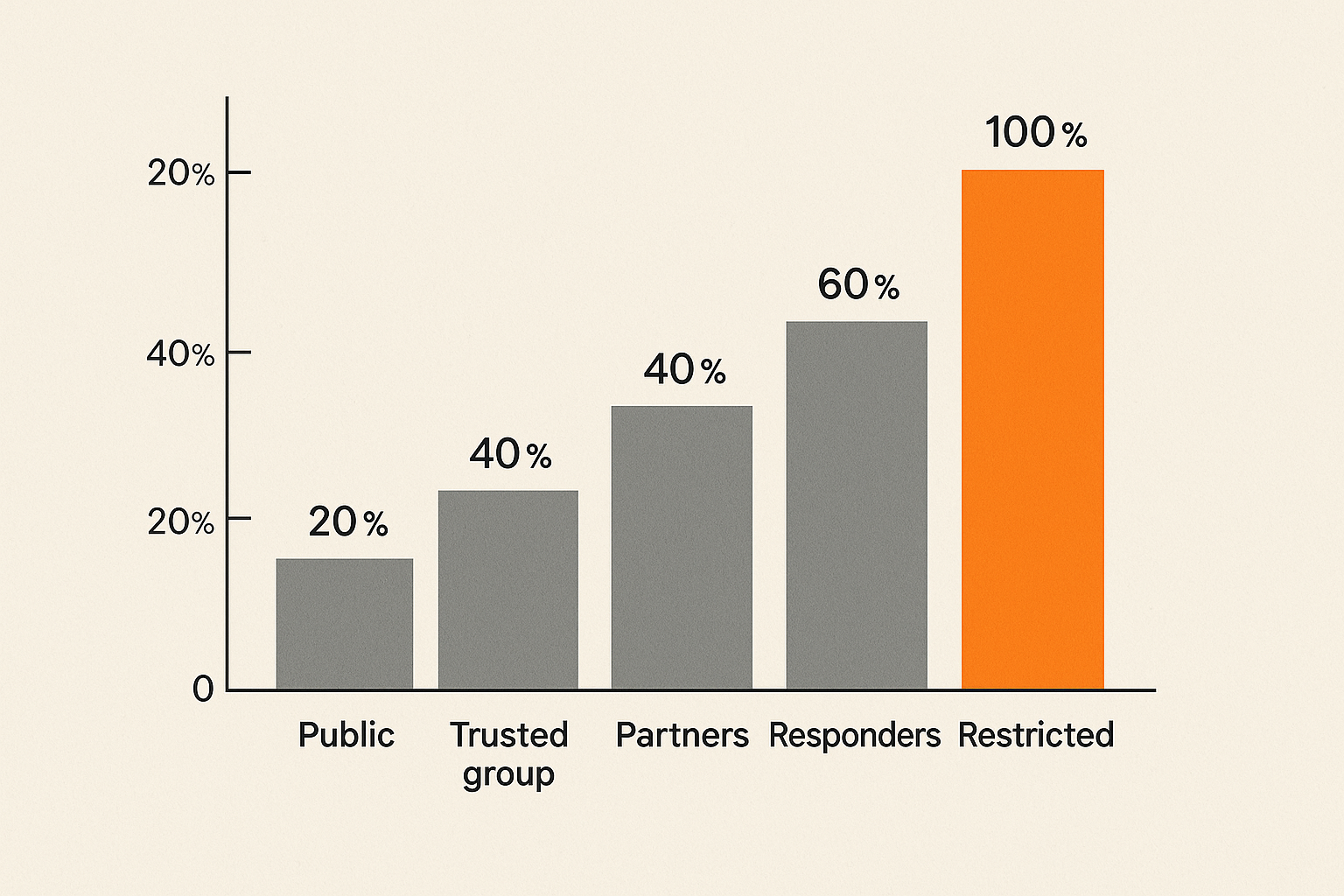
Trust tiers and disclosure boundaries
A practical model is to define trust tiers before incidents occur. The tiers do not need to be complicated. They need to be usable.
Example structure:
| Tier | Audience | What can be shared | Example use |
|---|---|---|---|
| Tier 0 | Public | Sanitized advisories, no sensitive detail | General awareness |
| Tier 1 | Broad trusted community | IOCs, TTPs, non-attributed observations | Sector alerting |
| Tier 2 | Named response partners | Timeline fragments, affected products, limited context | Joint validation |
| Tier 3 | Contracted or internal responders | Case evidence, logs, host details | Investigation and containment |
| Tier 4 | Legal/exec restricted | Regulated data, breach analysis, privileged strategy | Disclosure decisions |
This table becomes useful when it is embedded in playbooks. For each incident type, the incident commander should know which tier applies and who can approve movement between tiers.
The mistake teams make is relying on broad labels like confidential or internal only. Those labels are too coarse for incident response. A phishing indicator may be safe to share broadly. A victim mailbox export is not. A command-and-control domain may help peers immediately. A customer impact analysis may be legally sensitive.
Rules of engagement for shared intelligence
Shared intelligence needs handling rules. Otherwise community channels become a mixture of useful leads, speculation, screenshots, and untracked commitments.
Define rules such as:
- Mark unvalidated indicators clearly.
- Separate observations from conclusions.
- Do not paste sensitive logs into informal channels.
- Record who provided the information and when.
- Move evidence into the case system before acting on it.
- Confirm whether information can be redistributed.
- Establish expiration or review times for temporary blocks.
These rules sound procedural because they are. That is the point. Community-driven response only scales when shared context enters a controlled workflow.
Practical rule: Community intelligence should be easy to contribute, but never allowed to bypass validation, logging, and ownership.
Connect community signals to SOC workflows
Community signals become valuable only when they change SOC behavior. A message from a peer about an active campaign is not useful if it sits in chat. A local admin report is not useful if it never becomes a case note. A supplier notification is not useful if the SOC cannot connect it to affected assets.
The practical question is how community input moves from human conversation into detection, triage, response, and lessons learned.
From informal message to validated signal
Treat community input as a signal source. It is not automatically an incident, but it deserves a defined intake path.
A basic intake pattern:
- Capture the source, timestamp, channel, and confidence.
- Normalize the content into observable fields where possible.
- Check whether the information includes sensitive or restricted data.
- Search internal telemetry for matches.
- Assign an owner to validate or reject the signal.
- Promote validated signals into detections, watchlists, cases, or response tasks.
- Record the outcome and share back if appropriate.
This sequence prevents two common failures. First, useful community intelligence does not disappear into chat history. Second, low-confidence rumors do not trigger uncontrolled containment actions.
A concrete example: a peer reports a phishing domain targeting finance teams. The SOC should not simply block the domain and move on. It should search proxy logs, email gateways, identity telemetry, and endpoint events. It should check whether any users clicked. It should create a temporary detection or watchlist. It should decide whether to notify the finance help desk. The community signal becomes operational because it creates investigative tasks.
Routing community context into detection engineering
Detection engineers need more than indicators. They need behavior, environment, and attacker workflow.
Community context can improve detections when it answers questions like:
- Which roles were targeted?
- What pretext did the attacker use?
- Which SaaS permissions were requested?
- Did the campaign rely on region-specific language?
- Did peers observe post-compromise activity?
- Which controls failed or generated noise?
The detection team can turn that into logic. A reported phishing lure may lead to a rule for suspicious OAuth consent. A supplier compromise may lead to monitoring for unusual API token usage. A local community report about stolen devices may lead to temporary changes in conditional access risk scoring.
What fails is copying IOCs without context. Domains expire. IPs rotate. Hashes become stale. Community-derived detection is strongest when it captures attacker behavior and business impact, not just artifacts.
Build a community-enabled incident workflow
A community-enabled workflow does not replace the incident response process. It extends it. The core phases remain familiar: prepare, detect, analyze, contain, eradicate, recover, and improve. Community building adds named inputs and outputs to each phase.
The workflow should be written down. If it depends on memory, it will fail during fatigue, turnover, or a multi-day incident.
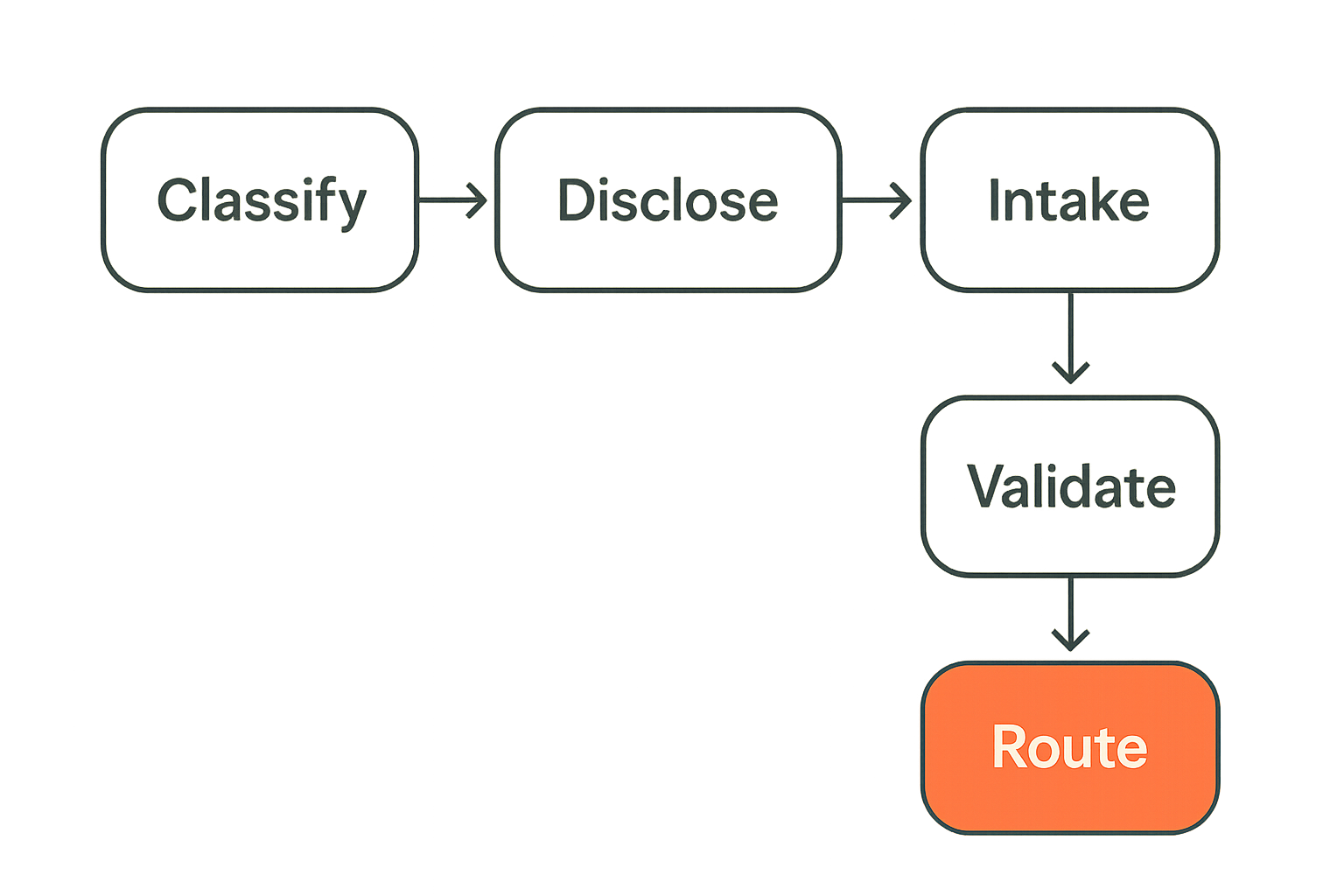
A practical sequence for activation
Use a simple activation sequence that operators can follow under pressure:
- Classify the incident type and potential community dependencies. Determine whether the case touches suppliers, regional teams, customers, peers, cloud providers, or sector groups.
- Select the disclosure tier. Decide what can be shared and who can approve it.
- Assign a community liaison. This person is not the incident commander. Their job is to manage external and internal community communication.
- Open tracked intake. Every community signal gets logged in the case system, even if it arrives through a phone call or private chat.
- Validate signals against telemetry. No blocking, disabling, or public statement should rely only on unverified community input.
- Route validated context to owners. Detection engineering, containment, legal, communications, and business owners should receive the specific context they need.
- Close the loop. Share sanitized outcomes where appropriate so contributors know whether their input mattered.
- Update the relationship map and playbook after the incident.
This sequence keeps community work from becoming side-channel chaos. It also reduces the burden on the incident commander, who should not be managing every relationship while making containment decisions.
Ownership across triage, containment, and recovery
Ownership is the difference between collaboration and noise.
During triage, the SOC owns signal validation. Community inputs may raise priority, but the SOC must connect them to internal evidence.
During containment, technical owners own action. A peer can warn you about token abuse, but your identity team disables sessions. A supplier can confirm compromise, but your application team rotates credentials. A regional IT team can confirm local device loss, but your endpoint team enforces isolation.
During recovery, business and communications owners become more important. Community relationships may help validate whether customers, partners, or peer organizations are still seeing related activity. But recovery decisions need defined authority.
The mistake teams make is letting the loudest channel steer the response. Good workflows preserve input diversity while keeping decision rights clear.
What works and what fails in practice
Community building incident response is easy to praise and hard to operate. The difference usually comes down to specificity. Vague collaboration creates noise. Specific roles, channels, and evidence rules create speed.
What works
What works is boring and durable:
- Named liaisons for internal and external communities.
- Pre-approved disclosure tiers.
- Case templates that include community signal fields.
- Quarterly relationship tests, not just annual tabletop exercises.
- Shared glossaries for severity, confidence, and impact.
- Feedback loops that tell contributors what happened to their input.
- Playbooks that include suppliers, regional teams, and business owners.
A useful field in an incident case might look like this:
community_signal:
  source_type: peer_security_team
  trust_tier: tier_2
  received_at: 2026-05-26T14:10:00Z
  confidence: medium
  redistributable: no
  observables:
    - domain: example-login-support.invalid
    - lure: finance invoice approval
  validation_owner: soc_triage_lead
  validation_status: pending
  action_deadline: 30m
The point is not the format. The point is that community context becomes structured enough to route, search, validate, and audit.
What fails
What fails is usually predictable:
- A single champion owns all relationships, then leaves.
- Community channels become unmoderated alert streams.
- Sensitive information is shared without approval.
- Incident commanders are overloaded with communication tasks.
- Detection teams receive indicators with no context.
- External inputs never make it into the case record.
- Contributors stop participating because they never receive feedback.
This is why community building must be managed like infrastructure. It needs owners, maintenance, access control, monitoring, and deprecation. If a partner contact is stale, replace it. If a channel produces mostly noise, change its purpose. If a sharing group cannot handle confidentiality, lower its trust tier.
Practical rule: A community that cannot be maintained should not be placed on the critical incident path.
Measure community building incident response without vanity metrics
Security teams love metrics until the metrics reward the wrong behavior. Community size is not a response metric. Number of members, channels, or messages does not tell you whether incidents are handled faster or better.
Community building incident response should be measured by operational contribution.
Operational metrics that matter
Useful metrics include:
| Metric | Why it matters | Bad interpretation to avoid |
|---|---|---|
| Time from community signal to case creation | Shows intake discipline | Faster is not better if everything becomes a case |
| Time from signal to validation | Measures SOC routing quality | Do not validate only easy signals |
| Percent of validated signals that change action | Shows operational value | Not every useful signal needs containment |
| Number of stale critical contacts | Measures relationship hygiene | Do not count low-value contacts as coverage |
| Drill response rate by community | Shows readiness | Do not punish teams without understanding constraints |
| Feedback loop completion | Shows trust maintenance | Feedback can be sanitized and still useful |
These metrics should be reviewed in incident retrospectives. If a supplier warning arrived early but did not reach the SOC for four hours, the issue is not supplier intelligence. It is intake. If a peer community shared a useful pattern but detection engineering never saw it, the issue is routing.
Qualitative signals worth tracking
Some of the most important signals are qualitative:
- Did contributors understand what was being asked?
- Did legal boundaries block useful sharing, or prevent risky sharing?
- Did the liaison reduce incident commander load?
- Were regional teams able to explain local business impact?
- Did the SOC receive fewer duplicate reports after the first update?
- Did the community continue to engage after the incident?
Qualitative does not mean vague. Capture it in retrospectives and assign action items. For example: create a supplier notification template, add a local IT escalation field, define a sanitized peer update format, or schedule a trust-tier review.
The goal is to improve the response system, not prove that the community is popular.
Failure modes that break community-driven response
Community-driven response fails when teams confuse speed with control. The goal is fast coordination, not uncontrolled information flow. Two failure modes show up often: unverified information spreading too fast, and no owner handling the handoff into real response work.
Unverified information spreads faster than containment
During active incidents, people want to help. That is useful until every helpful message becomes an assumed fact. A screenshot appears in a chat. Someone says a vendor is compromised. A peer reports an IP address. A local team claims a system is clean because they rebooted it.
If the SOC acts on that without validation, the organization can block legitimate business, miss the actual attacker path, or create legal exposure.
Controls that help:
- Label signal confidence explicitly.
- Keep speculative discussion separate from approved updates.
- Require evidence links in the case record before action.
- Use temporary controls with expiration where confidence is low.
- Assign a single owner to reconcile conflicting reports.
This is not bureaucracy. It is how you keep community speed without losing response integrity.
No one owns the handoff
The second failure mode is quieter. A community member provides good information, everyone acknowledges it, and nothing happens. No case update. No search. No detection change. No containment task. Later, the same information appears in the root cause analysis as an early warning that was missed.
Handoffs need names and deadlines. If an external peer shares a campaign pattern, the SOC triage lead owns validation. If a regional IT admin reports anomalous login prompts, identity owns correlation. If a supplier warns of credential exposure, application owners and secrets management own rotation.
A simple handoff template helps:
Signal: suspicious OAuth consent campaign targeting finance users
Source: trusted peer, tier 2, not redistributable
Owner: detection engineering lead
Action: search consent grants and create temporary analytic
Deadline: 45 minutes
Return path: update community liaison with sanitized outcome
What breaks in practice is assuming that visibility equals ownership. It does not. A message seen by twenty people can still have zero accountable owners.
Make the model sustainable for 2026 SOCs
By 2026, most SOCs are not suffering from a lack of channels. They are suffering from too many disconnected signals, too much tool sprawl, and not enough operational context. Community building incident response helps only if it reduces ambiguity. If it adds more feeds without ownership, it makes the SOC worse.
Automation helps, but relationships still carry ambiguity
Automation can capture messages, enrich indicators, open cases, route tasks, and notify stakeholders. Use it. But do not pretend automation can replace trust.
The hard parts of community response are often ambiguous:
- Can this partner be told that we saw related activity?
- Is this report credible enough to wake the identity team?
- Should this observation be shared with a sector group?
- Is this local outage actually part of the incident?
- Does this supplier notification trigger contractual obligations?
Automation can support those decisions by making evidence visible and repeatable. It should not hide the judgment layer.
A practical automation boundary is this: automate capture, enrichment, routing, and reminders. Keep disclosure, containment, and public claims under named human authority.
Keep the community useful between incidents
Response communities decay if they are only activated during emergencies. People change roles. Vendors reorganize. Local teams lose familiarity with procedures. External groups become noisy.
Keep the network alive with small operational habits:
- Run lightweight quarterly escalation tests.
- Share sanitized lessons learned after incidents.
- Rotate liaison roles so knowledge is not trapped with one person.
- Update trust tiers when relationships change.
- Invite internal communities into tabletop exercises.
- Review which community signals became useful detections.
- Retire channels that no longer produce actionable value.
The practical question is not how to keep everyone engaged all the time. That is unrealistic. The question is how to keep the response network accurate enough that it works when activated.
Where ThreatCrush fits in the architecture
For a SOC audience, the value of community building incident response is not the community itself. The value is better detection context, faster validation, cleaner escalation, and fewer blind spots between proactive and reactive security work.
ThreatCrush fits the architecture when teams need to connect threat signals, operational context, and response workflows instead of letting them live in disconnected tools and conversations.
Use community context as detection fuel
Community-derived context should feed the same operational loop as any other threat signal:
- Capture the signal.
- Validate it against telemetry.
- Convert useful patterns into detection logic.
- Route confirmed activity into response.
- Feed lessons learned back into preparedness.
This is where security teams can stop treating community information as informal chatter. A peer report can become a hypothesis. A local admin observation can become asset context. A supplier warning can become a containment trigger. A tabletop lesson can become a detection backlog item.
That is the durable version of community building incident response: not a bigger chat room, but a better response system.
Try threatcrush.com
ThreatCrush helps security operations teams think in workflows: signals, detection, validation, ownership, and response. If you are building a SOC model that connects community context with incident response execution, Try threatcrush.com.
Try ThreatCrush
Real-time threat intelligence, CTEM, and exposure management — built for security teams that move fast.
Get started →