Cloud Computing Security Operations: A Practical SOC Architecture for 2026

Cloud computing security operations gets messy fast when the SOC treats cloud as just another log source. The alert volume rises, asset ownership becomes unclear, and the evidence needed to investigate an incident is spread across IAM, control-plane logs, runtime telemetry, identity provider events, CI/CD systems, and SaaS consoles.
Teams think the problem is cloud visibility. The real problem is operating model drift: engineering ships infrastructure faster than security workflows can classify, detect, route, and respond.
That changes the conversation. The practical question is not “Which cloud security tool should we buy?” It is “How do we make cloud events actionable inside a SOC workflow without slowing down the business or drowning analysts?”
A useful way to think about cloud computing security operations in 2026 is as a distributed evidence and ownership problem. If you cannot map an event to an asset, identity, workload, business service, owner, and response path, you do not have an operations capability. You have telemetry.
Table of contents
- Why cloud computing security operations is a workflow problem
- The operating model: control plane, data plane, identity plane
- Telemetry architecture for cloud computing security operations
- Detection engineering that survives cloud velocity
- Investigation workflows: from alert to ownership
- Response automation without making outages worse
- Metrics that matter in cloud computing security operations
- Common failure modes and what breaks
- A 90-day implementation sequence
- Where ThreatCrush fits in the architecture
- Closing checklist for cloud computing security operations
Why cloud computing security operations is a workflow problem
Cloud changes where evidence lives
In traditional environments, many SOC workflows were built around stable network zones, endpoint telemetry, domain identities, and a relatively predictable asset inventory. Cloud breaks that mental model.
A suspicious event might involve a temporary role, a short-lived container, an ephemeral workload identity, a serverless function, a CI runner, a managed database, and a third-party SaaS integration. By the time an analyst opens the alert, the compute resource may already be gone.
The mistake teams make is assuming the SOC can compensate by collecting more logs. More logs help only if the workflow can answer basic questions quickly:
- What resource was involved?
- Who or what created it?
- What identity acted on it?
- What business service depends on it?
- Who owns the service?
- What is the safe containment action?
- What evidence must be preserved before the resource disappears?
If those answers require five consoles and three Slack threads, the detection is not operationally mature.
The SOC still owns the outcome
Cloud engineering teams own infrastructure delivery. Platform teams own guardrails. Application teams own services. But when suspicious behavior appears, the SOC is still judged by whether it can identify, triage, escalate, contain, and learn.
That does not mean the SOC should become the cloud admin team. It means cloud computing security operations needs explicit contracts between teams: telemetry contracts, ownership contracts, response contracts, and exception handling.
Practical rule: a cloud alert is not ready for production until it includes the owner, the affected service, the identity path, and the first safe response action.
Without that contract, analysts become dispatchers. They forward alerts to whoever seems closest to the resource. That works for a small environment. It fails when accounts, subscriptions, projects, clusters, and workloads scale across business units.
The operating model: control plane, data plane, identity plane
Control-plane activity explains intent
Control-plane logs describe changes to cloud resources: creating a security group rule, assuming a role, modifying a storage bucket policy, disabling logging, changing a key policy, creating a snapshot, deploying a function, or attaching a privileged policy.
These events are high-value because they describe intent. An attacker living in cloud control planes often tries to discover permissions, weaken controls, create persistence, access data stores, or prepare exfiltration.
Control-plane detections should answer: “What changed, who changed it, from where, using what authentication path, and is that normal for this environment?”
Data-plane signals explain impact
Data-plane activity shows interaction with workloads and data: object reads, database queries, API calls, container network behavior, process execution, file access, and egress. These signals are often more expensive, noisier, or harder to enable consistently, but they tell you whether a risky change became real impact.
For example, a public storage bucket policy change is important. A burst of object reads from an unusual ASN after that change is more important. A role assumption from a CI account is notable. That same role listing secrets and touching production databases is urgent.
Identity ties both planes together
Identity is the spine of cloud operations. Human users, service accounts, workload identities, federated roles, CI tokens, access keys, managed identities, and OAuth integrations all become part of the attack surface.
In practice, identity context is where many investigations break. Analysts see an assumed role but not the original principal. They see an API key but not the workload that owns it. They see a service account but not the deployment pipeline that created it.
A strong cloud SOC model treats identity resolution as an enrichment layer, not a manual lookup step.
| Plane | Primary question | Example signals | SOC risk if missing |
|---|---|---|---|
| Control plane | What changed? | IAM updates, firewall changes, logging disabled, snapshots | Missed attacker setup and persistence |
| Data plane | What was accessed? | Object reads, database queries, workload egress | No evidence of impact or exfiltration |
| Identity plane | Who or what acted? | Role assumption, token use, SSO events, service accounts | Slow attribution and poor containment |
Telemetry architecture for cloud computing security operations
Collect events before you normalize them
Cloud telemetry pipelines often fail because teams over-optimize too early. They build a neat normalized schema while silently dropping provider-specific fields that matter later.
Do normalize for search, detection, and correlation. But preserve raw event payloads or at least provider-native details for investigation and evidence. In cloud incidents, small fields matter: session issuer, request parameters, user agent, source VPC endpoint, key ID, MFA status, token age, organization ID, workload namespace, or deployment label.
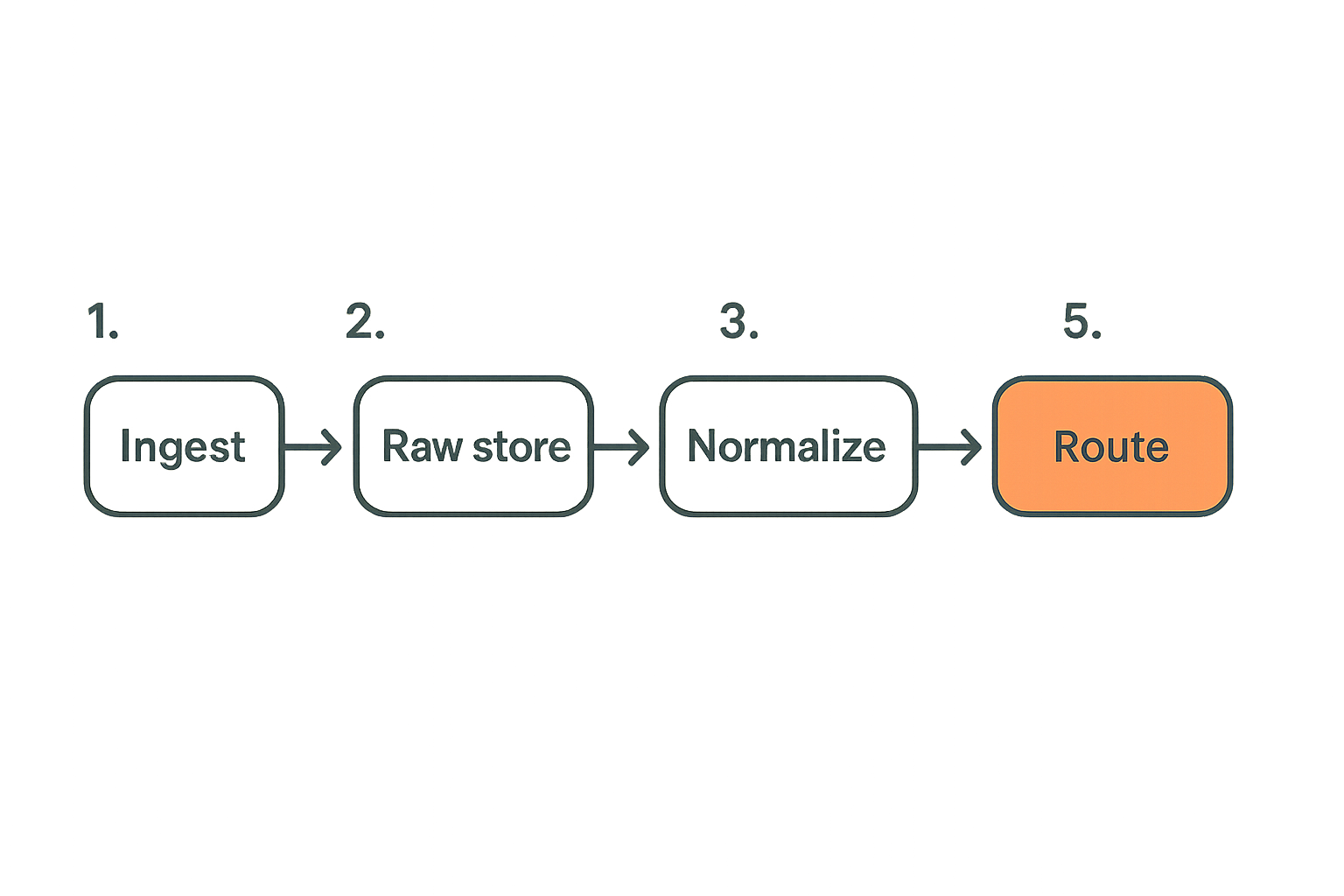
A practical pipeline looks like this:
- Ingest provider-native events from each account, subscription, project, cluster, and SaaS control plane.
- Store immutable raw events for audit and incident reconstruction.
- Normalize common fields for detection and correlation.
- Enrich with asset, identity, owner, environment, and business-service metadata.
- Route enriched events into SIEM, SOAR, case management, and long-term storage.
The order matters. If you normalize first and enrich later, you often lose the exact fields needed to prove what happened.
Preserve cloud context as first-class fields
Do not bury cloud context inside JSON blobs that analysts must expand manually. Make these fields searchable and visible in alert summaries:
- cloud provider
- account, subscription, or project
- region
- resource ID
- resource type
- environment
- service name
- owner team
- deployment source
- identity type
- original principal
- session issuer
- network origin
- tags and labels
What breaks in practice is not that the SOC lacks logs. It is that the alert says “IAM policy changed” without saying whether it happened in a production payments account, a sandbox lab, or a deprecated test project.
Separate hot investigation data from cold audit data
Not every cloud event belongs in expensive hot storage forever. But the SOC needs recent, enriched, searchable data for fast investigation. Compliance and forensics need longer retention, sometimes in cheaper storage.
A useful split:
- Hot tier: enriched, searchable, alert-ready events for active operations.
- Warm tier: recent raw and normalized events for deeper investigation.
- Cold tier: immutable audit storage for retention, legal, and reconstruction.
Practical rule: optimize cloud telemetry around investigation paths first and storage economics second. If analysts cannot answer the first five questions quickly, cheaper retention will not save the workflow.
Detection engineering that survives cloud velocity
Detect behavior, not just resource names
Resource names change constantly. Accounts get reorganized. Kubernetes namespaces come and go. Serverless functions are redeployed. CI systems create temporary infrastructure.
Good cloud detections focus on behaviors that remain meaningful across environments:
- logging disabled or tampered with
- privileged policy attached to a new principal
- cross-account trust modified
- unusual role assumption path
- storage policy made public
- secret read from an unusual workload
- snapshot created and shared externally
- new access key created for a dormant user
- egress spike after sensitive data access
Static allowlists still have a place, but they are brittle. The better pattern is environment-aware logic that combines behavior, asset criticality, identity trust, and change context.
Use environment-aware severity
The same event can mean different things depending on where it occurs. A public bucket in a training account may be low severity. A public bucket in a production customer-data account is a page. A privileged role change by Terraform during an approved deployment may be expected. The same change from an unmanaged IP using a long-lived access key is not.
Detection severity should reflect context:
detection: external_snapshot_share
base_severity: medium
severity_rules:
  - if: environment == "production" and data_classification in ["restricted", "customer"]
    set: critical
  - if: actor_type == "ci_cd" and change_ticket_exists == true
    set: low
  - if: source_geo not in approved_regions and mfa == false
    set: high
enrichment_required:
  - owner_team
  - business_service
  - original_principal
  - data_classification
This is not about fancy scoring. It is about making alerts credible enough that humans trust them.
Version detections like production code
Cloud detections should live in version control with tests, owners, review history, and deployment stages. A detection that can page the SOC is production logic. Treat it that way.
At minimum, track:
- detection owner
- purpose and threat scenario
- data sources required
- expected false positives
- severity logic
- test events
- response playbook
- last validation date
The team at c0mpute.com spends a lot of time thinking about distributed compute and workload execution, and the same lesson applies here: if the environment is dynamic, operational state and verification matter more than static diagrams.
Investigation workflows: from alert to ownership
Start with asset and identity enrichment
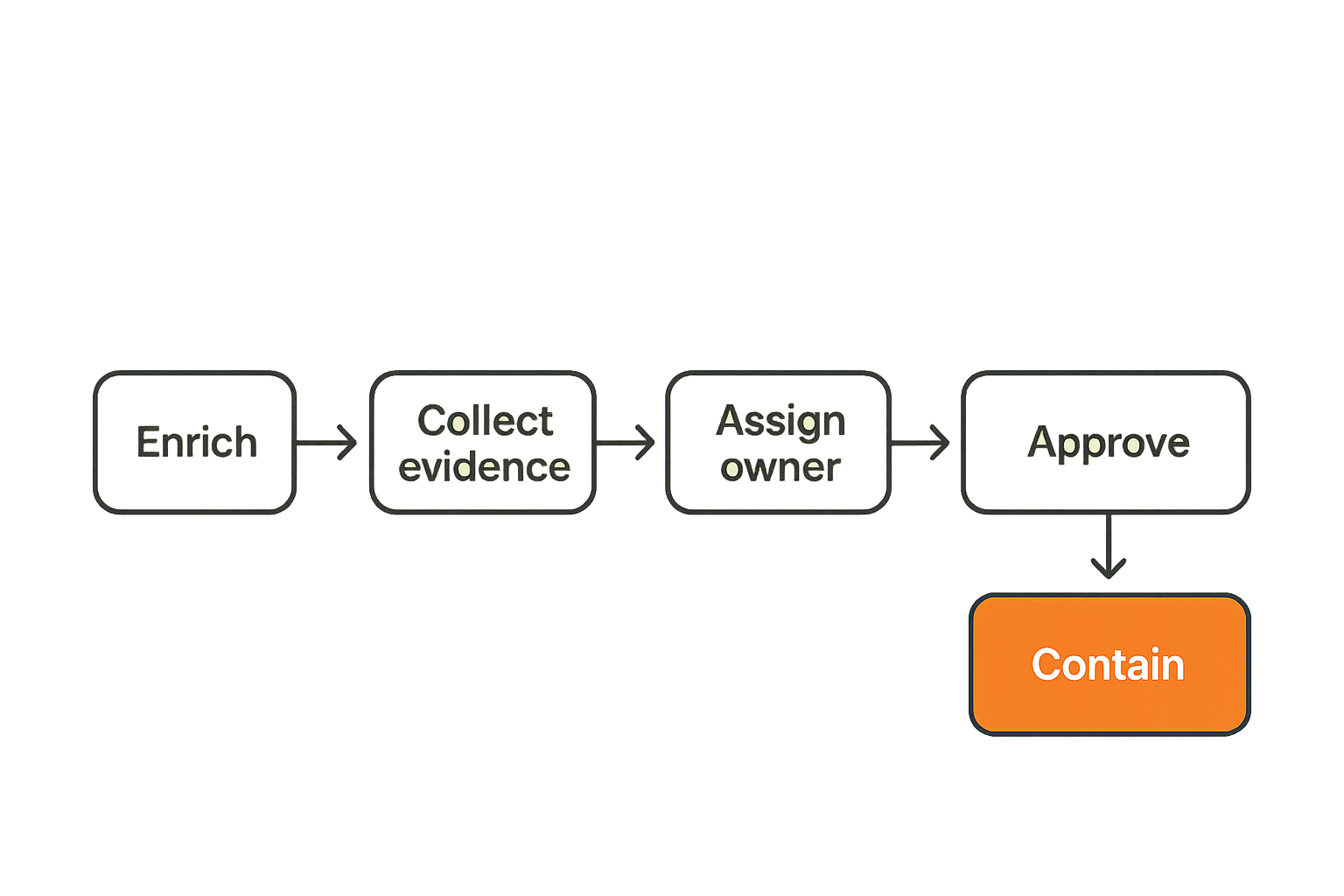
A cloud investigation should not begin with an analyst manually copying a resource ID into multiple consoles. The alert should already carry enough context to start a decision.
Minimum enrichment for most cloud alerts:
- asset criticality
- environment
- owner team
- business service
- deployment source
- recent changes
- original identity chain
- last known network origin
- related alerts
- known exceptions
If enrichment is missing, the alert should say that clearly. Unknown owner is not a neutral condition. In cloud operations, unknown owner is itself a risk signal.
Route by service ownership, not cloud account
Cloud account boundaries rarely map cleanly to operational ownership. A shared platform account may host workloads from many teams. A production account may include managed services owned by platform, data, and application groups.
Route incidents by business service and owner team where possible. Use account ownership only as a fallback.
A practical routing rule might look like:
- If resource has service tag, route to service owner.
- If no service tag, map deployment source to repository owner.
- If no repository owner, map cloud account to platform owner.
- If no platform owner, escalate to cloud governance queue.
- If production and owner unknown, page security leadership and platform on-call.
That sounds strict because it needs to be. Optional ownership creates permanent SOC toil.
Make evidence collection repeatable
For common cloud alert types, define evidence bundles. Analysts should not reinvent the collection process during an incident.
Example evidence bundle for suspicious role assumption:
- original principal and session issuer
- role trust policy at time of event
- MFA and SSO context
- source IP, ASN, user agent, device posture if available
- actions taken during the session
- resources touched
- recent changes to the role or attached policies
- related access key creation or token activity
- owner confirmation and expected-use statement
Practical rule: every high-severity cloud detection needs an evidence bundle and a containment decision tree before it pages humans.
Response automation without making outages worse
Automate containment, not panic
Automation is necessary in cloud computing security operations, but bad automation can take down production faster than an attacker.
The goal is not to auto-remediate everything. The goal is to shorten the path between detection, evidence, decision, and safe action.
Good automation examples:
- disable a newly created access key after confirming it is unused by production
- quarantine a workload by applying a preapproved network policy
- revoke a suspicious session token where supported
- snapshot a compromised instance before isolation
- remove public access from a storage bucket after owner confirmation or policy match
- open an incident with full context and assigned owner
Bad automation examples:
- deleting resources without evidence preservation
- disabling production roles without dependency mapping
- changing network rules globally from a single alert
- rotating secrets without notifying dependent services
- terminating workloads before collecting volatile data
Design guardrails for production systems
Production response requires blast-radius awareness. The SOC needs a response catalog that distinguishes safe, reversible, and dangerous actions.
| Response action | Typical risk | Use when | Approval model |
|---|---|---|---|
| Add monitoring tag | Low | Need tracking or escalation | Automatic |
| Open incident and notify owner | Low | Any credible alert | Automatic |
| Revoke unused access key | Medium | Key is confirmed suspicious and noncritical | Conditional automation |
| Isolate workload network | Medium to high | Active compromise likely | On-call approval |
| Disable production role | High | Confirmed malicious use and mapped dependencies | Incident commander approval |
| Delete resource | High | Rare cleanup after evidence capture | Manual only |
The practical question is whether the SOC knows the difference before an incident starts.
Keep human approval where blast radius is high
Human approval is not failure. It is a control. The trick is to make approval fast and informed.
An approval request should include:
- recommended action
- expected impact
- affected service
- owner team
- confidence level
- evidence summary
- rollback path
- time sensitivity
This keeps response from becoming a debate in a chat channel. The decision maker sees the operational tradeoff and can act.
Metrics that matter in cloud computing security operations
Measure investigation latency
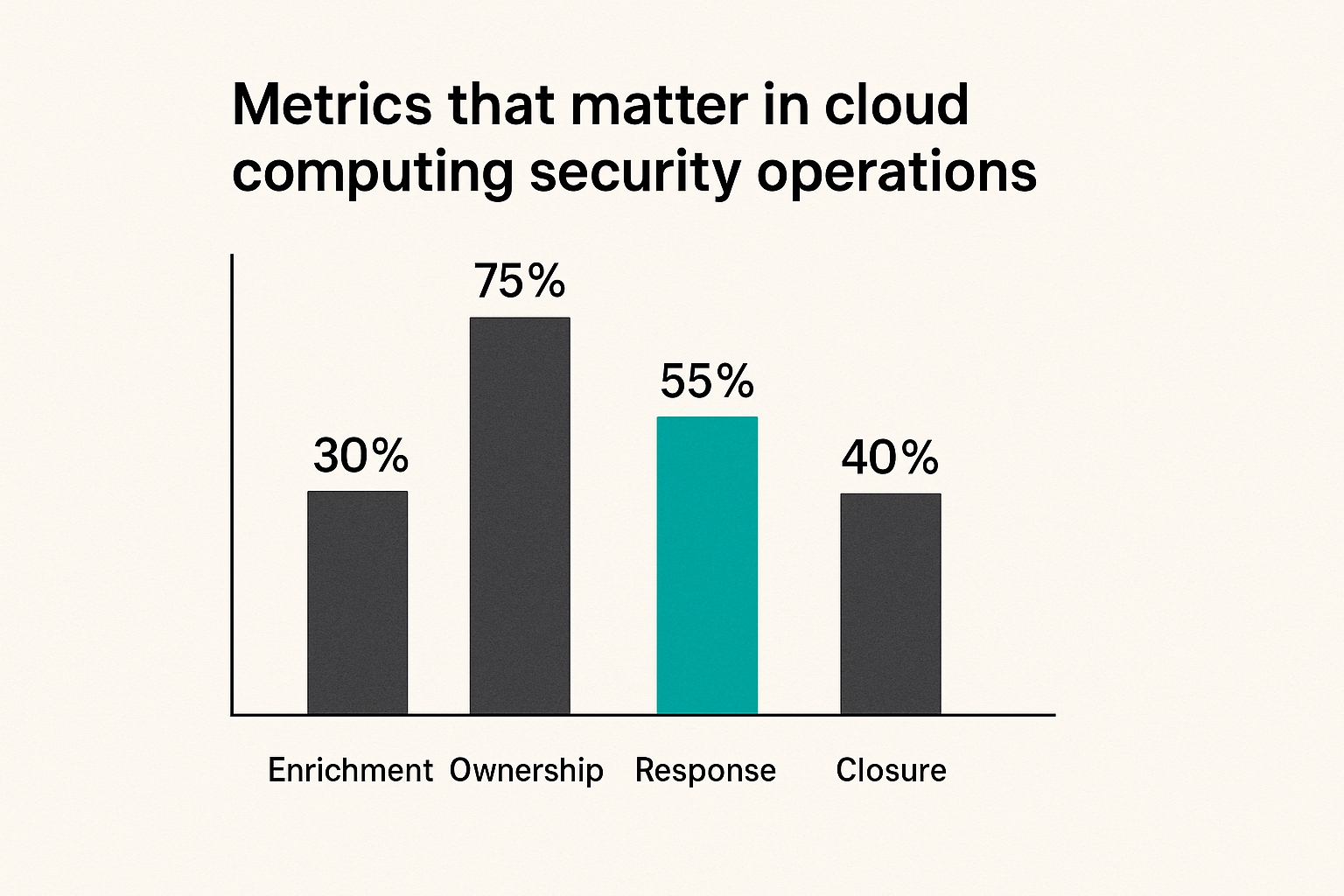
Mean time to detect is useful, but cloud SOC teams should also measure time to context. How long does it take to know what happened, who owns it, and what action is safe?
Track:
- alert creation to enrichment complete
- alert creation to owner assigned
- owner assigned to first response
- first response to containment decision
- containment decision to verified action
These numbers expose workflow friction. If enrichment takes 30 seconds but owner assignment takes six hours, the problem is not detection. It is governance and routing.
Measure enrichment quality
Enrichment quality can be measured without pretending everything is precise. Track the percentage of high-priority alerts with:
- valid owner
- business service
- environment
- identity chain
- asset criticality
- response playbook
- recent change context
This is where many teams find uncomfortable gaps. They have high-volume cloud logging but low-quality operational context.
Measure closure quality, not ticket count
Closing more tickets is not the same as improving cloud security operations. Measure whether cases close with enough information to improve the system.
Useful closure fields:
- true positive, benign true positive, false positive, or unknown
- root cause
- detection tuning needed
- asset inventory correction needed
- identity control gap
- response delay reason
- owner acknowledgement
- preventive control recommended
If “unknown” becomes the default closure reason, leadership should not trust the metrics.
Common failure modes and what breaks
What fails when logs arrive without context
The most common failure mode is a centralized log lake that receives cloud events but does not understand them operationally. The SOC can search, but it cannot decide.
What breaks:
- alerts lack owner and service context
- severity is based on event type alone
- analysts manually enrich every case
- false positives are hard to tune
- incident handoff is slow
- post-incident learning does not update detections
This creates a familiar pattern: the organization says it has cloud visibility, but responders still rely on tribal knowledge.
What fails when ownership is optional
Cloud assets without owners become SOC debt. Every unowned resource increases investigation time and response uncertainty.
The mistake teams make is treating missing tags as a hygiene issue. Missing ownership is an incident response issue.
If a production database snapshot is shared externally and no one knows which team owns it, containment slows down. If a service account reads secrets and the repository mapping is missing, attribution slows down. If a security group opens access and no owner responds, escalation becomes political.
Ownership must be enforced at creation time, validated continuously, and visible during investigation.
What fails when cloud response is improvised
Improvised response creates two bad outcomes: underreaction and overreaction.
Underreaction happens when analysts lack authority or context, so they wait for confirmation while an attacker continues operating. Overreaction happens when responders take broad action without understanding dependencies, causing avoidable outages.
Neither is acceptable. Cloud computing security operations needs prebuilt decision trees for common scenarios:
- exposed storage
- suspicious role assumption
- access key compromise
- logging disabled
- public management port exposure
- container breakout suspicion
- secret access anomaly
- external snapshot sharing
- malicious CI/CD deployment
For each scenario, define evidence, severity modifiers, owner routing, containment options, approval requirements, and rollback.
A 90-day implementation sequence
Days 1–30: build the evidence map
Start by mapping the evidence required for the incidents you most expect to handle. Do not try to boil the ocean.
Pick five cloud incident scenarios. For each one, document:
- Required telemetry sources.
- Required enrichment fields.
- Owner mapping method.
- Evidence bundle.
- Safe containment options.
- Approval path.
- Known gaps.
Then compare that map to current reality. The output should be a backlog, not a slide deck.
Focus first on production environments, privileged identities, internet-exposed services, sensitive data stores, CI/CD systems, and centralized logging controls.
Days 31–60: operationalize detections
Next, turn the evidence map into working detections and workflows. Start with fewer detections that analysts can trust.
A practical sequence:
- Implement detection logic for the highest-risk scenarios.
- Add enrichment requirements to each alert.
- Create case templates with evidence checklists.
- Define routing rules by service owner.
- Add suppression logic for approved deployment paths.
- Test with simulated events.
- Review false positives with engineering owners.
- Promote only validated detections to paging severity.
This is where detection engineering and SOC operations must work together. A detection that cannot be investigated is not finished.
Days 61–90: validate response workflows
Finally, test response. Tabletop exercises are useful, but they are not enough. Run controlled validation in nonproduction and, where safe, in production-like environments.
Validate:
- event generation
- alert firing
- enrichment completeness
- case creation
- owner routing
- evidence collection
- approval flow
- containment action
- rollback
- closure fields
- tuning feedback
The goal is not theater. The goal is to find where the workflow breaks before the attacker does.
Practical rule: if you have not tested the response path end to end, you have a detection hypothesis, not an operational capability.
Where ThreatCrush fits in the architecture
Connect proactive and reactive work
Cloud security teams often split proactive and reactive work across different systems. Exposure management lives in one queue. Threat intelligence lives somewhere else. Detection logic lives in a SIEM. Incident response lives in tickets. Asset ownership lives in a CMDB that may or may not be current.
That separation creates delay. A risky cloud exposure should inform detection priority. A confirmed incident should update exposure management. A threat intelligence signal should influence cloud hunting. A repeated false positive should update engineering guardrails.
ThreatCrush is useful where teams need to connect signals, workflows, detection context, and operational response instead of treating every alert as an isolated event.
Reduce noise with operational context
Noise reduction is not just suppression. Suppression hides work. Context changes decisions.
For cloud computing security operations, context means knowing whether the signal maps to a critical service, a known attack path, a recently changed identity, an internet-exposed asset, or a compensating control. That is what helps teams decide whether to page, ticket, enrich, hunt, or close.
A platform approach is strongest when it helps analysts move from raw signal to validated action without copying data between disconnected tools.
Use the platform where workflow breaks
Do not evaluate security operations platforms only by feature lists. Evaluate them against your failure modes.
Ask:
- Where do analysts lose time today?
- Which alerts lack ownership?
- Which detections cannot be validated?
- Which response actions are unsafe or unclear?
- Which cloud risks never make it into SOC workflows?
- Which incidents fail to improve future detection?
If a platform shortens those loops, it is solving the real problem. If it only adds another queue, it is not.
Closing checklist for cloud computing security operations
What works
Strong cloud computing security operations is built on a few practical habits:
- collect raw and normalized cloud telemetry
- preserve provider-specific fields
- enrich alerts with asset, identity, owner, and service context
- detect behavior rather than brittle names
- use environment-aware severity
- route by service ownership
- define evidence bundles before incidents
- automate low-risk actions
- require approval for high-blast-radius response
- measure time to context, not just time to detect
- feed incident lessons back into detections and controls
What fails
Weak cloud SOC programs usually fail in predictable ways:
- logs arrive without context
- ownership is optional
- detections page without response guidance
- analysts manually reconstruct identity chains
- cloud accounts become the only routing model
- automation deletes evidence or breaks production
- closure reasons do not improve the system
- proactive exposure work and reactive incident work stay disconnected
The closing point is simple: cloud computing security operations is not a tooling category. It is an operating architecture. The teams that make it work treat telemetry, identity, ownership, detection, response, and validation as one workflow.
Try threatcrush.com
ThreatCrush helps security teams connect signals, context, detection workflows, and response decisions for modern security operations. Try threatcrush.com.
Try ThreatCrush
Real-time threat intelligence, CTEM, and exposure management — built for security teams that move fast.
Get started →