CI/CD Security Threat Detection: A SOC Workflow for Pipeline Attacks

CI/CD security threat detection is where many security programs discover that their SOC was built for servers, identities, and networks, not for software delivery systems that change hundreds of times a day.
The alert may start as a suspicious workflow edit, a new deploy key, a strange runner process, or an artifact pushed from an unexpected job. By the time the SOC sees it, the pipeline may already be gone, the container may have shipped, and the engineer who owns the workflow may be in a different queue.
Teams think the problem is missing another scanner. The real problem is that CI/CD is an execution environment, an identity plane, a secrets broker, and a production release path. That changes the conversation.
The practical question is not whether you can detect bad things in a pipeline. The practical question is whether your SOC can turn pipeline signals into fast, owned, validated decisions without stopping delivery every time a build looks unusual.
Table of contents
- CI/CD security threat detection is an architecture problem
- Build the pipeline telemetry layer first
- Map threats to pipeline control points
- Detection logic that works in production
- Connect CI/CD alerts to SOC workflows
- Automate response without breaking delivery
- What breaks when teams implement it badly
- Metrics that prove the program is working
- Implementation sequence for a 90-day rollout
- Product fit: bringing CI/CD security threat detection into the SOC
CI/CD security threat detection is an architecture problem
CI/CD security threat detection fails when it is treated as a set of disconnected findings. Pipelines are not just places where code is checked. They are privileged automation systems that can mint tokens, fetch dependencies, build artifacts, deploy workloads, and modify production state.
Pipeline signals are different from endpoint signals
A workstation compromise may give you process trees, DNS, file writes, EDR telemetry, and interactive user behavior. A pipeline attack may give you an API audit event, a workflow file diff, a short-lived runner log, and a deployment event that looks normal in isolation.
What breaks in practice is time. Build jobs are ephemeral. Logs rotate. Runners terminate. Tokens expire. If the SOC is not collecting the right events at the right point, the investigation starts after the evidence has disappeared.
A useful way to think about it is that CI/CD detection needs to preserve the story of a change: who changed what, which automation executed, what secrets were available, which artifact was produced, where it was deployed, and whether that path was expected.
The attacker path crosses teams
Pipeline attacks rarely stay inside one tool. The path may start in source control, move through a pull request, trigger a build runner, extract a secret, push an altered image, and land in a runtime environment. That path crosses application teams, platform engineering, IAM, cloud operations, and the SOC.
The team at vu1nz.com sees this pattern often in DevSecOps work: the technical signals exist, but they are owned by different teams with different queues, naming conventions, and risk thresholds.
That changes the conversation from tool coverage to workflow design. Detection has to follow the attack path, not the org chart.
Detection without response ownership becomes alert debt
A high-quality alert still fails if nobody knows who can pause a workflow, revoke a token, quarantine an artifact, or block a deployment. The mistake teams make is assuming the SOC can resolve a pipeline alert the same way it handles an endpoint alert.
Practical rule: do not write a CI/CD detection until you can name the owner, the first response action, and the evidence needed to close the case.
Without that, CI/CD security threat detection becomes alert debt. Analysts escalate to platform teams. Platform teams ask for proof. Developers ask whether the build can keep running. Meanwhile, the attacker path continues.
Build the pipeline telemetry layer first
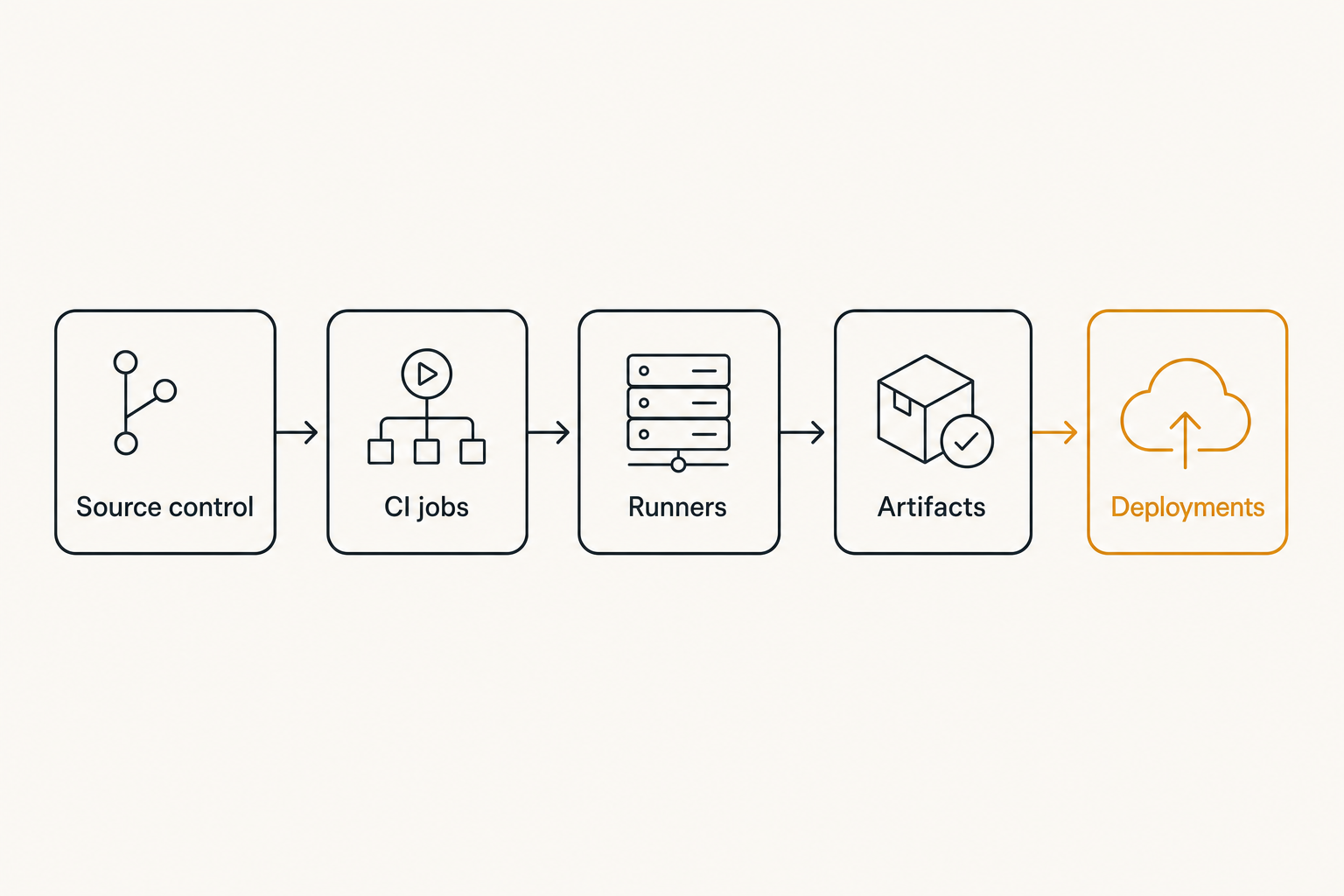
You cannot detect what you cannot reconstruct. Before writing advanced correlation logic, collect the core events that explain pipeline state changes. This is not glamorous work, but it is the difference between useful detection and guesswork.
Audit events you cannot skip
At minimum, collect events from these planes:
- Source control: repository creation, branch protection changes, force pushes, pull request approvals, webhook changes, deploy key changes, token creation, collaborator changes.
- CI orchestrator: workflow edits, job starts, job failures, runner assignment, environment variable changes, secret access events where available, manual job approvals.
- Runner layer: process execution, outbound network connections, filesystem writes to sensitive paths, container startup, privileged mode usage.
- Artifact and registry layer: image pushes, tag overwrites, package publishes, signature events, provenance changes, deletion events.
- Deployment layer: environment approvals, production deploys, infrastructure plan changes, cluster credential use, rollback events.
The exact source names vary by platform. The categories do not.
Normalize identities, jobs, and artifacts
The SOC needs a consistent way to join events. Human usernames, bot accounts, CI service principals, short-lived OIDC identities, runner IDs, repository names, commit SHAs, build IDs, artifact digests, package versions, and deployment IDs should be normalized into a small event model.
A practical event record can be simple:
event_type: workflow_modified
actor_type: user
actor: alex.example
repository: payments-api
branch: main
commit: 8f3a91c
workflow: release.yml
job: build-and-publish
runner: ubuntu-prod-runner-17
artifact_digest: sha256:abc123
cloud_role: prod-deploy-role
environment: production
risk_tags:
  - protected_branch
  - deploy_capable
This structure lets detection engineers ask better questions. Did a new actor modify a deploy-capable workflow? Did the same commit trigger a privileged runner? Did the resulting artifact reach production?
Keep enough history to prove sequence
CI/CD incidents are sequence problems. A single event rarely proves compromise. The suspicious pattern is the chain: branch protection changed, workflow modified, secret touched, artifact pushed, deployment approved from an unusual identity.
Retention matters. Keep enough telemetry to compare current activity with normal release behavior. Many teams need at least several release cycles of history to separate normal engineering bursts from attacker tradecraft. Avoid relying only on real-time alerts if historical joins are required for confirmation.
Map threats to pipeline control points
A detection program needs a threat model that maps to pipeline control points. Otherwise, teams write rules for whatever logs are easiest to query. That produces coverage that looks busy and misses the release path.
Source control and pull request abuse
Source control is the front door for many pipeline attacks. Watch for changes that alter trust boundaries:
- New or modified workflow files on protected branches.
- Pull requests from forks that trigger privileged jobs.
- Branch protection disabled before a merge.
- Required reviews bypassed by admin users or automation.
- New deploy keys or webhooks added to sensitive repositories.
- CODEOWNERS or approval logic modified near release files.
The detection question is not simply whether a file changed. The question is whether a change modified who can cause code to run with privileges.
Build runner and secret exposure
Runners are the execution layer. They fetch code, install dependencies, run scripts, access caches, and often receive secrets. A compromised runner can become an attacker workspace.
Signals worth prioritizing include:
- Privileged container mode in jobs that do not normally need it.
- Unexpected outbound connections during build steps.
- Secrets printed to logs or accessed outside approved jobs.
- New package managers or curl-to-shell behavior in release jobs.
- Self-hosted runner reuse across trust zones.
- Jobs that run unreviewed code with production credentials available.
Practical rule: treat self-hosted CI runners like production-adjacent servers, not disposable build plumbing.
Ephemeral does not mean low risk. It often means short evidence windows and high privilege density.
Artifact, registry, and deployment tampering
The artifact is where pipeline compromise becomes business impact. If an attacker can alter an image, overwrite a tag, publish a poisoned package, or deploy from an untrusted build, the SOC must be able to see it.
Compare expected and observed release properties:
| Control point | What works | What fails |
|---|---|---|
| Artifact identity | Digest-based promotion and signed provenance | Mutable tags treated as proof |
| Registry access | Push rights limited to release jobs | Broad developer push permissions |
| Deployment | Environment approval tied to trusted build IDs | Manual deploys with missing build context |
| Rollback | Known-good artifact history | Rebuilding during an incident without provenance |
| Evidence | Commit, build, digest, approver, environment joined | Separate logs with no shared identifiers |
The mistake teams make is focusing on code scanning while leaving artifact promotion unaudited. The artifact is the handoff between engineering intent and production reality.
Detection logic that works in production
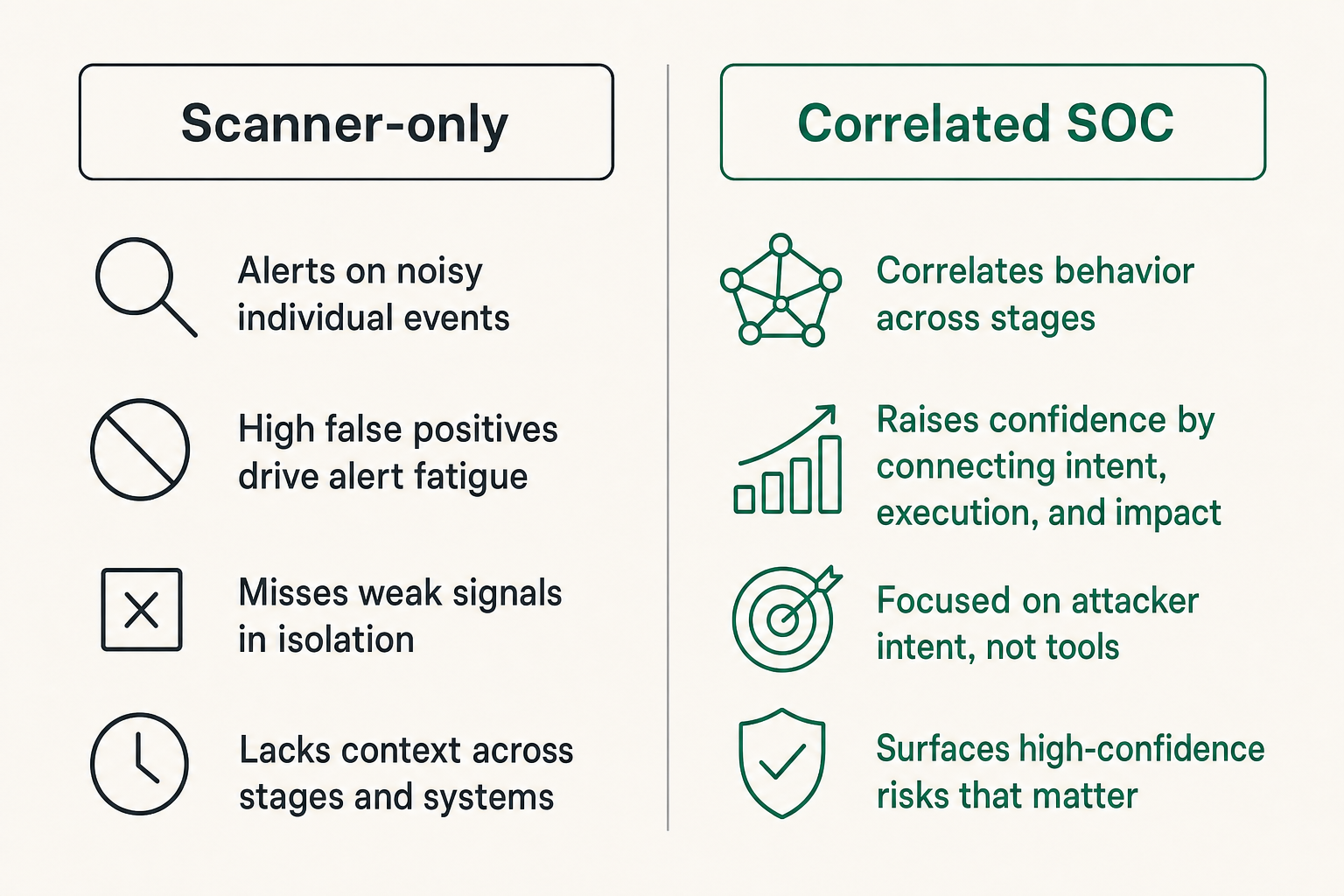
Detection logic in CI/CD has to survive normal engineering behavior. Developers rename workflows, add dependencies, run experiments, and hotfix production. If every unusual change becomes a critical alert, analysts will ignore the category.
Correlate behavior across stages
Good CI/CD detection correlates multiple weak signals rather than alerting on one noisy event. A workflow file edit may be normal. A workflow file edit by a new actor on a protected branch, followed by a privileged runner job and a registry push, is different.
Useful correlation patterns include:
- New repository contributor plus workflow modification plus secret exposure path.
- Branch protection change plus merge plus production deployment within a short window.
- Runner assigned outside its normal repository group plus unusual network egress.
- Artifact tag overwrite plus missing signature plus deployment to a sensitive environment.
- Manual approval by a rarely used admin account plus release outside normal cadence.
The goal is to raise confidence by connecting intent, execution, and impact.
Write detections around intent, not tools
Tool names change. Attack goals are stable. Write detection logic around what the attacker is trying to achieve:
- Gain the ability to execute privileged automation.
- Weaken review or branch controls.
- Exfiltrate secrets from a job.
- Produce or replace a trusted artifact.
- Deploy attacker-controlled code.
- Hide or delete evidence.
A rule named suspicious workflow edit is less useful than privileged release path modified by unusual actor. The second tells the analyst why the event matters.
Use allowlists carefully
Allowlists are necessary in CI/CD because automation is noisy. They are also dangerous because pipelines are full of trusted bots and recurring exceptions.
Use allowlists for stable, low-risk facts: approved runner groups, known release jobs, expected deployment environments, signed artifact issuers. Avoid broad allowlists for users, repositories, or IP addresses unless they are reviewed and expire.
Practical rule: every CI/CD allowlist entry should have an owner, an expiration date, and a reason tied to a control point.
A stale allowlist is an attacker gift. It converts suspicious behavior into accepted behavior because nobody wanted to tune the rule properly.
Connect CI/CD alerts to SOC workflows
Detection only matters if the SOC can act. CI/CD alerts need triage context, routing logic, and response playbooks that account for delivery pressure.
Triage context must travel with the alert
A useful alert should include the minimum investigation bundle:
- Repository, branch, commit, and pull request.
- Actor, actor type, and recent privilege changes.
- Workflow, job, runner, and environment.
- Secrets or cloud roles available to the job.
- Artifact digest, package version, or image tag.
- Deployment target and production exposure.
- Related events before and after the trigger.
- Recommended first action and owner.
Without this context, the analyst becomes a log courier. They ask the platform team for runner logs, the application team for release intent, and cloud operations for role usage. That is not triage. That is evidence scavenging.
Route by blast radius and environment
Not every pipeline anomaly deserves the same response. A suspicious job in a test repository is not the same as a suspicious production release workflow for a payments service.
Route alerts based on blast radius:
- Low: non-production repository, no secrets, no deploy capability.
- Medium: internal service, limited secrets, artifact publish capability.
- High: production deploy path, cloud credentials, customer-facing service.
- Critical: protected branch or release workflow modified plus artifact or deployment impact.
This routing model keeps the SOC from overreacting to harmless churn while escalating pipeline events that can actually change production.
Close the loop with incident response
CI/CD incidents need response steps that preserve evidence and stop propagation. Common actions include pausing workflows, revoking tokens, disabling deploy keys, quarantining artifacts, blocking registry promotion, invalidating caches, rotating exposed secrets, and rolling back to a known-good artifact.
The incident record should capture the full path from code to deployment. If the team cannot answer which artifact is safe, rollback becomes guesswork. If the team cannot identify which secret was exposed to which job, rotation becomes either incomplete or unnecessarily broad.
Automate response without breaking delivery
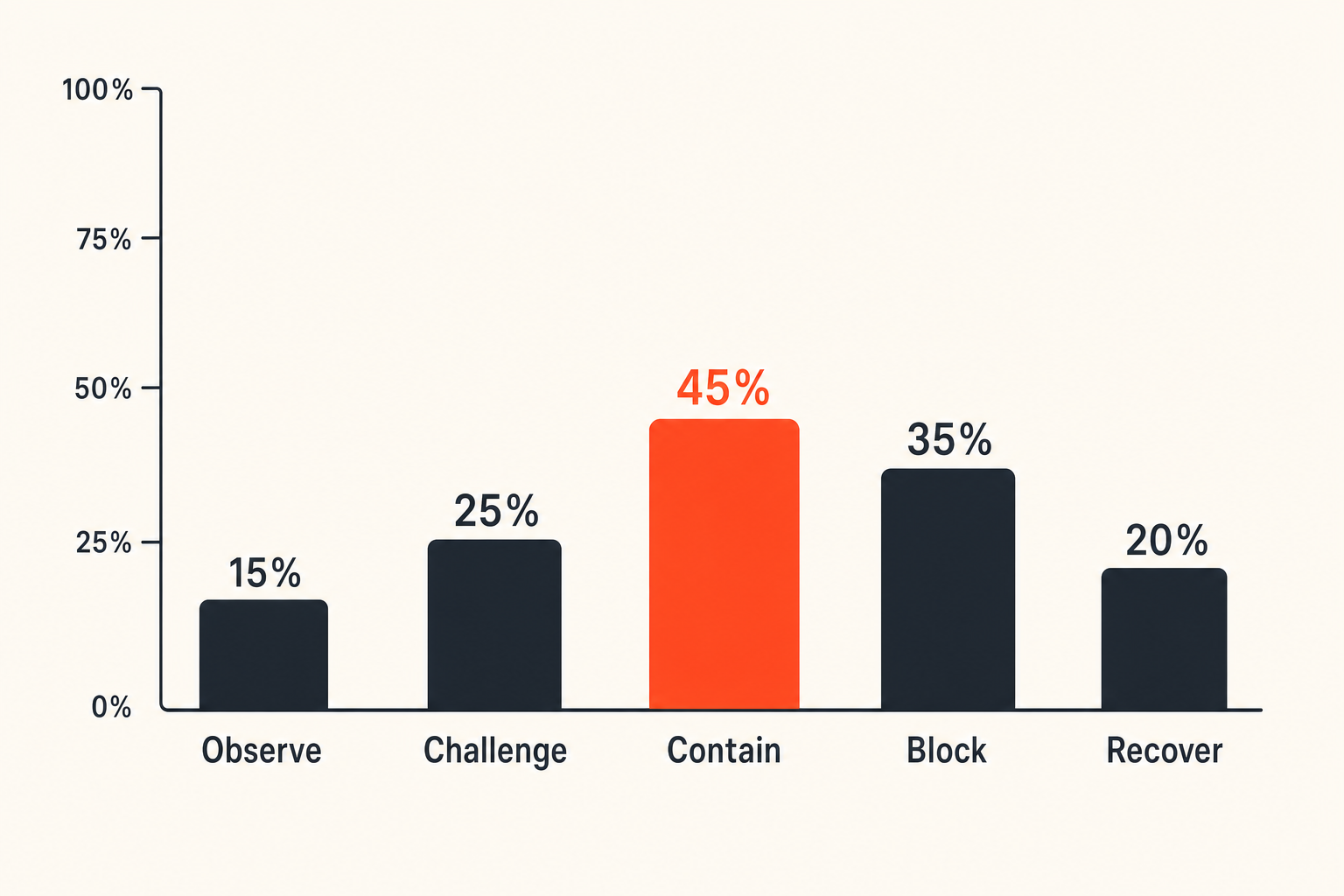
Automation is useful, but CI/CD is a bad place for reckless auto-remediation. A false positive can block a release, strand an emergency fix, or cause engineers to bypass security controls. Start with actions that reduce risk and preserve options.
Start with reversible actions
Good first automations include:
- Enrich the alert with repository, workflow, runner, artifact, and deployment context.
- Open an incident or case with the correct service owner and platform owner attached.
- Pause a specific workflow run rather than disabling the entire CI system.
- Require an additional approval for a production deployment.
- Quarantine a specific artifact digest from promotion.
- Snapshot logs and metadata before ephemeral evidence disappears.
These actions buy time without turning the SOC into the release blocker of first resort.
Use risk tiers for response
Response should be tied to confidence and blast radius. For example:
| Tier | Example condition | Response posture |
|---|---|---|
| Observe | New dependency in low-risk build | Enrich and monitor |
| Challenge | Workflow edit by unusual actor | Require owner confirmation |
| Contain | Privileged runner plus suspicious egress | Pause job and preserve logs |
| Block | Unsigned artifact deployed to production path | Stop promotion and page owner |
| Recover | Confirmed secret exposure | Rotate secret and rebuild from trusted source |
This gives analysts a playbook that is firm without being brittle.
Test response paths like code
Pipeline response should be tested. Run tabletop exercises and controlled simulations. Validate that the SOC can pause a workflow, quarantine an artifact, revoke a token, and identify a safe rollback candidate.
The practical question is not whether the policy exists. The practical question is whether the on-call analyst can execute it at 02:00 without guessing which team owns the release path.
What breaks when teams implement it badly
Most failed CI/CD detection programs do not fail because nobody cared. They fail because teams confuse visibility with operations.
Too many scanner findings, not enough attack signals
SCA, SAST, IaC scanning, and secret scanning are useful. They are not the same as CI/CD security threat detection. Scanner findings usually describe risk in code or configuration. Threat detection describes suspicious behavior in the delivery system.
If the SOC receives thousands of dependency findings but no signal when a release workflow is modified by an unusual account, the program is upside down. Vulnerability management and threat detection should feed each other, but they are different workflows.
Ownership gaps between security and platform
Security may own detections. Platform may own runners. Developers may own workflow files. Cloud teams may own deployment roles. Nobody owns the complete attack path unless the organization explicitly assigns it.
This causes predictable failure modes:
- Alerts routed to a generic DevOps channel.
- Analysts unable to pause jobs without approval chains.
- Platform engineers dismissing alerts as application behavior.
- Developers bypassing controls during release pressure.
- Incident reports missing artifact and deployment evidence.
The fix is not another meeting. The fix is a response matrix that maps control points to owners and actions.
Blind spots in ephemeral infrastructure
Ephemeral runners, temporary tokens, dynamic environments, and short-lived containers are excellent for reducing persistence. They are also excellent at erasing evidence if telemetry is not exported quickly.
Collect logs outside the runner. Export job metadata before teardown. Preserve artifact metadata even if builds are deleted. Record token issuance and role assumption events. If evidence lives only on a temporary runner, assume you will lose it during the incident that matters.
Metrics that prove the program is working
Metrics should tell you whether CI/CD security threat detection is improving decisions. Counting alerts is not enough and can even reward bad engineering.
Measure investigation time, not alert count
Useful operational metrics include:
- Time from pipeline event to SOC alert.
- Time from alert to owner acknowledgment.
- Time from alert to first containment action.
- Percentage of alerts with complete repository, job, artifact, and deployment context.
- Percentage of high-risk alerts closed with verified artifact status.
- Number of incidents where rollback target was known within the first hour.
These metrics expose workflow friction. If analysts spend 40 minutes finding the artifact digest, the detection is under-enriched.
Track coverage by attack path
Coverage should be mapped to attacker objectives, not tool integrations. Ask whether you can detect and respond to these paths:
- A malicious workflow change on a protected branch.
- A forked pull request gaining access to secrets.
- A compromised runner exfiltrating credentials.
- A package publish from an unusual identity.
- A tag overwrite in the container registry.
- A production deployment from an untrusted build.
- Evidence deletion after a suspicious release.
This helps teams find real gaps instead of celebrating log volume.
Review false positives as workflow defects
False positives in CI/CD are often workflow defects. Maybe release jobs are inconsistently named. Maybe production and staging use the same runner group. Maybe emergency changes bypass normal approval with no structured annotation.
Do not only tune the detection. Fix the workflow where possible. Stronger release conventions produce better detections.
Practical rule: if a detection is noisy because engineering workflows are ambiguous, improve the workflow before suppressing the signal.
This is where detection engineering and platform engineering should work together. The detection is telling you where trust boundaries are unclear.
Implementation sequence for a 90-day rollout
A practical rollout should build from visibility to correlation to response. Trying to automate containment before telemetry is reliable usually creates friction and mistrust.
Days 1 to 30: instrument and baseline
Start with the most production-relevant repositories and release paths. Do not boil the ocean.
- Identify the top services by production impact.
- Map their repositories, workflows, runners, registries, and deployment environments.
- Collect audit logs from source control, CI, runner infrastructure, registry, and deployment systems.
- Normalize identifiers across commit, build, artifact, and environment.
- Baseline normal release actors, jobs, runner groups, and deployment windows.
- Document owners for each control point.
The output of month one should be a working map of how code becomes production for critical services.
Days 31 to 60: detect and route
Build a small set of high-signal detections. Focus on release path manipulation, credential exposure, artifact tampering, and production deployment anomalies.
Good starting detections include:
- Protected release workflow modified by unusual actor.
- Branch protection disabled before merge to release branch.
- Privileged runner used by an unexpected repository.
- Job with production secrets triggered from untrusted context.
- Artifact promoted without expected signature or provenance.
- Production deployment from build ID not tied to approved commit.
Route each detection to a named owner group with an explicit severity model. If routing is unclear, fix routing before adding more rules.
Days 61 to 90: automate and validate
In month three, add controlled automation and validation.
- Auto-enrich alerts with build, artifact, and deployment context.
- Snapshot volatile logs for high-risk jobs.
- Require extra approval for suspicious production deployments.
- Quarantine artifact digests that fail provenance checks.
- Run tabletop exercises for compromised workflow, leaked secret, and poisoned artifact scenarios.
- Review metrics and tune based on investigation time.
By day 90, the goal is not perfect coverage. The goal is a repeatable SOC workflow for the highest-risk CI/CD attack paths.
Product fit: bringing CI/CD security threat detection into the SOC
CI/CD security threat detection should not live as a side dashboard that only the platform team checks. The SOC needs the signals, context, ownership, and response hooks in the same operational flow it uses for other threats.
Where ThreatCrush fits
ThreatCrush is built for security operations teams that need to connect signals, reduce noise, and move from alert to action. For CI/CD, that means treating pipeline telemetry as part of the broader threat detection workflow rather than a separate DevSecOps queue.
The useful pattern is straightforward: ingest pipeline and supply chain signals, correlate them with identity and infrastructure context, enrich alerts with release metadata, route by ownership and blast radius, and preserve the evidence needed for incident response.
What to integrate first
Start with the data that gives analysts decision power:
- Source control audit events for protected repositories.
- CI workflow and job events for release paths.
- Runner identity and execution metadata.
- Artifact registry push, overwrite, signature, and promotion events.
- Deployment approvals and environment changes.
- Identity events for tokens, deploy keys, and cloud role assumption.
Then connect those signals to playbooks. The SOC should know when to observe, challenge, contain, block, or recover.
The closing point is simple: CI/CD security threat detection is not a scanner project. It is an operating model for protecting the path from commit to production.
Try threatcrush.com
ThreatCrush helps security operations teams connect detection signals, workflows, and response context without adding another disconnected queue. Try threatcrush.com.
Elsewhere on this topic
- Security Service Architecture for Private Messaging Teams in 2026
- Brinks Home Security as a CI/CD Security Model: Alerts, Ownership, and Response
- Security Operations AI Agents Need Standards, Not Another SOC Copilot
- US rallies 24 nations to compete for 6G
- Shanghai's 15th Five-Year Plan bets on chips, AI, advanced packaging
- CXMT starts LPDDR6 mass production for Xiaomi 18 Fold, claiming global first
Try ThreatCrush
Real-time threat intelligence, CTEM, and exposure management — built for security teams that move fast.
Get started →