CI/CD Security Security Operations: A Practical SOC Architecture for Pipeline Risk

Build pipelines now move faster than most SOC workflows can observe them.
A compromised token, poisoned dependency, malicious workflow change, or abused runner can push code, modify infrastructure, and create cloud access before an analyst has enough context to decide whether the event matters. That is the operational gap.
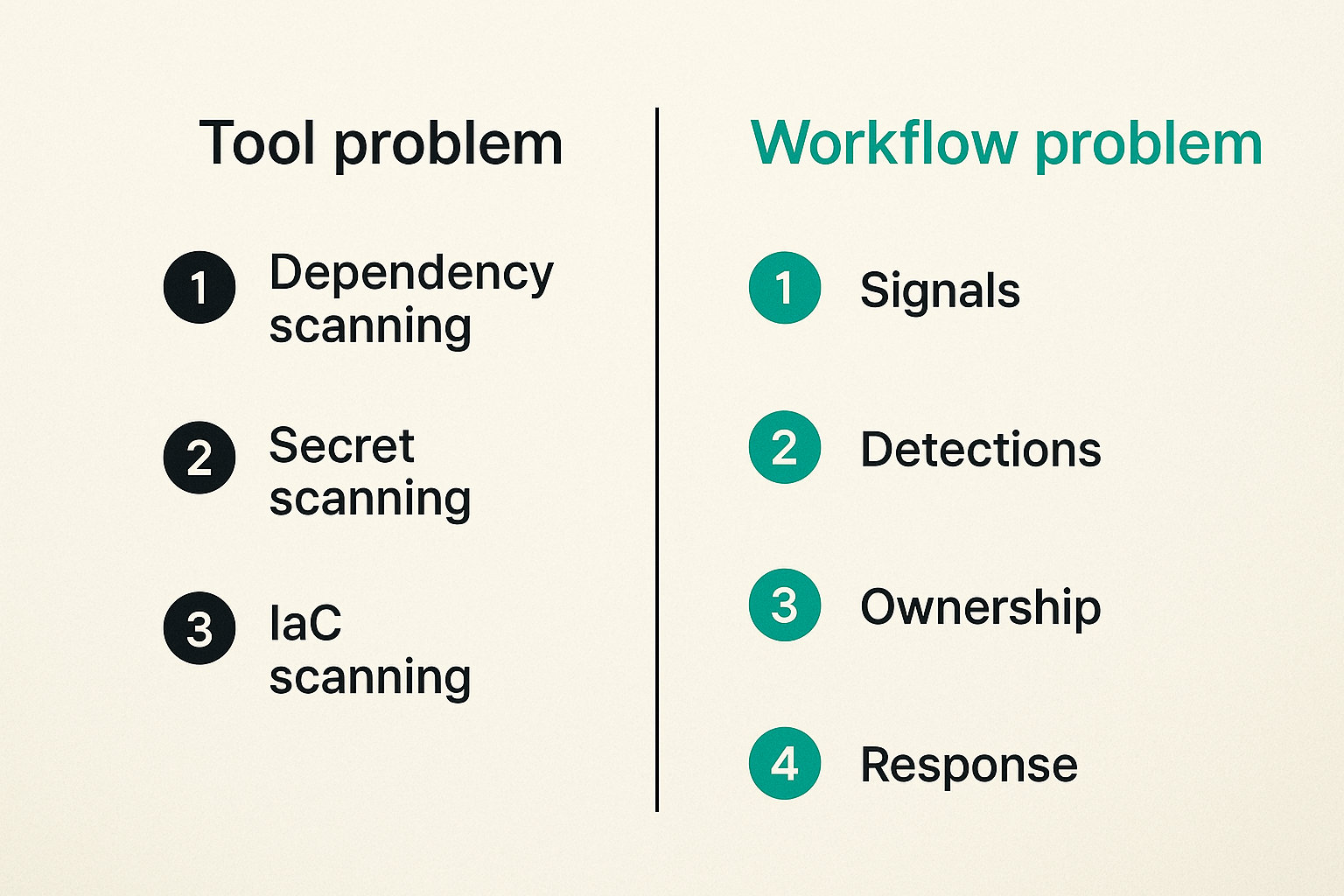
Teams think the problem is CI/CD security tooling. The real problem is CI/CD security security operations: how pipeline risk becomes signals, detections, ownership, containment, and validation inside the SOC.
That changes the conversation. The practical question is not whether you have scanners in the pipeline. It is whether security operations can understand and act on pipeline behavior when the build system becomes part of the attack path.
Table of contents
- Why CI/CD Security Security Operations Is a SOC Workflow Problem
- What Changes When Pipelines Become Production Infrastructure
- The CI/CD Security Security Operations Reference Model
- Signals SOC Teams Need From Build and Release Systems
- Detection Engineering for CI/CD Attacks
- Workflow From Pull Request to Incident Response
- What Breaks When Teams Implement CI/CD Security Badly
- Tooling and Integration Decisions That Matter
- Metrics That Actually Help Security Operations
- Product Fit Connecting CI/CD Security to ThreatCrush Operations
Why CI/CD Security Security Operations Is a SOC Workflow Problem
The pipeline is now a control plane
CI/CD used to look like an engineering convenience. It built code, ran tests, and shipped releases. In many environments, it now provisions infrastructure, assumes cloud roles, publishes containers, modifies Kubernetes objects, writes secrets, and triggers deployment automation.
A useful way to think about it is this: your CI/CD platform is a privileged automation layer with production reach. If an attacker can control the workflow, the runner, the token, or the artifact, they may not need to exploit production directly. They can use your own release machinery.
The mistake teams make is treating this as a collection of isolated DevSecOps checks. Dependency scanning, secret scanning, IaC scanning, and container scanning all matter. But none of them answers the SOC question: what happened, where did it spread, who can contain it, and how do we prove the release path is clean again?
Practical rule: If a system can deploy to production, mint credentials, or modify runtime configuration, it belongs in security operations visibility.
The SOC usually sees the damage late
Traditional monitoring is better at seeing runtime symptoms than build-time cause. A suspicious container starts. A cloud role is abused. An endpoint beacon appears. A new public object appears in storage. The SOC investigates from the symptom backward.
That is slow when the source is the pipeline. Analysts need to know whether the deployed artifact came from an expected workflow, whether the workflow definition changed, whether a maintainer token was used from an unusual location, and whether a runner executed commands outside the normal build graph.
Without that context, the incident looks like a cloud incident, an endpoint incident, or an application incident. In reality, it may be a software supply chain incident with a much larger trust problem.
Security ownership has to be explicit
CI/CD security crosses teams. Engineering owns repositories. Platform owns runners. Cloud owns roles. AppSec owns code risk. SOC owns detection and response. Incident response owns containment. Legal and compliance may own notification if customers are affected.
When ownership is implicit, response slows down. The first hour becomes a meeting about who can disable a workflow, revoke a token, block an artifact, or pause a deployment train.
As guest contributors, the team at vu1nz.com often sees the same pattern in pipeline defense work: the technical control exists, but the operational decision path was never designed.
What Changes When Pipelines Become Production Infrastructure
Identity becomes the main blast radius
Most serious CI/CD incidents become identity incidents. The sensitive object is often not the code itself. It is the credential that the pipeline can access or the role it can assume.
Examples include:
- Long-lived repository tokens with organization-wide scope.
- Cloud deployment roles trusted by any branch or workflow.
- Self-hosted runners with local credentials left on disk.
- Package publishing tokens shared across projects.
- Service accounts that can modify secrets, images, and infrastructure.
What breaks in practice is scope. A low-risk repository gets a high-power token because it was easier during setup. A temporary permission becomes permanent. A workflow intended for a protected branch can be triggered from a less trusted context.
Practical rule: Treat CI/CD credentials as production credentials unless you can prove they are scoped, short-lived, and bound to a specific trust condition.
Artifacts become evidence and attack surface
Artifacts are not just build outputs. They are part of the chain of custody. Containers, packages, binaries, SBOMs, provenance records, and deployment manifests need enough metadata for security operations to answer basic questions.
Which commit produced this artifact? Which workflow ran? Which runner executed it? Which dependencies were resolved? Which signer approved it? Which environment received it?
If you cannot answer those questions quickly, containment becomes guesswork. You may patch the runtime system while leaving the poisoned artifact available for redeployment.
Ephemeral systems still need durable audit trails
Runners are often ephemeral. Jobs are short lived. Logs expire. Temporary tokens vanish. That is good for reducing standing access, but bad if the evidence disappears before the SOC investigates.
You need durable audit trails outside the CI/CD platform itself. Build logs, workflow changes, job metadata, artifact hashes, token issuance, deployment approvals, and cloud role assumptions should land in a system designed for investigation.
The practical question is retention. If your average investigation starts three days after the suspicious release, seven days of build log retention may not be enough. Match retention to investigation reality, not vendor defaults.
The CI/CD Security Security Operations Reference Model
Control plane visibility
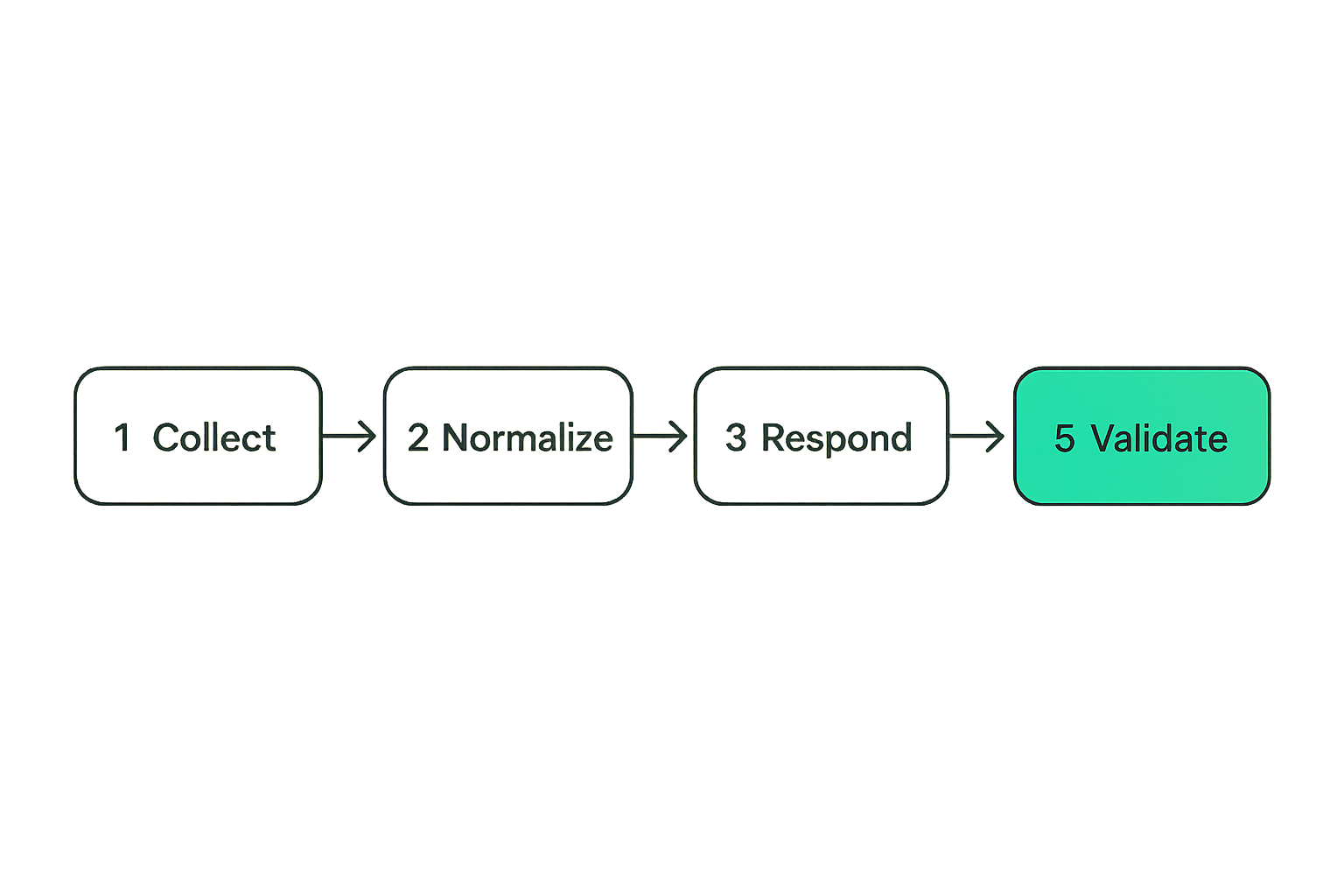
The reference model starts with the CI/CD control plane. This includes repository settings, branch protections, workflow definitions, runner configuration, environment approvals, secrets, tokens, package registries, and deployment permissions.
Security operations needs change visibility here. A malicious workflow edit may be more important than a failed login. A new self-hosted runner may be more suspicious than a scanner warning. A disabled branch protection rule may be the first observable step in an attack.
Control plane events should be treated like cloud control plane events. They describe changes to authority.
Telemetry normalization
Raw pipeline logs are noisy and inconsistent. Different tools call the same concept different names: job, run, build, action, stage, task, workflow, executor. Security teams need a normalized event model.
A practical event schema should include:
- Repository or project.
- Branch, tag, or release reference.
- Commit SHA and author metadata.
- Workflow or pipeline identifier.
- Runner identity and location.
- Actor identity and authentication method.
- Token or role used, where available.
- Artifact name, digest, and registry destination.
- Deployment target and approval state.
Normalization is not glamorous. It is the difference between a useful correlation rule and a brittle regex pile.
Response orchestration
Detection without response authority is theater. For CI/CD security, response actions often include disabling a workflow, quarantining an artifact, revoking a token, rotating secrets, blocking package publication, pausing deployment to an environment, or forcing re-approval.
Those actions may sit across different admin consoles. A SOC workflow should define which actions are automated, which require human approval, and which are break-glass only.
| Operational need | Weak implementation | Better implementation |
|---|---|---|
| Stop a suspicious deployment | Ask an engineer in chat | Predefined action to pause environment promotion |
| Revoke exposed token | Manual search across projects | Inventory mapped to owner and scope |
| Investigate artifact | Pull logs from CI manually | Artifact digest linked to build, commit, runner, and deploy target |
| Contain runner abuse | Rebuild runner later | Isolate runner pool and invalidate cached credentials |
| Validate recovery | Rerun scanner | Rebuild from trusted commit with clean provenance |
Signals SOC Teams Need From Build and Release Systems
Authentication and authorization events
Start with identities. The SOC needs to see human logins, SSO changes, MFA failures, token creation, token use, SSH key changes, deploy key additions, service account changes, and role assumptions from CI/CD.
The highest-value detections usually combine identity with context. A maintainer login is normal. A maintainer login from a new geography followed by workflow modification and token creation is not normal. A CI role assuming cloud access is normal. The same role used outside an expected runner network is not.
Do not only collect failures. Successful authentication and successful authorization changes are often more useful in pipeline attacks.
Repository and workflow changes
Repository telemetry should cover code and configuration. Watch for changes to workflow files, build scripts, dependency manifests, lock files, package publishing configuration, infrastructure code, Dockerfiles, deployment manifests, and branch protection settings.
The point is not to alert on every change. The point is to classify changes by operational risk. A README edit should not page the SOC. A workflow edit that introduces a new external action, adds a privileged permission, or changes the deployment condition deserves attention.
What works:
- Monitor workflow files as privileged configuration.
- Require review for changes that alter deployment logic.
- Compare requested permissions against known baselines.
- Link risky changes to the pull request and reviewer.
What fails:
- Treating all repository events as equal.
- Sending every dependency update to the SOC.
- Alerting without showing the effective permission change.
Build, artifact, and deployment events
Build telemetry connects intent to output. Deployment telemetry connects output to production. You need both.
Useful build events include job start, job completion, runner assignment, permission grants, cache restore, external dependency fetch, artifact creation, signing, and registry push. Useful deployment events include approval, environment selection, release version, deployment actor, rollback, and post-deploy validation status.
Practical rule: A deployment alert without artifact provenance is only half an alert.
Detection Engineering for CI/CD Attacks
Start with behavior, not vulnerability lists
Vulnerability data matters, but CI/CD attack detection should start with behavior. Attackers abuse trust relationships. They change workflows, steal tokens, poison dependencies, tamper with artifacts, and pivot from build systems into cloud infrastructure.
High-value detection ideas include:
- Workflow file modified by a first-time contributor or recently compromised account.
- New secret added and used by a workflow within a short window.
- Deployment job triggered from an unexpected branch, tag, or fork context.
- Build runner initiating outbound connections to unusual destinations.
- Package version published outside normal release cadence.
- Artifact digest deployed without matching expected build record.
- CI role assuming cloud permissions from an unexpected source.
The mistake teams make is importing scanner findings directly into the SIEM and calling it CI/CD detection. That creates workload, not coverage.
Correlate pipeline events with cloud and endpoint signals
Pipeline attacks rarely stay inside the pipeline. A compromised workflow might create a cloud access key. A malicious build step might contact command infrastructure. A poisoned artifact might create runtime behavior after deployment.
Correlation is where SOC value appears. For example:
- Repository workflow changed.
- CI job ran with elevated permissions.
- Cloud role assumed minutes later.
- New container image pushed.
- Kubernetes deployment updated.
- Runtime pod made unusual outbound connections.
Each event alone may be explainable. Together, they describe a credible attack path. That changes the analyst conversation from is this scanner finding real to did an attacker use the release system to reach production?
Validate detections with safe attack simulations
Detection logic for CI/CD should be tested like any other detection. Use safe simulations that do not expose real secrets or deploy malicious code.
Examples:
- Create a test workflow that requests broader permissions than baseline.
- Trigger a build from an unexpected branch in a sandbox repository.
- Publish a test artifact with a mismatched expected digest.
- Simulate token creation and immediate use by automation.
- Run a runner egress test to an approved canary destination.
Validation should measure whether the signal arrived, whether the rule fired, whether the alert had enough context, and whether the response owner knew what to do.
Workflow From Pull Request to Incident Response
The operational sequence
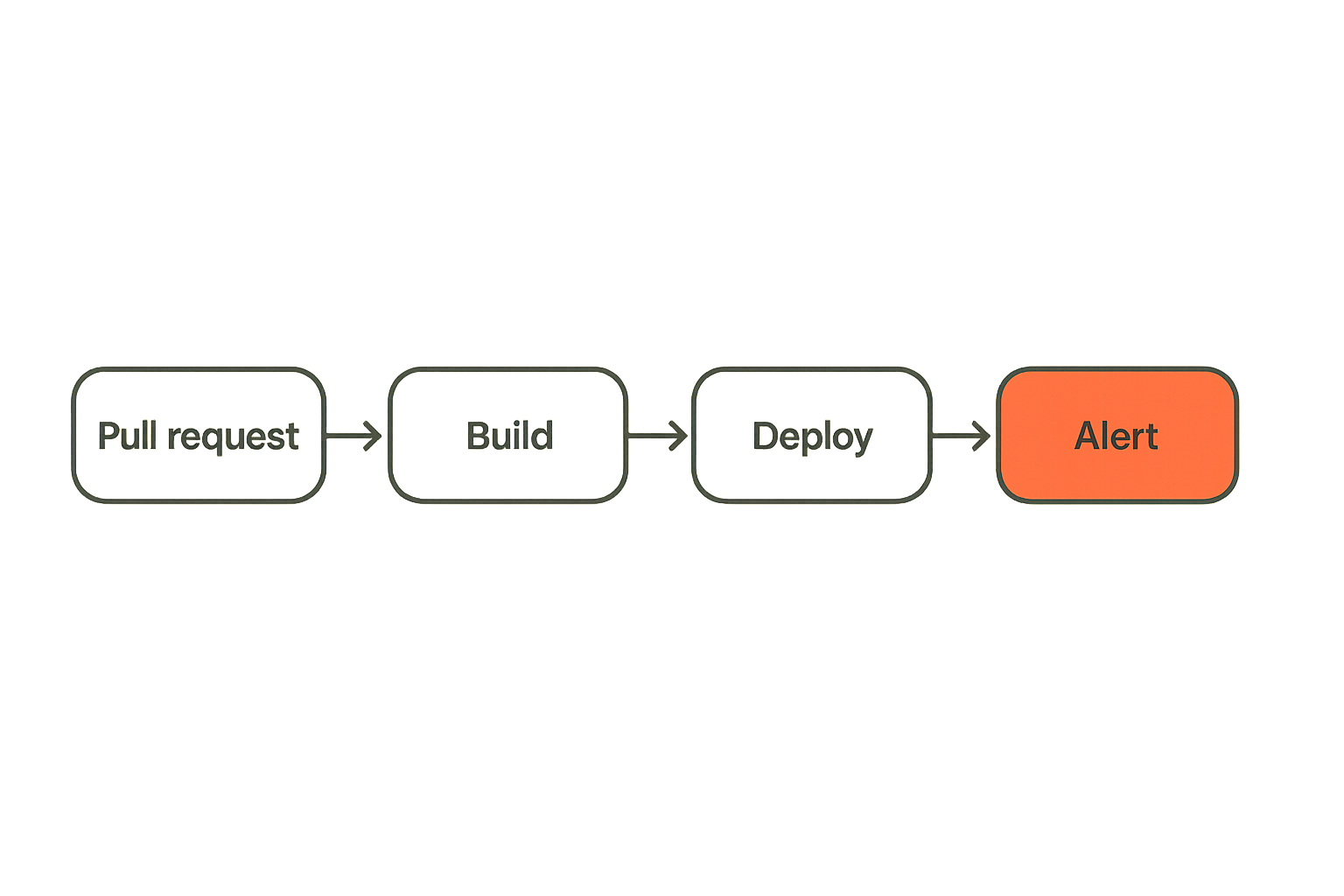
A working CI/CD security operations workflow has to follow the release path. If it only starts after production telemetry fires, it is already late.
- Classify repositories by production impact, data sensitivity, and deployment authority.
- Baseline normal workflow permissions, runner pools, deployment paths, package registries, and cloud roles.
- Collect control plane, repository, build, artifact, deployment, identity, and cloud events.
- Normalize events into a shared model that the SOC can query.
- Detect risky changes and suspicious behavior using context-aware rules.
- Route alerts to the right owner based on repository, environment, and control type.
- Contain by pausing deployment, revoking credentials, quarantining artifacts, or isolating runners.
- Rebuild and redeploy from a trusted source when needed.
- Validate that detection, containment, and recovery evidence are complete.
That sequence is simple on paper. In production, the hard part is not step five. It is keeping steps one, two, six, and seven current as teams create new repositories, runners, environments, and release processes.
Who owns which decision
Ownership should be mapped before an incident. A practical model looks like this:
- SOC owns triage, correlation, severity, and incident coordination.
- Engineering owns code intent, pull request review, and application impact.
- Platform engineering owns runners, pipeline configuration, and deployment mechanics.
- Cloud security owns cloud roles, trust policies, and resource containment.
- AppSec owns secure coding patterns and scanner policy.
- Incident response owns containment strategy and executive coordination for major events.
This does not mean every alert becomes a committee. It means the SOC knows who can answer the next operational question.
Escalation criteria that survive pressure
Define escalation based on blast radius and trust impact. A critical dependency finding in a non-deployed library may not need incident response. A workflow change that can publish a production package might.
Escalate when any of these are true:
- A pipeline credential with production scope may be exposed.
- A build artifact may have been tampered with.
- A deployment occurred from an untrusted or unexplained workflow.
- A runner with access to secrets may be compromised.
- A package or container image may have been published to customers.
- Control plane settings were weakened without authorization.
Practical rule: Escalate on loss of trust in the release path, not only on confirmed runtime compromise.
What Breaks When Teams Implement CI/CD Security Badly
Alert floods from low-context scanner output
Scanner output is useful input. It is not an incident queue by itself.
What breaks in practice is volume without decision support. The SOC gets thousands of dependency, container, and IaC findings with no runtime exposure, exploitability context, owner, deployment status, or compensating control. Analysts learn to ignore the feed.
A better pattern is enrichment before alerting. Is the affected component deployed? Is it internet-facing? Is it in a production image? Is there known exploitation in your environment? Did the finding appear in a release candidate or an abandoned branch? Who owns the service?
If those questions are not answered, send the issue to engineering backlog management, not SOC paging.
Dead secrets and zombie permissions
CI/CD environments accumulate access. Old repositories keep deploy keys. Retired services keep package tokens. Temporary cloud permissions survive migrations. Self-hosted runners keep cached credentials. Secrets get copied because the original owner left.
This is where prevention and detection meet. Inventory is a security operation. You cannot detect abnormal use of a token if you do not know why it exists.
What works:
- Short-lived credentials from workload identity or OIDC where possible.
- Repository-to-role mapping with explicit owners.
- Automated detection for unused tokens and stale secrets.
- Alerts on new long-lived credentials in production-capable projects.
- Periodic access reviews tied to deployment authority.
What fails:
- Shared organization tokens.
- Secrets with unclear owners.
- Runner pools that serve both trusted and untrusted workloads.
- Manual rotation plans that require tribal knowledge.
Rollback plans that do not include the pipeline
Many rollback plans focus on the runtime environment. Revert the deployment. Restore the previous container. Roll back the database migration. Those are necessary, but they may not fix a compromised release path.
If the pipeline itself is untrusted, a normal rollback can redeploy another compromised artifact or reuse the same stolen credentials. Recovery has to include the pipeline control plane.
A credible recovery plan should answer:
- Which workflow definition is trusted?
- Which runner pool is clean?
- Which credentials were rotated?
- Which artifacts are quarantined?
- Which deployment approvals need to be reissued?
- Which commit and dependency set will be rebuilt?
Tooling and Integration Decisions That Matter
SIEM and SOAR integration
The SIEM should receive normalized CI/CD events, not just raw logs. The SOAR layer should support response actions, but not blindly automate destructive changes.
Good automation candidates include ticket creation, owner lookup, evidence collection, artifact quarantine in a staging registry, and temporary deployment pause for lower environments. Higher-risk actions such as revoking production credentials or disabling release workflows may need approval unless the confidence is very high.
The practical question is reversibility. Automate actions that are safe to reverse. Put guardrails around actions that can stop business-critical delivery.
Scanner output versus operational risk
Scanners are specialized tools. Let them do what they do well: find vulnerabilities, secrets, misconfigurations, malicious packages, unsafe images, and policy violations. Then translate their output into operational risk.
A simple routing model helps:
| Finding type | Default destination | SOC involvement |
|---|---|---|
| Secret exposed in public repository | Security incident queue | Immediate triage and revocation |
| Critical CVE in deployed internet-facing service | Vulnerability response | SOC correlation if exploitation signals exist |
| IaC misconfiguration in feature branch | Engineering backlog | Usually no SOC page |
| Malicious package in build path | Incident queue | Investigate artifact and dependency chain |
| Unsigned artifact in production deploy | Release integrity queue | Escalate if policy bypass is unexplained |
The goal is not fewer findings for its own sake. The goal is fewer findings that require human interpretation before anyone knows what to do.
Identity controls for human and machine users
CI/CD identity controls should be boring and strict. Use SSO, MFA, least privilege, branch protection, environment approvals, workload identity, short-lived tokens, and separation between build and deploy roles.
Machine identity deserves special attention. A workflow should not receive broad permissions by default. A build job should not automatically have deployment rights. A pull request validation job should not access production secrets. A runner used for untrusted code should not share a network or credential cache with privileged jobs.
The cleanest designs bind identity to context: repository, branch, workflow, environment, and audience. If the context does not match, the credential should not work.
Metrics That Actually Help Security Operations
Time to detect pipeline abuse
Mean time to detect is useful only if you define the start point. For CI/CD security, start from the risky action: workflow changed, token created, runner registered, artifact published, or deployment triggered.
Track detection time by scenario. You may detect secret exposure quickly but miss suspicious runner behavior for days. That difference matters more than a blended average.
Useful detection metrics include:
- Percentage of production-capable workflow changes reviewed and logged.
- Percentage of deployment events linked to artifact provenance.
- Detection coverage for privileged token creation.
- Detection coverage for branch protection changes.
- Alert enrichment completeness for high-risk repositories.
Time to revoke and rotate
Containment speed is often the real measure. If a production-capable token is exposed, how long until it is revoked? How long until dependent systems are updated? How long until failed jobs caused by rotation are resolved?
Measure the operational path, not just the security action. A token can be revoked in five minutes and still leave the business broken for five hours if nobody knows which deployment depends on it.
Better metrics include:
- Time from alert to owner identified.
- Time from owner identified to credential revoked.
- Time from revocation to successful redeploy.
- Number of systems affected by one credential.
- Percentage of credentials with documented rotation procedure.
Coverage of high-risk repositories
Not all repositories deserve equal attention. Prioritize based on production deployment authority, customer impact, sensitive data, package publishing rights, and infrastructure control.
A small number of repositories often carries most release risk. Start there. Baseline them deeply. Build detections around them. Prove response workflows. Then expand.
This is also how you keep SOC workload sane. High-value coverage beats broad, shallow visibility that nobody can operate.
Product Fit Connecting CI/CD Security to ThreatCrush Operations
Where a security operations platform helps
CI/CD security security operations needs connective tissue. The value is in joining pipeline signals with identity, cloud, endpoint, network, and response context.
A security operations platform can help by centralizing signals, enriching alerts, mapping ownership, supporting detection workflows, and preserving investigation context. For pipeline risk, that means analysts should be able to move from an alert to the related repository, workflow, actor, runner, artifact, deployment, and cloud activity without rebuilding the timeline manually.
That is the difference between a tool alert and an investigation-ready signal.
What still has to stay with your team
No platform can decide your release trust model for you. Your team still has to define which repositories are production-critical, which workflows can deploy, which credentials are acceptable, which actions require approval, and what level of evidence is required to restore trust after compromise.
The mistake teams make is buying tools before agreeing on authority. Tools can enforce and observe. They cannot fix unclear ownership.
A useful first step is a one-page release security map for each critical service:
- Repository and primary owners.
- Pipeline platform and runner type.
- Deployment environments.
- Cloud roles and secrets used.
- Artifact registry and signing requirements.
- Required approvals.
- SOC alert routes.
- Emergency containment actions.
Once that map exists, CI/CD security security operations becomes much easier to implement, test, and improve.
Try threatcrush.com
ThreatCrush helps security teams connect signals, detections, workflows, and response context across modern security operations. If your SOC needs to bring pipeline risk into the same operating model as cloud, endpoint, and network threats, Try threatcrush.com.
CI/CD security security operations is not a separate program. It is the release path becoming part of the SOC operating surface.
Try ThreatCrush
Real-time threat intelligence, CTEM, and exposure management — built for security teams that move fast.
Get started →