CHP Traffic Incident Thinking for SOC Incident Response Architecture

A chp traffic incident looks like a public safety problem. For a SOC, it is also a useful operating model.
A lane is blocked. Multiple reports arrive. The first report is incomplete. Units are assigned. Status changes. Impact expands or clears. The value is not the original alert. The value is the workflow that turns messy signals into coordinated response.
Teams think the problem is getting more security alerts into the queue. The real problem is turning incomplete, changing signals into owned incidents with state, context, and action.
That changes the conversation. A SOC does not need another dashboard that says something happened. It needs an incident architecture that behaves more like dispatch: normalize the signal, understand impact, assign ownership, update state, and close the loop with evidence.
Table of contents
- What a CHP traffic incident teaches SOC teams
- Treat incidents as state machines, not tickets
- Build an incident signal pipeline
- Triage like a dispatcher, not a dashboard watcher
- Correlate proactive and reactive security work
- Automate the boring parts, keep judgment where it matters
- What works in production
- What fails and why
- Product fit: where ThreatCrush belongs
- Closing: use CHP traffic incident thinking to improve SOC response
What a CHP traffic incident teaches SOC teams
From road event to operational signal
A traffic incident feed is valuable because it carries operational context, not because it is beautiful data. A useful incident entry tells responders what happened, where, when, how severe it appears, what is blocked, who is responding, and whether the situation is getting better or worse.
That is the same shape a SOC needs.
A phishing alert, suspicious PowerShell execution, exposed service, or command-and-control beacon is not enough by itself. The practical question is whether it blocks business, exposes a critical asset, indicates attacker progress, or requires coordinated response.
A useful way to think about it is:
| Public safety incident field | SOC equivalent | Why it matters |
|---|---|---|
| Location | Asset, identity, cloud account, subnet | Response depends on where impact lands |
| Lane blocked | Business function degraded or exposed | Severity depends on obstruction, not drama |
| Units assigned | Owner, resolver group, incident lead | No assignment means no response |
| Status update | Investigation state | Teams need to know what changed |
| Road reopened | Containment or remediation complete | Closure requires evidence |
The mistake teams make is treating alerts as static records. In reality, incidents move.
The security analog is not perfect, but it is useful
A CHP traffic incident is physical, visible, and usually bounded. Security incidents are often ambiguous. Attackers hide. Identity paths are messy. Cloud control planes change quickly. Telemetry may arrive late.
Still, the model is useful because it forces SOC teams to separate signal from workflow. The alert is only the first report. The incident is the managed state that follows.
Practical rule: Do not optimize for alert creation until you can explain how an alert becomes owned work.
This is especially relevant in 2026 because many security programs are trying to connect detection engineering, exposure management, threat intelligence, and incident response. That connection fails when every tool creates its own version of incident truth. If you need a broader operating baseline, the ThreatCrush guide to security operations in 2026 frames the SOC as a workflow architecture problem, not just a tooling stack.
Treat incidents as state machines, not tickets
Why status matters more than title
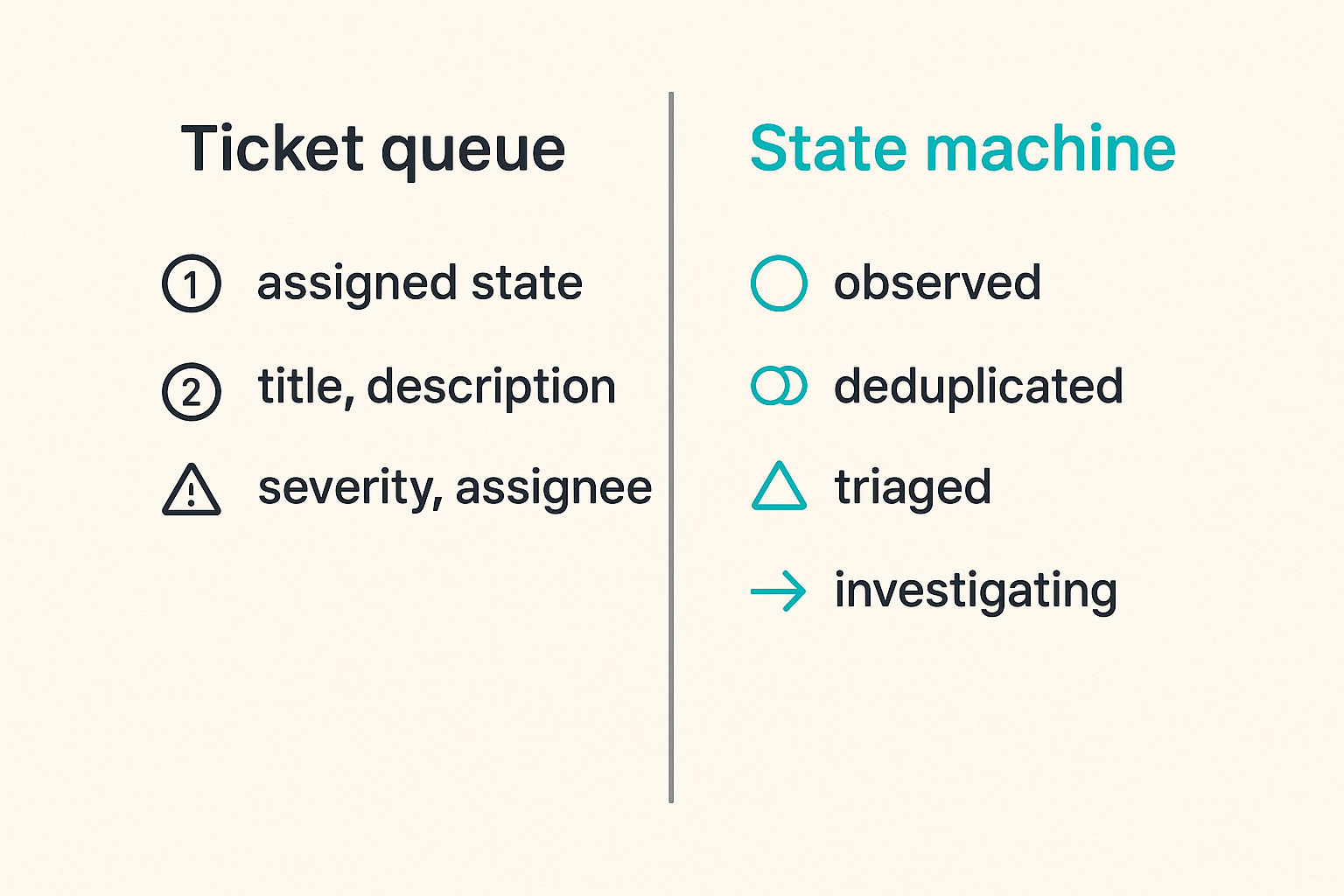
Most tickets have a title, description, severity, assignee, and comments. That is not enough. A ticket can sit in assigned state for hours while the actual incident changes three times.
A state machine is more honest. It defines what the incident can be, which transitions are allowed, what evidence is required, and who can move it forward.
A practical SOC incident state model might look like this:
- observed
- deduplicated
- triaged
- investigating
- contained
- remediating
- validating
- closed
- reopened
The names matter less than the discipline. If the SOC cannot tell whether an incident is waiting for triage, waiting for endpoint response, waiting for cloud remediation, or waiting for validation, the queue becomes theater.
The minimum useful incident schema
Do not start with a massive taxonomy. Start with the fields required to move work.
incident_id: inc-2026-0714-042
state: investigating
signal_type: suspicious_authentication
primary_asset: okta-user-1842
business_service: billing_admin
impact: privileged_access_risk
severity: high
owner: identity-response
source_confidence: medium
first_seen: 2026-07-14T09:31:00Z
last_updated: 2026-07-14T09:44:00Z
evidence:
  - impossible_travel
  - new_mfa_device
  - tor_exit_node
next_action: revoke_sessions_and_validate
This schema is not fancy. That is the point. It gives the SOC enough structure to route, investigate, automate, and report.
Practical rule: If a field does not change routing, severity, response, validation, or reporting, it probably does not belong in the first version of your incident schema.
What breaks when state is implicit
What breaks in practice is not usually detection. It is coordination.
When state is implicit, analysts rely on comments, chat threads, tribal memory, and screenshots. A responder asks whether containment happened. Someone says it was handled. The SIEM still shows activity. The EDR console says isolated. The cloud team removed one key but not another. Nobody knows whether the incident is actually closed.
Implicit state causes:
- duplicate investigations
- missed containment steps
- stale severity labels
- noisy executive reporting
- handoff failures between shifts
- reopened incidents with no root cause history
The cost is not just analyst time. It is trust. Once engineers stop trusting incident status, they build side channels.
Build an incident signal pipeline
Collection without context creates noise
Security teams are good at collecting. They ingest endpoint telemetry, cloud logs, identity events, vulnerability scans, DNS, proxy, email, SaaS audit logs, threat feeds, and case management updates.
Collection is not the same as operationalization.
A traffic incident feed that says collision reported is less useful than one that says collision reported on a specific route, blocking two lanes, with emergency units assigned and estimated delay. Likewise, an alert that says suspicious process is less useful than one that says unsigned binary executed on a payment processing host by a service account that never logs in interactively.
The practical question is not can we ingest it. The practical question is can we make it decision-ready.
Normalize before enrichment
Teams often enrich too early. They take raw alerts and bolt on threat intelligence, vulnerability data, asset context, geolocation, user data, and cloud metadata before they have normalized the basics.
Normalize first:
- What entity is this about?
- What time did it start?
- What source produced the signal?
- What behavior or condition was observed?
- What confidence does the source deserve?
- What business service could be affected?
Only then enrich. Otherwise, enrichment becomes a junk drawer.
A normalized incident signal may include:
entity_type: host
entity_id: prod-api-17
signal_category: lateral_movement
observed_behavior: remote_service_creation
source: edr
confidence: high
business_context: revenue_api
exposure_context: internet_adjacent_subnet
After that, enrichment can answer better questions: Is this host vulnerable? Is the account privileged? Is the destination known malicious? Is the service business critical? Has this behavior appeared elsewhere?
Preserve timestamps and source confidence
Timestamp handling sounds boring until it ruins the investigation. Many incidents include telemetry from multiple tools with different collection delays, time zones, retention windows, and event semantics.
For each signal, preserve:
- event time
- ingestion time
- correlation time
- enrichment time
- last analyst update time
Source confidence matters too. A threat feed indicator, an endpoint prevention event, a cloud audit log, and a user report do not carry the same reliability. Treating them equally produces false certainty.
Practical rule: Never collapse multiple timestamps into one updated_at field. You will need the timeline when the incident becomes serious.
Triage like a dispatcher, not a dashboard watcher
Severity is impact plus obstruction
Severity is not just maliciousness. It is impact plus obstruction.
In a traffic incident, a minor collision on an empty shoulder is different from a stalled truck blocking all lanes during peak hours. In a SOC, commodity malware on an isolated test machine is different from suspicious authentication against a production identity provider.
A useful severity formula is:
severity = attacker_progress + asset_criticality + exposure + business_obstruction + confidence
You do not need to make this mathematical on day one. But the logic should be explicit. Otherwise, severity becomes personality-driven.
Ownership has to be assigned early
An unowned incident is just a noisy observation.
Ownership does not mean the first analyst solves everything. It means someone is accountable for moving the incident to the next valid state. That person may coordinate endpoint response, identity, cloud, network, legal, fraud, or application teams.
A good owner knows:
- current state
- next action
- decision deadline
- required evidence
- escalation path
- closure criteria
The mistake teams make is assigning ownership after they understand the incident. In production, you need provisional ownership before full understanding. Dispatch first, refine as evidence arrives.
Escalation should be a route, not a debate
Escalation paths should be designed before the incident. If every high-severity case triggers a chat debate about who should respond, the architecture is broken.
Define escalation routes by entity and impact:
| Incident condition | Primary owner | Escalation route |
|---|---|---|
| Privileged identity compromise | IAM response | Incident commander, legal if data access confirmed |
| EDR containment on server | Endpoint response | App owner, infrastructure, business service owner |
| Internet-exposed critical CVE | Exposure management | Platform team, change manager, incident lead |
| Suspicious cloud role activity | Cloud security | Cloud platform owner, service owner |
| Data exfiltration indicators | SOC lead | IR lead, legal, privacy, executive comms |
This table should live in runbooks and automation logic, not only in a slide deck.
Correlate proactive and reactive security work
CTEM needs live incident feedback
Continuous threat exposure management is often discussed as proactive work: find exposures, prioritize risk, validate controls, reduce attack surface. That is correct, but incomplete.
CTEM improves when it consumes incident feedback. If incidents repeatedly involve the same identity patterns, exposed services, unmanaged endpoints, or vulnerable software, that should change exposure priorities.
A live incident is not just a response object. It is evidence about where the environment is actually weak.
This is where the chp traffic incident analogy helps again. A traffic system learns from recurring collisions, bottlenecks, and blocked routes. A SOC should learn from repeated incident patterns and turn them into control improvements.
Threat analysis should update control priorities
Threat analysis workflows often produce good conclusions that die in documents. The SOC identifies a likely actor technique, maps it to telemetry, writes notes, and moves on. Then the same pattern reappears.
The fix is to connect analysis to controls:
- New technique observed becomes a detection backlog item.
- Repeated exposure becomes a CTEM priority.
- Unclear ownership becomes a runbook update.
- Missing telemetry becomes a logging requirement.
- Slow containment becomes an automation candidate.
For a deeper treatment of this loop, see the ThreatCrush guide to threat analysis workflows that actually work, especially the parts on connecting analysis, detection, and response.
Adjacent teams face the same ownership problem
Security teams are not unique here. Remote operations, DevSecOps, and even product teams run into the same failure mode: tools produce signals, but the workflow does not define ownership.
Related reading from our network: teams evaluating operational tooling face similar tradeoffs in this guide to remote access software architecture, where security, support, and ownership matter more than the feature checklist.
Related reading from our network: the CI/CD security lesson in Securitas Security Services USA and CI/CD security architecture uses patrols, checkpoints, evidence, and response as a practical model for pipeline security.
The common pattern is simple: without ownership, every signal becomes somebody else's problem.
Automate the boring parts, keep judgment where it matters
Use automation for routing and evidence
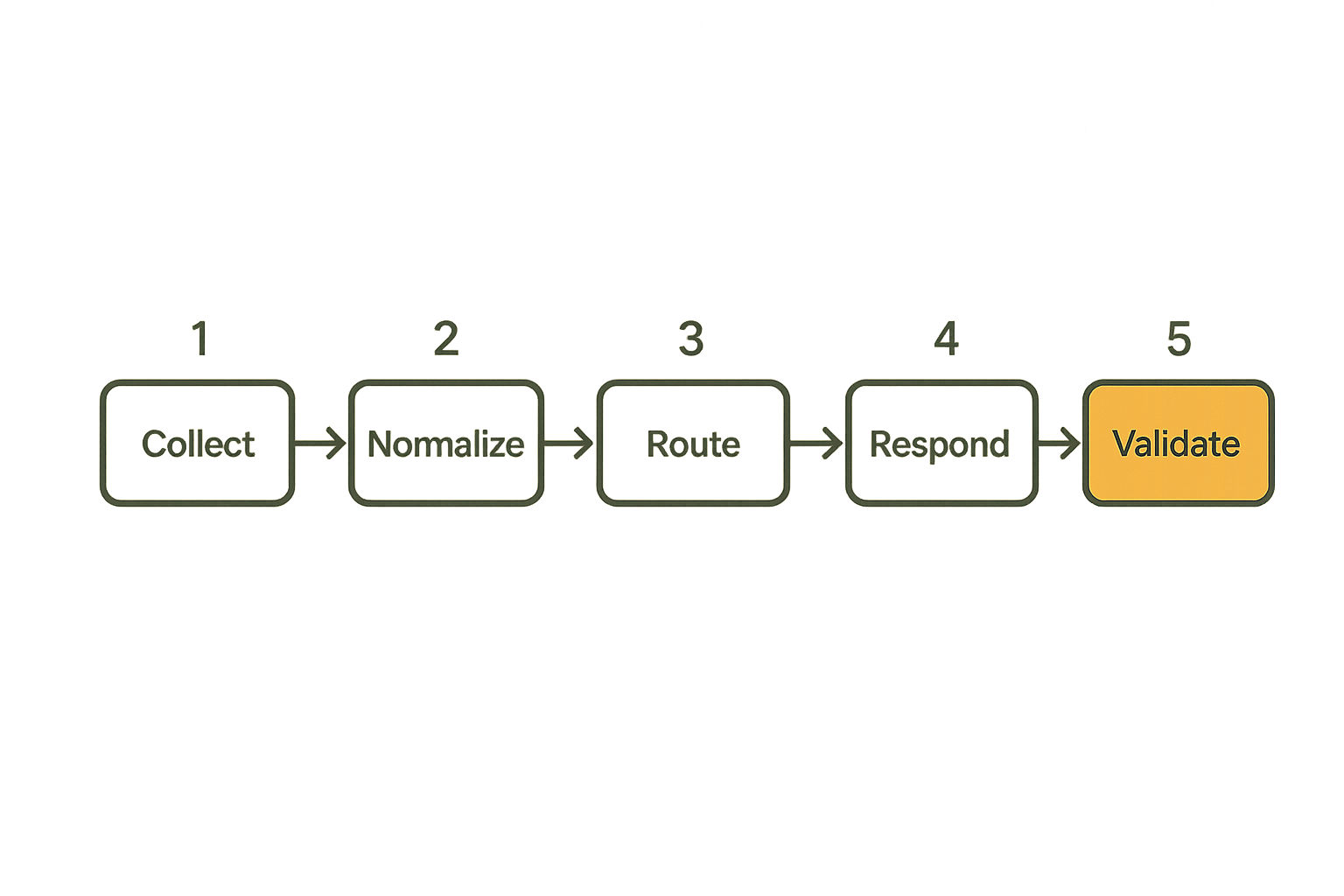
Automation should make the incident easier to understand and faster to route. It should not pretend to understand intent when the evidence is weak.
Good automation candidates:
- deduplicate repeated alerts
- attach asset and identity context
- tag business service ownership
- create timeline summaries
- open the right case type
- notify the right responder group
- collect volatile endpoint or cloud evidence
- update incident state after confirmed actions
Bad automation candidates:
- closing incidents based only on one benign label
- escalating everything with a threat intel hit
- isolating critical systems without business context
- changing severity without evidence history
- overwriting analyst notes with generated summaries
Automation should reduce drag, not hide uncertainty.
Use humans for intent and blast radius
Humans are still needed where judgment matters. Did the activity match attacker intent, admin maintenance, broken automation, or user error? What is the likely blast radius? Should the team contain immediately or preserve access for investigation? Is legal review needed? Is customer impact plausible?
The best SOC architectures give analysts better context earlier. They do not bury them under twenty enrichment panels.
A useful split is:
| Decision | Automate | Human judgment |
|---|---|---|
| Deduplicate alerts | Yes | Low |
| Attach asset owner | Yes | Low |
| Estimate business impact | Partial | Medium |
| Determine attacker intent | Partial | High |
| Contain endpoint | Conditional | Medium to high |
| Notify executives | No | High |
A practical implementation sequence
Do not try to rebuild the SOC in one quarter. Start with one incident class that hurts, such as suspicious privileged authentication, endpoint containment, or internet-exposed critical vulnerability exploitation.
- Select one high-volume or high-impact incident class.
- Define the incident states and valid transitions.
- Create the minimum schema required for routing and response.
- Normalize signals from the top two or three sources.
- Add only enrichment that changes a decision.
- Assign provisional ownership rules.
- Encode escalation routes in runbooks and automation.
- Measure flow: time to triage, time to owner, time to containment, time to validation.
- Review closed incidents weekly and update the schema, runbooks, and detections.
Practical rule: Automate the path of the work before you automate the decision to close the work.
This sequence is intentionally narrow. Broad, abstract SOC transformation programs tend to stall. A focused incident class creates proof, reveals integration problems, and teaches the team what the platform actually needs.
What works in production
Small schemas beat giant taxonomies
Large taxonomies look mature. They often slow teams down.
A small schema that every analyst uses correctly is better than a perfect model nobody understands. Start with fields that drive action: entity, behavior, state, severity, owner, confidence, business service, next action, evidence, timestamps.
Add complexity only when you can explain the operational reason. For example, adding attacker technique may help detection engineering and reporting. Adding legal hold status may help regulated investigations. Adding data classification may help privacy impact decisions.
Related reading from our network: product teams face a surprisingly similar systems problem when naming becomes a launch, support, and search workflow; the same operational discipline shows up in product names as a shipping system.
Runbooks should encode decisions
A runbook is not a checklist of console clicks. It should encode decisions.
For each incident class, define:
- what evidence confirms escalation
- what evidence downgrades severity
- what action contains the threat
- what action validates containment
- when to involve legal or privacy
- when to notify business owners
- what artifacts are required for closure
This makes shift handoff easier. It also makes automation safer because the automation follows explicit decision points.
A weak runbook says: investigate suspicious login.
A useful runbook says: if privileged user has impossible travel plus new MFA device plus unfamiliar ASN, revoke sessions, require MFA reset, capture identity logs for the previous 24 hours, check admin actions, and escalate if privileged configuration changed.
Metrics should measure flow
Many SOC metrics measure volume because volume is easy. Alert count, case count, and ingestion count tell you something, but not enough.
Measure flow instead:
- time from first seen to normalized signal
- time from normalized signal to triage
- time from triage to owner
- time from owner to containment
- time from containment to validation
- reopen rate by incident class
- percentage of incidents with complete evidence
- percentage of incidents with missing owner or missing next action
These metrics expose workflow problems. If time to owner is high, routing is broken. If containment is fast but validation is slow, closure criteria are weak. If reopen rate is high, analysts may be closing on assumptions.
That changes the conversation from work harder to fix the system.
What fails and why
Alert-only thinking collapses under load
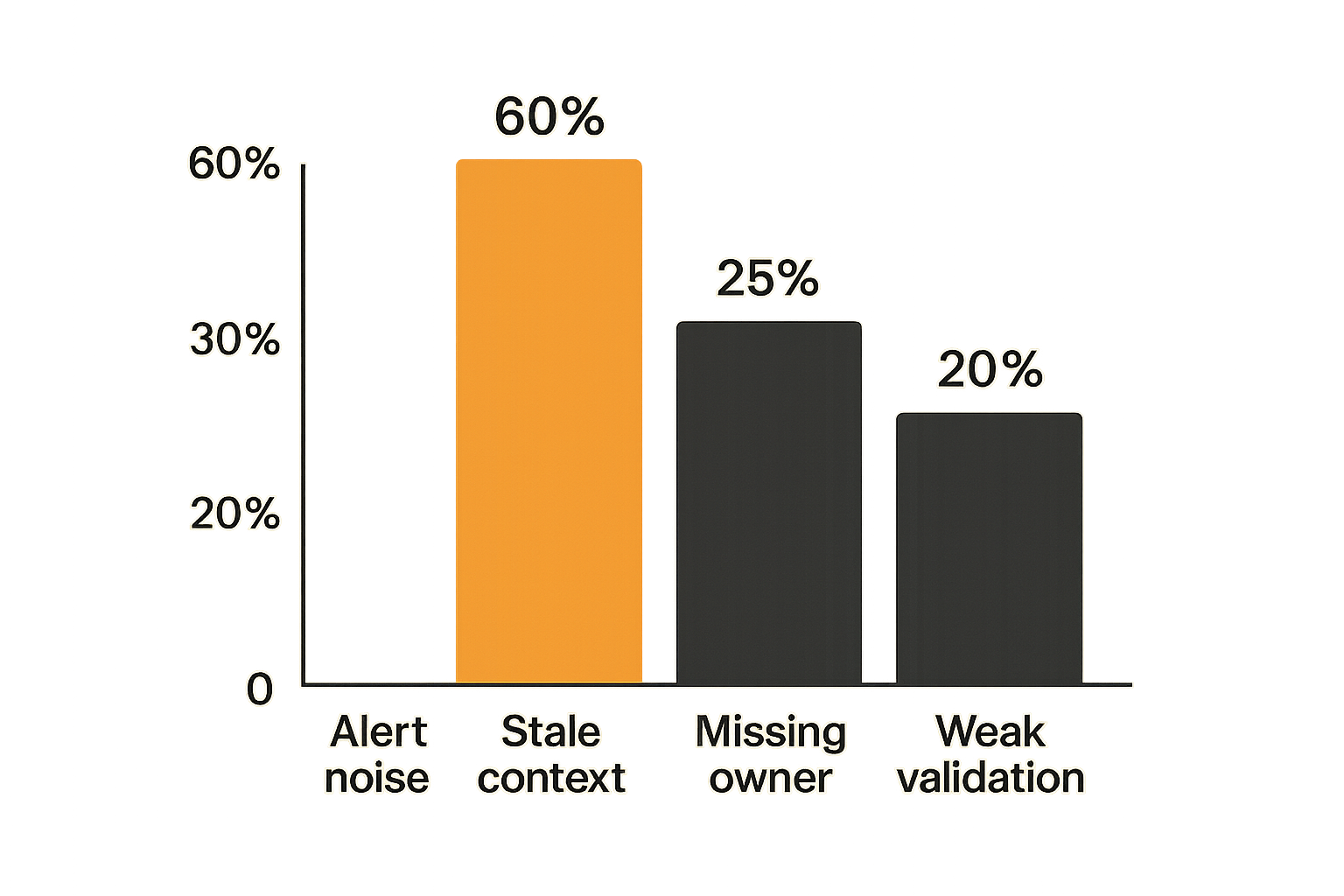
Alert-only thinking works when volume is low and analysts know the environment by memory. It collapses when telemetry expands, cloud assets multiply, identity becomes the perimeter, and teams operate across shifts.
The dashboard watcher model assumes the analyst can look at alerts and infer the workflow. That does not scale. Under pressure, analysts triage titles, skim enrichment, and move on.
Failure signs include:
- lots of alerts, few well-managed incidents
- severity labels that do not match business impact
- repeated questions about who owns response
- cases closed without validation evidence
- shift handoffs that require long meetings
- detection engineers unaware of recurring response pain
Enrichment sprawl hides the answer
Enrichment is useful until it becomes camouflage.
Teams add reputation scores, WHOIS data, geoIP, sandbox results, vulnerability data, asset tags, user attributes, SaaS metadata, and AI summaries. Then the analyst still does not know what to do next.
The issue is not that enrichment is bad. The issue is that enrichment is not organized around decisions.
Ask this for every enrichment source:
- Does it change severity?
- Does it change owner?
- Does it change containment action?
- Does it change validation criteria?
- Does it add confidence or reduce uncertainty?
If not, keep it available but do not put it in the critical path.
No owner means no incident
This is the bluntest rule.
If nobody owns the next action, the incident is not operationally real. It may exist in the SIEM. It may exist in a case system. It may appear in a report. But it is not being worked as an incident.
Ownership must survive tool boundaries. The endpoint team may own containment. The identity team may own session revocation. The cloud team may own key rotation. The incident commander may own coordination. The SOC may own investigation quality.
What fails is assuming that creating a ticket creates accountability. It does not. Accountability comes from routing, state, escalation, and closure criteria.
Product fit: where ThreatCrush belongs
Connect external signals to SOC workflows
Threat intelligence is most useful when it changes what the SOC does. Real-time feeds, vulnerability tracking, attack surface monitoring, and actor intelligence should not live as separate tabs analysts check when they have time.
They should feed the incident workflow:
- raise confidence when external indicators match internal telemetry
- prioritize exposed assets tied to active exploitation
- enrich incidents with actor behavior that affects investigation
- update detection engineering backlogs
- support CTEM prioritization with live threat context
ThreatCrush fits best when teams treat intelligence as workflow input, not decoration. The goal is not to add another stream of scary context. The goal is to shorten the path from signal to decision.
Make validation part of the loop
Validation is where many SOC processes get weak. A case is closed because the alert stopped, the host was isolated, or a patch was deployed. But did the threat path actually disappear? Did the identity session get revoked? Did the vulnerable service stop being reachable? Did the detection fire correctly after tuning?
Threat intelligence, exposure data, and detection context should help answer those questions. That is the architectural value: connect proactive and reactive work so closed means verified, not merely quiet.
For teams building integrations, the ThreatCrush documentation is the practical place to start mapping feeds, agent data, and workflow hooks into your existing SOC stack.
Do not replace judgment; reduce drag
A good platform should not ask operators to trust magic. It should reduce the manual work around context gathering, routing, prioritization, and validation.
The SOC still owns judgment. The platform should make that judgment faster and better supported.
That means:
- fewer disconnected screens
- clearer ownership paths
- better context attached to incidents
- faster validation of exposure and threat relevance
- tighter feedback between CTEM, detection engineering, and response
The product fit is strongest when the organization already wants to operate from a shared incident model. If every team insists on its own queue, its own severity language, and its own closure rules, tooling will only expose the fragmentation faster.
Closing: use CHP traffic incident thinking to improve SOC response
The takeaway for security teams
The value of CHP traffic incident thinking is not the traffic data. It is the operating discipline.
Security teams need the same discipline: incomplete reports become normalized signals, signals become owned incidents, incidents move through explicit states, responders update status, and closure requires evidence.
Teams think the problem is finding more bad things. The real problem is building the workflow that turns bad things into coordinated response.
If you use the chp traffic incident model as a forcing function, ask these questions:
- What is the incident state right now?
- Who owns the next action?
- What evidence changes severity?
- What response route applies?
- What validates closure?
- What should feed back into CTEM and detection engineering?
Answer those consistently and the SOC gets calmer. Not because threats disappear, but because the work has shape.
Try threatcrush.com
You are writing for security operations professionals building and scaling SOC capabilities. Try threatcrush.com to connect threat intelligence, exposure context, and SOC workflows into faster incident decisions.
Try ThreatCrush
Real-time threat intelligence, CTEM, and exposure management — built for security teams that move fast.
Get started →