AI Content Threat Detection: A SOC Workflow for Synthetic Content Risk

AI content threat detection is becoming one of those problems that looks simple in a demo and gets messy the moment it hits the SOC queue.
A user forwards a suspicious email. Legal flags a fake executive statement. Sales receives a polished vendor invoice request. HR sees a convincing recruiting message with a malicious attachment. None of these incidents are solved by asking whether the text was generated by an LLM.
Teams think the problem is detecting AI-written content. The real problem is deciding whether content is part of an attack path, who owns the response, and how fast the SOC can reach a defensible decision.
That changes the conversation. AI content threat detection is not a standalone classifier. It is a workflow that connects content analysis, identity context, delivery telemetry, infrastructure signals, business impact, and response playbooks. As a guest contribution from the team at bl0ggers.com, this guide focuses on the operational side: how to build the detection and triage loop without turning the SOC into a content moderation team.
Table of contents
- AI content threat detection is not a detector purchase
- What changed in 2026
- Signal architecture for AI content threat detection
- Detection methods: what works and what fails
- Build the intake pipeline
- Scoring, triage, and escalation
- Response playbooks for synthetic content threats
- Validation and measurement
- Common failure modes
- Closing the loop on AI content threat detection
AI content threat detection is not a detector purchase
Why AI-written does not mean malicious
The mistake teams make is treating AI content threat detection like plagiarism detection for the SOC. They want a percentage score that says whether an email, post, document, or chat message was generated by a model.
That score is rarely enough. A perfectly human-written invoice scam is still dangerous. A fully AI-generated product announcement is usually not. A synthetic voicemail from a fake CFO may be high risk even if the transcript looks ordinary.
The practical question is not: did a model write this? The practical question is: does this content create a security-relevant action path?
Those action paths usually look familiar:
- credential capture through a link or attachment
- payment redirection or wire fraud
- malware delivery through documents or archives
- impersonation of executives, vendors, recruiters, or support teams
- social engineering that moves the target to a second channel
- publication of false content that damages trust or triggers operational response
- leakage of internal data into external AI tools
AI changes the volume, polish, and personalization of the content. It does not change the need for attribution, scope, impact, containment, and recovery.
Practical rule: Do not alert on AI authorship alone. Alert when synthetic content intersects with a risky request, suspicious identity, untrusted delivery path, or sensitive business process.
The outcome the SOC actually needs
A SOC does not need philosophical certainty. It needs a decision package.
For an inbound message, the package should answer:
- who received it
- who appears to have sent it
- whether the sender is trusted or spoofed
- what the content asks the user to do
- whether links, files, or phone numbers are involved
- whether similar content appeared elsewhere
- what systems, users, or workflows are at risk
- what response action is safe and proportional
This is why AI content threat detection belongs in detection engineering and incident response, not just in policy. The detector is one component. The workflow is the product.
Where the workflow should start
Start at the points where content becomes operationally relevant. For most organizations, those are email, collaboration tools, web forms, customer support queues, public brand monitoring, ticketing systems, and internal AI tools.
Do not start by trying to inspect every sentence everywhere. That creates cost without ownership. Start with content that can trigger a security event or business action.
Good starting scopes include:
- reported phishing emails and suspicious attachments
- inbound vendor payment changes
- executive or finance impersonation attempts
- suspicious customer support tickets containing links or attachments
- public posts impersonating the company or leadership
- pasted prompts or outputs containing regulated or confidential data
The workflow should be narrow enough to tune and broad enough to reduce real analyst work.
What changed in 2026
Synthetic content is cheap and personalized
Attackers no longer need to choose between scale and quality. They can generate clean, localized, role-specific messages quickly. They can rewrite lures for different business units, industries, and geographies. They can create convincing first drafts of emails, text messages, scripts, comments, profiles, and support conversations.
What breaks in practice is the old assumption that bad writing is a useful signal. Some malicious content is now better written than legitimate internal communication. Grammar quality, tone, and formatting are weak indicators.
A useful way to think about it is this: AI reduces the attacker cost of plausibility. It does not remove the operational clues around sender reputation, infrastructure, timing, targeting, and requested action.
Trust channels are now attack surfaces
Security teams used to focus heavily on email. Email still matters, but synthetic content moves through more channels now:
- Slack, Teams, Discord, and community platforms
- LinkedIn-style recruiting and sales conversations
- customer support chat
- comment forms and lead forms
- fake press statements and social media posts
- voice transcripts and meeting summaries
- AI copilots connected to internal data
That changes the telemetry problem. The SOC needs to connect content risk to channel context. A suspicious message in a public comment form has different implications than the same message sent to finance by an apparent vendor.
Analyst time is the limiting factor
Many teams can technically collect the content. Fewer can triage it without drowning analysts.
If every AI-looking message becomes a ticket, analysts stop trusting the system. If only high-confidence malware gets escalated, social engineering and impersonation slip through. The middle is where architecture matters.
The goal is to reduce investigation time by assembling context before the analyst opens the case. That means enrichment, deduplication, clustering, and clear escalation criteria.
Practical rule: The best AI content threat detection pipeline is not the one with the most model outputs. It is the one that removes the most repetitive investigation steps while preserving evidence.
Signal architecture for AI content threat detection

Content signals
Content signals are the features visible in the message, document, transcript, or page. They include language, structure, intent, embedded entities, and requested actions.
Useful content signals include:
- requests for credentials, payment, gift cards, payroll changes, secrets, or remote access
- urgency, secrecy, authority pressure, or channel switching
- links, domains, phone numbers, wallet addresses, file hashes, and QR codes
- inconsistencies between claimed identity and signature details
- attachment type and macro or script indicators
- similarity to known lures, templates, or previous incidents
- model-likelihood or synthetic-style score, where available
The model-likelihood score is the least important item on that list unless it is combined with the rest. Treat it as a clue, not a verdict.
Example normalized finding:
content_findings:
  requested_action: update_vendor_bank_account
  pressure_terms: high
  embedded_links: 1
  attachment_types: [pdf]
  ai_likelihood: medium
  lure_similarity: finance_bec_cluster_17
This is more useful than a single field that says generated: true.
Identity and relationship signals
Identity context often decides severity. A synthetic message from an unknown sender to a public inbox may be low priority. The same message from a spoofed vendor to accounts payable is different.
Useful identity signals include:
- sender authentication results such as SPF, DKIM, and DMARC
- display-name mismatch and lookalike domain indicators
- prior communication history with the recipient
- vendor, customer, or partner relationship status
- executive, finance, legal, HR, or IT target role
- abnormal timing or impossible travel context for internal accounts
- compromised account indicators from identity telemetry
The point is not just to prove impersonation. It is to determine whether the content can plausibly move a business process.
Delivery and infrastructure signals
Infrastructure still matters. AI-generated text does not hide poor delivery infrastructure forever.
Collect and enrich:
- sending IP and ASN reputation
- domain age and registrar patterns
- URL redirects and final landing pages
- TLS certificate details
- hosting provider and CDN usage
- attachment hash reputation
- sandbox behavior for files and links
- QR code destinations
This is where traditional SOC work remains valuable. AI may make the message better, but the campaign still needs infrastructure, accounts, domains, files, and delivery paths.
Detection methods: what works and what fails
Classifier output is only one signal
AI-content classifiers can be useful, especially for clustering and prioritizing review. They can also be brittle. Content can be short, edited by humans, translated, quoted, templated, or produced by legitimate enterprise tools.
Use classifier output as a feature in a larger scoring model. Avoid hard enforcement based only on synthetic probability.
| Approach | What works | What fails |
|---|---|---|
| AI-authorship classifier | Adds a weak signal for synthetic style and clustering | Breaks on short text, edited text, mixed authorship, and legitimate AI use |
| Intent extraction | Identifies the requested action and pressure pattern | Needs tuning for business-specific workflows |
| Entity enrichment | Turns links, domains, names, and files into investigable signals | Misses risk if metadata is stripped or normalized badly |
| Relationship context | Separates random spam from business-process risk | Requires integration with identity, email, CRM, vendor, or HR data |
| Campaign clustering | Reduces duplicate analyst work | Can over-cluster unrelated messages with similar wording |
| Provenance checks | Useful for signed media, known content sources, or internal publishing | Not consistently available across channels |
Intent beats authorship
Intent extraction is often more reliable than authorship detection. You want to know what the content is asking the recipient to do.
A simple intent taxonomy might include:
- open file
- click link
- enter credentials
- approve payment
- change account details
- install software
- share secret
- move to phone or chat
- ignore normal process
- amplify public claim
Once you know the requested action, you can map it to business risk. An AI-written message asking a user to read a public blog post may not matter. A human-written message asking finance to bypass vendor verification matters immediately.
Provenance helps when it is available
Content provenance can help, but it is not universal. Some ecosystems support signatures, watermarking, publishing records, or origin metadata. Many do not. Screenshots, copy-paste chains, forwarded messages, and re-uploaded documents often destroy provenance.
Use provenance as an accelerator, not a dependency. If provenance confirms that content came from an approved internal publishing system, that can reduce noise. If provenance is absent, the workflow still needs to evaluate identity, delivery path, intent, and impact.
Practical rule: Provenance is a trust bonus, not a safety guarantee. Missing provenance should increase scrutiny only when the business process expects provenance.
Build the intake pipeline
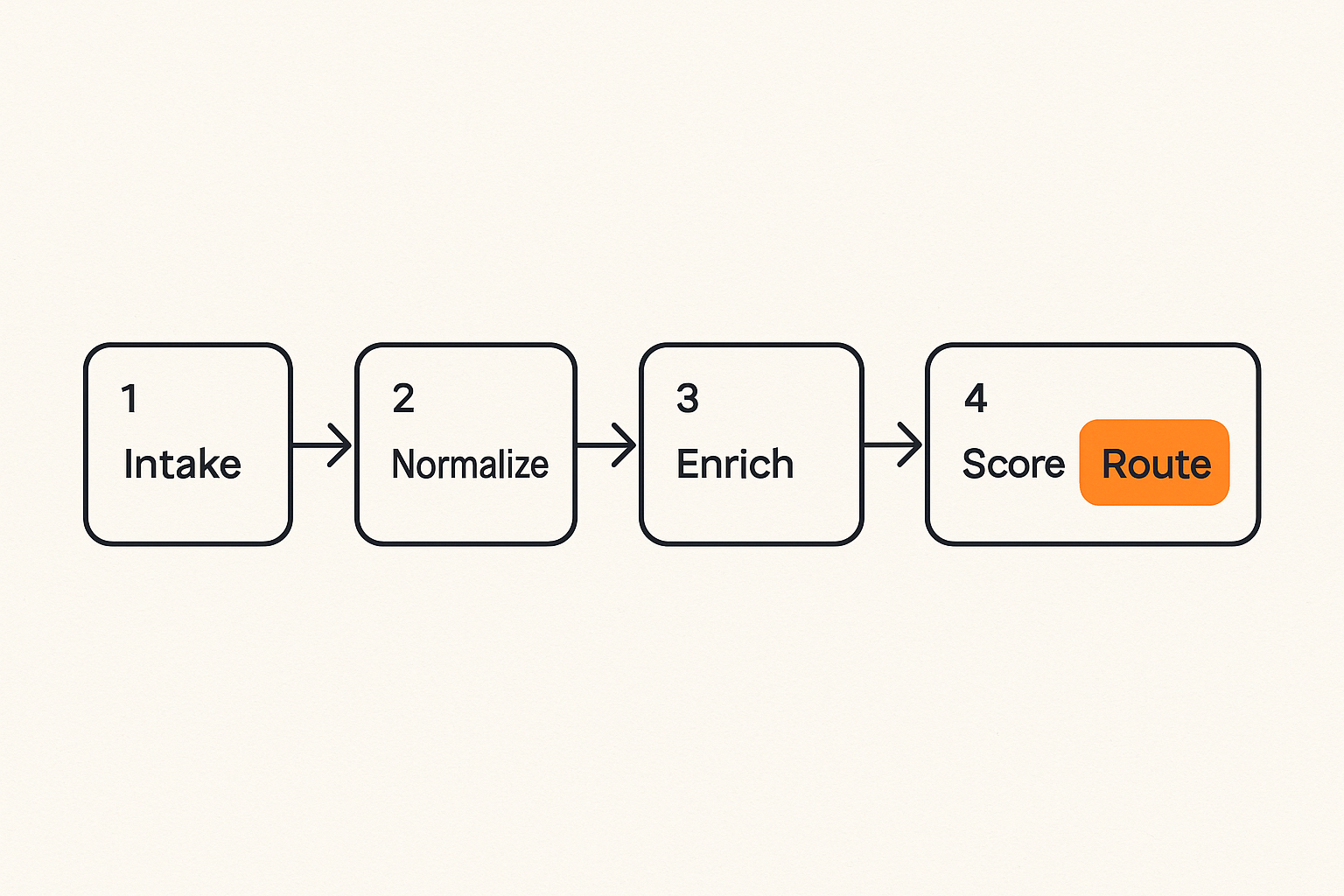
Normalize content before analysis
AI content threat detection breaks quickly when every channel sends different fields. Normalize first.
For email, parse headers, body, attachments, URLs, sender authentication, and recipient groups. For chat, capture workspace, channel, sender identity, message thread, links, files, and reactions. For web forms, capture source IP, user agent, form fields, uploaded files, and account context. For public content, capture URL, author handle, timestamps, screenshots, and page metadata.
Normalize into a common event shape:
event_type: content_risk_observation
source_channel: email
observed_at: 2026-06-04T14:31:00Z
actor:
  claimed_identity: vendor_ap_team
  verified_identity: unknown
target:
  user: finance.ap@example
  business_unit: finance
content:
  text_ref: object_store://case-884/body.txt
  entities: [domain, url, invoice_id]
  requested_action: change_payment_details
metadata:
  auth_result: dmarc_fail
  attachment_count: 1
The schema does not need to be perfect on day one. It needs to be stable enough for enrichment, correlation, and response.
Preserve evidence and metadata
Do not let normalization destroy the evidence. Analysts and incident responders may need the original email, headers, attachments, screenshots, transcripts, or page captures.
Preserve:
- raw message or source object
- parsed text
- extracted entities
- original timestamps
- channel-specific IDs
- attachment hashes and copies where policy allows
- screenshots or rendered views for public pages
- enrichment history and model versions
This matters for legal, HR, executive impersonation, vendor fraud, and post-incident review. It also matters for tuning. If you cannot reproduce why a detection fired, you cannot improve it safely.
A practical implementation sequence
A working pipeline can be built in stages:
- Choose the first channel. Start with reported phishing, finance vendor-change emails, or public impersonation reports. Pick a channel with clear ownership.
- Define the event schema. Standardize fields for content, sender, recipient, channel, entities, attachments, and requested action.
- Extract entities. Pull URLs, domains, files, hashes, emails, names, phone numbers, wallet addresses, invoice numbers, and account references.
- Run layered analysis. Apply intent extraction, entity reputation, relationship checks, infrastructure enrichment, and optional AI-authorship scoring.
- Cluster duplicates. Group similar messages, shared infrastructure, repeated lures, and common targets.
- Score risk. Combine content risk, identity risk, delivery risk, target sensitivity, and requested action.
- Route cases. Send high-risk cases to the SOC, finance fraud, legal, brand protection, or IT depending on the action path.
- Capture analyst outcome. Store true positive, benign, policy violation, duplicate, and unresolved outcomes for tuning.
This sequence keeps the first deployment grounded. You can add channels later without redesigning the entire workflow.
Scoring, triage, and escalation
Risk equals content plus sender plus path plus action
A useful scoring model is simple enough to explain and flexible enough to tune.
Example scoring dimensions:
risk_score:
  content_intent: 0-30
  identity_mismatch: 0-25
  infrastructure_reputation: 0-20
  target_sensitivity: 0-15
  campaign_correlation: 0-10
A score like this is not magic. It is a way to force consistent thinking. The SOC can tune weights based on business risk. Finance impersonation may get a higher target sensitivity weight. Public brand abuse may weight reach and executive identity more heavily.
The mistake teams make is hiding all logic inside an opaque model. Analysts need to know why a case is high priority.
Severity should map to decisions
Severity levels should map to actions, not adjectives.
For example:
- Low: log, cluster, no analyst interrupt unless repeated
- Medium: analyst review during normal queue handling
- High: block or quarantine where safe, open case, notify owner
- Critical: contain active account or domain risk, page incident responder, preserve evidence, start stakeholder notifications
This reduces argument during incidents. If a synthetic CFO impersonation is sent to finance with a lookalike domain and a bank-change request, it should not wait in a generic suspicious-content queue.
Queues need ownership
AI content threats often cross team boundaries. Email security owns the gateway. SOC owns triage. Finance owns payment validation. Legal owns takedowns. Communications owns public statements. HR owns recruiting impersonation. IT owns account compromise.
If ownership is unclear, cases stall.
Define routing rules early:
- credential or malware path goes to SOC and IT
- payment or vendor-change path goes to finance fraud process
- executive public impersonation goes to legal or brand protection with SOC context
- employee data leakage goes to security, privacy, and the relevant business owner
- internal AI misuse goes to security governance or policy owner
The SOC should not become the permanent owner of every suspicious paragraph. It should own detection, enrichment, correlation, and security response coordination.
Response playbooks for synthetic content threats
Phishing and business email compromise
For phishing and BEC, AI raises the quality of the lure but the response still follows known patterns.
Useful playbook steps:
- quarantine or remove messages where safe
- block domains, URLs, hashes, and sender infrastructure
- search for similar messages across mailboxes and collaboration tools
- identify users who clicked, replied, downloaded, or approved
- reset credentials or revoke sessions if needed
- validate whether payments, vendor details, or access changes occurred
- notify affected users with specific guidance
- update detection rules and awareness examples
The key difference is clustering. AI-generated campaigns can produce many variations of the same lure. Exact-match searches miss them. Use semantic similarity, shared entities, infrastructure, and requested action.
Executive impersonation and brand abuse
Executive impersonation is not always a malware problem. It may be a trust and reputation problem. Fake statements, synthetic interviews, cloned profiles, and fabricated announcements can trigger customer confusion or internal escalation.
The SOC role is to establish technical facts:
- where the content appeared
- who posted or distributed it
- whether company accounts were compromised
- whether domains, profiles, or infrastructure imitate the organization
- whether employees or customers interacted with it
- whether the content links to credential theft, payment fraud, or malware
Then route to legal, communications, platform abuse teams, and leadership support. The response may involve takedown requests, public clarification, domain blocking, internal advisories, and executive protection monitoring.
Internal AI misuse and data exposure
AI content threat detection also applies inside the organization. Employees may paste sensitive data into external AI tools, generate code with secrets, or publish AI-assisted content that includes confidential details.
Treat this as a security workflow, not a morality play. The goal is to reduce exposure and guide safe use.
Detection sources may include:
- DLP events involving AI domains
- browser or proxy logs
- SaaS audit logs
- code repository secret scanning
- internal chatbot logs where policy allows
- document publishing workflows
Response should distinguish between accidental exposure, policy misunderstanding, malicious exfiltration, and compromised accounts. Those require different actions.
Validation and measurement
Build a test corpus that reflects your business
Generic benchmark data is not enough. Build a test corpus from your environment.
Include:
- real reported phishing samples
- known benign vendor and customer messages
- internal executive communications
- finance workflow examples
- HR recruiting conversations
- public brand mentions and impersonation examples
- AI-assisted legitimate content from approved workflows
- synthetic attack simulations created by the detection team
Label by outcome, not just authorship. Labels like malicious, benign, policy violation, duplicate, needs business review, and unknown are more useful than AI and human.
Keep the corpus versioned. When the model, parser, enrichment logic, or scoring weights change, rerun tests and compare operational impact.
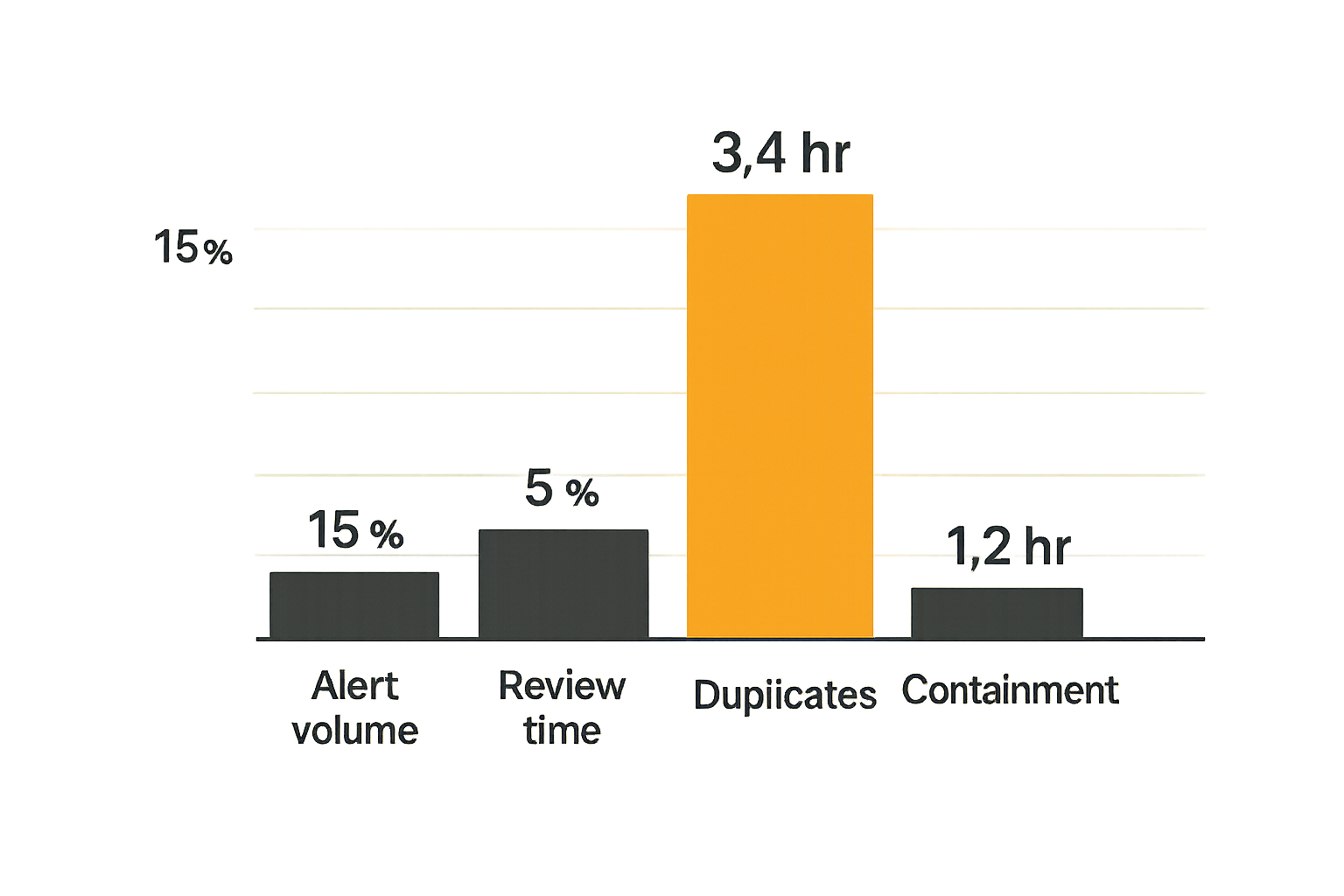
Measure analyst burden, not model vanity
Accuracy metrics matter, but they are not enough. A classifier can look good in isolation and still create operational pain.
Track metrics that reflect SOC reality:
- alert volume by channel and severity
- analyst review time per case
- duplicate reduction from clustering
- false positive rate by business unit
- false negative findings from incident retrospectives
- time from observation to containment
- percentage of cases routed to the right owner first time
- number of cases closed automatically with safe logic
The practical question is whether the workflow helps analysts make better decisions faster. If not, the model score is decoration.
Tune with closed-loop feedback
Closed-loop feedback means analyst outcomes directly improve the pipeline. When an analyst marks a case as benign vendor communication, the system should learn from the relationship, not just suppress the exact message. When an analyst confirms a BEC lure, the system should search for similar content, infrastructure, and targets.
Feedback should update:
- allowlists and denylists
- sender relationship models
- lure templates and similarity clusters
- severity weights
- routing rules
- user and department risk context
- response automation thresholds
Do this carefully. A single bad analyst disposition should not suppress a real campaign. Use review rules for broad suppressions.
Common failure modes
The standalone detector trap
The most common failure is buying or building a detector that produces AI-likelihood scores with no workflow around them.
What breaks in practice:
- analysts receive alerts with no business context
- legitimate AI-assisted content creates noise
- attackers evade by editing or shortening content
- security cannot explain why action was taken
- response teams still need to manually inspect links, senders, and targets
A detector without enrichment is a queue generator. It may feel modern, but it does not reduce risk by itself.
No policy for borderline content
Some cases will be ambiguous. A message may be synthetic but benign. A public post may be false but not security-relevant. An employee may use an AI tool in a way that violates policy but does not create incident-level risk.
If there is no policy, the SOC becomes the policy engine. That is unfair and inconsistent.
Define categories:
- security incident
- fraud risk
- brand or legal issue
- acceptable AI-assisted content
- policy violation without active compromise
- user education opportunity
- no action
Then map each category to owners and response steps.
Automation without containment logic
Automation can help, but unsafe automation creates new incidents. Blocking every AI-looking email from vendors can break business. Auto-posting public corrections can create legal problems. Auto-deleting internal messages can destroy evidence.
Use automation where the containment logic is clear:
- enrich entities automatically
- cluster duplicates automatically
- search for similar messages automatically
- quarantine known malicious attachments and URLs under existing policy
- open tickets with prefilled context
- notify owners using approved templates
Require human approval for actions with business, legal, or reputational impact unless you have very mature controls.
Practical rule: Automate context collection before you automate judgment. The first win is reducing analyst lookup work, not replacing incident ownership.
Closing the loop on AI content threat detection
Integration criteria for security teams
AI content threat detection should plug into the systems your SOC already uses. If it lives outside the alerting, case management, identity, email, and threat intelligence workflow, it will become another dashboard that nobody checks during an incident.
Look for capabilities that support:
- channel ingestion from email, collaboration, web, and public sources
- entity extraction and enrichment
- identity and relationship context
- campaign clustering across variations
- explainable scoring
- case routing and ownership
- evidence preservation
- response automation with guardrails
- analyst feedback loops
- reporting on operational outcomes
The architecture matters more than the label. Some organizations will implement this with SIEM, SOAR, email security, threat intel, and custom pipelines. Others will use a platform that connects more of the loop. The important part is that content risk becomes actionable security context.
Where ThreatCrush fits
ThreatCrush is built for security operations teams that need to connect signals, workflows, and response. AI content threat detection fits that pattern because the hard part is not spotting suspicious language. The hard part is correlating content with identity, infrastructure, targeting, and active response.
A useful product fit looks like this:
- suspicious content enters from a monitored channel or analyst report
- entities are extracted and enriched
- related observations are clustered
- risk is scored with context
- the right owner receives the case
- containment and follow-up actions are tracked
- analyst outcomes improve future detection
That is the loop teams should optimize. If synthetic content creates more alerts but not better decisions, the program is failing.
The closing point is simple: AI content threat detection should make the SOC faster, not busier. Treat it as architecture, not a magic detector, and the work becomes much more manageable.
Try threatcrush.com
ThreatCrush helps security teams connect detection signals, triage workflows, and response context so AI content threat detection becomes operational instead of noisy. Try threatcrush.com.
Try ThreatCrush
Real-time threat intelligence, CTEM, and exposure management — built for security teams that move fast.
Get started →