ADT Security for SOC Teams: The Alert Detection and Triage Architecture Guide
ADT security sounds simple until the SOC is drowning in alerts that all claim to be urgent. The queue grows, analysts burn time opening five consoles per case, and leadership asks why the expensive detection stack still misses obvious attack chains.
Teams think the problem is more detection coverage. The real problem is alert detection and triage architecture: how signals become decisions, how context moves with the alert, and how ownership survives the handoff from detection to response.
That changes the conversation. ADT security is not just a product label or a dashboard view. For a SOC, it is the operating model that decides whether a suspicious event becomes noise, a validated incident, or a missed compromise.
The practical question is not whether you have alerts. You do. The practical question is whether your ADT security workflow can convert raw detection into prioritized, explainable, and actionable work before the attacker finishes the next step.
Table of contents
- ADT Security Is Not a Tool Category
- What ADT Security Must Do in a SOC
- The ADT Security Data Model
- Build the ADT Security Workflow
- What Works vs What Fails in ADT Security
- Detection Engineering for ADT Security
- Automation Without Losing Control
- Metrics That Prove ADT Security Is Working
- Ownership, Handoffs, and Escalation
- Product Fit: Where ThreatCrush Belongs in ADT Security
- Closing: Make ADT Security Measurable
ADT Security Is Not a Tool Category

The search term hides an operating problem
In a SOC context, ADT security is best treated as alert detection and triage security. Some people will associate the phrase with physical alarm systems. That is not the workflow problem this article is solving. For SOC engineers, the useful interpretation is the system that turns telemetry, detections, enrichment, analyst judgment, and response actions into a controlled operating loop.
The mistake teams make is buying another alert surface and calling it a triage upgrade. A new console can expose more signals, but it does not automatically decide priority, suppress duplicates, preserve evidence, or route work to the team that can act.
A useful way to think about it is this: ADT security is the connective tissue between detection engineering and incident response. If that tissue is weak, good rules still create bad operations.
Why the old alert queue model breaks
The old model is linear: a tool fires, an alert lands in a queue, an analyst opens it, then the analyst decides what to do. That model breaks when the same campaign produces endpoint alerts, identity anomalies, cloud events, vulnerability exposure, and threat intelligence hits at the same time.
What breaks in practice is not just analyst capacity. The alert loses meaning as soon as it is separated from related entities. A suspicious login is one thing. A suspicious login from a host with an exposed critical vulnerability, recent malware telemetry, and a newly observed command-and-control domain is another.
Practical rule: Do not treat alert volume as the primary ADT security problem. Treat disconnected context as the primary problem, because disconnected context creates both noise and misses.
The SOC outcome that matters
The outcome is not fewer alerts by itself. Fewer alerts can mean better tuning, or it can mean blindness. The outcome is faster, more accurate decisions with evidence attached.
A working ADT security architecture should answer four questions quickly:
- Is this alert credible?
- What asset, identity, workload, or user is affected?
- What is the likely attack path or business impact?
- Who owns the next action?
If the workflow cannot answer those questions, the SOC does not have a triage system. It has an alert inbox.
What ADT Security Must Do in a SOC
Detect with enough context to triage
Detection without triage context creates analyst debt. Every missing field becomes a manual lookup. Every manual lookup increases time to decision and increases the chance that two analysts interpret the same signal differently.
At minimum, each alert should carry:
- Source system and detection rule
- Entity identifiers such as host, user, IP, container, service, or application
- Timestamp and event window
- Severity and confidence, separated from each other
- Known related alerts or correlated events
- Initial enrichment results
- Recommended next action or investigation path
Severity is not confidence. A high-impact asset with weak evidence should not be handled the same way as a medium-impact asset with strong attacker infrastructure correlation. Separating those fields makes prioritization less political.
Route alerts to the right owner
ADT security fails when routing is an afterthought. Identity alerts may require IAM ownership. Cloud workload alerts may require platform engineering. Endpoint containment may require IT operations. Application abuse may involve product security or fraud teams.
The routing decision should be based on alert state, affected entity, and required action, not on whichever tool produced the signal. A cloud detection involving leaked credentials might originate in the SIEM, but the owner may be IAM plus incident response.
For a deeper architecture view on connected investigation paths, the ThreatCrush guide to threat analysis workflows that actually work is a useful companion because it treats analysis as a workflow rather than a checklist.
Preserve the investigation trail
A triage decision without evidence is just an opinion. If an analyst suppresses, escalates, merges, or closes an alert, the reason must remain attached to the case. That history helps with audits, detection tuning, and post-incident review.
The practical format can be simple:
alert_key: source + rule_id + asset + entity
state: new | enriched | investigating | escalated | contained | closed
reason: analyst or automation rationale
confidence: low | medium | high
evidence: event_ids + enrichment_refs + notes
owner: team or person
next_action: required step
This is not bureaucracy. It is how a SOC avoids rediscovering the same facts every shift.
The ADT Security Data Model
Normalize the alert before enrichment
Normalization sounds boring until you try to correlate endpoint, identity, DNS, vulnerability, and cloud alerts with inconsistent names for the same entity. One tool says hostname. Another says device_name. Another has instance_id. Another has userPrincipalName.
The first ADT security design decision is the canonical alert schema. Normalize before enrichment so every downstream system can rely on stable fields. If enrichment happens against inconsistent entities, you will enrich the wrong thing and create false confidence.
Core normalized fields should include:
- Alert ID and deduplication key
- Rule ID and rule version
- Entity type and entity ID
- Detection source
- Event time and ingestion time
- Severity, confidence, and priority
- Tenant, environment, and business unit
- Current state and owner
Attach business context early
Security context is not enough. The SOC needs business context early in triage: asset criticality, data classification, internet exposure, crown-jewel mapping, owner team, deployment environment, and known exceptions.
A low-severity detection on a domain controller, payment service, or production identity provider is not low priority. A high-severity detection on a retired lab host may be less urgent than it appears.
Related reading from our network: teams building transaction systems face a similar state and reconciliation problem in crypto payments architecture, where the UI is only the visible part and the real work is state, settlement, retries, and trust boundaries.
Make state explicit
Most SOC tooling stores events. Fewer teams model alert state cleanly. State matters because it prevents duplicate work and unsafe automation.
Useful states include:
- New
- Enriched
- Suppressed by policy
- Awaiting owner
- Under investigation
- Escalated
- Containment requested
- Contained
- Resolved benign
- Resolved malicious
- Reopened
Practical rule: If your ADT security workflow does not model state, analysts will model it in comments, spreadsheets, chat threads, and memory. That is where investigations go to fragment.
Build the ADT Security Workflow
A practical implementation sequence
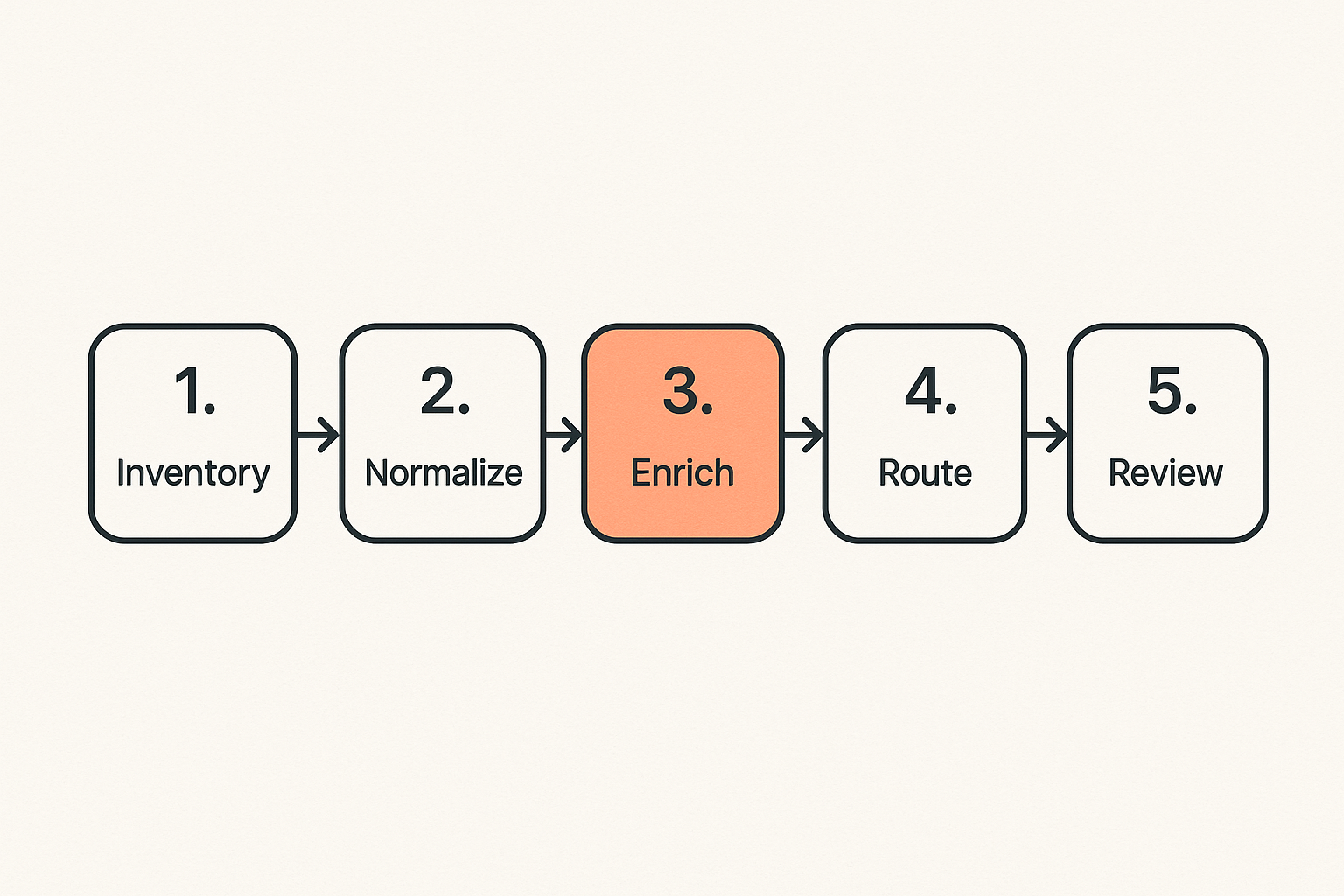
Do not start by automating response. Start by making the workflow observable and repeatable. A practical rollout sequence looks like this:
- Inventory alert sources and list the top alert types by analyst time, not just count.
- Define a normalized alert schema and require source systems to map into it.
- Create deduplication keys for repeated alerts on the same entity and behavior.
- Add enrichment for asset criticality, identity context, vulnerability exposure, and threat intelligence.
- Define triage states and allowed transitions.
- Assign ownership rules based on entity type and required action.
- Add analyst decision templates for close, escalate, suppress, and contain.
- Automate evidence collection for common cases.
- Automate low-risk response actions with approval gates.
- Review outcomes weekly with detection engineering and incident response.
The order matters. If you automate before you understand state and ownership, you just move confusion faster.
Where automation belongs
Automation belongs where the task is repetitive, evidence-based, and reversible or low risk. Pulling endpoint process trees, resolving IP reputation, checking whether a user is privileged, collecting cloud audit context, and attaching recent vulnerability exposure are good candidates.
Automation should reduce analyst search time. It should not hide uncertainty. If enrichment fails, the alert should say enrichment failed rather than pretending the entity is clean.
Where humans must stay in the loop
Humans should remain in the loop for judgment-heavy actions: declaring an incident, containing a production system, disabling a privileged account, notifying legal, or escalating to executives.
The goal is not to remove analysts. The goal is to stop wasting analyst judgment on copy-paste work. An analyst should spend time deciding whether the evidence indicates compromise, not hunting through tabs to find the same metadata every time.
What Works vs What Fails in ADT Security
What works in production
What works is boring in the best way: stable schemas, consistent routing, high-quality enrichment, clear state transitions, and feedback loops that improve detections.
Successful ADT security programs usually have a few visible traits:
- Analysts trust the core fields on the alert.
- Detections include expected investigation steps.
- Owners are assigned by rule, not by hallway knowledge.
- Suppression requires a reason and expiration.
- False positives become rule changes, not permanent analyst folklore.
- Escalations include evidence packages, not vague urgency.
Practical rule: A good ADT security workflow should make the next right action obvious for common cases and make uncertainty explicit for uncommon cases.
What fails under pressure
What fails is the everything queue. Every alert, from every tool, lands in the same place with inconsistent severity and no ownership. Analysts sort by vendor severity because there is no better priority model. Cases get escalated through chat because the ticket lacks context.
The first major incident exposes the weakness. Duplicate alerts flood the queue. Automation takes actions without understanding maintenance windows. The incident commander asks for a timeline, and no one can reconstruct which alerts were related, suppressed, or ignored.
This is why ADT security should be designed as an operating system for alert decisions, not a cosmetic layer on top of SIEM output.
The comparison operators should use
| Area | Weak ADT security | Strong ADT security |
|---|---|---|
| Alert schema | Source-specific fields | Normalized canonical fields |
| Priority | Vendor severity only | Severity plus confidence plus business impact |
| Enrichment | Manual lookups | Automatic evidence collection with failure visibility |
| Ownership | Analyst judgment each time | Routing rules tied to entity and action |
| State | Comments and chat | Explicit lifecycle states |
| Automation | One-off scripts | Controlled playbooks with approvals and rollback |
| Feedback | Ad hoc tuning | Scheduled detection review from outcomes |
This table is not theoretical. It is the difference between a SOC that can absorb a campaign and a SOC that turns a campaign into a coordination crisis.
Detection Engineering for ADT Security
Write detections for decisions
A detection rule should not only say what happened. It should explain why the SOC should care and what the analyst should check next. That means detection engineering needs to include triage intent.
A useful detection package includes:
- Detection logic
- Assumptions and known blind spots
- Expected false positive patterns
- Required data sources
- ATT&CK technique or behavior mapping where useful
- Suggested enrichment
- Triage questions
- Escalation criteria
The mistake teams make is treating detection content as finished when the query returns results. In ADT security, a detection is not finished until the alert can be triaged consistently.
Version rules and assumptions
Rules change. Data sources change. Attackers change. If an alert cannot tell you which rule version fired, you cannot reliably compare current outcomes to past outcomes.
Version detection logic and document assumptions. If a rule expects complete endpoint telemetry but the EDR agent is missing from 15 percent of workstations, the triage record should expose that coverage gap. Otherwise analysts may treat absence of evidence as evidence of absence.
Application and pipeline signals create their own ownership problems. The ThreatCrush guide on DevSecOps and application security for SOC teams covers that adjacent issue: appsec alerts only help the SOC when ownership, signal quality, and response paths are designed together.
Test detections against triage reality
Detection tests should include analyst workflow tests. Ask:
- Does the alert include enough entity context?
- Can the analyst validate the behavior in under a defined time target?
- Does the detection create duplicate cases during normal attacker activity?
- Does the escalation path know what to do with it?
- Can the rule be tuned without suppressing real attacks?
If the answer is no, the detection may be technically correct and operationally weak.
Automation Without Losing Control
Automate collection before action
Collection automation is usually safer than response automation. Pull the evidence first: process lineage, parent-child relationships, identity risk, recent logins, DNS history, file reputation, cloud role changes, vulnerability exposure, and known threat infrastructure.
This gives analysts a prepared case file. It also gives automation a chance to fail harmlessly. If a lookup times out, the system can mark the enrichment as unavailable and continue the investigation.
Use idempotent response steps
Response automation should be idempotent where possible. Running the same playbook twice should not double-disable accounts, duplicate firewall blocks, or create contradictory tickets.
Design response steps with guards:
- Check current state before action.
- Record action IDs and timestamps.
- Avoid duplicate containment requests.
- Require approval for destructive or business-impacting steps.
- Expire temporary blocks and suppressions.
Related reading from our network: scaling teams in software operations run into the same control problem, where growth breaks releases and support unless the operating workflow is explicit; see scaling a software product for the adjacent operator view.
Design rollback paths
Every automated action needs a rollback path or a clear statement that rollback is not possible. Blocking an IP is reversible. Disabling a user may be reversible but disruptive. Isolating a production host may create business impact. Deleting infrastructure is not normal SOC triage and should require a separate incident authority model.
The practical question is not whether automation is good or bad. The practical question is whether the action is appropriate for the confidence level, asset criticality, and blast radius.
Metrics That Prove ADT Security Is Working
Measure decision latency
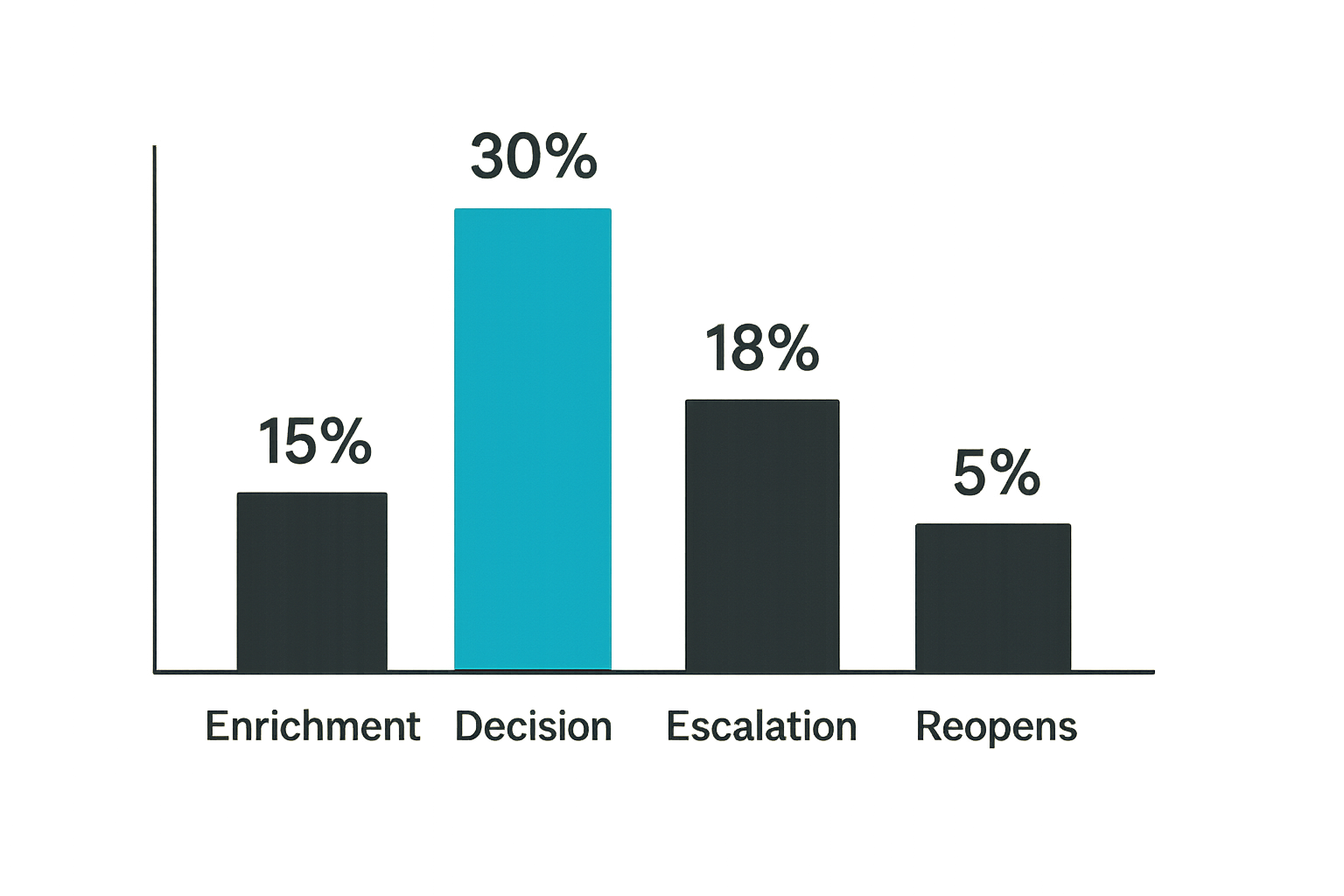
Mean time to detect is useful, but ADT security needs decision latency: the time between alert creation and a confident decision. That decision may be close benign, escalate, merge, suppress, contain, or reopen.
Measure decision latency by alert class. Credential theft alerts, malware alerts, cloud privilege alerts, and vulnerability exploitation alerts should not be averaged into one meaningless number. Each has different evidence requirements and owners.
Useful latency metrics include:
- Time to enrichment complete
- Time to analyst open
- Time to first decision
- Time to escalation accepted
- Time to containment requested
- Time to closure with reason
Measure alert quality
Alert quality is not just false positive rate. A low false positive rate with poor context can still be expensive. Measure whether alerts arrive with the fields analysts need.
Track:
- Percentage of alerts with complete entity mapping
- Percentage with asset owner attached
- Percentage with business criticality attached
- Percentage with related alerts linked
- Percentage with clear triage guidance
- Percentage reopened after closure
If reopened cases increase, you may have a triage quality problem. If suppressions grow without expiration, you may be creating blind spots.
Measure handoff loss
Handoff loss is the gap between one team saying action is required and the next team actually accepting ownership. SOCs often lose time here. The ticket is assigned, but the owner lacks evidence. The owner pushes back. The SOC adds screenshots. The attacker keeps moving.
Track escalation acceptance time and rejection reasons. If the same team rejects the same alert class repeatedly, fix the evidence package or the routing rule. Do not blame the queue.
Related reading from our network: local coordination has similar routing and follow-up constraints, and community action as local network infrastructure is a useful non-security analogy for why trust, routing, and follow-through matter.
Ownership, Handoffs, and Escalation
Define who owns the alert state
Someone must own alert state. Not the tool. Not the shift channel. A team. Usually the SOC owns alert state until an incident is declared or a response owner accepts a specific action. After that, incident command or the response team owns the action while the SOC maintains detection visibility.
Write this down. If ownership is implicit, it will fail during shift changes, weekends, and high-severity incidents.
A simple ownership model:
- SOC owns triage state and evidence quality.
- Detection engineering owns rule quality and tuning.
- Incident response owns declared incident coordination.
- IT or platform teams own containment actions in their environments.
- Asset owners provide business impact and recovery constraints.
Escalate with evidence, not anxiety
Escalation should include the minimum evidence needed for the next owner to act. That usually means affected entity, observed behavior, why it matters, confidence, recommended action, deadline, and blast radius.
Bad escalation says: suspicious activity on server, please investigate.
Good escalation says: production host payment-api-03 executed encoded PowerShell from a service account, contacted a newly observed domain, and has a critical internet-facing exposure. SOC confidence is high. Request containment approval or owner validation within 15 minutes.
The second version changes the conversation. It gives the owner a decision, not a mystery.
Close the loop with detection engineering
Every closed alert is training data for the detection program. False positive because of backup software? Add a scoped exception with expiration. True positive but low severity? Fix priority logic. Escalation rejected because evidence was incomplete? Add enrichment.
The loop should be scheduled, not accidental. Weekly review of high-cost alert classes is often more useful than broad monthly dashboards. Bring SOC analysts, detection engineers, and response owners into the same review so tuning decisions include operational reality.
Product Fit: Where ThreatCrush Belongs in ADT Security
Use threat intelligence as triage infrastructure
Threat intelligence is often bolted on as a score next to an indicator. That is too shallow. In ADT security, threat intelligence should function as triage infrastructure: enriching indicators, connecting infrastructure to known campaigns, tracking vulnerability exploitation, and helping analysts decide whether a signal is routine noise or part of a live threat.
The useful question is not whether an IP is bad in isolation. The useful question is whether the IP, domain, file, exploit, identity behavior, and exposed asset create a credible path to impact.
Connect proactive and reactive work
Many teams keep proactive exposure management and reactive SOC triage in separate systems. That separation hurts. If an alert fires on an asset with a known exploitable vulnerability and active threat actor interest, the SOC should know immediately. If threat intelligence identifies infrastructure targeting your sector, detection engineering should know which rules and logs to validate.
ThreatCrush is designed for security operations professionals building and scaling SOC capabilities, with real-time threat feeds, vulnerability tracking, attack surface monitoring, and threat actor intelligence connected into the way teams investigate and prioritize work. The ThreatCrush documentation is the right place to look when you are mapping integrations into an existing SOC workflow.
Keep the stack smaller than the workflow
The mistake teams make is letting the tool stack become larger than the workflow. Every additional product needs integration, ownership, data mapping, access control, tuning, and support. If a tool does not improve decision quality or reduce operational drag, it may be adding surface area rather than capability.
A good ADT security architecture can use multiple systems, but it should feel like one workflow: detect, enrich, decide, route, respond, validate, learn.
Closing: Make ADT Security Measurable
The operating standard
ADT security should be judged by operational standards, not slideware. Can analysts trust the alert fields? Can they see related context? Can they make a decision quickly? Can owners act from the escalation package? Can detection engineering learn from the outcome?
If the answer is yes, the SOC gets faster without becoming reckless. If the answer is no, more alerts will not help. More dashboards will not help. The workflow is the system.
The practical standard for 2026 is clear: ADT security must connect detection, context, ownership, automation, and feedback into one measurable operating loop. Anything less is just another queue.
Try threatcrush.com
threatcrush.com is for security operations professionals building and scaling SOC capabilities. If you are tightening ADT security around threat intelligence, exposure context, and faster triage, Try threatcrush.com.
Try ThreatCrush
Real-time threat intelligence, CTEM, and exposure management — built for security teams that move fast.
Get started →