ADT Home Security as a SOC Architecture Model: What Enterprise Teams Should Actually Copy

ADT home security is not a SOC platform. It is not an enterprise detection stack. But the operating model behind it is useful because it exposes a problem security teams still struggle with in 2026: sensors are easy to install, but trusted response is hard to operate.
Teams think the problem is buying more detection coverage. The real problem is building a workflow where signals become decisions, decisions become actions, and actions are validated.
That changes the conversation. If you look at ADT home security only as cameras, door sensors, and alarm panels, the analogy is shallow. If you look at it as a monitored system with escalation paths, ownership boundaries, false alarm handling, and response expectations, it becomes a practical architecture pattern for SOC teams.
The practical question is not whether a SOC should copy consumer alarm systems. It should not. The practical question is what enterprise security operations can learn from a model that assumes sensors fail, people miss alerts, context matters, and response has to be coordinated.
Table of contents
- Why ADT home security matters to SOC architecture
- Translate the alarm model into SOC workflow
- Build a layered detection architecture, not a pile of tools
- Design the triage workflow before buying more signals
- Ownership and escalation are the real control surface
- Common failure modes when teams copy the wrong model
- What works: validation, metrics, and continuous tuning
- Integrations: make SOC systems share state
- Where ThreatCrush fits in an ADT home security-inspired SOC
Why ADT home security matters to SOC architecture

Consumer security is a useful analogy
A useful way to think about it is this: a home security system is not valuable because a magnetic sensor exists on a door. It is valuable because the sensor participates in a monitored workflow. It has a normal state, an abnormal state, an owner, a response path, and a way to decide whether the event matters.
That is exactly where many SOC programs get messy. They have endpoint telemetry, identity logs, cloud detections, network events, vulnerability data, and threat intelligence. But those signals often land in different queues with different owners and inconsistent escalation logic.
The mistake teams make is treating detection coverage as the outcome. Coverage is only an input. If a signal cannot be understood, routed, acted on, and validated, it is not coverage in any operational sense.
ADT home security is useful as a metaphor because it forces simple questions:
- What are we sensing?
- What state changed?
- Who is watching?
- What happens next?
- How do we distinguish normal activity from an emergency?
- How do we avoid waking everyone up for noise?
Those are SOC architecture questions, not consumer security questions.
The control plane matters more than the sticker
The visible part of home security is the device: keypad, camera, siren, yard sign. The important part is the control plane: event routing, monitoring rules, customer contact order, emergency escalation, account context, and maintenance state.
Enterprise teams have the same split. The visible part is the SIEM dashboard or EDR console. The important part is the operational control plane behind it:
- Asset ownership
- Business criticality
- Identity context
- Detection state
- Suppression logic
- Escalation rules
- Response authority
- Evidence retention
- Post-incident feedback
Practical rule: If a detection does not have an owner, escalation path, and validation method, it is not production-ready. It is a sensor making noise.
This is why SOC maturity is rarely about the number of tools. It is about whether the tools share enough state for an analyst or automation to make a defensible decision.
Translate the alarm model into SOC workflow
Sensors are not detections
Door contacts, glass-break sensors, motion detectors, and cameras are not the same as monitored security. They are inputs. A home alarm becomes useful when multiple inputs are normalized into a small number of operational states: armed, disarmed, triggered, verified, bypassed, faulted.
SOC teams need the same discipline. A raw event is not a detection. A detection should encode intent, scope, confidence, and expected action.
| Alarm system concept | SOC equivalent | What breaks when ignored |
|---|---|---|
| Door sensor | Endpoint or identity event | Raw activity floods the queue |
| Armed mode | Detection enabled for a business context | Rules fire during known maintenance |
| Bypass zone | Approved suppression | Analysts ignore repeated false positives |
| Monitoring center | SOC triage function | Alerts wait without ownership |
| Contact list | Escalation matrix | Incidents stall after initial triage |
| Verified alarm | Correlated high-confidence case | Response teams do not trust alerts |
The table is intentionally simple. The point is not to turn enterprise operations into a consumer alarm panel. The point is to separate signal generation from operational decision-making.
What breaks in practice is that teams connect every available telemetry source to a SIEM and call the result detection coverage. Then they wonder why analysts do not trust the queue.
Monitoring is not response
Monitoring means somebody or something observes the state change. Response means the organization can take action within an agreed boundary.
Those are different capabilities.
A SOC can have excellent monitoring and weak response if analysts can see suspicious behavior but cannot disable accounts, isolate hosts, block indicators, or reach system owners. A SOC can also have aggressive response tooling but weak monitoring if automation triggers on poorly understood signals.
The practical question is: what decision is the alert supposed to support?
Good detection logic should answer:
- Is this event expected or unexpected?
- Is the affected asset important?
- Is the actor known, trusted, suspicious, or unknown?
- What evidence supports escalation?
- What response action is safe?
- What human approval is required?
Related reading from our network: teams thinking about SOC workflows as shipped capabilities rather than loose tasks may find security operations product management useful, because ownership and backlog discipline matter as much as tooling.
Build a layered detection architecture, not a pile of tools
Perimeter, identity, endpoint, cloud, and application
Home security works best when multiple sensor types confirm or challenge each other. A door opens. Motion follows. A camera sees movement. The system now has a stronger story than any single sensor could provide.
Enterprise detection should work the same way. A suspicious login becomes more meaningful when paired with endpoint behavior, cloud control plane activity, abnormal data access, or known infrastructure overlap.
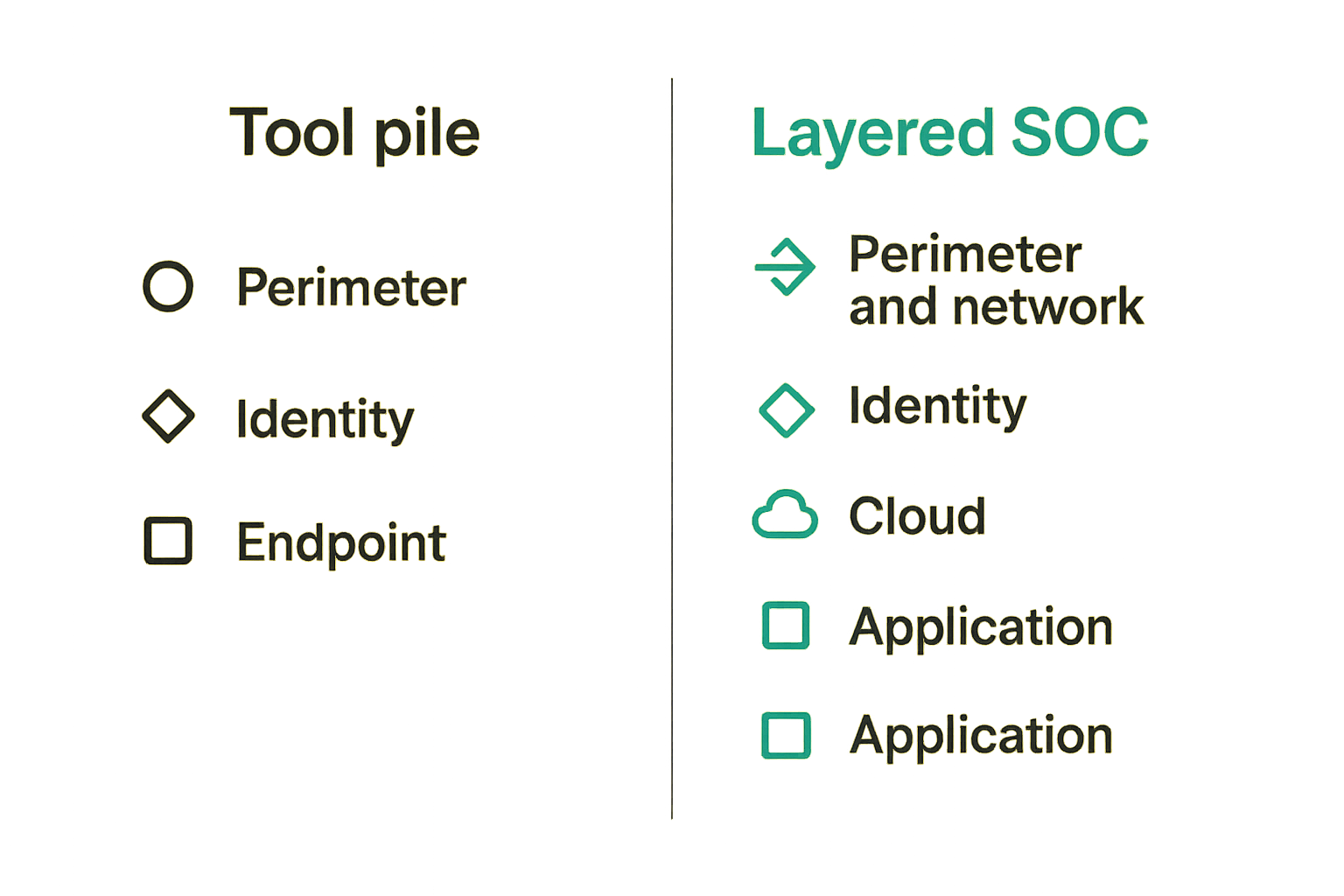
The layers usually look like this:
- Perimeter and network: ingress, egress, DNS, proxy, firewall, VPN, lateral movement paths.
- Identity: authentication patterns, privilege changes, impossible travel, MFA fatigue, service account misuse.
- Endpoint: process lineage, persistence, credential access, script execution, memory activity.
- Cloud: API calls, role assumptions, storage exposure, workload changes, control plane events.
- Application: admin actions, sensitive object access, abuse of business logic, suspicious transactions.
The mistake teams make is buying one product per layer and assuming the architecture is complete. Layers are useful only when their signals can be correlated around the same asset, user, workload, or business process.
A detection architecture should make it easy to answer: are these separate alerts, or one incident seen from multiple angles?
Evidence quality beats alert volume
More alerts do not mean better detection. They often mean the SOC has not decided what evidence is required before interrupting a human.
A practical pattern is to assign detections an evidence class:
- Observation: interesting but not actionable alone.
- Suspicion: abnormal activity requiring enrichment.
- Confirmation: multiple signals indicate likely malicious activity.
- Impact: evidence suggests compromise, data access, privilege abuse, or business risk.
This helps analysts and automation make better decisions. Observations can feed baselines or hunting. Suspicion can trigger enrichment. Confirmation can open an incident. Impact can trigger containment.
Practical rule: Tune for decision quality, not alert count. A smaller queue with clear evidence is usually more valuable than a larger queue with ambiguous severity.
This is also where threat intelligence helps, but only if it is operationalized. An IP address on a list is not automatically an incident. An IP address tied to active exploitation, observed against your exposed asset, with matching endpoint behavior, is a different conversation.
For adjacent reading from our network, threat intelligence asks and offers is a useful model for treating intelligence as an exchange of specific operational needs instead of a noisy feed.
Design the triage workflow before buying more signals
A practical alarm-to-case sequence
If you take one lesson from ADT home security and apply it to the SOC, make it workflow design. Decide how a signal becomes a case before you add more sources.
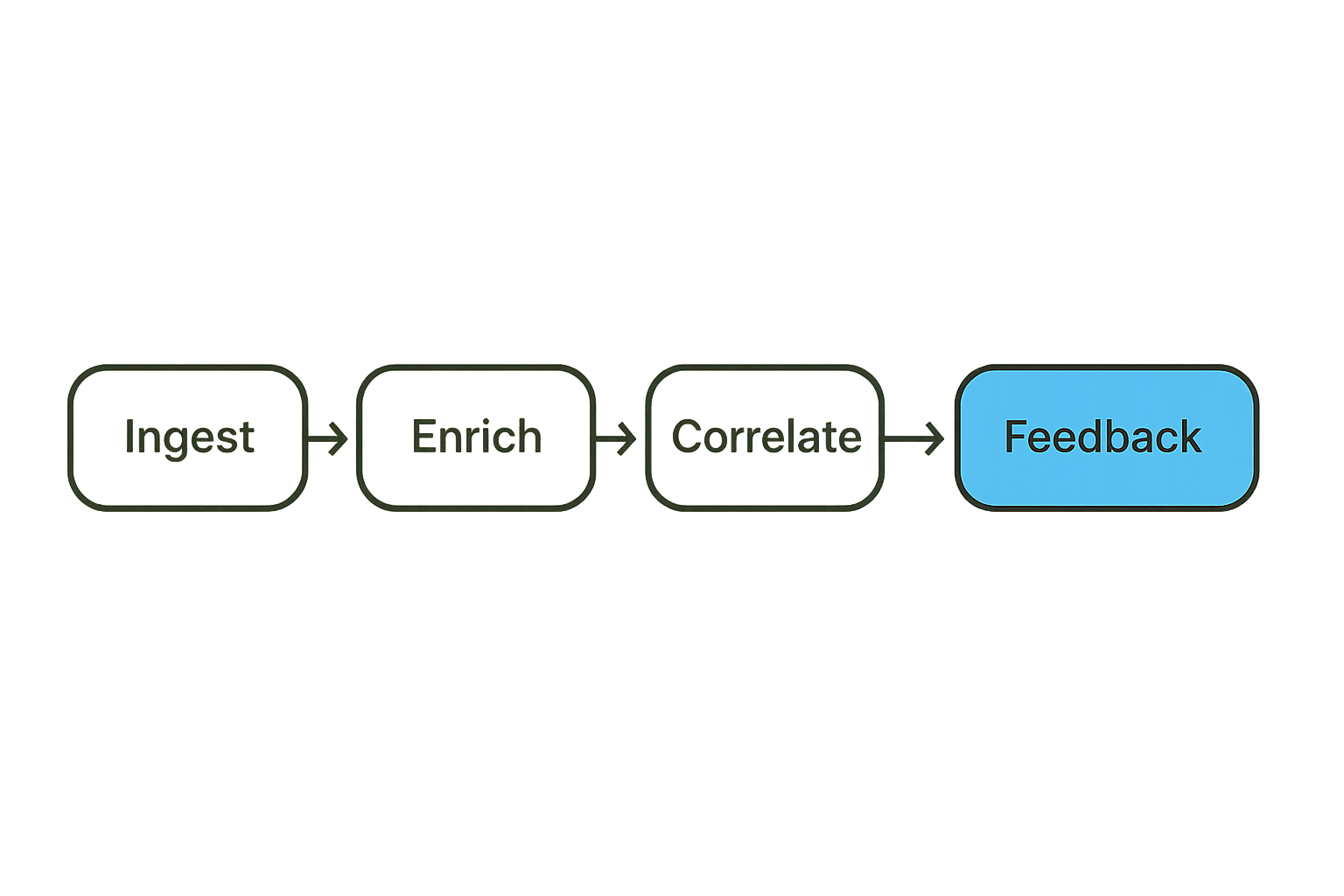
A workable sequence looks like this:
- Ingest the event. Normalize source, timestamp, asset, user, network indicators, detection name, and confidence.
- Attach ownership. Resolve business unit, system owner, application owner, cloud account, and response group.
- Check state. Determine whether the asset or detection is in maintenance, suppression, exception, or heightened monitoring mode.
- Enrich context. Add threat intelligence, vulnerability exposure, identity risk, recent changes, and historical activity.
- Correlate related signals. Link events by user, host, workload, session, IP, domain, process tree, or campaign.
- Score operational priority. Combine confidence, asset criticality, exposure, exploitability, and potential impact.
- Route the case. Send to SOC analyst, incident commander, cloud team, application team, or automated containment.
- Record the decision. Capture why it was closed, escalated, suppressed, or converted to an incident.
- Feed the result back. Update detection logic, enrichment, runbooks, asset inventory, and response playbooks.
This is not glamorous. It is the plumbing. But this is where investigation time is saved.
If your team is already trying to connect triage, enrichment, and escalation, our guide to threat analysis workflows that actually work goes deeper on building the end-to-end workflow instead of optimizing isolated analyst steps.
What good enrichment looks like
Enrichment should reduce uncertainty. It should not decorate an alert with ten panels of unrelated data.
Good enrichment answers operational questions:
- Is this asset internet-exposed?
- Is there an exploitable vulnerability on the affected system?
- Is the user privileged?
- Is the identity behavior abnormal for this account?
- Has the indicator been seen in active campaigns?
- Did the activity occur after a risky code or infrastructure change?
- Are there similar events on peer systems?
- Is there a known business process that explains the activity?
What fails is enrichment without a decision model. Analysts get reputation scores, WHOIS output, sandbox links, vulnerability lists, and identity metadata, but no clear path to action.
A good test is simple: if an enrichment field cannot change routing, severity, containment, or closure, it probably does not belong in the first analyst view.
Ownership and escalation are the real control surface
Define who can silence, escalate, and close
In a home alarm workflow, not everyone has the same authority. Some people can arm the system. Some can disarm it. Some can be called first. Some can cancel dispatch. That structure matters because response without authority becomes chaos.
SOC teams need the same model.
Define authority for:
- Disabling a detection
- Suppressing a known false positive
- Approving containment
- Contacting an executive owner
- Declaring an incident
- Closing a case as benign
- Changing severity
- Updating a runbook
The mistake teams make is giving every analyst the burden of judgment without giving them the authority or context to make the decision safely. That creates slow escalations, inconsistent closures, and alert fatigue.
Ownership should be explicit in the case object, not hidden in tribal knowledge. A cloud account should map to an owner. A critical application should map to a service team. A privileged identity should map to a business function. A response action should map to an approval boundary.
Treat runbooks like contracts
A runbook is not a wiki page that says investigate suspicious login. It is a contract between detection engineering, SOC analysts, incident responders, infrastructure owners, and business stakeholders.
A useful runbook specifies:
- Trigger conditions
- Required evidence
- Enrichment sources
- Decision points
- Escalation criteria
- Safe response actions
- Approval requirements
- Closure reasons
- Feedback steps
Practical rule: A runbook should tell an analyst what decision to make next, not merely where to click next.
Runbooks also need versioning. Detection logic changes. Cloud permissions change. Applications move. Business owners leave. If the workflow is not maintained, analysts eventually learn that the documented process is fiction.
This is where SOC work starts looking like product operations. You have users, service levels, defects, releases, and backlog tradeoffs. The output is not just closed tickets. The output is a security capability that keeps working under pressure.
Common failure modes when teams copy the wrong model
The false sense of coverage
The worst way to borrow from ADT home security is to copy the visible layer: more sensors, more dashboards, more signs of security. That produces a false sense of coverage.
Enterprise equivalents include:
- SIEM rules that nobody owns
- EDR alerts routed to a mailbox
- Threat feeds that never influence triage
- Cloud findings with no application owner
- Vulnerability alerts disconnected from exploitation context
- SOAR playbooks that enrich but never decide
- Dashboards that show volume but not outcomes
What breaks in practice is trust. Analysts stop trusting alerts. Engineers stop trusting escalations. Leaders stop trusting metrics. Eventually the SOC becomes a reporting function instead of a response capability.
A useful way to think about it is alarm verification. A verified alarm has enough context to justify action. A SOC case should meet the same bar before it interrupts the business or triggers containment.
The disconnected incident handoff
The second failure mode is treating incident response as a separate world. The SOC detects, then throws a ticket over the wall. Incident responders restart the investigation because the case lacks evidence, context, and decision history.
That handoff burns time.
A good incident handoff includes:
- Timeline of observed activity
- Source detections and confidence
- Affected assets, users, workloads, and applications
- Business criticality
- Known vulnerabilities or exposures
- Intelligence matches and why they matter
- Actions already taken
- Open questions
- Recommended next decision
Related reading from our network: crypto payment teams face a similar state-and-trust problem when intelligence influences holds, settlement, and merchant operations; the architecture discussion in threat intelligence blockchain workflows is adjacent even if the domain is different.
The lesson for SOC teams is straightforward: do not make responders reconstruct the alarm after escalation. Preserve state from the first signal through final closure.
What works: validation, metrics, and continuous tuning
Measure the path from signal to decision
Most SOC metrics overemphasize volume. Alert count, case count, and rule count are easy to measure. They are also easy to misread.
Better metrics follow the operational path:
- Time from event to ingestion
- Time from ingestion to ownership resolution
- Time from alert to enrichment completion
- Time from enrichment to analyst decision
- Time from decision to containment or escalation
- Percentage of cases with clear closure reason
- Percentage of escalations accepted without rework
- Detections with current runbooks
- Detections tested in the last review cycle
This changes tuning conversations. Instead of asking why alerts are down, ask whether high-confidence detections are reaching the right owner faster. Instead of asking whether the SOC closed more tickets, ask whether responders had to redo less work.
Practical rule: Measure the workflow, not just the queue. A quiet queue can mean good tuning, broken ingestion, or analysts ignoring noise.
Validation should also include negative checks. If a critical source goes silent, that should be visible. If enrichment fails, the case should show degraded confidence. If ownership cannot be resolved, routing should not pretend everything is fine.
Use tests that resemble real incidents
Detection validation often fails because tests are too synthetic. A rule fires in a lab, so the team assumes the workflow is ready. But production incidents involve partial telemetry, missing owners, overlapping alerts, ambiguous severity, and business constraints.
Useful tests include:
- Known attack emulation mapped to actual data sources
- Cloud control plane misuse in a real account structure
- Suspicious identity behavior involving privileged accounts
- Endpoint behavior with incomplete process context
- Application abuse that looks like legitimate admin activity
- Source outage simulations
- Enrichment failure simulations
- Escalation drills with real service owners
The goal is not theater. The goal is to find where the workflow breaks before an attacker does.
For application-heavy environments, the SOC also needs to understand how pipeline, code, and runtime signals become security decisions. The same ownership problem shows up in DevSecOps; our guide on DevSecOps and application security for SOC teams covers how to keep application signals from becoming another noisy queue.
Integrations: make SOC systems share state
Idempotency, deduplication, and context
SOC integrations fail for the same reason many distributed systems fail: state is inconsistent. One tool thinks a case is new. Another thinks it is closed. A third creates a duplicate. Automation runs twice. Analysts lose trust.
Borrow a few boring engineering patterns:
- Use stable event identifiers where possible.
- Generate deterministic case keys for correlated events.
- Make enrichment jobs idempotent.
- Track source freshness and ingestion health.
- Preserve original evidence even after normalization.
- Separate suppression from deletion.
- Record automation actions as case events.
- Make closure reasons structured.
This matters because SOC workflows are not just human workflows. They are distributed systems with humans in the loop.
If a suspicious domain appears in DNS logs, proxy logs, EDR telemetry, and threat intelligence, the architecture should create one understandable case, not four competing alerts. If an analyst closes the case as approved business activity, that decision should inform future tuning without deleting the evidence.
Connect proactive and reactive work
Continuous threat exposure management, vulnerability management, threat hunting, detection engineering, and incident response often run as separate programs. Attackers do not care about those org charts.
A better pattern connects proactive and reactive work:
- Exposure data informs detection priority.
- Threat intelligence informs hunting hypotheses.
- Incident findings update asset criticality.
- Vulnerability exploitation changes alert severity.
- Detection misses create engineering backlog items.
- Repeated false positives create tuning tasks.
- Business owner gaps create governance work.
The practical question is: can a signal from one program change the decision in another?
If threat intelligence says a campaign is targeting a specific appliance and CTEM shows you expose that appliance, detections around that asset should become more urgent. If incident response confirms a technique was missed, detection engineering should receive a specific gap, not a vague request to improve monitoring.
That changes the conversation from tool integration to operational state sharing.
Where ThreatCrush fits in an ADT home security-inspired SOC
Use threat intelligence as routing context
Threat intelligence is often treated like a siren. Indicator matches fire, analysts look up reputation, and the queue grows. That is the wrong model.
In an ADT home security-inspired SOC architecture, intelligence should act more like routing context. It helps decide whether a signal deserves escalation, which owner should see it, what evidence matters, and what response is safe.
Good intelligence integration can answer:
- Is this indicator tied to active exploitation?
- Is the campaign relevant to our technologies or geography?
- Are any exposed assets affected?
- Have we seen related infrastructure internally?
- Does the actor behavior match endpoint, identity, or cloud telemetry?
- Should this become a hunt, a detection update, or an incident?
This is where intelligence connects proactive and reactive operations. It should not live in a separate portal that analysts check only after the case is already stale.
Product fit without adding another console
ThreatCrush is relevant when teams want threat feeds, vulnerability context, attack surface monitoring, and actor intelligence to influence SOC workflows instead of sitting beside them.
The architectural fit is not another dashboard for analysts to babysit. The fit is using intelligence and exposure context to improve routing, prioritization, enrichment, and validation inside the workflows teams already operate.
For a SOC engineer, the useful questions are practical:
- Can intelligence enrich cases automatically?
- Can exposure context raise or lower priority?
- Can detection engineering see which threats matter now?
- Can incident response receive campaign context without starting over?
- Can CTEM findings influence monitoring coverage?
That is the same lesson from the alarm model: value comes from connected state and trusted response, not from another blinking panel.
Try threatcrush.com
ThreatCrush is for security operations professionals building and scaling SOC capabilities. If you are turning threat intelligence, exposure data, and detection workflows into an operating system for response, Try threatcrush.com.
ADT home security is only an analogy. The real takeaway for SOC teams is architectural: sensors are cheap, trusted workflows are hard, and response depends on shared context.
Try ThreatCrush
Real-time threat intelligence, CTEM, and exposure management — built for security teams that move fast.
Get started →